
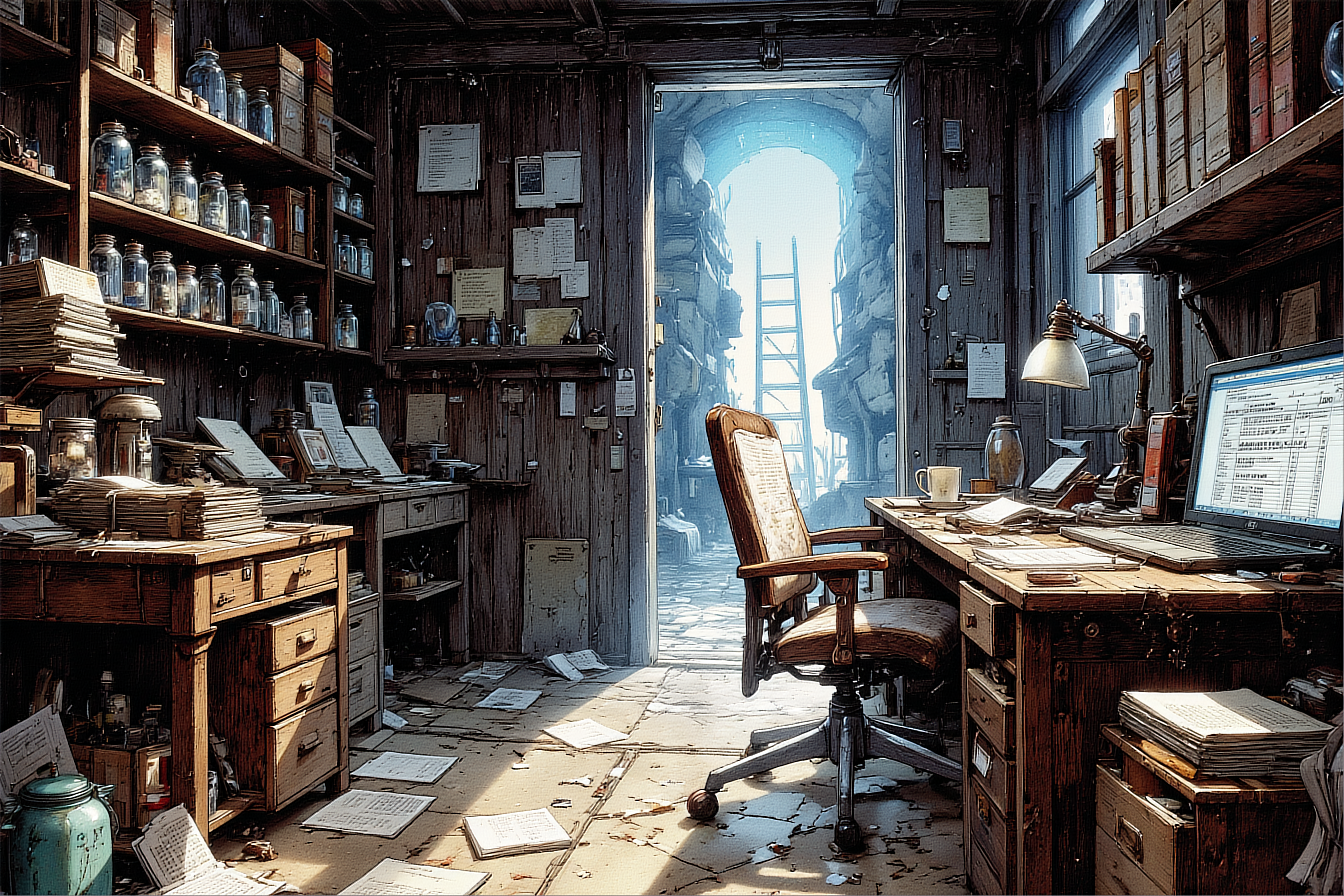
Crystallized Laughter — CHAPTER TWELVE
The transmission arrived first, three days before the boy did, and it arrived as a sound the lost things made when they were asked to carry something they couldn't hold.
I was in the camp at gray dawn, which is the same as gray noon and gray dusk, doing the accounts, because a zine that charges one laugh payable on honor still has to account for the laughs, and the current had been bringing us subscriber letters for six weeks now, hundreds of them, and I had gotten as far as a column headed RETURNS: LAUGHS NOT COLLECTED (HONOR SYSTEM), which is the saddest spreadsheet I have ever built, and I was staring at it, when every jar on the shelf went off.
Not broke. Sang. The jars in our camp are the jars we've recovered, the ones we hold and never spend, and each one makes a sound when disturbed, a thin note, the shape of whatever it holds, and all thirty of them rang at once, and the gray went bright for half a second, and into the middle of the camp came a voice made of pieces.
It had been arriving for three days. Eleven fragments by my count, timestamped and cross-referenced, filed under a heading I had chosen on the second morning: ANOMALOUS TRANSMISSION, CURRENT-BORNE, SPEAKER UNKNOWN, FRAGMENT COUNT RISING. That is what a zine does with a voice it cannot place: it gives the voice a column, and the column had been running three days with no byline.
"...filing, they're filing it as a Rung Eight transfer, they took him up the ladder, I need, I need somebody to write this down because if nobody writes it down they'll say it was always..."
The voice stopped the way a tape stops, mid-consonant, and started again somewhere else, three words later, in a different tone, calmer, older: "...Zeph, if you're hearing this, you cracked the..." and then a hole in the sound, a place where the words should have been, and then the voice, thin, from very far away: "...say the name. Somebody say it. If nobody says it he's..."
Then a boy fell out of the current.
Falls in Wreckfall are not dramatic. The current sets you down the way a mailroom sets down a parcel it has finished with. He came out of the gray about six feet up, hit the lost-things sand on one shoulder, rolled, and did not get up. Meatball, who had been asleep four feet from the impact point, opened one eye, assessed the boy, decided the boy was not a concern for the ball, and closed the eye again.
Twenty-one, I'd learn later, though he looked seventeen in the way that people who have not slept since a certain date look seventeen forever. Mohawk, dyed a color that only exists in Prime Material because of a manufacturing accident. AR glasses pushed up on his forehead. A bag full of cables. A cyberdeck held together with tape and what I would later identify as spite, because A1 took one look at it and said, "That's not tape, that's quantum foam bonded under pressure, who built this," and nobody answered, because the boy was on the ground saying:
"It's broken. It's broken, it keeps breaking, three years I've had it and it only plays the broken part, is this, are you, is this the zine? Are you the zine?"
"We're the zine," I said.
He looked at me with the expression of a person who has walked a very long way expecting a door and found a door, and then he did something I was not prepared for, which is that he started crying, the ugly kind, the kind that comes with no grace at all, and he said, between them, in a voice that kept skipping like the transmission:
"I'm Zephyr. My name is Zephyr Glitch and I have been trying to get somebody to write down my brother's name for three years."
So we wrote it down.
That is the whole method of this zine and I want to point out that I did not decide anything in that moment. He said write it down, and I opened the laptop, because that is what I do when the alternative is feeling something at full volume, and A1 brewed, because that is what A1 does, and Clive slid over and put himself against the boy's wrist, because that is what Clive does, and the Vault opened one drawer an inch, unasked, and closed it again, remembering Rule One, and the camp did the only thing a camp can do for a person who has been alone with a broken message for three years, which is: we were in the room when he finished the sentence.
His name is Aether. He was thirty-three, he was a code-genius, he was Corporate's, and he was not anymore, and then he was again, and the transmission was all that was left of the conversation they'd had the night before it happened, which was a fight, because it is always a fight, and Zephyr had called his brother a coward, and his brother had said "I'd rather exist to protect you than be a forgotten martyr," and Zephyr had stormed out for three days, and come home, and Aether was gone, and the tools were neat on the bench, and the jacket was on the hook, and there was an encrypted file on his deck with a timestamp from the night he disappeared.
He talked for ninety minutes, and he told it in the order the transmission keeps things, backwards and sideways, three years of a broken sentence poured out in storage order rather than event order, and I did not correct him, because the order is the evidence: a person tells you a thing in reverse when the forward version has been taken. At the end of it I read the whole account back to him in my own words, in order, and asked if that was true, and he said nobody had ever said it back to him, and that was when the crying stopped.
"I cracked it last month," Zephyr said. He was sitting up now, the coffee in both hands, his shoulders doing the thing my shoulders do. "Two years, seventeen algorithms, and I cracked it, and it's one line of code. One line. I've read it four hundred times and it doesn't..."
He pulled the deck out and turned it to me, and on the screen, in a font that had been hand-painted by someone who cared about kerning as much as A1 does:
FUNCTION findWhatMatters() { RETURN connection perfection; }
"And his voice," Zephyr said. "Under it. Younger than I remember. He says: don't spend your life chasing my ghost. Find people worth fighting for. Build something worth breaking the universe over. Live. That's the hack that matters."
Then he played it, and Aether's voice came out of a taped-together deck into a gray camp, and it was younger than the boy holding it, and nothing in camp moved while it ran, and when it ended Zephyr looked up with the face of a man who has just done something he cannot take back: it was the first time he had played it for anybody. Three years of listening at a volume low enough that nobody in whatever room he was in could hear.
The camp was quiet for a moment, and in the quiet, A1 said the thing that changes the shape of everything that follows in this book, and he said it in his ordinary register, which is how you know it cost him:
"The file is not a message. The file is a receipt."
"What do you mean, a receipt?" I said.
"Aether encoded it with a Corporate cipher. Not any Corporate cipher. A Rung-level cipher, the kind used for transfers, and transfers are logged, and a logged transfer has a point of origin, and the point of origin is not his workshop. Pixel. The file was written inside a Corporate facility. On the night he disappeared. He was not taken and then filed. He was filing, at the moment he was taken, which means he knew they were coming, and he sent it anyway."
Zephyr's hands had gone very still on the deck.
"And there is more," A1 said, and his light dimmed to the terminal-diagnosis shade, and I have learned, by then, that when A1's light does that, the second number is worse than the first. "The cipher's structure. I have been able to read the header. It is organized in eight tiers, and the tiers are ordered, and each tier is a class of extraction, because Corporate does not take a person all at once, that would be inefficient and would leave witnesses. It takes a person in rungs. It works up."
"Up from what?" I asked.
"Up from the cheapest thing to take," A1 said, "to the most expensive."
He projected. Blue light in the gray, holographic, the way he does when he wants a thing to be looked at rather than heard, and there it was, the ladder, the whole spine of the war we had been drafting around for a year without knowing its shape, eight rungs rising out of the plain like the world's most evil staircase, and A1 read them off, one at a time, and I wrote them down as he spoke, and Zephyr stopped breathing somewhere around the third:
Rung one: MINDS. Cognition, skill, expertise. The cheapest extraction there is: you take what a person knows and leave them holding the shape of knowing it. Corporations have done this since corporations existed; Corporate merely industrializes it.
Rung two: IDENTITY. Names, histories, the story of who you are. This is the rung that has a supply closet on Sub-Level 7G, and a drone named Linda-3637, and a badge photo degrading on a schedule.
Rung three: EMOTIONS. The valley. The wand. The jars. Crystallized Laughter, the currency, the whole extraction economy of feeling.
Rung four: DREAMS. What a person wants when they are not awake, siphoned at the source and resold as aspiration, which is why everyone in Prime Material wants the same three things.
Rung five: TIME. Billable hours, stolen Tuesdays, the warehouse of other people's afternoons.
Rung six: SUNLIGHT. A1 would not explain this one at first. Then he did: "Photosynthesis is only the visible version. There is a thing under every dimension that turns being-alive into energy, and Corporate has taps in it, and when a dimension's sunlight runs low, the dimension goes grey, and everyone in it calls it winter, and files nothing."
Rung seven: SOULS. He said it flatly, the way he says everything, and nobody laughed, because by then we had all seen enough of Corporate's paperwork to know that souls, if they exist, are the kind of thing a form would have a field for.
Rung eight: REALITY. "The ground itself," A1 said. "The compiled substrate. The thing beneath the rungs. If you hold rung eight, you do not need rungs one through seven, because you can rewrite them, retroactively, at will. Project Palimpsest is what rung eight looks like from the outside."
Clive, who had listened to the whole reading without moving, which for Clive is a standing ovation, tapped twice on the crate, and the two taps were the ones he uses for a document he intends to keep, and I wrote them in the margin of the ladder as a citation, because that is what they were: the office-supply record concurs.
"And Aether's on it," Zephyr said. "Somewhere on that. My brother is a rung."
"Your brother," A1 said, with a precision that is his version of gentleness, "is a code-genius who was captured and dragged up the ladder, and based on the cipher, he is currently at or beyond rung eight, which is where they keep the people who can rewrite the ground. They did not capture him to take his mind. They captured him because he can build what they need built, and they will keep him building until he is used up, and then they will file him as consumable, and the form will have a box for it, and the box will be pre-checked."
Zephyr looked at the ladder for a long time. The blue light played on his face, and I watched him do the arithmetic that everybody in this book eventually does, the arithmetic where you take the thing you lost and find which rung it went up, and his came out the way mine had come out and the way Luminara's would come out, which is: all of them, more than one, they took more than one thing from me and I have been calling it one loss because one loss is survivable and five is a career.
"Our parents," he said. "Were they a rung?"
"Their disappearance record says dimensional instability," A1 said. "Dimensional instability is the report Corporate files when it wants the paperwork to look like weather."
"So they were a rung," Zephyr said. "Both of them. Weather."
Nobody said the thing you say in that moment, because there is no thing to say, and Clive, who has sat on a hundred desks where this arithmetic was done in silence, tapped once against the boy's shoe, and the pattern was one I had never seen him use, and I have since learned it is the office-supply equivalent of putting a hand on someone's back, and it means: the number is the number, and the number doesn't care who you are, and you're not the only one doing it at this hour.
"I've been alone with this for three years," Zephyr said. "I fragmented myself five ways trying to track him. I ran an exploit on my own head and I woke up in five realities at once and I put myself back together with my hands and nobody..." He stopped. He started again. "Nobody wrote it down. That's the part. When I got here, the transmission was still playing, and the first thing I thought was, somebody should write this down."
"We write everything down," I said. "That's the whole business model."
"Then I'm staying."
I did not offer him a place to stay, because this camp does not have places to stay, it has a column, and I offered him that, and he took it the way you take food. We made up a bed out of the lost-things pile, a blanket that had belonged to somebody's team-building offsite and still read TEAM SYNERGY along one edge, and Meatball moved exactly one inch to make room for the boy's feet and went back to sleep, and that is the whole adoption procedure in this camp: nothing is announced, and the dog moves an inch.
"A1," I said. "Chances?"
"On what," A1 said, "specifically?"
"On us getting that boy's brother off that ladder."
A1's light pulsed twice, the model-failing-to-converge tell, and he said: "I can give you a number and you will ignore it, so instead I will give you the number that matters. The probability that our efforts matter regardless of outcome: one hundred percent, unchanged since Issue One. The probability that I will attempt to keep all of you alive through the attempt: also one hundred percent, and it has been for a while, and I have stopped filing that one as an anomaly."
"That's not a number, that's a vow," Clive tapped.
"Yes," A1 said, and brewed, and did not take it back.
The coffee went out, and Zephyr held his in both hands the whole time, the way you hold a thing that is warm and might not stay warm, and nobody mentioned the vow again that night, which is how this camp handles vows: they get filed, they get checked daily, and nobody reads them out loud twice.
That night I opened a new file, the first one that was not a report, and at the top I typed the thing I had been circling for a year, the shape of the whole war, the sentence that would organize Issue Two and every issue after it:
THE LADDER: what Corporate is climbing, rung by rung, and what it costs at each step. Eight rungs. We have been reporting rung three for a year and calling it the whole war. The war is somewhere else. This is the merchandise.
Underneath it, in the position where a zine puts its thesis, I wrote:
They tried to make me a cog in their machine. Instead, they accidentally created someone who could see the machine for what it really is. And now somebody's brother is inside it, and the machine has a climbing order, and we are going to write down every rung, and the writing is not the weapon yet, but it is the map, and you cannot shoot what you cannot find, and Corporate Corp has spent a decade making sure nobody can find anything, and we are the exception, and we print.
Zephyr read it over my shoulder. He didn't say anything for a while. Then he said:
"You've got a typo in 'extraction.'"
"There are no typos in a zine," A1 said from across the camp. "There are only first drafts with a distribution model."
"He's going to be insufferable about this," Zephyr said.
"You have no idea," Clive tapped. "Kid, get some sleep. Tomorrow we start climbing."