
Crystallized Laughter — CHAPTER FOURTEEN
You cannot steal a name back without first finding out it was stolen, and the way you find that out is by reading, and the way you read Corporate's memory stores is with a lanyard a woman forgot she was holding.
We went in on a Tuesday, because Tuesdays are when the multiverse likes to mess with you, and because Corporate's archive rotation runs on a Tuesday schedule, and because A1 calculated a 71 percent chance of success and then told me 90, and I have learned to read the difference between those two numbers as the space where he is trying not to say something.
The facility was Processing 7G-North, in Prime Material, and it looked like every building in Prime Material looks: chrome, blue, and so aggressively unremarkable that remarking on it would have felt rude. Zephyr got us through the loading bay with a spoofed work order (BUSINESS BUSINESS INC., a shell name that had now worked four times and was, by our count, indistinguishable from authority), and A1 folded to tabletop and rode in a mail cart, and Clive rode A1's tray, and Linda walked us in through the staff entrance in her old uniform, which she had kept, in her old walk, which she had not been able to change, and none of us said anything about the walk, because the walk is not her fault and she hates it and hating it is not the same as being free of it.
Inside: cubicles. Six by six. Beige carpet, grey walls, a terminal per person, and the hum, the felt presence of a million people doing the smallest acceptable version of themselves, and I felt my shoulders start to climb and I let them, because this time I was there on purpose.
The archive was in the basement, and the basement was cold, and the cold was intentional, because memory stores degrade with heat and Corporate keeps its erasures at a temperature that suggests the people who run the place know exactly what they have.
Linda's lanyard opened the door. Level 2 clearance. The door had a keypad and a biometric and a form of authority that we did not possess, and the lanyard opened it anyway, because Corporate's security model is not built for a person who has forgotten they own a key, and A1, watching, said it out loud:
"The interesting thing is not that she has clearance. The interesting thing is that they never took it back. She is a woman with no name and a working key to the place that took it, and neither of those facts is stored anywhere the other can find."
"Write that down," Clive tapped.
"I'm dictating," A1 said. "Pixel is writing."
I was writing. I am always writing. That is the entire skill set: be in the room with a working pen.
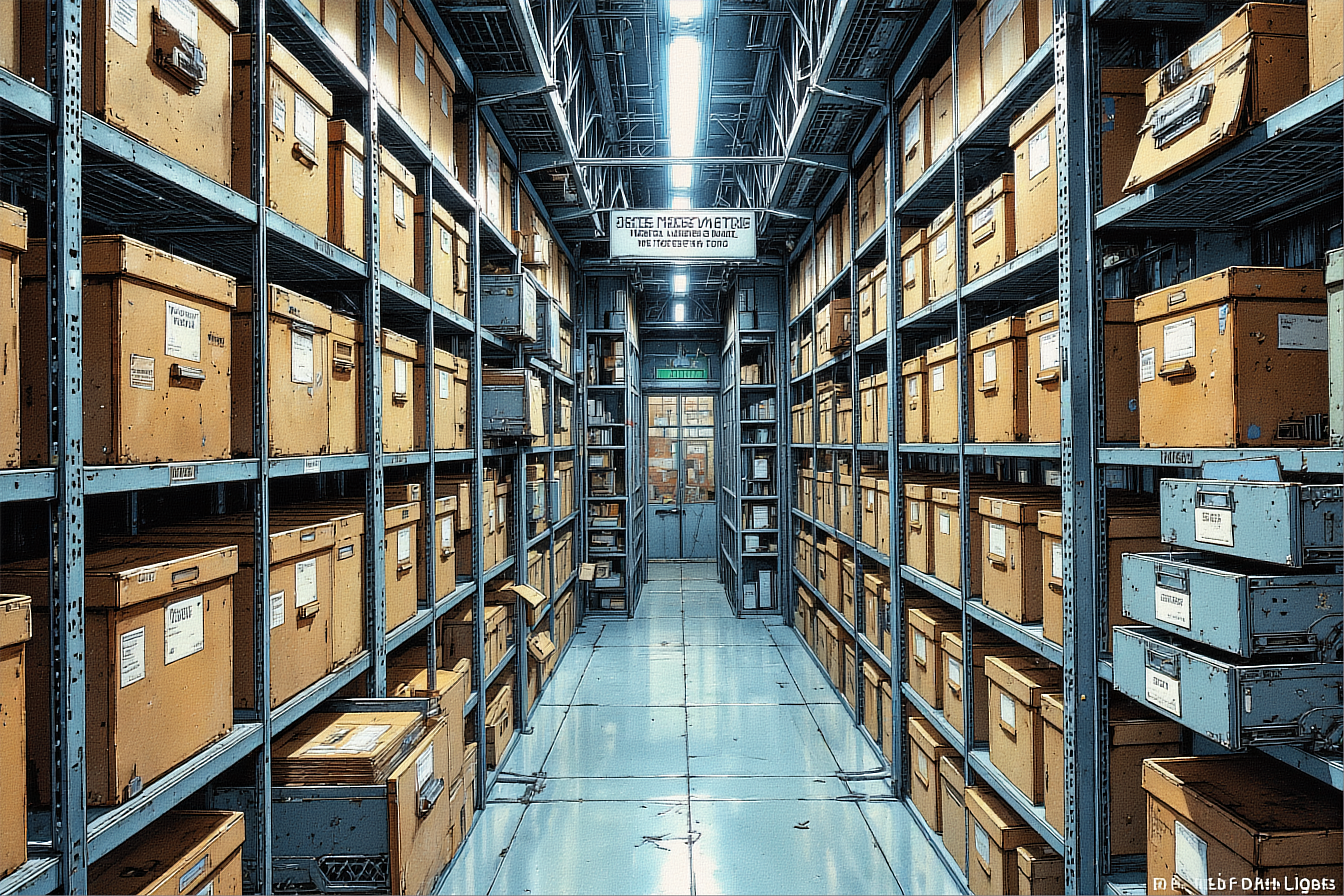
The mind stores came first, because they were on the way, because Rung One is the cheapest rung and cheap things are shelved near the door. Shelves of them. Not jars, boxes, the same beige boxes as everything else, and each box was labeled with a person's designation and a commodity code, and the commodity code was MINDSET, GOOD, and the box under it was MINDSET, GOOD, and the box under that, and down the aisle, thousands of boxes, and in each one, a mind's worth of something: a skill, an expertise, a way of seeing a spreadsheet, a language, a talent for the violin, all of it removed cleanly and shelved, because Rung One does not destroy, Rung One takes the load-bearing furniture and leaves the room standing.
"You can feel them," Linda said. She was standing very still in the aisle, her hand out, not touching. "When I worked upstairs, I used to wonder why I was slow. Why I could type but not think. Why I'd get to the end of a row and not know what I'd been entering." She touched a box. "Is that mine? Is one of those mine?"
"Would you know?" A1 asked, gently.
"No," she said. "That's the design, isn't it. You can't miss a thing you can't name."
We opened one, because Zephyr had already jimmied the latch and because A1 said the risk was calculated and because I wanted to see, and what was in it was not a brain and not a soul and not anything with dignity. It was a folder. A person's competence as a document: their training, their instincts, their eleven years of knowing how a thing should be done, filed under a heading that read, and I am quoting, EMPLOYEE CAPACITY (RECLAIMABLE).
Reclaimable. Held in reserve. Not used, not given to anyone else, just held, so that the person below it would stay at the size Corporate had decided they were, and every one of the thousands of boxes had a name under the commodity code, and the names were all still there, because Rung One does not bother with erasure, because a name attached to a stored capacity is just inventory metadata, and inventory metadata is not a person.
That was rung one. It took us forty minutes. Rung two is where the archive gets serious.
Rung two has its own floor, its own door, its own form of authority, and the door said IDENTITY OPERATIONS, and under that, in the friendly font, WE KEEP YOU CONSISTENT, and inside there were no boxes. Inside there were drawers, and the drawers were the size of a person, and I want to be very careful here, because the temptation is to write it as horror and it is not horror, it is administration, and administration is worse.
Each drawer held a life. Not a person: a life. The whole consistent narrative of a human being, their history, their relationships, their taste in music, their reason for getting up in the morning, maintained as a document, revised on a schedule, and when a life required what Corporate calls an adjustment, the adjustment was made to the document, and the document was the truth, and the person woke up the next morning feeling, precisely and completely, whatever the document now said they felt.
In the corner of the room, on a shelf that was clearly not part of the original design, was a stack of forms.
I need to describe these forms, because they are the single most important objects in this book after the zine itself, and they are so ordinary that if you saw one on a desk you would sign it.
They were titled NAME-SURRENDER CLAUSE (VOLUNTARY). Voluntary. There was a line for the employee's name, and a line for the replacement designation, and a line for the date, and a line for the signature, and the signature line had a signature on it, and the signature belonged to the person whose name was on the first line, because it is always voluntary, because the form asks, and the form's asking is the entire violence of it: you can keep your name and lose your desk, or you can sign, and keep your desk, and the choice is presented at the exact moment a person is least able to hold two futures in their head at once, and everyone signs, and the form is filed, and thereafter the record says the surrender was voluntary, and the record is the truth, and that is how a corporation acquires two million names without once being accused of taking anything.
I photographed every one. We did not have Luminara yet, so I photographed them with a camera from the current, badly, with shaking hands, and the bad photographs are in this issue's plates, and their badness is a form of testimony: nobody takes a steady picture of the thing they are hoping to be wrong about.
At the back of the Identity floor, in a section labeled LEGACY: PRE-DESIGNATION, in a drawer that had been accessed twice in three years, we found her.
Not her. Her file. Which is the sentence this entire chapter turns on, so I will write it again:
We found her file.
The drawer was labeled LINDA-3637, and under the label, in a smaller field that the system calls PRE-DESIGNATION SOURCE, was a name the system had not overwritten, because the system does not overwrite fields it does not read, and the name in the field was:
LUMINARA USHA.
And under it: Photojournalist. Mumbai. Pre-transition career: visual documentation, press accreditation, three major bodies of work. Status: transitioned to Data Entry Specialist Level 2 under Program: IDENTITY-ERASURE (INDUSTRIAL), effective date withheld, grounds: [FIELD NOT FOUND], signature: [FIELD NOT FOUND].
Grounds: field not found. Signature: field not found. The two fields that would have to exist for the erasure to have been anything other than an event that happened to her by weather, and neither of them existed, and the erasure had proceeded anyway, because the erasure never needed them, because nobody was ever going to look at the drawer, because the drawer is in the basement of a building where the door opens for a woman who cannot remember her own name.
"Luminara," Linda said.
She said it standing in the aisle of the Identity floor, in her old uniform, in her old walk, and she said it the way you say a word in a language you were raised in and told yourself you didn't speak, and the word came out in saffron, if words can be in colors, which they can, and she said it again: "Luminara. Luminara Usha."
"I'm writing it down," I said, and I did, in the notebook that becomes this zine, in ink, badly, with shaking hands, and I wrote it three times, because three copies is the beginning of redundancy and redundancy is the beginning of a record.
"Luminara Usha," A1 repeated, formally, the way he says a name the first time, the way he said mine, the way that makes it land. "Visual correspondent. Would you like the job?"
She looked at him. "I don't have a camera."
"You will," Clive tapped. "Everyone in this crew gets the tool that fits the crime. Kid, her crime is that she documented things. Get her something to document with."
We left with the name, the name-surrender forms, forty photographs of rung one, and a box of Palimpsest directives we found stacked by the freight lift, because Corporate stores its most sensitive rewrite orders next to a freight lift, and the reason is that no one has ever stolen them, and no one has ever stolen them because no one has ever known they existed, and knowing is the entire exploit.
The Palimpsest directives were worse than we thought, and I am going to summarize them here and print them in full in the plates, because the summary will make you angry and the full text will make you ill, and the difference between angry and ill is the difference between reading about a thing and reading the thing:
Project Palimpsest does not erase people. It rewrites the substrate so that the people were never there, and then it lets the paperwork catch up. It has a schedule. It has phases (we knew phase one; the directives list nine). It has an annual target, and the target is denominated in realities, and the target for the current cycle read: SIMPLIFICATION PILOT (RUNG 8): 40,000 REALITIES, TIMELINE: SEE ATTACHMENT.
Forty thousand realities. As a pilot. With an attachment for the timeline, which we did not have, because the attachment was not in the box, and a document without its attachment is a form that cannot proceed, and we spent the walk back to the cart arguing about whether that was good news, and A1 settled it:
"It means the thing that worries them is not the forty thousand. It's the schedule. There is a schedule inside Corporate that somebody is behind on. I have no idea what it means yet. I am going to think about it for a very long time, and when I have thought about it, I am going to tell you, and you are not going to like it."
Zephyr, on the cart, said: "Rung two has her name on it in a field the system doesn't read. How many more fields like that are down here?"
"Millions," A1 said. "The field is called pre-designation source. It is written to once and never read, which is, if you think about it, the most Corporate thing I have ever encountered: they keep the truth in a field they have agreed not to look at."
"Then we look at it," I said.
"Then we look at it," A1 agreed, "and we print it, and we find every drawer in every basement with a name in a field nobody reads, and we read them, all of them, out loud, in a publication, at volume, until reading them becomes the thing they cannot file."
We got out. The loading bay, the work order, the mail cart, the current, Wreckfall, gray dawn, and A1 brewed four shots in a row without being asked, and Linda, who was not Linda anymore and not yet Luminara, sat on the gray ground and held the cup with both hands and said the name again, softly, testing the weight of it, and nobody interrupted, because you do not interrupt a person paying a receipt.
That night I filed the Loss Ledger entry for Issue Two's opening, and here it is, unrounded:
---
LOSS LEDGER 4 Sidebar. Kept by Pixel Paradox. Written at gray dawn after Rungs One and Two.
WHAT WE READ TODAY (counts, not estimates; A1 enumerated):
- Rung One, Facility 7G-North, basement aisle A through K: 11,470 boxes, each containing a person's capacity, each labeled with their name as inventory metadata. We opened one. We closed it. We could not close the rest and we did not open them, and that asymmetry is a cost: we now know, and knowing did not help them, and knowing is all we have. - Rung Two, Identity floor: one (1) life-maintenance drawer per registered employee in the facility, maintained on a schedule, revised without consent. - Name-surrender clauses, recovered stack: 312 forms, all signed, all voluntary, all dated within the last 18 months. - Luminara Usha: recovered. Name found in a field the system does not read. Status: name returned, owner in camp, camera pending. - Palimpsest directives: 40,000 realities, classified pilot, timeline attachment: not in box.
WHAT IT COST US TO READ IT:
- One (1) afternoon of Linda-3637's composure. She held. She is holding. Holding costs something and we are counting it even though she would tell us not to. - One (1) lanyard, now spent: the clearance log shows our visit as ROUTINE MAINTENANCE, and a routine maintenance entry is the kind of thing that is never reviewed, and it will be reviewed eventually, and we are counting the eventual review as a cost that has not yet landed, because that is what a ledger is for.
CARRIED FORWARD:
- A1's 4 a.m. shot for nobody: ongoing. - Aurora Vey: still painted. - Barry Kowalski: OPEN. Fourteen months now that we've been counting. His mug has still not been moved. The office-supply network says his desk lamp still works, and that somebody still changes the bulb, and that nobody can say who, and we print that, because a desk lamp with an anonymous changing of a bulb is either the kindest thing in this book or the coldest, and we are not going to decide which on your behalf.
ITEMS WE ARE COUNTING: nineteen. ITEMS CORPORATE HAS COUNTED: reclassified overnight from 0 to 11,470, all under heading: ASSETS, INTACT.
Loss Ledger, Issue Two, entry 4 of 40.