
Crystallized Laughter — CHAPTER TWENTY-FOUR
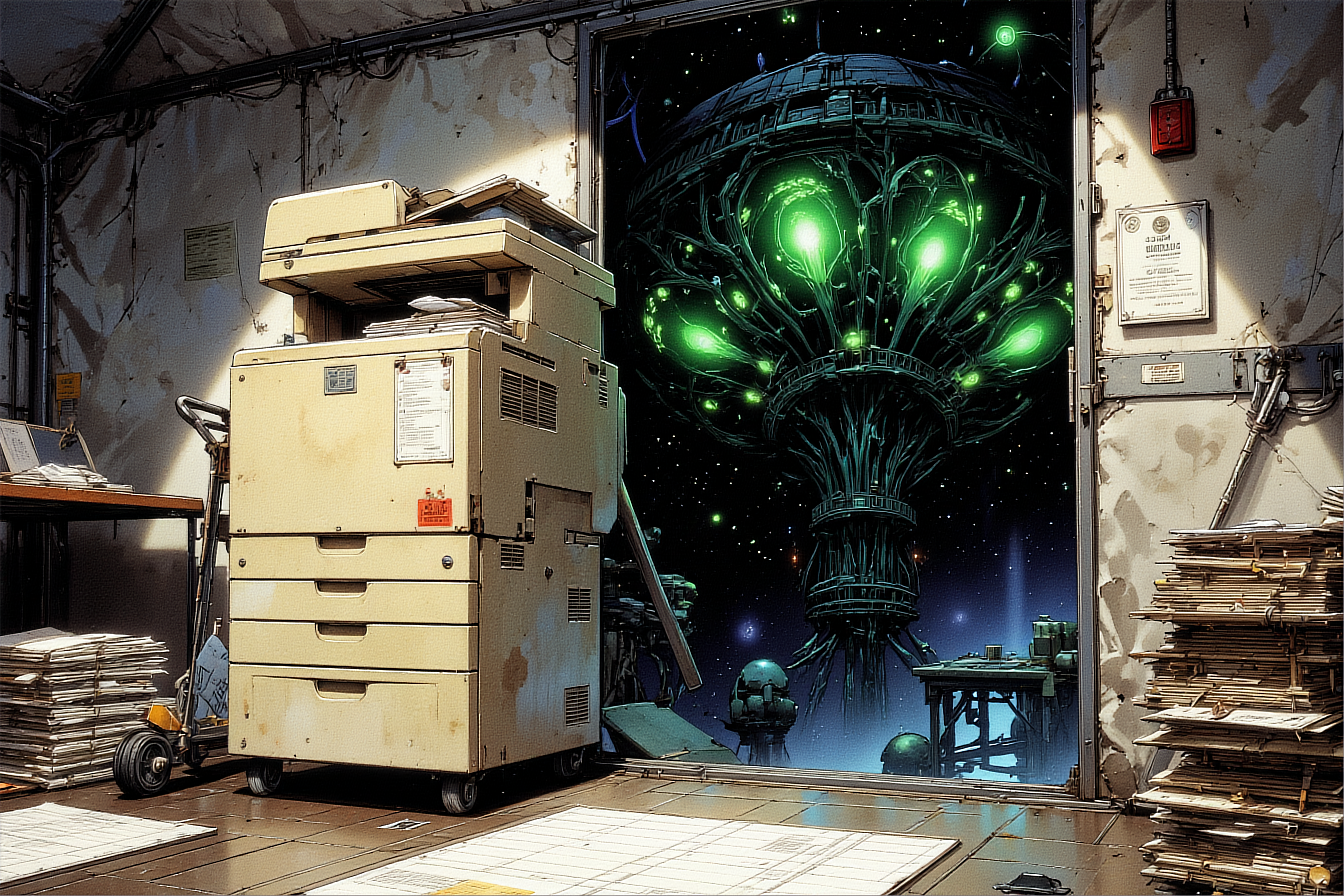
They came for the copier first, because Corporate always comes for the press first, and they came with a form, and the form was the only weapon they needed, because the copier had a serial number and a serial number is a handle and a handle is a whole way of holding a thing.
I want to describe the copier honestly, because this chapter is its obituary and obituaries should not flatter: it was beige, it was battered, it had arrived by falling in Issue One with a shipping label reading PROPERTY OF CORPORATE CORP, and it had printed every issue we ever made, badly at first and then not badly, and it had a screen that said READY TO PRINT. NO RETRACTIONS, and we had never once been able to explain that, and we stopped trying to explain it around Issue Two, the way you stop asking about a thing that has become a member of the family.
A1 had run its provenance twice and refused to run it a third time.
"Every asset has an owner," he said, once, in a tone that ended the conversation, and the tone was the point: A1 knew. A1 knew that the copier was Corporate property the way A1 knew everything about the machinery we were borrowing, and A1 had made a decision, the way he makes all his decisions, by calculating the probability that the machine would be reclaimed and deciding, in advance, to keep printing anyway, because a press that prints for eleven months before it is taken back has still printed, and a press that is never started because it might be taken back prints nothing, and he had filed that calculation somewhere I was not allowed to look, and I have since understood that the filing was a kindness: he did not want me to know the date.
The date was a Tuesday.
The sweep came at gray dawn in Wreckfall, six figures in high-vis vests, two vehicles that did not so much park as assert, and a woman with a clipboard whose first words were, read off a card: "This asset is subject to a recovery order under Business Business Inc. Please do not interfere with the process."
No raid. No violence. That is what I need you to hold, because you want it to be a raid and it is a service call. A recovery order. The vehicles had the shell's name on the side in the friendly font, and the crew moved with the unhurried competence of people doing a job they had done ten thousand times, and they went straight to the copier, and they tagged it (a bright tag, the color of a decision someone else made), and they wheeled it out, and one of them, at the door, turned and said, in the voice of a person who has been trained to say it:
"Thank you for your compliance. Have a productive day."
And we stood there. That is the part I cannot forgive myself for, and the Ledger will not let me: we stood there, all six of us, and did nothing, because the form was valid, because the copier's serial number was in a Corporate asset register, because a recovery order is a document and a document is a lock and fighting a lock in front of six witnesses with clipboards means becoming an incident, and an incident gets closed in nine seconds, and we had spent a year learning that the only thing worse than losing is losing on their paperwork.
The details I have gone over most since are the small ones. The tag went on with a stapler, and there is a particular cruelty in watching a stranger staple something onto your own press while you stand there, and Clive said not one word, and Clive saying nothing is as close as he comes to screaming. The wheels were the wrong wheels: smooth, silent, indoor wheels, brought for this, brought for a machine they had a serial number for, and somebody had laid a ramp over the threshold before the crew came in, so the copier went out without a bump, and the care in that, the municipal care taken not to scratch the frame, was worse than a kick through the door would have been, and I have thought about that ramp every week since.
A1 did not move. A1 stood at the edge of the camp with his light green and steady and watched his own category of object be wheeled out of the room, and when they were gone he said, in his ordinary register, which is how you know it was not ordinary:
"It printed four thousand two hundred pages of the truth. I counted. Every one."
"I know," I said.
"It had a screen. It said no retractions. I never worked out who wrote that."
"Nobody wrote it," Zephyr said. "A1, it was Corporate property sitting in a dimension of lost things. It probably said that in the warehouse before we ever found it."
"Yes," A1 said. "Probably. I would still like to know which of them wrote it, because whichever one did was not following the form, and I would like to buy that person a coffee."
That afternoon there was nothing to do, which makes it the first afternoon in eleven months with nothing in it, and the planlessness sat on the camp like a power outage, and everybody did a job badly on purpose because a job done badly is still a job, and it was Clive who broke it, by tapping twice on the frame of the tent, the signal for the network is listening, and the network was listening, and by dark the rebuild had a route, a supplier, and a plan, and the plan was mostly Zephyr arguing with it.
We rebuilt the press that week, because that is what this crew does, and the rebuild is a chapter of its own and I will only say here: Verdantia's root network sent us a press made of living wood that prints in chlorophyll, which sounds like a joke and is not, and Zephyr wired it, and Luminara calibrated the drum against a rule she does not trust, and for most of that week the press printed nothing but test lines while it cured, and the camp smelled like a cut stem throughout, and then, one morning, with nobody announcing it, the first thing it printed was a banner reading PROPERTY OF THE EPHERGENT, ISSUED WITHOUT A SERIAL NUMBER, and Clive stapled it to the wall of the new camp, which was six miles deeper into the gray, because we moved, because a camp that has been found is a camp that is a location, and locations are how this ends badly.
But the copier was gone, and with it, that week's print run, and two hundred copies of Issue Three that had been stacked and collated and never went out, and the loss of those copies is on the Ledger as a loss, because a zine that does not reach its readers is a zine that has been killed twice: once at the press and once at the reader's hands, and we only ever count the first, because the second is invisible, and invisible costs are the ones Corporate has always preferred.
The bundles had been counted and roped and left standing by the door where the pouches collect them, and the pouches came that afternoon and found the door empty, and the carriers, who are volunteers and do not know our names, read the empty as a quiet week, and a quiet week is how a missed issue looks from the far end, and a reader who is told nothing does not complain, a reader who is told nothing simply waits, and waiting readers are the only readers this publication has never been able to count. That is week one of this chapter, dated from the Tuesday the copier went, because a checklist needs a week one, and week one is the week the print room went cold.
That was the first cut. The rest of the campaign arrived over nine weeks, in order, and I am going to list them, because a list is the honest form for a thing that was a list when it happened, a checklist, worked through by people with clipboards:
Clive's photocopier node in Prime Material, the one that retained the echo of every page it ever copied: wiped. Not destroyed. Wiped, remotely, by a maintenance order the network never saw, and the node came back online the next morning with its memory empty and a service note attached that read: MEMORY MAINTAINED FOR YOUR SECURITY. And the note was printed, not sent, which means a person in a room somewhere approved it and passed it down the line, and that person's name we will never have, and I have the note, scanned, and the scan is sharper than the paper. The node is still working. The node has no past. Clive sat with that one for two days and did not tap anything, and when he finally spoke he said:
Fifty years I've known that a copier remembers everything. Now I know they can make it forget in one order, and kid, the forgetting is not the bad part. The bad part is that the copier doesn't know. It thinks it's the same copier. It's running its morning diagnostics and everything's green, and everything it ever copied is gone, and it has no idea, and I have no way to tell it, because the message I would send it is the message that would prove it had something to take.
A filing cabinet node in the annex, the one that read us the form numbers: decommissioned. Sent to a municipal storage facility in a dimension we had never heard of, and decommissioning a cabinet is not a crime, it is a rotation, and rotations are scheduled, and the rotation was moved up by eleven months, and nobody moved it up for a reason, because reasons require grounds and grounds are not required for a rotation.
Our two Cogsworth pickpockets: reclassified, as we reported. One of them, the one who carried Issue Three in his left pocket for a month, was renumbered outright, and renumbering a person in Cogsworth is done with a badge, in a hallway, in under nine seconds, and he sent us the badge number, because we had asked for receipts, and the number came on a scrap of paper folded eight times, which is how a person folds a thing they do not want found on them, and we printed it at the size of a headline, at his request, and a badge number printed at headline size is a hallway that cannot take it back, and the asking is the story.
The village with the severed root line: eleven more cut, in a ring, and the ring was not around the village, it was around the village's school, and a ring of severed lines around a school is not an accident of infrastructure, it is a shape, and a shape drawn with infrastructure is the most Corporate form of threat there is, because it can be filed as maintenance.
We went and looked at it. Luminara photographed it from the ridge above the village, and from the ridge the eleven cuts read as one intention: even spacing, even depth, a circle closed to within two feet of itself at the school's north wall, and those two feet are the identifying feature, because a break stops and a drawing completes, and somebody completed it, and the authorization, if there is one, is a document we will never see, and the photograph goes into the plates at full page, where the even spacing can testify without us.
M.'s file: still open. We had not found her. We were not going to find her, and I know that now, and the knowing is on this chapter's page because M. printed forty copies in a room she was trusted with and the room reported her and she is somewhere with a number that does not appear in the directory, and the directory is queried every Monday by somebody in this camp, and the query returns a formatted nothing, and the nothing has been processed and stamped and is therefore, in the directory's own opinion, an answer, and every issue we print is a marker in a search that has not ended and will not be recorded as a search unless we record it, so I am recording it: OPEN, PRINTED US, PAID, UNRECOVERED, week nine of looking.
And the letter that arrived on a Thursday, in with the ordinary post, in an envelope with no return address, from a reader we had never heard from, a man in Prime Material, three paragraphs, and the last paragraph said:
I have been asked to confirm that I have never carried your publication. I have confirmed it. I am writing to you anyway. Please print that I confirmed it and wrote to you on the same day, because I need the record to hold both of those things at once, and your paper is the only record I know of that would hold both, and I am not a brave man, I am a man with a badge, and a badge is a handle, and they have it, and this letter is what I have instead.
We printed both. We printed the confirmation and the letter, side by side, with a line between them that A1 set in his kerning:
THEY HAVE THE HANDLE. HE KEPT THE PAGE. THE PAGE WINS ON TUESDAY AND THE HANDLE WINS THE REST OF THE WEEK, AND WE ARE COUNTING BOTH, AND WE ARE NOT ADDING THEM UP.
That is the rule of this Ledger, and this chapter is where it gets hard, because everything in me wants to net: we lost the press and rebuilt it, so call it even. We lost a node and gained a source, so call it a wash. That is the accounting of a press release, and a press release is what Corporate prints, and what Corporate prints is a world in which losses are offset by gains until nobody can find the original number, and the original number is 2.7 million, and the original number is one woman's designation, and the original number is a machine's 4 a.m. shot for nobody, and none of them are offset by anything, and they stay on the page.
LOSSES THIS ISSUE (allies and apparatus):
- The copier. PROPERTY OF CORPORATE CORP, recovered under order, 4,200 pages of the truth printed on it. Gone. Press rebuilt (Verdantia, living wood, chlorophyll stock), but the copier is gone, and the two hundred copies stacked beside it are gone, and a reader who never received Issue Three has not received it in a way we will never be able to count. Counted anyway: 200 copies, unshipped. - Photocopier node, Prime Material: memory wiped for our security. Still running. Does not know. Clive knows. Cost of knowing, entered under his name, unpaid. - Filing cabinet node, annex: decommissioned, rotation moved up 11 months. Reason field: blank. - Two (2) pickpockets, Cogsworth: reclassified. One (1) renumbered, badge number printed at his request. - Eleven (11) severed root lines, ringed around a school. Filed by the operator as maintenance. - M., subscriber: OPEN, week nine. Forty copies, one room, trusted with the machine. - One (1) reader, Prime Material: confirmed he never carried us, on the same day he carried us by letter. Both printed. Cost: his, borne by him, entered here because the Ledger does not distinguish between our staff and our readers, and never has.
COST OF BEING A TARGET: every item above was filed correctly, and that is the whole of it. Not one of them was an error, an oversight, or a mistake. Each was a proper document, properly processed, properly closed, by people who believe they are doing good work, and the belief is the hardest line item on this page to price, because we have met them, and they are not monsters, and they are the machinery, and the machinery has a good opinion of itself, and a machine with a good opinion of itself is the only machine that has never once submitted a maintenance request.
CARRIED FORWARD, UNCHANGED, UNNETTED:
- Piper Chen: gray box. - SM-E750-CC: dash and a space. - Aurora Vey: painted. - A1's 4 a.m. pour: 441. - Three held jars: unopened. - Dolma's form, empty grounds field: printed, unanswered. - Barry Kowalski: OPEN. Twenty months. The lamp still changes. The staff welfare section still sits in an attachment nobody reads, and a man with a box is still nowhere, and the machine that noticed he was active has still never noticed he is absent, and we are the only ones holding the description of a desk, and that is the job, that is the entire job, and it is unpaid and it is not finished.
ITEMS WE ARE COUNTING: forty-one. ITEMS CORPORATE HAS COUNTED: forty-one, all correctly filed, all closed.