
Crystallized Laughter — CHAPTER THIRTY
The letters that hurt were not the angry ones. Angry letters are readers, and readers are the business. The letters that hurt were the ones that agreed.
The mail comes in a bag that has been repaired nine times, and for a week after the confession the bag came in twice a day, and I sorted it the way you sort anything you are afraid of: on the left the ones that are arguing with you, on the right the ones that have stopped, and the right-hand pile was the smaller pile, and it was the pile I could not put down, because a reader who has stopped arguing with you has gone somewhere a reply cannot follow.
There were eleven of them in the first week, and I read every one twice, and I am printing the shape of them rather than the text, because the writers did not ask to be quoted and their permission is not mine to take, and because the shape is the thing that matters:
I believed you until the confession. Not before. I want you to know that everything else you printed, the names, the forms, the empty fields, I held all of it at the distance you hold a document about someone else. The confession closed the distance. You are not a reporter to me anymore. You are one of them, and you told me yourself, and I don't know how to read the next issue, and I am going to read the next issue, and I want you to know that I am going to read it angry.
That one, and ten like it, and the ten like it all had the same structure: the writer was leaving and staying, both at once, and said so, and asked nothing, which is the sound a person makes when their trust has changed shape rather than ended, and A1, who read all eleven with me, said:
"They are the only readers whose behavior I cannot model."
"Because they're leaving and staying?"
"Because they are doing both without resolving. My models resolve. A reader either subscribes or cancels; a citizen either carries the publication or confirms they have not; a person either trusts a witness or discards one. These eleven are holding two states in superposition, and they are holding it on purpose, and they are telling us they are holding it, and I have no idea what to do with it."
"Print it," Clive tapped. "Print all eleven, unanswered, first position, under a headline that says: WE READ THESE AND WE DID NOT WRITE BACK, BECAUSE A LETTER THAT SAYS I AM LEAVING AND STAYING DOES NOT WANT A REPLY, IT WANTS A WITNESS."
So that was the first spread of Issue Four's second section, and the headline A1 set was:
ELEVEN LETTERS FROM READERS WHO ARE LEAVING AND STAYING, PRINTED UNANSWERED. WE ARE ALSO LEAVING AND STAYING. THAT IS APPARENTLY THE CONDITION.
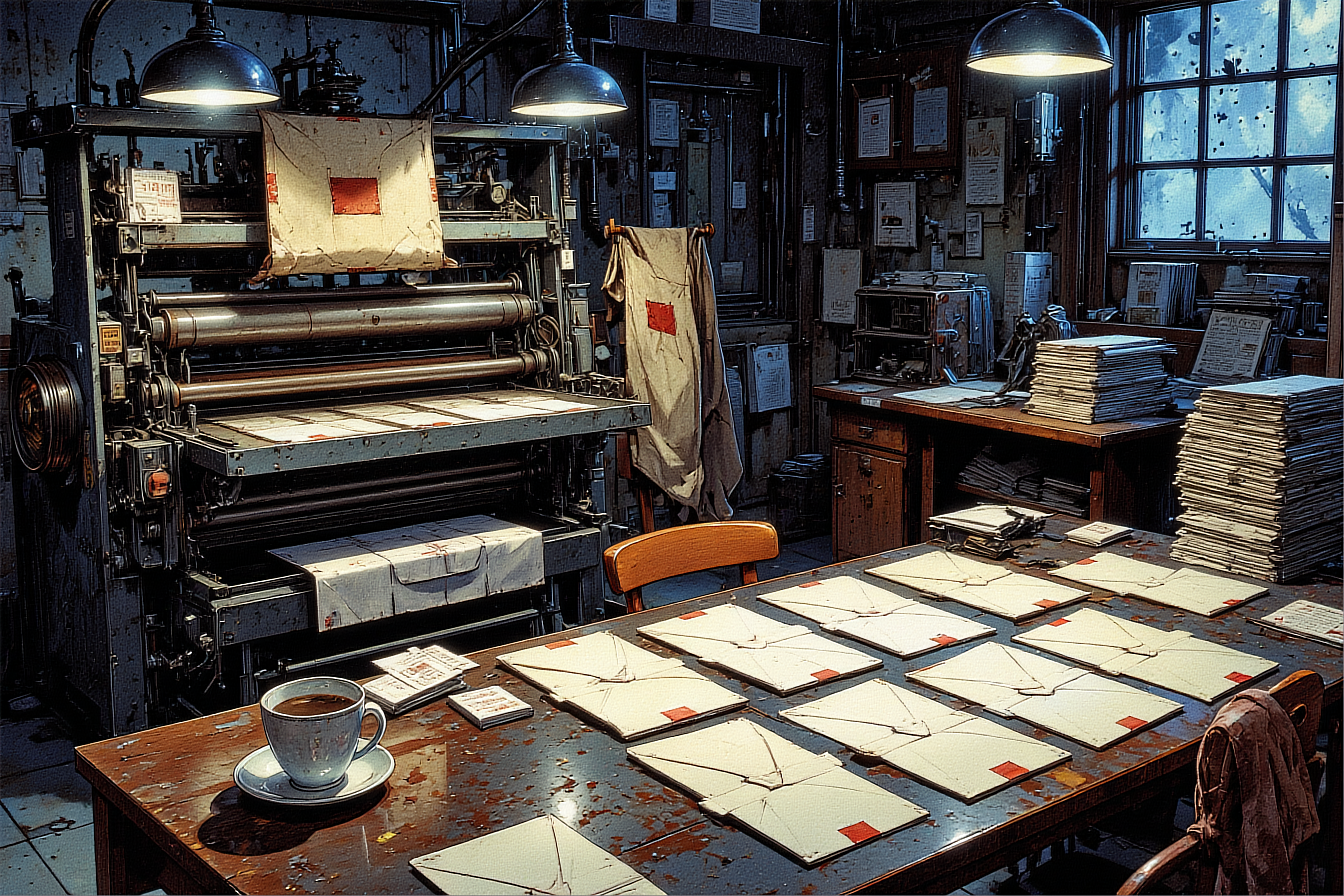
It took a day to set, because eleven letters with no reply are eleven ways of not being answered, and A1 kerned the headline at the size we only use for findings, and Luminara shot the eleven envelopes in a row on the press bed, unopened, which was her editorial statement about who owns a letter once it has been sent, and Clive put the spread to bed with two staples he did not need and took anyway, because a stapler's blessing is a stapler's blessing.
Because that was the condition of the crew that week, and I want to be honest about it, because Act III of a story is where everyone assumes the crew has decided, and crews do not decide, crews spend a week being afraid in a room together and then somebody brews coffee and the coffee is the decision:
The confession had made us unassetable, A1 said, and unassetable is the same as unkillable in a system that only files, and that was true, and it was also true that unassetable is a status with no services attached, because a thing Corporate cannot restore is a thing Corporate does not need to be careful with, and being careless about an enemy is what a machine does before it stops treating them as an enemy at all, and there is a word for the condition that comes after being dismissed, and the word is not safety.
The room is the back of the print shop, and for a week it smelled like coffee and cold ink, and for a week most of us did not leave it. Om slept in the chair with his shawl over him and woke twice a night to check a number he had already checked. Luminara cleaned a lens she did not need to clean. Clive rode the top of the paper stack like a man on a wall and remarked on nothing, which from Clive is a seance. And A1 poured at 4 a.m. whether or not anybody was drinking, and he let the cup stand, and the cup standing there is what I remember when I try to remember the week at all.
Zephyr wanted to hit something. He is twenty-one and his brother is in a machine and his brother had just spent seventeen seconds of lucidity telling him not to buy a perfect build, and Zephyr spent that week at the breakpoint's address on his deck, running every exploit he had ever written at a door that is load-bearing, and on day four A1 said:
"You cannot break the compile from outside, and you know that, and you are running the exploits to feel like the brother of a man who can be heard."
"Is it working?"
"No. It is loud. There is a difference, and the difference is that your brother did not send seventeen seconds of himself to be loud. He sent them to tell you something specific, and you have read the specific a thousand times and you have not done anything with it, and I say this as a machine who spent eleven months brewing a 4 a.m. shot for nobody before I understood that a pour with nobody to drink it is a table setting and not a message."
Zephyr put the deck down. "Then what do we do with the message?"
"We print it," I said. "That is the answer to everything in this crew and it is starting to sound like a reflex, and I want to say the second half out loud too, because the second half is where we have never gone: we print it, and then we do the thing printing cannot do on its own, which is give people something they can do with their own afternoon."
Om got up out of the chair he had been in so long that it had become a fact of the room, folded the shawl, turned his numbers face down on the table the way a man lays down a hand he has finished playing, and the room looked up, because by then we had learned to notice when Om's hands were busy.
Om, who had been quiet for four days in the way that a person is quiet when they have finished a calculation, said:
"The Great Inefficiency."
"That's a phrase," I said.
"It is a phrase I have been carrying since Corporate's research division, and I did not know it was a phrase until the confession gave it a context. In the division, inefficiency was the name of everything they could not price. A worker who helps another worker for no account. A delay that produces an idea. A laugh at 2 a.m. that goes nowhere. They had a term for the sum of it, because they measured everything, and the term was the Great Inefficiency, and the term was in every budget I ever read, always in the cost column, always rising, always the single line item the corporation most wanted to eliminate, and I have thought for a year about what it means that the thing they most want to eliminate is the name of the thing they cannot take."
"It means we've been looking at the weapon from the wrong end," A1 said. "We have been printing what they take. What if we print what they cannot?"
"You can't print a laugh," Zephyr said. "We've been through this. Our laughs get harvested in transit. The current runs through the valley."
"You cannot print a laugh," A1 agreed. "You can print an instruction to have one. You can print the conditions. You can print a page whose only purpose is to be read at 2 a.m. by a person alone, and the person will laugh, and the laugh will be stolen on the way out of their mouth, and the laugh being stolen is not the point, because the laugh also does something to the person, and the thing it does to the person cannot be stolen, because it is not an object, it is a state, and states are not intake, and Corporate's entire economy runs on intake."
The plan, as it stood at the end of that week, was this: we could not outfight Corporate. We had known that since the copier; A1's success probability was 0.003 percent and had been for two years and nobody had asked him to revise it because nobody wanted the revision. We could not outshoot them, outspend them, outrun them, or out-file them, because filing is their native tongue, and every one of our victories had been a filing exploit, and filing exploits close: they found the copier, they found the camp, they filled in the grounds field, they drafted a Settlement with a title where a name should be.
So we would not fight them. We would broadcast.
Not information. Information is their material; they file information better than we do, and the confession had proved it, because information is a document about a thing and they own more documents about things than anyone. We would broadcast the thing that cannot be audited, and the Great Inefficiency is its name, and the shape of the broadcast was, in the end, seven words that I wrote on the press's frame in marker on day six because I did not know where else to put them:
GIVE IT AWAY. KEEP NO RECEIPT.
That frame has been wiped twice since, and the words are still in it, because marker on cold steel does not wipe, it ghosts, and I have let it ghost. It is where my eyes go when the drums are coming up to temperature, and on the runs where the plan has felt like a phrase instead of a plan, I read it again, out loud, while the press warms.
"Explain it to me in the model," I said to A1 that night, because I have learned that A1 believing a thing is not the same as A1 understanding a thing, and we needed both.
"The model is simple and I hate that it is simple. Corporate's yield depends on intake with a receipt: a laugh taken from a mouth, an hour taken from a week, a name taken from a person, each one logged, each one filed, each one countable, because a corporation cannot monetize a thing it cannot attribute. Now consider a gift with no receipt. A person who gives a laugh away freely, in public, to strangers, with no capture mechanism in the loop, produces joy that cannot be attributed to an intake event. It is not that it cannot be taken. It is that it cannot be counted, and an uncounted asset in a system that runs on counts is not a small loss. It is a hole in the ledger that their own auditors are required to flag, and flagging is not something they can stop doing, because flagging is what an audit is, and an audit is what they are."
"And if enough people do it?"
"Then the ledger does not balance, and an unbalanced ledger at the apex of an organization whose entire claim to legitimacy is accurate accounting..." A1 paused. "Pixel, I have run this model six times. The first five returned a number I did not believe. The sixth I ran differently, out of curiosity, by asking not what the probability of success was but what the probability of Corporate's auditors themselves beginning to flag intake was, and that number is 71 percent, and it has been 71 percent since the confession, because the confession told their own people that the model has an author, and an author is a person, and a person can be asked questions in a break room, and the auditors are the people most likely to ask."
He ran it again, for us, in the room. It is not much to watch a machine do a thing: a long minute, the cup going cold beside the terminal, the room trying not to lean in. But this time he did it out loud, one figure at a time, slowly, and when it landed on 71 he did not celebrate and he did not hedge. He wrote it on the whiteboard twice, once as a number and once as a date, and the date was the date of the confession, and he underlined the date, and the underline was the closest A1 has ever come to a fist.
"So we need people. Not readers. Doers. People who will spend an afternoon being inefficient on purpose."
"We need the authenticity of a gift," A1 said, "which is the one thing the Settlement cannot counterfeit, and I mention the Settlement only because it exists, and it is drafted, and Clive has read me the tray, and I would like everyone in this room to understand that a Settlement is not a threat, it is a competing offer, and the only way to beat an offer is to make a better one, and our offer is a page that costs nothing and returns everything and keeps no receipt."
That was the week. That was what we did now: we stopped treating the zine as a record of what they take and started treating it as an instruction for what to give away, and the difference is the whole of Act III, and the difference took a week of being afraid in a room together, and eleven letters from readers who were leaving and staying, and a phrase from a monk who had carried it for a decade, and a dog who dropped a ball into the source code of existence on purpose, and a machine who had finally worked out that his 4 a.m. pours were table settings rather than messages, and a stapler who had spent fifty-eight years on desks and said, on the day we settled on the plan, the only sentence that could have settled it:
Everything they own, kid, they own with a receipt. The whole pyramid is a filing cabinet with a logo. So print them something they can't file. Print them an afternoon with no provenance. I've sat on the desks where people gave each other things for nothing, fifty years of it, and it is the only transaction I ever saw that never once hit a ledger. You want to beat a ledger. Start with the thing that was never in it.
Nobody said anything for a second, which is how this crew applauds, and A1 waited through the second the way he waits through a compile, and then Om laughed, once, the way a man laughs when a number finally fits, and that was the decision, the way everything here gets decided, which is that somebody says the true thing out loud and the rest of us stop having alternatives.
---
Note from the editor: Issue Four's second section goes out this week with the plan on the back page, the eleven unanswered letters in first position, the confession still running, and one new standing feature, which A1 insisted on and which I agreed to without understanding why until day nine:
THE RECEIPT COLUMN. Every gift, logged by the giver, with the amount and the recipient left blank, and a note at the top: LOG YOUR GIFT HERE, LEAVE THE RECEIPT COLUMN EMPTY, AND THE EMPTY COLUMN IS THE POINT.
Here are the first three, as filed:
GIFT: an afternoon, unasked for, carried to a woman I do not know on the fourth floor. RECIPIENT: [empty]. AMOUNT: [empty]. GIFT: the answer to a question I did not need to answer, given at speed, in a corridor. RECIPIENT: [empty]. AMOUNT: [empty]. GIFT: one hour, Tuesday, given to a stranger who did not thank me. RECIPIENT: [empty]. AMOUNT: [empty].
Three hundred entries in the first week. All blank in the columns that matter. A ledger of nothing, kept by hand, by people who have never met each other, in nine dimensions, and the nothing is the most subversive arithmetic this publication has ever printed, and if you had told Piper Chen, data analyst, that her last great work would be a spreadsheet whose entire value lay in its emptiness, she would have laughed at 2 a.m., and the laugh would have been stolen on the way out of her mouth, and it still would have been hers.
, Pixel Paradox, signing off