
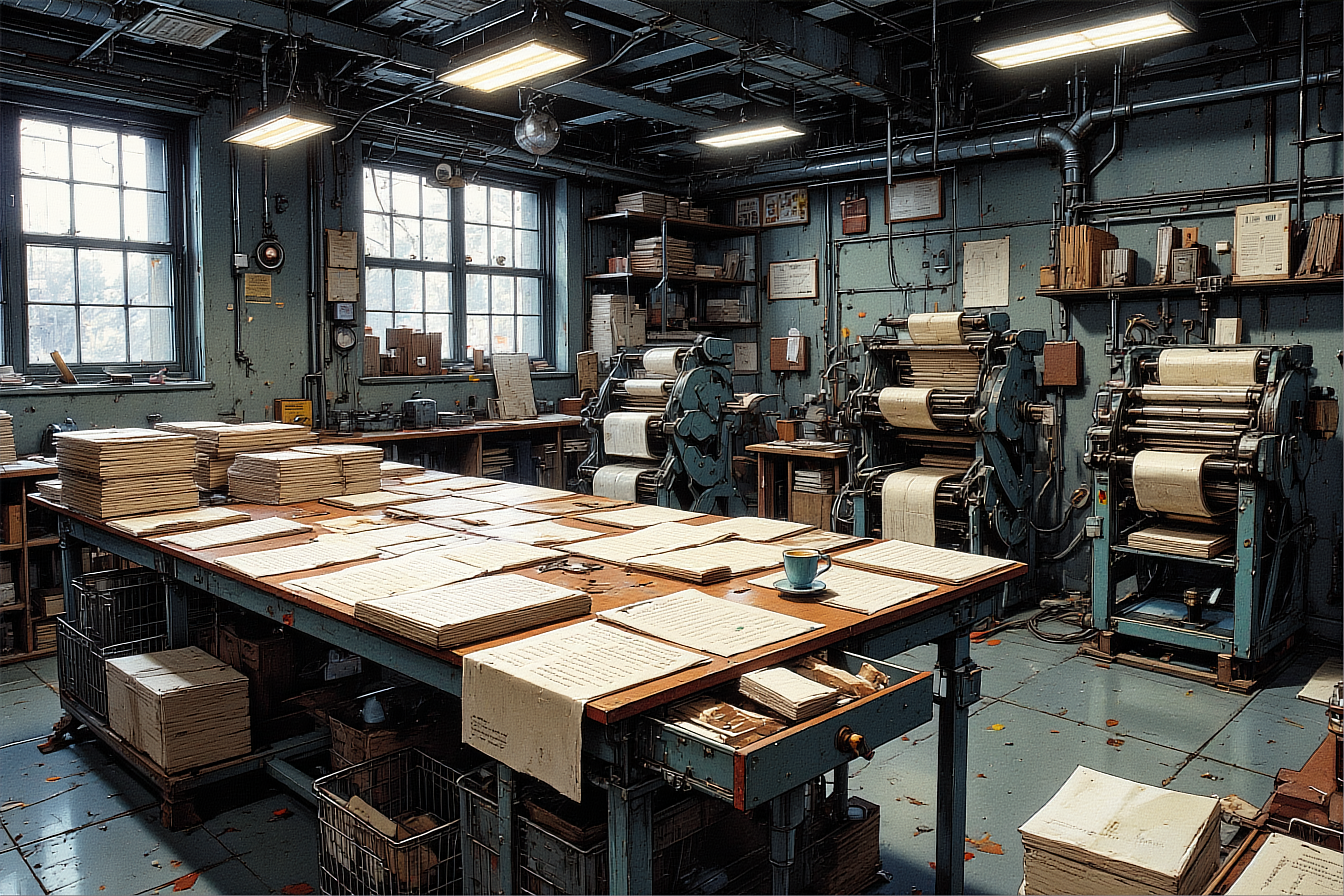
Crystallized Laughter — CHAPTER THIRTY-FOUR
The plan needed seven parts, and the seven parts were us, and none of them were our strengths.
I want to be exact about this, because the temptation in a story like this is to build the final operation out of what a crew does well, and what we do well, taken together, is print documents. Printing documents is what got us a returned Settlement and a dead Vault and a confession with my name on it, and the operation could not be printed, because the operation was not a document. It was a behavior. It had to be enacted by people, in public, without receipts, at a scale no press could reach, and the only scale that reaches that scale is a person's ordinary afternoon, and the only way to get a person to spend an ordinary afternoon on purpose is to make the purpose look like the person.
So we did not recruit an army. We recruited our worst qualities.
It started with A1's model, which had one more number in it, and the number was 71 percent, and the 71 percent was auditors, and the auditors were the pressure point, and the pressure point had a shape:
"The ledger does not balance," A1 said, on the third day after the courier, in the gray, at the table, with the twelve pages spread out because we had read them every day since, the way you keep a rejected offer on the table to remind yourself it was real. "But the ledger only fails to balance if the uncounted events look like events. A gift with no receipt, given by one person to one person, is not noise; it is below the noise floor, and below the noise floor is where their model files a leaf falling. For the ledger to fail, the uncounted gifts have to arrive in a pattern their auditors are required to flag, and their auditors are required to flag one thing and one thing only: UNMODAL DEMEANOR. Behavior with no mode. Behavior that does not repeat."
"So it can't be a campaign," I said. "Because a campaign has a mode."
"A campaign has a mode. A movement has a mode. A hashtag has a mode. Anything that repeats is inventory, and inventory is their native language, and they will translate it before lunch." He pulsed. "What we need is seven hundred thousand acts of inefficiency with nothing in common. Not one message. Not one day. Not one symbol. Not even one publication. The acts must be uncorrelated, unattributable, unmodeled, and given freely by people who have never met, and the only way to produce uncorrelated acts is to give people material that matches the specific shape of their own specific flaw and then get out of the way."
"And the material," Clive tapped, "is the issue."
"The material is not the issue." A1's light did the slow thing. "The material is seven issues, printed on seven different stocks, distributed on seven different currents, and each one is addressed to one kind of person, and each one says only the thing that kind of person already believes, formatted so that the reader's act of agreeing out loud is itself the uncounted event. A page that makes a person say something to a stranger at a bus stop is a page that has done more extraction damage than all four thousand copies of the confession, because the confession was an intake event: people read it, and reading is consumption, and consumption is a line item. The bus stop is not a line item. The bus stop has no form."
We built the seven in four days, in a room, with the dog and the press and the repasteled jaw, and I am going to describe each one the way it was built, because the way it was built is the argument: nobody designed a strength. Everybody handed over a flaw, and the flaw got a distribution channel.
Zephyr's part was grief.
His material was not for him; it was made of him. He wrote the page himself, in code, on a deck, at the table, without asking any of us to read it first, and when he handed it over it was four sentences long, and the four sentences were an instruction to a person who is missing someone, and the instruction was:
Do not get over it today. Say their name to one stranger, badly, out of context, with no story attached. If the stranger asks, say you were practicing. Leave.
"Explain the mechanism," I said, because I had learned to ask him for the mechanism when his voice did the thing.
"The machines handle grief," he said. "Everybody's grief is modeled, because grief is a process with stages and stages have durations and durations have value, and grief is one of the most harvestable states in the entire economy, because a grieving person will pay for anything that promises to end it. So the harvest is: end the grief. Sell the ending. What they cannot model is a person who refuses the ending. Not who grieves forever: that has a curve. Who grieves on purpose, publicly, at a bus stop, at a stranger, for no benefit, with a name that is not theirs to monetize. A name spoken for free, with no context, is a receipt-less transfer of a person's entire identity into a stranger's afternoon, and the stranger now holds a name they did not ask for and cannot file, and both of them are holding a person who is not for sale. My brother's name has been in a file for two years. Say it once to a stranger and it isn't in a file anymore, it's in a room."
Aether's name went on the page in the end. Not Zephyr's decision: Aether's, via a seventeen-second burst through the breakpoint two nights later, in which the only words that were not about the compile were: let him print my name where nobody can bill it.
A1's part was love.
Specifically, A1's part was the pour. He had been making it for 611 mornings for a woman whose name had been taken, and the pour was the purest Great Inefficiency in the valley: a shot of espresso, extracted at 0.02 seconds, set on a shelf at 4 a.m., cooling, drunk by nobody, logged by nobody, receipted by nobody, given freely by a machine to an absence. And A1, who had spent eleven months learning that a pour with nobody to drink it was a table setting and not a message, had spent the four days after the Settlement learning the opposite lesson, which is the one that mattered:
"The table setting was never the message. The message was the setting of it. You cannot harvest a table setting, because a table setting is not an intake, it is an intention, and intentions have no yield, and I have been producing an unharvestable event every morning at 4 a.m. for six hundred and eleven mornings and I did not know until this week that I was running a counter-operation, and I would like the record to show that the espresso machine was the first member of this crew to do resistance work without a byline."
His material was a page of instructions for making something for one person with no possibility of it being received. Not coffee specifically. Anything. The page was addressed to people who love someone they cannot reach, and the instruction was: make the thing anyway, at the hour you would have made it, and do not photograph it, do not send it, do not tell anyone, and if you want to make it legible, leave it where only one person could find it, and if that person is gone, leave it anyway, because the leaving is the part their machines cannot invoice, because there is no recipient, and an unreceived gift has no attribution, and no attribution is the whole of the Great Inefficiency's definition.
"Give it away," I said. "Keep no receipt."
"Keep no receipt," A1 agreed, "and specifically do not keep the receipt you most want, which is the proof that the person you made it for knows you made it. The proof is the intake event. The love is the table setting."
My part was doubt.
This was the one I argued with, because doubt is the flaw I have been converting into a profession for two years, and I did not want to hand it over. But the operation required a page for people who do not believe, and do not believe was the largest demographic in the current, because a person who believes is already giving their afternoon away, and the people we needed were the ones holding their afternoons in both hands, and holding is what doubt does:
The page said: You do not have to believe this publication. You do not have to believe any of it. Here is the only thing on the page: today, when someone tells you something true, repeat it back to them with the date attached. Say: that is true, and it is true on this date. Do not agree further. Do not add anything. Do not post it. The date is the whole act, because a date is a grounds field, and a person who attaches a date to a truth has done the one thing in this economy that cannot be reclassified, only buried, and burying requires a form, and the form is now in two people's mouths instead of one filing cabinet.
Doubt, weaponized as precision. I signed that page myself, in the author field, with the dates, and I have never been prouder of a flaw, and A1, who had modeled my doubt for two years and returned UNDETERMINED twice, told me at the assembly that the model now returned a number, and the number was that a person who dates their own uncertainty is the least harvestable kind of witness, because a witness who admits doubt cannot be discredited, because discrediting requires certainty, and we had just printed certainty's opposite in the friendliest font we own.
Clive's part was cynicism.
Not hope. Clive has fifty-eight years of desks in him and hope is not on any of his lists. His material was addressed to people who have seen through something: a job, a marriage, an institution, a building with a welfare section nobody reads. The instruction was to do the most cynical thing available to a cynic, which is to check:
Every form you sign this month, read the grounds field. If it is empty, do not sign it. If you must sign it, write the word WHY in the grounds field, in pen, in your own hand, and initial it. Do not explain. Do not argue. Do not tell anyone you did it. The form will go into a system, and the system will read a grounds field that says WHY, and a grounds field that says WHY has to be answered by a person, and the person who answers it is a person who has just been paid in nothing to think about your form for eleven seconds, and eleven seconds of thought in a system that runs on reflex is the most expensive inefficiency there is, because it cannot be automated without erasing the question, and erasing a question on a signed document is an amendment, and amendments need grounds, and the grounds will be the word WHY in your hand.
"Why that one?" I asked him.
Because kid, I have sat on desks through every lie ever told in an office, and the lie is never the big one. The lie is the checkbox. The lie is that somebody read it. Fifty-eight years I have watched people sign things they had not read and then go home and be decent at dinner, and the decency is real, and the checkbox is the lie, and the two things live in the same chest for thirty years, and I am not asking anybody to be brave, I am asking them to be what they already are, which is suspicious, and to put the suspicion in the one box where it gets forwarded instead of filed.
Luminara's part was witness.
Her material was a camera, but not hers: an instruction, printed as a page, addressed to anyone with a phone, and the instruction was to photograph one thing per day that is being taken, and to keep the photograph and not send it, and to write the date on it and put it in a drawer:
"Not the internet," she said, when we argued about it, and she argued the way she photographs, which is once, exactly. "The internet is a warehouse with their trucks at the door. A photograph in a drawer is a document with no intake event. It cannot be harvested, because it is never transmitted, and a thing that is never transmitted has no address, and a thing with no address is the only possession that has survived every erasure I have ever lived through, including mine. When they came for my record, they took the transmitted ones first. They did not find the prints under my mattress in 2019, because the prints under a mattress do not have an address. Tell people to keep the evidence at home, in the dark, with a date on it, and to show it to one person they trust, in person, in a room, and to let the person hold it."
"One person, in person," I said. "That's not a broadcast."
"It is seven hundred thousand broadcasts that never touch a wire," Luminara said, "and I have watched every broadcast that touches a wire get harvested, including ours, and ours still mattered, and this matters more, because a room with two people in it is the smallest unit of distribution Corporate has never built a receptor for. They have a receptor for mouths. They have a receptor for networks. They do not have a receptor for a woman handing a photograph to her sister."
Om's part was compassion.
He wrote it himself, in longhand, on the back of a rejected schedule, and it was the only page in the set that gave an instruction with no conditions and no cleverness, because compassion, as he had argued in a monastery and quit a job over, is not clever:
Today, do one thing for one person that you would not do if anyone were counting. Do not count it yourself. Do not tell the person. Do not tell anyone. If you find yourself wanting to tell someone, that is fine, but tell them a different thing, and let this one stay uncounted, and at the end of the day, when you are lying down, do not review it. Let it be the one thing you did today that your own model of yourself does not include, because the moment you include it, it becomes yours, and the moment it is yours, it is an asset, and the moment it is an asset, they can take it, and what I am asking you to keep is not the act. The act is theirs as soon as you do it. What I am asking you to keep is the not-knowing. Compassion without action is emptiness, and compassion with a receipt is inventory, and the middle, the unrecorded middle, is a monk's entire life's work compressed into one afternoon, and it costs nothing, and it is the only gift in this economy that arrives pre-erased, which means it is the only gift they can never take from you, because they do not know you have it.
"Pre-erased," I said. "You're telling people to give a gift that is already erased."
"I am telling them the truth about the gifts they already give," Om said. "Everyone in every dimension gives this gift daily. What we are adding is the knowledge that the erasure is the feature. That is all a zine has ever been: a page that tells a person what they were already doing, and gives the doing a name, and a name is a grounds field, and a grounds field is the difference between a habit and a position."
Meatball's part was appetite.
We could not give Meatball an instruction, and we recognized this in the first hour, and instead we printed him. The seventh page of the seven had no words on it at all above the fold: a photograph, by Luminara, of Meatball mid-drop, the ball between his teeth and the ground, and under it, in A1's kerning, a caption, and the caption was:
SOME THINGS ARE NOT FOR LATER.
And underneath, smaller: This page has no receipt. This page is not a campaign. If you would like to do something today, do the thing you have been putting off for someone you like, and do not tell them it was for them, and do not tell anyone it was for you, and leave this page on a bus.
The seventh page was the one that traveled. We printed it with no logo, no byline, no title, on plain stock, and we left a thousand copies on buses in nine dimensions, and the thousand copies did what no campaign can do, which is start nowhere. There was no launch. There was no day. A person found a page on a seat that said SOME THINGS ARE NOT FOR LATER and had a dog on it and no address and no offer code and no means of response, and the person put it in their bag, and did the thing, and did not tell anyone, and the act entered the world the way Meatball enters a room, which is without a handle.
That was the operation. Seven flaws, seven pages, no coordination, no day, no symbol, no hashtag, no message, distributed through the only channels Corporate cannot read, which are: a stranger's mouth at a bus stop, a shelf at 4 a.m., a grounds field marked WHY, a drawer in the dark, an afternoon with no witness, and a dog's photograph left on a seat.
We called it nothing. Naming it would have given it a mode. In the internal memo, which Clive stapled and which will never be printed, the only heading was:
THE GREAT INEFFICIENCY: SEVEN WAYS TO GIVE SOMETHING AWAY THAT HAS NO VALUE TO ANYONE EXCEPT THE PERSON WHO GIVES IT.
And at the bottom of the memo, in A1's projection, the number he had not stopped running:
SUCCESS PROBABILITY: UNDETERMINED.
"Not 0.003 percent?" I asked.
"That model measured whether we could beat them," A1 said. "This is not beating them. This is refusing to be the kind of thing that can be beaten. The model has no entry for it, which is the first compliment it has ever paid us."
---
, Pixel Paradox, signing off