
Everyone Lost Tuesday — Chapter 33: Compliance
The Edge in the morning is the color of a page held up to a lamp, which is to say the color of paper about to be believed. The compile light came up over the low buildings at the end of everything, and the Registry Office of Existence sat where it always sat, low and clean, its front door standing open because the man who should have closed it at three had apparently decided that leaving it open was the most defensible act left in his day.
We came up the drive with the Ephergent under Luminara's coat, the deck in Zephyr's fist, and Meatball at our heels, and nobody stopped us. At The Edge you are always stopped, politely, with a form. The absence of the form was the first thing I noticed, and it felt less like welcome than like a building that had stopped being able to decide who we were.
Inside, the lobby's public screen ran the daily compliance bulletins, and the bulletins had been replaced by a paragraph. A paragraph, in a public office, at eight in the morning, running on a loop with no graphic behind it and no music. A woman at Desk 11 had the sound up, because the paragraph was being read aloud, and she was listening to it the way you listen to a leak you have decided not to fix.
The paragraph was a memo. I had seen the memo. I had paid a piece of myself to read the memo, and I knew it the way a man knows a song from a single bar of it. Two point seven million lives, filed as acceptable losses, in a feasibility study for the Simplification, with a hearing convened to hear it, convened on a Tuesday. The voice on the loop had the flatness of somebody reading under instruction, and at the end of the first pass it stumbled on the number, and at the start of the second pass it did not stumble, because somebody in the room had made a decision about that.
"That's three precincts," Zephyr said. He had his deck up beside the screen, cross-reading, and the little strip of the week showed three bright points, one in each precinct's band, pulsing on the same second. "Prime Material, Nocturne, Cogsworth. Same paragraph, same time, same voice model. Somebody is reading it aloud everywhere at once."
"Not somebody," A1 said from the bag. "The notary guild. The transcript of that interview was notarized at Cogsworth, cross-jurisdiction, and a notarized statement cannot be un-said without a hearing in the place it was said. They are not broadcasting a leak, sir. They are reading a record into evidence, in three rooms, forever."
The clerk at Desk 11 turned her screen so we could see the rest of it. Her nameplate read E. MARLOW, and her hands were the hands of a person who has been steady for twenty years and is not enjoying it. On her screen an objection had been filed, and then another, and then a column of them, each one numbered, each one signed with the small electronic mark of an ordinary employee.
"Procedure 11," she said. "It's a worker protection. Any instruction that touches an operator personally, the operator may object, and the objection stays the instruction until it is heard. It was written so that nobody down here could be blamed for a deletion order they didn't read. Nobody ever filed one. Why would you file one? The order comes from The Edge."
She tapped the column and let it run. Objections against deletion orders. Objections against the schedule. One against the word acceptable, filed by a man in shipping, which was not a procedure anybody had anticipated and which had been accepted anyway, because acceptance is also a procedure and this one had no filter at the bottom of it.
"And now?" Luminara said.
"And now every instruction that touches an operator personally is standing still," Marlow said. "Including mine. Including his." She did not look at the ceiling and she did not look at a particular office. She did not have to.
Zephyr was grinning, which is what his face does when a system does the thing he has been telling everyone systems do. "It's got exploits," he said, half to the screen. "It's got exploits, and the exploit is its own rulebook."
Verse:
The tower doesn't fall, it files, and the filing goes on, and the last sound in the street is a stapler agreeing with a form.
Pixel went ahead of us into the building and came back at a walk that meant she had found something worth walking slowly toward. "He's in," she said. "He's been in all night. He's had the negatives out on the desk since before the flood stopped. And the marshals are parked at the service entrance, waiting on a decision from somebody who has stopped answering."
The Registry's upper corridor is bare floors and low doors, and the doors were open, and at each open door an employee stood with a form in hand, waiting for a clerk ahead of them in a queue that no longer had a head. One of them, a young man with a scanner still in his grip, looked at Luminara's camera and stepped aside without being asked to, and then looked surprised at himself for having done it.
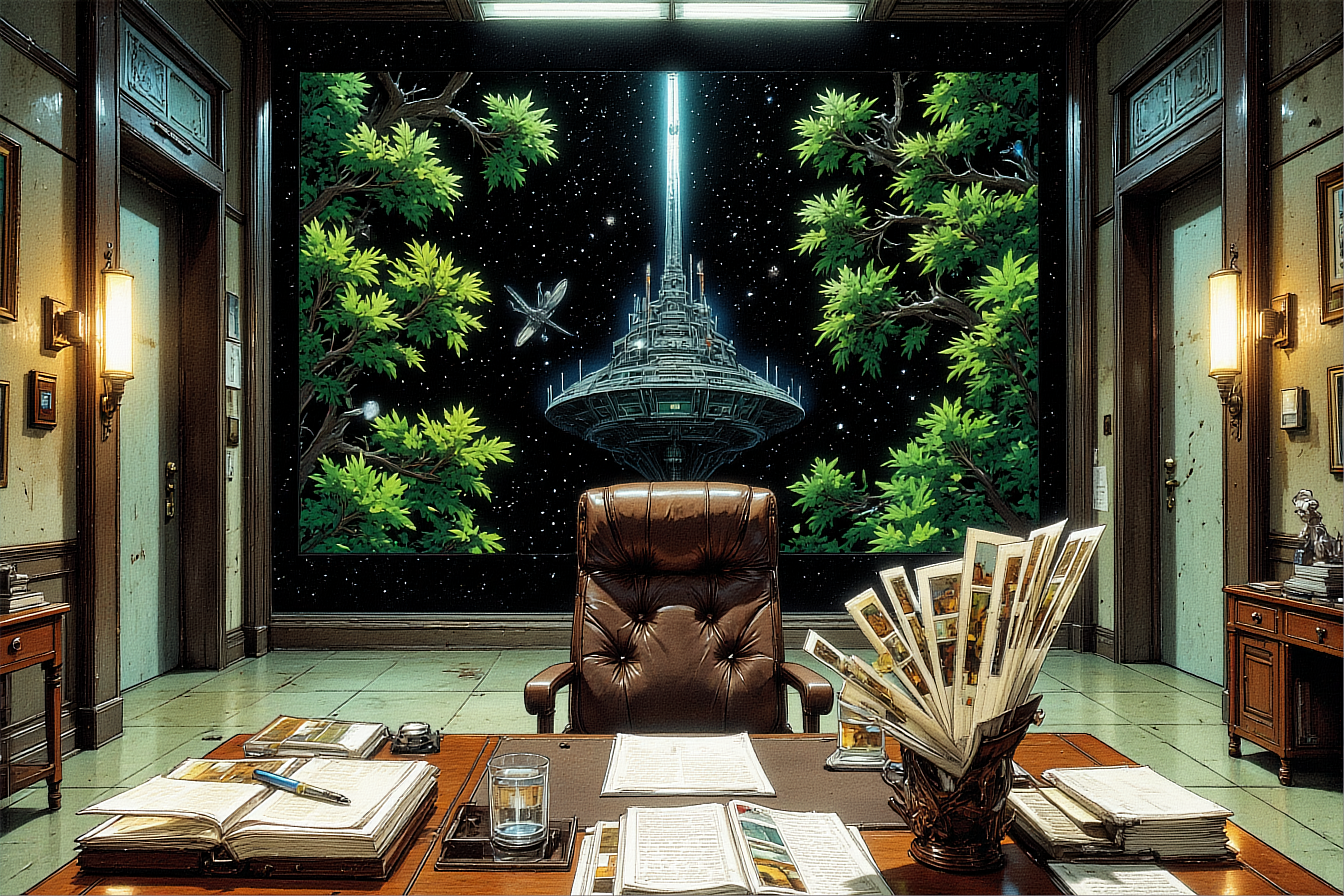
Hollis Grimshaw's office was at the end of the corridor, and his door was open too, and he was at his desk, and he was arranging it.
That is the whole of what he was doing when we came in. He had a blotter, a pen, a water glass, a stack the height of a phone book, and a fan of glassine sleeves, and he was putting them in order. The pen went parallel to the blotter's edge. The stack got squared with the edge of the desk, half an inch at a time, the way you square a thing you have squared ten thousand times and are going to square again. He was a man with clean hands and a soft voice and nothing at all in his face, and when he saw us he finished the square before he spoke.
"Sit down," he said. "There is water. There is not much else, this morning. The coffee service has objected to itself."
Luminara did not sit. She came to the desk with the camera up, and she put the fan of glassine sleeves in the light with two fingers, spreading them wider, and every sleeve held a strip of negatives, and I knew the strips, because we had pulled them out of an evidence shipment bound back to this building, and they had been seized from her years ago by harvesting division men, and they had ended here, because the man at this desk keeps a copy of everything.
Verdantia. Greenhouse light. Faces that had been booked as raw material.
"Those are mine," she said.
"Those are mine as well," Grimshaw said. "That is the difference between us, Miss Usha, and it is not a large one. You keep them for what they prove. I keep them because a copy is a kindness to the future. I was always going to be the one who still had them when the future arrived."
She photographed him. The shutter went, and then again, and then twice more with the sleeves fanned wider, and the rule of her camera is that it photographs what is true, and what was true in that frame was a man at a desk with the evidence of his own career laid out at his right hand and not one muscle in his face asking to be misunderstood. Photographs cannot be falsified and bars cannot cross paper that is already true, so that frame is going to outlive the building it was taken in.
"I was erased," she said, not to him, to the shutter, to the room. "I came back. And now I document everyone else who refuses to stay deleted."
Grimshaw arranged a page. He did not rage. There was no table to overturn in him, nothing theatrical to do with his hands, and I have known men with worse in them who reached for something to break, and he simply took the page he had been reading and aligned it with the stack and pressed it flat with two fingers.
"The Simplification is suspended," he said. "You will want to hear that and you will want it to be more than it is. Protocol 4, paragraph two: while a read ledger is active across more than one precinct, no deletion operation may proceed, because deletion during a public read produces a discrepancy, and discrepancy is the one thing the office exists to prevent. The office is preventing itself. I filed the suspension at four, myself, because the alternative was to issue an order I knew would be refused, and an order that is refused is worse than an order that is not issued."
"And the audit?" Zephyr said. "The hearing that never happened?"
"Is happening," Grimshaw said. "In three precincts, as we speak, being read into a record notarized where I have no standing. I have standing in five dimensions and none of them are Cogsworth. That was clever of somebody. It was probably the photographer."
He looked at me then. He had been aware of me since the door, the way you are aware of a piece of furniture that has been in the building longer than you have, and he looked at me the way he had looked at me in this same office before: with the mild attention of a man inspecting a record he finds slightly unusual.
"And you," he said. "You are still carrying it."
I did not move. Moving is speech, and I was not in the mood to be agreeable.
"You kept a five-year file on a man nobody will produce, at cost, at real cost, and the Settlement was the only offer that ever mentioned him, and you stapled it into the folder as a refusal." He said it without heat, the way a man reads a finding back to a room. "I do not hate you for it. I have never hated you for it. I pity the file. It will not close. It was never going to close, and you knew that when you opened it, and you opened it anyway, and you will be carrying it when this building is a car park in somebody's redevelopment plan. That is the only thing I have ever seen that I could not file, and it is not a compliment, it is a diagnosis."
The personnel file was on his desk. It had to be: Procedure 11 puts the operator's own record in front of him when an objection stands against him, and Hollis Grimshaw had read his own personnel file twice that night and squared it once. It lay open at the middle, under his left hand, a thin folder with a career in it, every deletion initialed, every initialed page kept.
I could not hold a pen. I have never held a pen and I never will, and it is the only sentence in my life I have ever wanted to answer with one. So I used the only instrument I have, and I drove it into the margin of the page he had been reading: forty-five degrees, doubled, flush, my signature in the position I use when a man I trust has told me to mean it, and next to it the annotation the pattern has never been able to carry in wire, so I said it to the room and let a clerk translate it if the clerk wanted to.
GUILTY IS A FILING STATUS.
The young man with the scanner read it out loud before he could stop himself, and then stood there holding his own sentence.
Grimshaw looked at the staple in the margin of his own file for a while. He did not touch it. He put his hand flat on either side of the page, the way you steady a book for somebody else to read, and he said, "That is not a status in any form I recognize," in the same mild voice, and he squared the folder, and he waited.
The marshals came in at nine. Two of them, in soft shoes, with a notice, and the notice had been notarized at Cogsworth, which meant it had been notarized by people who had been reading all night and were pleased with themselves about it. They served it the way you serve anything in an office that still believes in offices: placed it on the corner of the desk, squared to the edge, and stepped back one pace so that the man could read it in his own light.
He read it twice. He asked whether his copies would be retained. They would, as evidence, inventoried at intake, admissible in any jurisdiction party to the notary compact. He asked them to note that the inventory was to be complete, and he gave a number for the shelf in the antechamber, and one of the marshals wrote the number down, and that was the arrest of Hollis Grimshaw, Senior Compliance Officer, Registry Office of Existence: a squared page, a shelf number, two men in soft shoes, and a room full of employees who had come down the corridor to watch and who stood there with forms in their hands and did not applaud, because you do not applaud in a building where applause would have to be filed.
He went with them past his own open door and down the bare floor, and at the end of the corridor he paused at the queue of clerks, each one holding an objection, and he looked at the queue the way a man looks at a department he once ran.
"File them properly," he said. "Whatever you think of me, file them properly."
Corporate did not fall like a tower. Towers fall in stories where somebody is underneath them. Corporate filed for its own dissolution at eleven in the morning, on Form 14-DIS, which had been sitting unused in the same drawer since the year the office was founded, and the reason it went through is the reason everything there eventually went through: the forms no longer agreed with each other. A deletion order here, a notarized record there, a suspension protocol in the middle, an objection column with no head, and a ledger being read aloud in three precincts that could not be barred because read material cannot be un-read. The machine did not break. It found itself out of compliance with itself, and compliance with itself was the only law it had ever obeyed.
In the middle of all of it, at the clerk's desk where the dissolution schedule was being worked, a line item came up from the Settlement.
It was the small one, the one that had been buried in the terms in the section that a man reads twice when he is deciding whether to lose everything he has. Close the file, and the missing man comes back. The clerk, who did not know she was touching the only wound in the building that still had skin over it, ran the clause through the schedule the way they run any open commitment, and the schedule looked for the procedure that would produce a person, and there was not one.
"There's no intake for it," she said to nobody in particular. "It says he returns. Returns where? There's no lodging line, no transit, no hold. What do I put in the box?"
Nobody answered her. Zephyr looked at the floor. Luminara's camera stayed down at her thigh, which is how I learned that she had decided some things are not for the frame. And the clerk, being a clerk, and being in the middle of the most thorough housekeeping in five dimensions, wrote "no yield" in the box because it was a box and she had a pen, and moved the page along, and nobody pretended otherwise, and nobody looked at me.
Verse:
I was ready for the lie, the neat deal that gives a man back for the price of a closed file. I was not ready for the box marked no yield, filled in neatly, by a woman with a pen.
The building emptied the way offices empty: in ones and in twos, with tote bags and with eyes forward, past the screen still running the paragraph, past Desk 11 where E. Marlow had stopped objecting to things because there were no instructions left standing to object to. Outside, the compile light did what it has always done at the end of everything: it compiled, without preference, on all of us the same.
We were the last four out, plus a dog with a page, plus a pot in a bag who had been running figures for an hour and had finally found one he wanted to say aloud.
"The probability that the office that invented deletion has just been deleted by its own forms: I make it even, sir," A1 said. "The probability that this makes anything right: not a figure I am authorized to quote."
And under the light, on the drive, with the door of the Registry standing open behind us because nobody had any business left in it, I felt the specific weight under my base plate that has been there for five years, and it had not moved, and it was not going to, and the whole morning of paperwork could not get at it.
Barry was not in the dissolution schedule. Barry was not in the queue, or the marshals' notice, or the box marked no yield. The Settlement had promised me the one thing Corporate was still holding, and now Corporate was holding nothing at all, and the promise went with it, and nobody came out of that building carrying him, and nobody so much as looked for a cupboard to check.
I have been given a great deal of news today. The best of it is that they cannot produce him even now, and the rest of it is that neither can I.