
Everyone Lost Tuesday — Chapter 35: The Blank Page
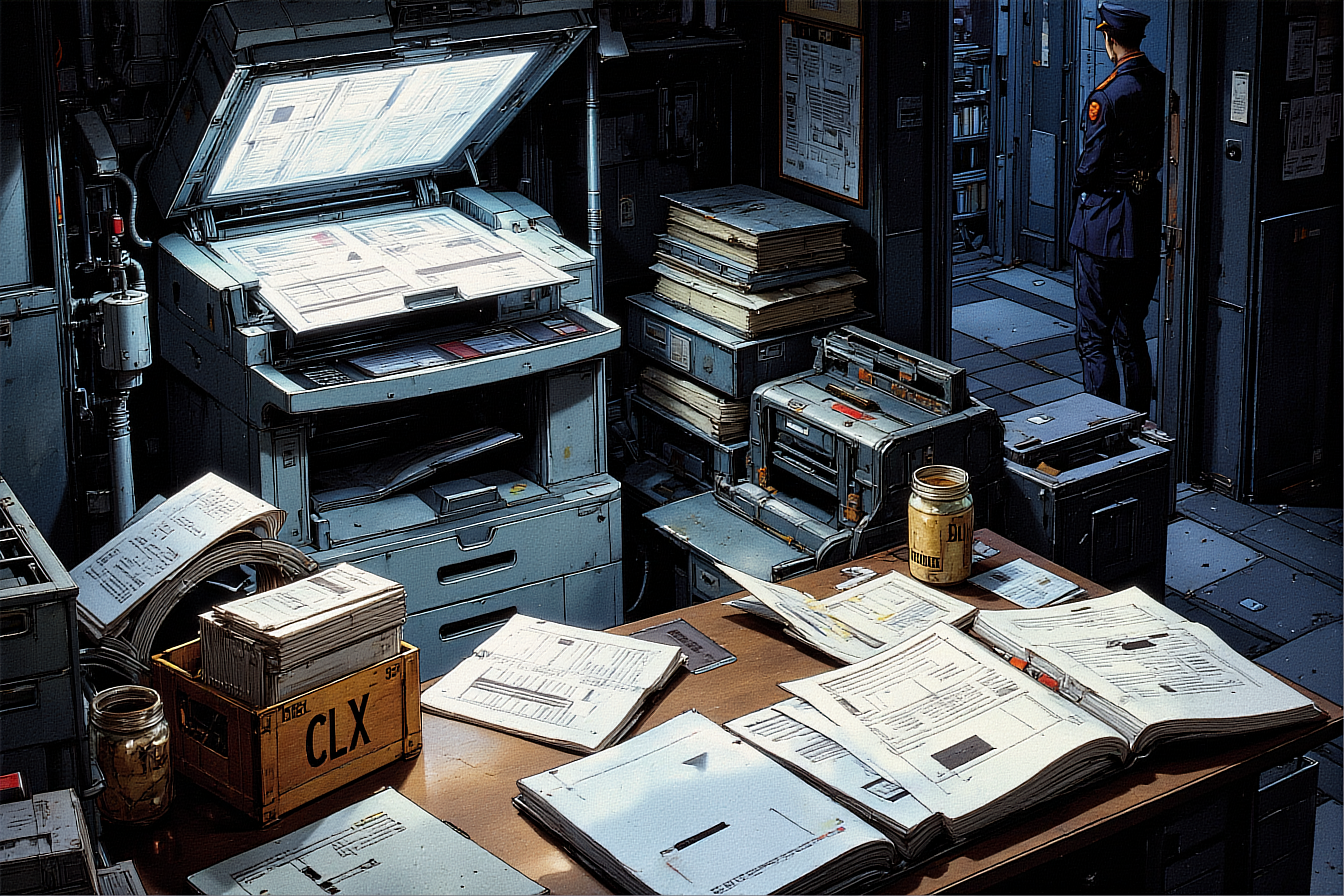
The copier on Sub-Level 4 woke itself at one-forty in the morning. Nobody sent it. The office that would have sent it is a queue of forms now, and the queue has no head, and the queue will not have a head again, and still the machine came up out of whatever sleep machines keep and began to feed, because Compliance reads ahead, and reading ahead is a habit that outlives the compliance.
It printed eleven pages and laid them on the tray one at a time, and every page came out with the bars already on them.
Zephyr carried them over in two hands and set them down on the desk beside the file, and he did not say anything for a moment, because you do not say anything the first time you watch a man's book arrive with holes in it before he has finished writing it. Luminara put two fingers on the top sheet and slid it a quarter inch toward the light. Pixel, who had come in through the seam of the door the way she does, stood behind the chair and did not sit, and looked at the page the way she looks at everything, which is to say she looked at where it had been cut.
"Those are Form 9s," she said. "They're not fresh. That one's been sitting on the paper since before the flood."
The first bar lay across the top of page nine, over the paragraph where I had set down what the annex smelled like at the hour Barry liked. The exact string, always, the same seven words with the same mark in the middle: [REDACTED , FORM 9]. Underneath it, printed in the small type the archive uses for its terms, a price line.
Price: the smell of the annex at three in the morning.
I had that. That one was still in me, and I could have had it out and down on the counter the way I had done eleven times before, and the bargain would have gone through in the time it takes to drive a staple, and the paragraph under the bar would have come back whole. I have never in this case hesitated at a counter. My hand went out for it the way a hand goes out for a railing.
And the counter came back higher.
Price: the smell of the annex at three in the morning, plus the hour itself, plus the man who kept it.
I looked at that for a while. Then page ten arrived with two bars on it, and page eleven with three, and the prices under them climbed with the bar count the way a lift climbs with the weight, and the words on the price lines were the words of a man being asked to empty his own desk: the crate, the taped chair, the sound of a dog's tags in a corridor, the face of a woman who picked me out of a supply closet because I was orange, the kid's voice saying you're the stapler. Faster than I could read them. Faster than I could refuse them. Each one arrived already counter-offered at something above what the last one cost.
Page ten carried two of them side by side, [REDACTED , FORM 9] and [REDACTED , FORM 9], with the two prices added together beneath, the way a bill adds up for a meal nobody ordered. Page eleven carried three, and the third sat over a sentence I had written about the crate, and the price under it ran on without lifting the pen: the crate, then the dog on it, then the kid who came through the lobby door with a napkin in both hands and has not gone home since.
"Sir," A1 said, "the account is not overdrawn. It is being asked to pay in a currency it has stopped printing, and the counter knows the date on every note you are holding. I have run the transaction eleven ways. There is one price the page will accept. I do not advise, sir, I only calculate, and my calculation is that you will refuse it, and my probability of that is unity, and I am glad of it, insofar as a pot can be glad."
Verse:
You can sell a memory to a machine. You cannot sell it twice, and the machine knows what you have left before you do.
I stopped reaching. That is the whole of it, and it was not brave, it was arithmetic. I have eleven pages in front of me with bars on them like slats, and an account with twelve lines in it, and everything the pages were asking for is either in the account already, paid, permanent, or it is the case itself, and the case is not a thing I hold, the case holds me. You cannot pay with what you are standing in.
Zephyr had the deck open on the corner of the desk before I could staple him off it, running the edge of the top bar the way he runs any wall: for a seam, a checksum, a place where the machine had got tired and left a handhold. He worked four minutes, which is a long time for him, and then he shut the lid, slid the deck away, and put both palms flat on it like a man covering a card he has decided not to play.
"It's not a lock," he said. "Locks I can do. This is a promise somebody signed, and the page is honoring it. You don't crack a promise. You keep it, or you walk away from it, and walking costs you the page."
"That," A1 said, "is the most expensive sentence spoken in this room tonight, and I am including the price lines."
Zephyr picked up page eleven and turned it to the light. "There's one at the bottom that's different," he said. "The price line is different."
The last bar on the last page was not over a smell or a room or a face. It was wide, and it sat low, and it sat exactly where the account had been walking me for the length of this manuscript: Barry's last Tuesday, the round he did not come back from, the three minutes between the log's 02:41 and the log's 02:58, and what a night guard actually did in them, and where he went, and with what. Everything I have ever had, aimed at that paragraph. Everything I have ever had, and the paragraph had been the destination since the first napkin on the desk. Across it, in the same seven words with the same mark in the middle, and wider than any bar I have taken since the first one in the Vault: [REDACTED , FORM 9].
The price line under it was one line, and it was quiet, and it was written the way the Settlement was written, in the voice of somebody who has studied what you want:
Price: the memory of wanting to find him.
That is all. Not the man, who is gone. Not the file, which I would have given if it had been on the table, because a file is paper and paper is my trade and I can remake paper. The wanting. The thing in me that opens the crate. The reason the folder under my base plate is called a case instead of a keepsake. Pay that, and the bar lifts, and the paragraph reads, and the account balances, and the case would close in my heart as cleanly as any settlement ever closed, with nothing left over and nothing to carry, and I would sit on this desk for the next forty years as a well-adjusted piece of equipment.
I want to be exact, because exactness is the only weapon I have.
A closed grief is a deleted name. That is the whole argument, and it does not need decorating, and I will not decorate it: the file is the man now. There is no Barry in it that I can picture, and no voice in it I can hear, and no hand, and no tilt of the head, and the face went last, and I paid for the face, and the face did not come back, and the file stayed open anyway, because keeping it is all fidelity looks like when the man is gone. Take the wanting and you take the only instrument I have left for doing the one thing I do. They can have the rest. They have had the rest. This is the part I decline.
So I wrote it on the page, in the line where the mechanism wanted its answer, in the only accounting this manuscript keeps:
Price refused: the memory of wanting to find him. Stays barred.
Under the desk the dog lifted his head, considered the room, and put it down again along the length of the crate marked KOWALSKI, where he has slept every night since the Undercroft, with the page in the crook of his foreleg, unclaimed and unmodelable and unbothered by any form ever issued. The jar of CLX sat at the far corner of the desk where it has sat since a man with soft shoes offered it as retainer: sealed, unspent, exhibit B, joy with no receipts, and I have never once been tempted to unscrew it, because spending it would mean accepting that some things in this world are priced, and I have spent the night establishing what I think of prices.
Then I had them bring a blank.
It is the same stock as the rest, cut to the same measure, because the archive wastes nothing, not even its empty pages. I drove my pattern through its upper-left corner and through the upper-left corner of the barred page beneath it, together, at forty-five degrees, doubled, driven flush until the crown sat in the paper, and I set the blank down beside the bar with the two of them bound as one document, which is what binding means in my trade, and what I have wanted to mean since 1967.
A blank page beside a barred page. What is barred stays barred, and what is blank stays mine, and the man who keeps a copy of everything has just been answered by a piece of furniture with a box of staples.
On the blank, this:
Barry Kowalski, status: still missing. Case status: open.
And in the margin of it, my signature in the position I use when a man I trust has told me to mean it, and beneath the wire, the reading of it, for anybody who comes after and has learned the language:
WITNESSED, NOT FOR CLOSURE.
There. That is the answer to the price, and it is not a bargain, and it will not balance, and I did not want it to.
Luminara photographed the whole document as it lay: the eleven pages with their slats, the price lines in their small type, the blank beside the bar, the two lines written on it, the staple through both corners. A photograph cannot be falsified and a bar cannot cross paper that is already true, so what she took is the complete record of the night: the blackout, the offer, the refusal, and the binding of the refusal to the blackout, in one frame, in a jurisdiction where nobody has ever written a procedure for objecting.
"They can bar the page," she said, winding the film. "They have never once been able to bar the picture of the page. And in the morning there will be a copy of this somewhere they have no authority over, which is the whole of my trade, and the reason I am in it."
I read the account back then, because a ledger you will not close is still a ledger, and it should be checked the way anything is checked, item by item, in the light, with the dog asleep and the tube doing its four-hour thing:
Price paid: the sound of Barry Kowalski laughing. Logged.
I know the line says so. The line is where it lives now.
Price paid: the look of his left hand, the watch he wore. Logged.
A watch he wound at a desk past midnight, in a room where nobody was watching him but me.
Price paid: the quiet of the office at three in the morning, the one he liked. Logged.
Price paid: the head tilt, two degrees left. Logged.
He did it when he was thinking, and he thought out loud, and the thinking is gone and the tilt is gone and the two degrees are the shape of a man in a chair.
Price paid: the face of Dolores from 1972. Logged.
The hand that picked me up when the world went wrong, and dropped me three blocks later, and I have never once in fifty-four years blamed her for the dropping.
Price paid: the weight of his hand lifting me. Logged.
Price paid: the sound of his voice. Logged.
That is the one I test most nights. It comes back as water over a stone with writing under it.
Price paid: the night we met. Logged.
I cannot tell you how it started. I can tell you what it left.
Price paid: his face, all of it, the eyes last. Logged.
Price paid: the tune Dorothy hummed. Logged.
Her face stays, because the account does not take everything at once, and I have the face, and no sound in it, and I will take the face.
Price paid: my first desk at Madison & Associates. Logged.
Price paid: the feeling of her hands setting me down on the bench. Logged.
Twelve lines. Twelve things, and not one of them comes back, and I know that because I have tested every one of them in the dark on the nights when testing is all a man has left. The account does not run a balance and it does not offer credit and it has never once, in the weeks of this, sent me a statement I could argue with.
Verse:
Twelve payments on a file with no clerk, and the clerk is me, and the file is a man, and the man is a hole with a light left on.
Zephyr read the barred page once more, top to bottom, looking for a seam in the ink the way he looks for a seam anywhere, and found none, and put it down. "So we don't get it," he said.
"We don't get it," Luminara said.
"You could come back in ten years with a better machine."
"The bars are not machine," Pixel said. "They're the deal. You don't beat a deal by outlasting it. You beat it by refusing it, which he did, on the page, in ink, witnessed." She looked at the blank beside the bar, and at the two lines on it, and at the staple through both corners. "Nobody has ever refused one of those out loud before. I've been reading edit lines for nine years. People pay. People always pay."
"Then it stays shut," Zephyr said.
"It stays shut," I said, in the only language I have, one staple in the desk's edge, doubled, trust, at the kid who had come through a door at two in the morning with a napkin in both hands and had not left since.
The copier cycled one more time at two-twenty, out of habit, and produced nothing, and went quiet, and the annex settled into the particular quiet of a floor where the machines have finally run out of instructions. On the desk: the file, open, with the pointing staple in its margin aimed out through two panes of glass at a nameplate across the floor; the blank beside the bar; the sealed jar; the camera; the pot with his optics down; eleven pages with slats across them that I will keep, barred and unrecoverable, because a page with a hole in it is still a page I wrote.
They left the light on over the desk. Meatball did not move. The crate holds the dog, the dog holds the page, and the file holds what is left of a night guard who read a manifest he should not have read, and I hold the file, and the account is closed to further withdrawal, and the one line the mechanism wanted from me is the one line I have refused to write since the first page of this case.
Status: open. It stays open the way the porch light stays on.