
Static Between Stars — Chapter 12: The Gate Ledger
The queue at Orra Gate Sixteen advanced one hull at a time, and every hull that advanced came back priced.
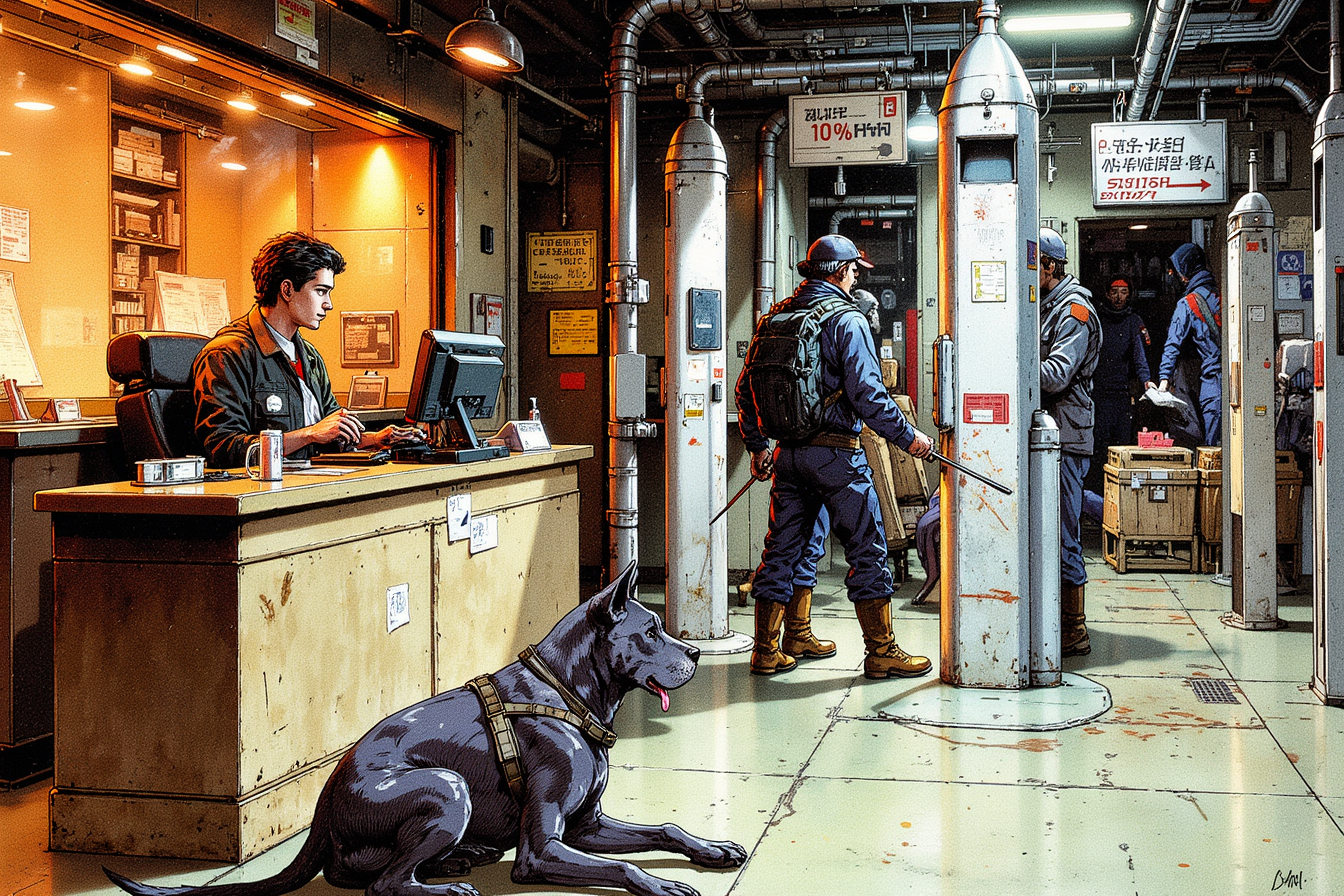
Om Kai watched from the crew gallery above the concourse, his tea cooling in both hands, and read the tariff board the way he had once read interferometry results in the Deeproot Cloister: as a statement about the instrument rather than about the world. The board hung between the gate's two grey pylons in flat white letters. It did not list distances. It did not list tonnages. It listed statuses.
Registered world: standard rate. Registered, under review: standard plus review surcharge. Struck world: salvage rate. Unregistered: passage at discretion of the gate. Cargo assessed. Crew assessed.
Every ship that arrived paid for what it was, and what it was had been decided somewhere else, by clerks the ship would never meet. A measurement is a promise to stop asking questions afterward. The gate did not board you. It observed you, and you became the number the observation produced, and the number was filed, and the filed numbers were the galaxy as far as anyone in the queue needed them to be.
Ahead of them a tramp freighter flying a Dorrow's Landing transponder hung at the pylon and would not clear. On the open channel its master worked through the delay in the flat commercial sentences of a man who expected to be charged for the argument: cargo provisioned, contract live, forty minutes on the gate's meter, and Dorrow's Landing was four jumps from striking. The clerk answered in the register the whole gate used, courteous as a closed door.
"Row struck in the spring, sir. Salvage rate applies to the hull. Your crew's rows carry pending delisting notices, so each of you is billed at discretion. Step to the window."
"The notices are pending," the master said. "The world is still there."
"The world is there, sir. Your row is pending. I price the row."
Om watched the master come down the freighter's ramp and join the line at the window, a man being priced ahead of an event that had not happened yet. Pending was its own status on the board. He had read the Conglomerate's courtesy packets often enough to know that a pending row was a row with a date attached, and that the date was always the turn of a shipping season.
His earpiece crackled. "Queue's moving," Pixel said. "You're four away. Papers?"
"In hand."
"Do they resolve?"
"The papers resolve," Om said. "I am less sure about me."
He had made his peace with that sentence before he left the ship, or thought he had, which is the softer version of peace and usually the accurate one. Om Kai. Chaplain. Doctor of quantum measurement, a degree the Registry had issued him and then revoked the year it struck Verdantia's row. Status on his own registration: deceased, variance incident, three years ago, no successor record. He carried the papers of a dead man to a counter that priced the living and expected the paperwork to do the arguing.
Three places ahead of him a customs second ran a cargo wand over a shuttle's open hold. The wand went down the manifest in order: crates, spares, a crate of medical stock, one dog.
"Canine, thirty-eight kilograms," the second said into his collar. "Classification?"
"He is a dog," the shuttle's master said.
"The board wants a code."
"The board can ask him."
The dog, a heavy grey-muzzled thing with no interest in bureaucracy, sat on its owner's boots and declined to be classified. The second stared at the wand, then at the dog, and entered something that pleased nobody. It was the only joke the gate had told all morning, and nobody laughed at it, which is how Om knew the gate was afraid.
Two away. The gallery rail was cold under his palm. Behind him the concourse ran its usual errand: freight clerks, pilgrims, a school group on a field trip to watch ships get measured, children pressed to the glass with the guileless delight of people who had not yet been assigned a yield.
He thought about the Deeproot Cloister, because the gate's air (ozone, floor wax, and the particular paper smell of a place that files things) always took him there. Verdantia's air had smelled of wet bark and leaf mould and the cloister kitchen at the hour the students burned the rice. Sixty-one in the congregation by his last honest count. Sixty-one rows, each with a name, each carrying the small administrative details that make a person legible to a ledger: tithing record, work assignment, next of kin, a notation from the grove-elder recommending a correction to the irrigation tithe.
The archive had gone first, before the people. That was the order of it, and he had been off-world at the time, at a measurement conclave on Sere, which was the only reason he was standing in a queue instead of being one of the sixty-one. A harvest tender at the cloister's gate. Monks signing a transfer under the tender's courteous supervision. Four hundred years of copied records, the Cloister's own registry of Verdantia's deep valleys, the parish rolls, the yield surveys the grove-elders had kept since before the Conglomerate came: boxed, crated, gone. Then the packet on the civil band. Then the row struck, and sixty-one names moved to the column Om kept in the back of his liturgy book, where he did not round.
He had carried one folio out of that archive in the lining of his robe, had never been able to say aloud what was written on it, and the weight of it had not lessened in three years.
"One away," Pixel said in his ear. "Om. Whatever they ask, you answer truthfully and you answer small. A gate clerk with a truthful small answer has nothing to file."
"Yes, Captain."
"And if it goes wrong, we do not argue at their counter."
"We never argue at counters," Om said. "We only ask questions at them."
He gathered his papers, finished the cold tea in one swallow because a monk wastes nothing, dregs of a bad brew included, and stepped down to Counter Nine.
The clerk behind the glass was young, tired in the specific way of a person who has been tired for weeks and has stopped negotiating about it. His nameplate read CLERK-SECOND ORIN BEL. His terminal showed a queue of eleven and a defect counter that Om, reading the private side of the screen as Bel angled it to sign a form, counted to one.
"Next," Bel said. Papers across the glass. The scanner passed over them with its small grey light: name, ship, manifest, and then the pause Om had expected the way a man on a stair expects the last step to be missing.
The screen turned amber.
STATUS: DECEASED. FLAG: IDENTITY MISMATCH. AUDIT REQUIRED AT COUNTER.
Bel looked at the screen, then at Om, and his shoulders made the small settling movement of a man whose morning had just acquired a procedure.
"Sir," he said. "I'm sorry. Your row reads deceased. I have to open an audit."
Om did not reach for the papers. He folded his hands the way his shoulders wanted them folded and said, "Before you do, may I have your name?"
Bel blinked. In nine years, Om suspected, nobody had asked. "Orin Bel. Clerk-Second, Counter Nine. Registration eighty-eight, two-fourteen, seven-seven-ten, if you're planning to file a complaint."
"I am planning to thank you," Om said, "and to tell you what your audit will find, so that you are not charged for the surprise. May I?"
Bel's fingers hovered over his terminal. The queue behind Om was four deep and patient, because queues at gates are always patient; the ships pay by the minute either way. He made the gesture of a man who has decided that a spoken minute costs less than a filing.
"Say it."
"My registration was struck three years ago in a variance incident. Six of us went in and the Registry's roll office issued all six as deceased, and it never reissued me, because reissue requires a live petition and a dead man cannot file. Your scanner is correct. Your flag is correct. Your audit, opened at this counter, will spend an hour establishing that the man in front of you is legally dead, and it will resolve to null, because the gate prices the living and I am, on paper, not among them."
"A null comes back to me as a defect," Bel said.
"Your board shows one already. I saw it when you turned the screen to sign."
Bel's hand went to the terminal and turned it back, and Om watched him read his own number the way a man reads a rumour about himself. One defect. The double shift. Delisting season, when the gates ran at full queue and the reviews came down like weather. He had the look of a clerk who checked his own world's row on every break, and Om understood suddenly that the amber screen in front of him was the second-most frightening thing Bel had read that morning.
"You could open it anyway," Om said. "It would be procedure, and procedure protects you, and I would stand here for the hour and answer every question honestly. But the audit belongs to the roll office at the Registry Court, and a deceased row filed at a gate counter comes back to you as a misfile, and a misfile and a defect are the same number to whoever counts them. So you have two ways to lose and one way to close it, and I would like to help you take the third."
"You're asking me to wave you through."
"I am asking you to write what happened, which is that a deceased registrant presented himself at Counter Nine, that no live billing is possible, and that the flag was closed without audit at the clerk's discretion. Every word of that is true. I am not disputing my death, Orin Bel. I am only declining to be billed for it."
Bel's mouth did something that was the ghost of a smile and went away. He typed. The amber cooled to grey.
"Closed without audit," he said, and did not look pleased about it, and Om did not blame him: a man who has been talked out of a procedure by a stranger in a robe has every right to feel handled. So Om gave him the true thing, the thing that cost nothing to give.
"You have been kind to me at a counter," he said, "and kindness at a counter is expensive. I have a question for you in return, if I may ask it small. What does your own row say?"
Bel's hands stopped.
"Fine," he said.
"Rows do not say fine. Rows say numbers."
"Then it says nothing to you." Bel squared the papers back into a stack, squared them again, a small precise violence. "It says review. It has said review since the summer. No surcharge yet. It's fine."
"It is pending," Om said, "and you know what pending means, because you price it on other people all day." He let that sit the way a bell keeps sitting after the rope is let go. "When the review comes, they will not ask you how you felt about it. They will ask what your counter kept. Keep copies of everything you file, Orin Bel. Every transfer, every struck row, every closure you sign. Not for the Registry. For the day somebody comes asking whether any of it was ever real."
Compassion without action is just well-intentioned emptiness, and advice was the only action available to a monk at a counter with a queue behind him, so he gave the advice in the form of a warning and watched Bel hear it.
"A copy doesn't mean anything," Bel said. "A copy of a struck row is litter."
"A copy is a row that has not been observed yet," Om said. "It can still turn out to be anything."
The closure needed two signatures, because a flag closed without audit requires a witness to the closing, and the witness had to countersign at the filing terminal in person. Bel studied him for a moment with the flat clerk's appraisal that Om had seen on better and worse faces, then reached under the desk and produced a grey badge on a lanyard.
"Counter's Nine. Filing level's below. You'll walk down with me and put your mark where I tell you, and then you'll go back to your ship and your dog and your dead registration."
"With pleasure," Om said.
"You're the first person in nine years who's asked me where the struck rows go."
"I am not surprised," Om said. "Nobody asks a gate about its vaults. Gates are for arriving."
"That's the job, isn't it," Bel said, and he came out from behind the desk, and the queue parted for a clerk the way water parts for a stone, without warmth and without complaint.
The filing level was colder than the concourse and smelled of paper the way a chapel smells of wax, which is to say the smell had been there so long it had stopped being a smell and become the building. Down a service ramp, through two doors with no signage, into a long room with the gate's pylons humming above it through three decks of steel. The delisting vaults of Orra Gate Sixteen ran the length of it: grey containers stacked four high, each stencilled with a lot code and a status, and behind them, racked in steel sleeves, the physical registry books of systems the board upstairs no longer priced.
Om walked slowly, which is how a monk walks through an archive, and also how a man walks when he is trying to read a room before the room reads him.
"Salvage statute," Bel said. He had the cadence of a person reciting the one paragraph of law he uses every day. "Older than the Conglomerate. A salvage master keeps his manifest ninety-nine years. Can't pulp, can't purge, can't consolidate without a transfer record with two signatures on it. So when a row gets struck, the Registry doesn't delete anything. It re-files. The struck system's registry copy becomes salvage property, and salvage property keeps a manifest, and the manifest keeps the copy." He slapped the nearest container without affection. "Deletion was never in the statute. Somebody's grandmother wrote that law when the only thing that ever sank was a boat."
"And the copies stay here until?"
"Until the consolidation pull. Fully delisted systems only, whole registry, one copy of the lot. They get hauled to the central salvage depot and the physical copies here get pulped after transfer." Bel checked the transfer list on his pad. "Ours goes in six weeks."
"Where is the depot?"
"The Vannic Reach." He said it the way a man names a place he has never been and expects never to go. "Reach Salvage Consolidation, filed under salvage, unregistered jurisdiction. Nobody's authority, technically. That's why everything ends up there. It's outside the audit, so it keeps the manifest, so it keeps the world."
Om stood very still. The pylons hummed. Six weeks, and the only physical registry copy of a struck system at Orra would be pulp, and the row would live in one room in the Vannic Reach, filed as salvage, outside every audit.
He walked the racks with his hands behind his back and found the container he had known he would find, because he had known the shape of it since the day it was carried out of his cloister's gate.
VERDANTIA / DEEPROOT CLOISTER / ARCHIVE. LOT 11-8842. ROLL COUNT 61. TRANSFER 14. STATUS: SALVAGE, CONSOLIDATION PENDING.
Sixty-one. The same sixty-one. Somebody at some desk had counted his congregation the way he did, and had not rounded, and had stamped the total on the side of a box, and the box had been sitting here, three decks under a board that priced ships by what they were, for three years.
Om put his palm flat on the container and left it there for one breath, which is the entire liturgy the moment allowed, and then he took his hand back and read the lot code twice and filed it in the place in his head where he keeps everything he cannot write down.
"Consolidation pending," he said. "Six weeks."
"Give or take."
"And at the Vannic Reach, the manifest is permanent."
"Ninety-nine years," Bel said. "Give or take."
"The names will be there," Om said. "All sixty-one of them, and every row struck before mine. Filed as salvage."
"That's where the struck rows live now," Bel said. "Yes."
Om took out the small black book he kept in his sleeve and wrote the depot, the jurisdiction, the filing status, and the lot code on the same page, and the page had room, because the page always has room, because he does not round.
"Captain," he said into his collar, quietly, while Bel re-racked the manifest. "The location is fixed. A system that is fully delisted keeps one registry copy, in one place, and the place is the Vannic Reach, under salvage filing. Filed as salvage, so it survives the audit. Confirmed today, with six weeks before the physical copy here goes to pulp."
"A copy," Pixel said, "of everything?"
"Of everything they kept. Which is everything they were ever billed for."
He closed the book. Above them the pylons hummed, pricing a ship for what it was, and Om thought of a measurement collapsing a wave into a number and of sixty-one names that had collapsed into one stamped total on the side of a box, and he thought it was the same act performed twice at different scales, and that the second one was the same crime.
Back up the ramp, through the doors, into the wax and ozone of the concourse, where the queue had advanced four places and Counter Nine's line had grown. Bel went behind the glass and became a clerk again, and Om stepped to the public directory terminal by the school group and completed the last small action he owed the man.
He sent Orin Bel a copy. The countersigned closure, sealed, to the address on his badge, with one line attached: You kept it. Keep the rest.
Then, because a name in a book is a person and a person has a number, he typed the registration into the directory's public index, out of plain curiosity, the kind a chaplain follows the way he follows a knock at a door.
REGISTRATION 88-214-7710. NO SUCH ROW. POINTER DOES NOT RESOLVE.
Om read it twice. He checked the digits against the badge through the glass, where Bel was pricing a pilgrim's shuttle at discretion, and typed them again.
NO SUCH ROW. POINTER DOES NOT RESOLVE.
Somewhere behind that number had been a world with a row, and the row had been struck or transferred or re-filed out from under the man who still wore the number on his chest, and no directory in the gate would say where, and the number went on being printed on his nameplate and read out loud when he introduced himself to strangers, a name on the record that no longer resolved to anything.
The gate observed everyone who passed it and never once observed its own clerk. Om had looked, the way physics taught him to look, and resolving the number changed nothing about Bel. It cost him only the sentence he could keep saying: the man has a row.
The boy from the school group pressed his face to the glass and watched a freighter get measured. Bel called the next ship forward. Om opened his small black book, and beneath the lot code and the depot he wrote the name, ORIN BEL, and the number, and the three words the directory had given him, and he did not round them either.
Then he walked back to his ship with the location fixed in the book and the clerk's name fixed in the same page, one of them alive and one of them already gone, both of them filed.