
Static Between Stars — Chapter 17: Linda3637, Reclaimed
"Luminara Usha," she said.
The stenograph took it. The clerk, who had Kessel's reserved objection folded in front of her like a hand she had been told not to play yet, glanced at the bench, and Magistrate Ilva Sorn moved two fingers in the small circular gesture that meant proceed with the routine, and the routine began.
"Registry row as restored," the clerk read, in the level voice clerks keep for sentences that ought not to be read twice. "Designation Linda3637. Name field: empty. Prior status: struck, eleven of Frayl, nine years last season, recorded cause: variance incident, deceased. Restoration: by broadcast, contested, admitted for the purpose of this petition."
The words went out as she said them, because the carriage was live and nobody had sealed it, and in the gallery two hundred people heard a clerk read a number in the tone other clerks use for a person's whole biography.
Kessel stood. "The record should carry the designation. It is the only identity this Registry can verify for this witness."
Roan did not stand at once, which was a habit of hers that Luminara had come to find either maddening or perfect, depending on the day. "The petitioners move to strike the designation from the record of these proceedings and enter the witness's name."
"Denied as to striking what the row says," Sorn said. "Granted as to entering what she says. Both belong in the transcript, one as history and one as fact. The designation was this Registry's contribution to the witness. The name is the witness's contribution to the Registry. Clerk: enter Luminara Usha in the name field of this row, rule the designation beneath it as the former state of the entry, and post the change to the carriage."
The clerk's stylus moved twice. The name field, which had read empty for nine years, read Luminara Usha, and Linda3637 went underneath it behind a single clean rule, and the amended row posted to the carriage board at the dais. Luminara watched her own name arrive in public the way she had watched a thousand things arrive: as light on a surface, in sequence, one line after the next, traveling farther than her eye could follow.
Roan let the room settle before she asked her next question, because she had read her witness and knew that rooms needed settling. "Madam witness, what is your work?"
"I take photographs."
"Of what?"
"Of what is happening, before somebody files it as something else."
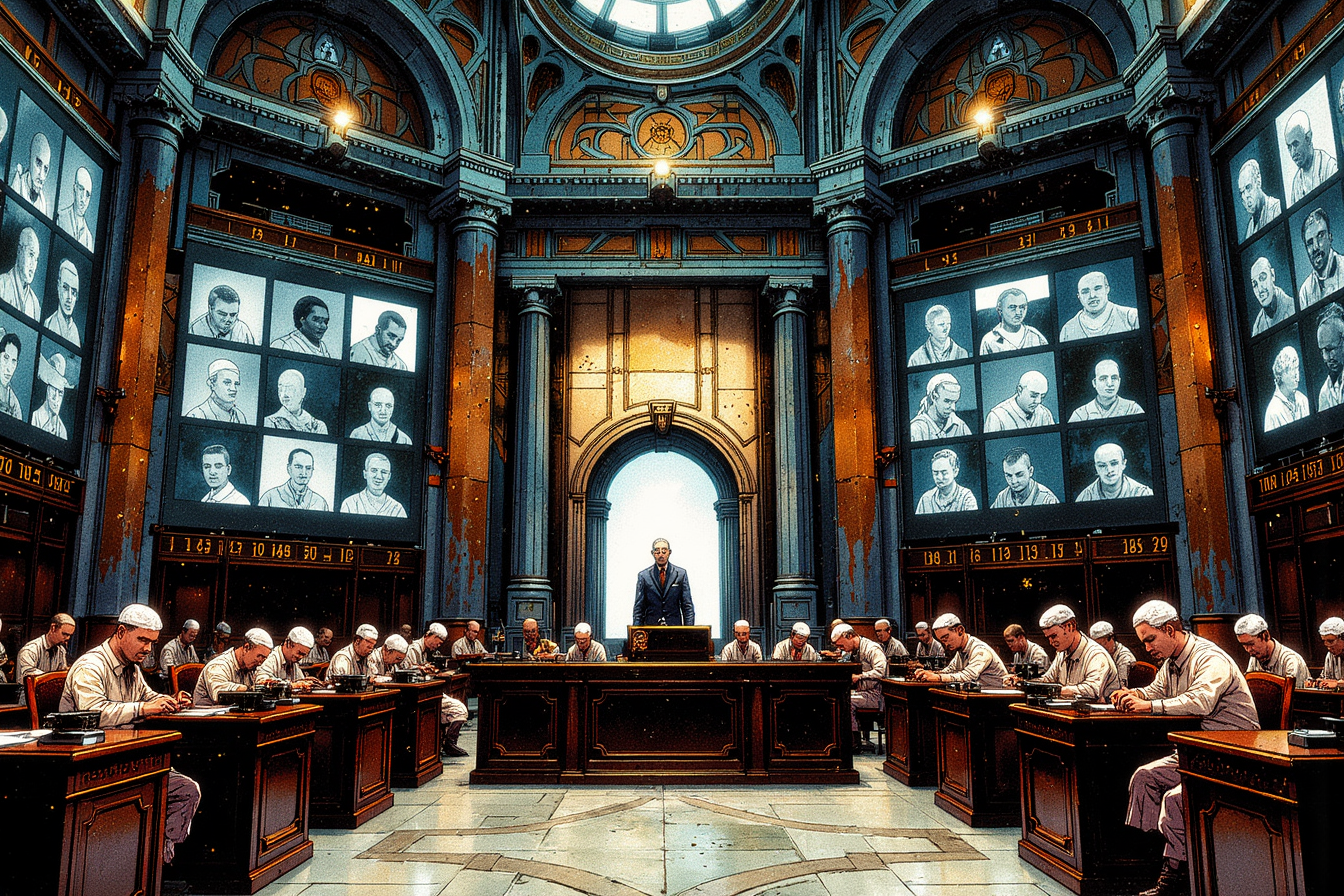
The first exhibit came up on the west wall of the chamber, where four centuries of judgments had been reflected in dark stone, and the stone went black and then showed Ostrell.
Luminara had taken it from orbit through a viewport at 0412, the last crane going out on a world whose lights were being unhooked in rows, quayside last, the loading lamps holding to the end because loading lamps were contractual. In the projection the crane stood alone against a dark harbor like a question somebody had asked and then been answered.
Exhibit two: a line of freighters stopped at the Rim approach, hulls against hulls in the dark, no one firing, every one of them waiting on a courteous notice. Exhibit three: the Sorrowful Moon extraction plate under its twilight that never lifted, workers with sweeping tools bent over their own weather, the crystals they gathered stacked in bins with quota tickets on the bins. Exhibit four: a gate queue at the Vannic Reach, two hundred people holding restored printouts in their own hands, reading their own names off paper the way you read a name you have been told you were no longer entitled to know.
The chamber took the images the way a room takes weather. A clerk near the north door put her stylus down. In the gallery someone exhaled on a schedule of one breath per image, and Luminara, who had spent nine years learning to hear a room's silence through a lens, heard this one and framed it anyway, in her head, without lifting the camera: light on two hundred bowed heads, and the reflection of the projection in the black lacquer of the bench, so that the images played across the magistrates' faces as though the court were being shown to itself.
"Madam witness," Roan said, "when did you stop being Luminara Usha?"
"A Tuesday," she said. "Nine years ago. At 0900 my agency's access revoked itself. At 1100 the mirrors started scrubbing, which is the word they use. By evening every public mirror in the trade zone that had ever carried one of my photographs was showing a gray rectangle with a registry notice in the corner. And the notices were accurate, which is the part people do not expect. It did not say I had been deleted. It said I had been lost in a variance incident, and it thanked the reader for their continued participation in standardised trade."
"And your name field?"
"Empty. Designation only. Linda3637. I carried it for nine years on every gate and every lease and every dockside license. You learn to say it fast, the way you learn anything that is not yours. Hotels read it back to me at the desk. Insurers quoted it. A man at a gate in the Brinal cut asked me, quite kindly, what number I used to be."
She paused. The projection still held the gate queue, two hundred printouts raised in the light.
"The images I rebuilt," she said. "Four hundred and some. I put them back from memory. Some came back wrong, and I kept the wrong ones in, because a memory that has been through a person is evidence too, and I am done being the only one who knows what I saw."
Roan said, "No further questions."
Counsel Kessel crossed into the well with a pad he did not need and a voice calibrated to the exact temperature of institutional courtesy. "Madam witness. You are these days a passenger aboard a vessel for which the Registry holds an interdiction order."
"I am crew aboard a press ship," Luminara said.
"The Ephergent. Wanted for theft of Registry property and for unlicensed broadcast across nine sectors." He let the nine sectors sit in the room the way a man sets down luggage he expects to be staying with. "Your testimony reaches this bench on channels the Registry did not open. Your photographs arrived the same way. Would you say your evidence comes to this Court by permission?"
Roan was up. "Objection. Calls for a legal conclusion, and it prosecutes a vessel that is not a party to this petition."
"Sustained as to conclusions." Sorn's eyes had not left Kessel. "The witness may describe how her work travels. She has been doing it, by my reading of the file, since she was nineteen years old."
Luminara's hands had settled on the camera without her deciding they would. "My work travels the way weather travels. People carry it because it belongs to them before I get there. A photograph of your own quay is not contraband because a ship you were never allowed to board printed it on the way past."
"Everything you have shown this bench," Kessel said, "was carried by a fugitive."
"Everything you have shown this bench," Luminara said, "was carried by a fleet. We are agreed on the method, Counsel. We differ on the receipt."
A sound moved through the gallery that the bailiff addressed with a look. Kessel wrote on his pad, and Luminara lifted the camera and framed the bench, because she had been examined for eleven minutes and had not yet made an image, and a witness who lets the light go is a witness who has decided the room is not evidence. The shutter was a small sound in a stone room and it landed like a cough.
"Objection," Kessel said. "The witness is recording the proceedings."
"The proceedings are recorded, Counsel," Sorn said. "The witness may photograph this bench. If this Court is going to be remembered, it may as well be lit properly."
Luminara lowered the camera and looked at the frame she had taken: Sorn center, the white hair and the cut of it, the two associating magistrates blurred at the edges, and behind them the west wall where her Ostrell crane still stood in the dark harbor of the projection. She had photographed a hundred officials in her life and knew what their faces did when they believed they were being observed rather than seen. Sorn did not change. Sorn kept her hands where they were and let the lens do the arithmetic, and Luminara framed her again, and this time the magistrate looked directly into the glass and did not blink, and the second shutter sounded.
"You were legally dead, witness," Kessel said, as if handing her a coat. "Struck, filed, corrected. An error of the variance kind, now fixed. And in the nine years since your correction you have sold images of delisting to every open market that would carry them. What is your compensation for that work?"
Roan began an objection about scope and did not finish it, because her witness had already decided.
"I was paid in a designation," Luminara said. "I am spending it. Every frame I have shown this room is drawn against an account your office opened the morning it spelled my death out politely and thanked the reader for their continued participation. You may audit the balance at the carriage board like everyone else."
"You speak as though the Registry injured you personally."
"I was struck by Standard Metric 11 in a variance incident that no one has ever explained to me, and my name field was emptied, and my pictures were scrubbed from every mirror you control, and I am sitting in your court under my own name, which it took this long and this much to get back. If that is personal, Counsel, then the metric is personal, and I would like the record to keep the word."
Kessel looked at the bench. Sorn's stylus moved once, which meant the record kept the word.
"No further questions," Kessel said. "The respondents reserve on provenance and on the admissibility of exhibits carried by a wanted vessel."
"Reserved," Sorn said. "The witness will remain under oath. This court stands in recess until the hour."
The witness waiting room was gray, with a jug of water nobody had poured and one monitor bolted to the wall above a bench that had been bolted to the floor for the same reason benches in custody rooms always are. Roan had gone back out to the gallery to be seen being calm. The clerk's assistant had brought Luminara a copy of the transcript as it posted, page by page, five minutes behind the room.
She read her own name at the top of page one. Then she read the designation under it, struck, with the strike rendered in the official record as a single clean rule through the characters, and beneath the rule, in the clerk's small hand and the court's seal: enter Luminara Usha.
She took a photograph of the page with the camera still warm from the bench. The flash was off. She did not want the page lit. She wanted it the way it had arrived.
On the monitor the open band was doing what the open band does when it has been given something true to carry, which is everything at once. She turned the dial and let it wash over her.
At the Vannic Reach gatehouse, the clerk had run the transcript out of the public printer until the paper ran out and then kept printing on the maintenance roll, and someone had pinned the first forty lines over the departure board so that passengers waiting for the freight to the outer lanes read the proceedings in the queue, at a slant, with their luggage between their feet. A photograph of the gatehouse wall arrived on her monitor from a channel with no sender, and she photographed the monitor, so that the image in the room was a photograph of a photograph of a page pinned to a wall, and each copy was one more place the words had been.
A yard tug's mess deck. The transcript's second page gone up beside the duty roster with one staple in the upper left corner, which she recognized as the standard fastening of every crew that has ever pinned an order it intends to obey.
On the tactical band, callsigns she had never been able to keep straight began answering each other with lines of her testimony instead of rote. A flight lead out of the Woken quoted the bench's sentence about the designation and the name, gave it as authority, and launched. Then four more. Then a freighter flotilla that had been sitting at the Rim approach under advisory blockade since the spring, holding position because nobody had given them a lawful reason to move, pulled up anchor in a single hour with the transcript's forty-first line riding on every hull: the respondents may argue what name her row deserves, in evidence, at length.
She watched ships become a fact. She had photographed funerals and harvest barges and the faces of people reading notices about themselves, and she had learned that history rarely announces itself in the room where it happens. It arrives afterward, on somebody else's monitor, already copied, already folded, already being read out loud by a person who was not there.
Her palm-unit buzzed. A channel she recognized: the ship the Registry says does not exist. Zephyr's text, no greeting: your name is on every board between there and the rim. do not come out the side door, the press has the front.
Under it, one from Om Kai, later, shorter: I have kept a count of the dead. Today I added a line to the other side. It has your name in it.
Luminara set the palm-unit down and looked at the bolted bench and the unpoured water and the monitor full of her own words traveling, and she understood that she was afraid in the specific way of a person who has finally gotten what she came for and can see the price tag on the back of it.
Then the band found the dispatch she had been waiting for, and she turned the dial until the voice came clean through the bolted monitor's small speaker: the day counted back to her in Pixel's register, the gatehouse at the Vannic Reach out of paper and printing on the maintenance roll, the flotilla at the Rim approach handed its order by a magistrate reading a name off a row, and the sentence she had not managed to say to herself, out of a speaker at volume: nobody fired, a clerk read a name aloud in a stone room, and four hundred hulls decided they had permission.
The feed pods folded flat against the stone, and the chamber lost the small electrical sound that had been running under every word all day.
Before the adjournment Sorn had the clerk read one instrument more. The amendment to the row of Linda3637: name field restored, designation retained beneath it as history rather than identity, entered by authority of Session 1141 and sealed with the Registry Court's own seal. "Entered," Sorn said, and the word went out on nine thousand channels. "This record is an instrument and not a courtesy. No administrative officer may amend it. Only this bench may reopen it. The Registry will carry the row as it now reads."
Which meant that in the master spine, in the same lattice where a designation had sat alone for nine years, there was now a name with a seal on it, and the seal carried three magistrates' signatures behind it, and the only body in the galaxy that could take the name away was the body that had just spent a day putting it there.
"The petitioners' examination resumes at nine," Sorn said. "This court stands adjourned."
The pods retracted, the plates went dark, and the gallery rose in the shuffling way of people who have been sitting on stone for six hours and are not ready to stop. Roan took Luminara's hand in the corridor and held it the way you hold a rope, and the restored citizens closed gently around her, a crowd with nowhere else to be, and somebody said her name twice to somebody else just to hear how it sounded said.
Her palm-unit buzzed three times. The third message came from no one she knew, a press relay forwarded twice with the header stripped, and she read it standing up, with the camera still slung across her body and the crowd moving around her the way water moves around a stone.
OFFICE OF TRADE CONTINUITY. EMERGENCY SESSION CONVENED. TIMESTAMP 1740. CALENDAR CLEARED. DOORS CLOSED. AGENDA, ITEM ONE: WHAT TO DO ABOUT A WITNESS.
Roan read it over her shoulder and let out her breath slowly, the way a woman releases a thing she has been holding since morning. "They convened inside the hour."
"Is that a threat?"
"It is a confession," Roan said, "that they have decided the transcript is the war, and that they intend to hold the argument about you in a room where the decision leaks before the ink dries." She squeezed Luminara's hand once and let it go. "Your name is entered and sealed. It is law. A memo cannot take it back. Only the bench that gave it can."
Behind them the corridor lamps went to night cycle, one bank after another, orderly, and the last thing lit in the Registry Spire was the departure board over the gate, still running the transcript's line numbers for anyone waiting on the freight to the outer lanes.