
Static Between Stars — Chapter 22: The Harvest Line
A harvest fleet is the man who comes back to the scene of the crime, and it had been over Ostrell for nine hours before anybody on the crew's side said the number aloud.
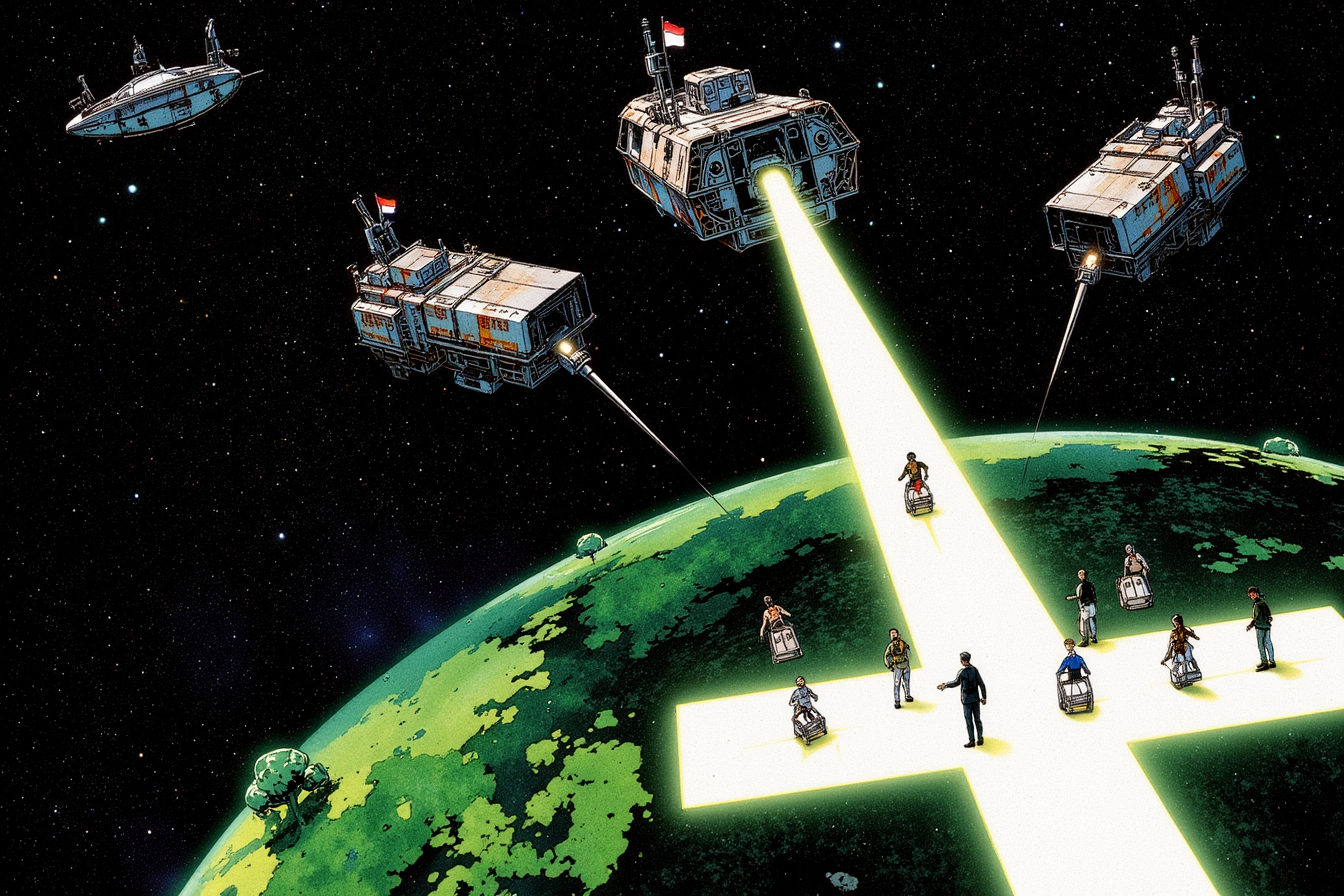
From the port in the Bittern's aft hold he could take in all three barges without turning his head. Slab hulls with the running lights off, hanging over the dark side of a small green world the way furniture waits in a room where somebody has died. The nearest had painted herself the Reconciliation, Registry gray, pennant still fresh on the flank like a new collar, and down her belly the loading lamps burned in one long white rectangle, and out of that rectangle climbed the lifts from Ostrell's one real harbor, one every forty seconds, patient as a heartbeat. The harbor had gone dark with the grid at the turn of the shipping season. Barges do not need grids. Barges bring lamps.
People went up in the lifts.
That is the sentence, and he is writing it down because the whole procedure depends on somebody writing it down. Four hundred and six thousand rows of the same treatment, file after file, loaded the way freight is loaded: a weight ticket, a ramp, a courteous hand at the checklist. The hold glass carries no sound at all. What he got came up through the deck plate instead, a regular tread in the metal that a crewman on the far side would have logged as shift traffic.
He has logged a hundred desks. Gate desks, depot desks, an audit bench where a woman read him a closing note she had practiced in a mirror, a clerk's desk in the Vannic Reach where the clerk's own name had stopped resolving. This is the room where the desks come from. Everything he ever stapled into a file started in a bay like this one, where a world comes off the books in bulk and goes into crates with a number painted on the side.
He had watched this very world's row go blank from the bridge of The Ephergent, lane by lane along one coast, kitchen lights going out in rows like a theatre emptying, the last thing still lit a crane, and the crane had gone at 0412. That was the paperwork. This was the pickup. Somewhere down there the harbor was running lifts on a schedule that somebody had typed, and up here three barges were eating the result, and in nine hours they would be full and gone and the coordinates would be quiet twice over, once by notice and once by inventory.
The one file he never finished lives folded in the slot beside his staple reserve, which is the only pocket a Swingline has. The Petrel. Barry Kowalski. A survey hull out of the lost Rim, gone before silence was fashionable, and at the bottom of every page of it, in handwriting that is his, the same two words: status: open. Crews have asked him to close it. The Registry would close it for him at no charge, one form, one stroke, and a clean file is exactly what they sell. He keeps it folded. A case that never closes is the only honest entry in his inventory, and somebody has to hold it open until somebody comes back to a desk.
Zephyr's voice came over the hold comms with the flatness he keeps for intercepted freight. "Manifest cleared her comm schedule. Listen to the commodity line." Key clicks, then his reading: "Assets, sentient, delisted, awaiting reprocessing." A breath. "Quantity line reads four hundred and six thousand. They aren't estimating off a guess. They're working off the row."
"The row is the one thing they kept," he said. "They blanked the histories and the schools and the grave markers, and they kept the row, because the row is inventory, and inventory is the only thing the Conglomerate will not burn."
"Then we take the row back," Rook Adeyemi said. She was at the forward frame with two of the Woken, reading a charge map on a slate by the light of one hooded lamp, and she said it the way she says everything, which is like a woman reading a shift roster she has read before.
The book came up from the surface at 0210.
A launch, Registry gray, riding the lift stream like any other freight until it bypassed the loading rectangle and docked at the Reconciliation's upper collar instead. Then two clerks in gray coats came out of the umbilical carrying a case between them, and the case had the Registry seal on the side, and they walked it down the barge's deck at the pace of people who have been told exactly how valuable the thing in their hands is.
"That's it," A1 said over the circuit, and his voice had the small-cup sound in it, which is the one Clive has never asked him to enlarge. "Ostrell's registry codex. The original of record. Six generations of rows, physically bound, seal intact. The digital copy can be disputed on procedural grounds. The book cannot."
"Then the book is the evidence," he said.
Zephyr was already pulling the barge's outbound traffic apart. "And her bridge is being polite about it. Civil band, courtesy copy to all shipping in the system, listen to this." He let the channel open. A clerk's voice came through the hold speaker at a tempo you could have eaten lunch to: "Registry codex, Ostrell, received aboard Reconciliation under seal at oh-two-ten. The Conglomerate thanks the residents of Ostrell for six generations of service and wishes them well in their future endeavours."
The same sentence. They had used it to end the world and now they were using it to sign for the box.
"That's the desk," he said. "That voice is the desk, and it has no idea it's the last stop before the crate."
"Then we take the desk apart," Rook said, and went back to the slate.
"The book is the whole case," Pixel said. She was on the bridge of The Ephergent in the dark three thousand kilometers off the barge's quarter, and he could hear her turning the problem over in her hands the way she turns over anything that arrives too calmly. "They can reprint the lies as often as they like. They can't reprint the names and deny the reprint came from the same book. Rook, what does taking it cost?"
Rook moved the slate to the light. "The vault is amidships upper, off the main spine, two doors, one lock, a purser's system that will tell the bridge the moment it opens. After that we are on a clock inside a clock."
"Fifty-one minutes," A1 said. "The Reconciliation is drawing standby current on her jump cradle. Fully spooled in fifty-one minutes. I recommend fifty, because I would rather we were gone before the argument about the last one."
"Four minutes of quiet on her hail," Zephyr said. "I can hold her channel closed for four minutes. After that, her escorts on the far bearing hear every word, and the Quiet Adjustment is fourteen minutes out at best pace."
Osei Kade spoke from the pilot's chair at the forward end of the hold, where the Bittern's board threw a little green light up under his chin. "She's lit up like a dock, which is the gift. I come in under the glare on her port quarter, transponder dark, engines to idle at two klicks so the drive wash reads as her own cargo handling. There's a service collar on that quarter nobody has painted in nine years. Grapple there and we are welded to her before her bridge finishes its coffee."
"How many will she carry?" Rook asked.
"Depends how you use the word carry." Osei turned his head at last, and the green light moved across his face. "She's empty and she's dry. Three thousand standing, freight stacked the way freight stacks, so long as nobody asks me to make room for dignity. I'd rather not find out what she does with three thousand and one."
"And if we are wrong about the plating?" Rook asked.
Renna Sol was down at the cutting rig, running a gloved hand along the torch head the way you check a horse's bit. "Then it takes eleven minutes instead of nine. Optimism is extra and I don't bill for it." She looked up at Rook, then at him, hanging in his harness on the frame where the crew had hung him for the briefing. "Clive takes the seam. My hands stay on the plate. He stitches, I hold, and nobody in this corridor gets reorganized into vacuum."
"Jobs in order," Rook said. "Book, then the shutters, then everybody walks out the hole we cut. We go quiet until somebody doesn't. Then we go fast, and we do not stop for arguments with clerks." She let the slate go dark against her chest. "I will say the thing nobody wants said. This is a cargo hull with a lock on a records door, and she carries almost nothing for guns, so her bridge will not fight us the way a warship fights us. Her bridge will fight us the way a warehouse fights us. It is big, we are ten people, and the moment she understands us we are inside a machine whose entire opinion of fire is a door that closes."
"A barge vents," Renna said. She had not looked up from the torch. "Every cargo hull in the fleet gets built with the same fire plan, because fire is expensive and air is cheap. Her bridge decides we are a fire, she starts at the far compartment and works toward the noise, and every bulkhead between us and our hole becomes a bulkhead that has decided to close."
"A1," Rook said. "Can you watch her pressure grid?"
"I can watch her pressure grid," A1 said. "I will tell you which way the air is about to go and roughly when. I would rather we were not in it when I do."
"Two holds," Pixel said. "Hold One and Hold Two are the priority, and the book goes with you either way. If you have to choose, the people come first and the book comes second, and I don't want anybody being noble about the arithmetic."
"Captain," A1 said, "the cradle just changed pitch. We are at fifty minutes."
Forty minutes looked like this: eleven of the boarding party in the dark of the Bittern's hold with the hooded lamp off, listening to a freighter drift, and Fes asleep sitting up with her rifle across her knees and one hand resting on the shoulder of the stapler she had been told to guard.
Woken sleep like people who expect to be woken by something specific. Fes had been at it for fourteen days straight, since the Combats, since the hour she had first been given an afternoon of her own and had spent it asking everyone she met what their name was. Vivid is the word the others use for her. It is the right one. She had come aboard the Bittern for the staging with her kit taped in a color pattern no regulation would permit, and she had talked the whole way down the corridor about the harbor at Ostrell: how she meant to see it in daylight, how she had read the crew's first broadcast of the delisting and laughed until she cried at the phrase future endeavours, and how a notice like that ought to be stapled to the desk of whoever signed it.
She woke anyway, the way Woken do, with no transition at all, and found him still on her shoulder strap.
"You were snoring," he told her.
"Staplers don't have ears, Fes." She checked the charge, checked the strap, checked the little card of door codes Rook had printed for the team. "Talk to me until we go. I do my best thinking when somebody's lying to me."
"Barry Kowalski carried a box somewhere and never came back to a desk," he said. "That's my whole file. That's everything in it."
"See? Now I'm calm." She grinned, and the hooded lamp came up, and Rook was on her feet.
He counted his staples while the rest of them stood. Forty-eight, and every one of them is a piece of him, which is the arithmetic nobody else on this crew has to do. Forty-eight pieces of a 1967 Swingline to hold shut a corridor in a ship he did not like, on a job he would have taken for free. He has done worse numbers on better nights.
Hallam was the big one at the back of the line, a Woken with forearms like cargo strapping, whose job tonight was the stretcher and Clive's second carriage should Fes's strap ever need relieving. Before the Combats he had rigged gantries somewhere, and he moved with the particular care of a man who had spent a decade not falling off things. He saw Clive looking at him and tapped his own chest plate twice with two fingers, which he had learned from watching Fes do it to Clive. Two taps is yes.
Renna had her torch rig stripped and laid out on a cloth in the order she works them, seals checked twice, hoses run by feel with her eyes on the port. Osei sat with his hands flat on the board and his eyes doing nothing at all, the way pilots wait, and the two of them had the quiet of people who have crewed together so long that one of them can start a sentence the other one finishes on a different topic.
Then A1, in the small cup's voice: "Quiet Adjustment has changed her bearing by two degrees. She has noticed something she does not yet have a word for. The word will arrive in eleven minutes."
Osei ran the numbers without turning around. "Two klicks. One klick. She's got us under her belly now and her cargo handling is washing right across the face of us, so to her bridge we're a crate that drifted." His hands moved on the board in the flat way pilots have. "Grapple in nine. Renna, your window starts when the teeth bite."
The Bittern came in on the Reconciliation's shadow with the running lights dead and her engines at the whisper that freighters use for station approach, and the barge's own loading lamps threw their shadow up her flank and never thought to look at it. Through the port he watched the service collar come up at him, unpainted, unmanned, a ring of metal with nine years of dust in a vacuum where dust does not fall.
The grapple bit at 0244. The whole hull of the Bittern said one hard thing in metal and then held still.
Nobody on the Bittern breathed for a count of ten. A lift went past their port with its lamps on and its crates stacked to the ceiling, close enough that they could have read the numbers painted on the sides, and beyond it the barge's running lights stayed off and her hail stayed silent, and A1's voice came down the circuit at a volume that suggested he had been doing the counting for all of the boarding party. "The collar does not report to her dock board. It has not reported to her dock board since the refit nine years ago. As far as the Reconciliation knows, she is holding onto her own hull." A pause that had espresso in it. "She is also now holding onto us, which I mention for the record."
"There's a sentence I'll be logging," he said.
"Log it fast," Rook said. "Renna. Nine minutes of your life."
Renna was already at the collar plate on their side with the torch rig clamped to the frame, and the cut started as a sound before it was a light: a thin bright line waking up in the dark, then a hole the width of a man's shoulders going orange and then white, and the smell of cut metal coming down the ventilation to tell them about a ship three meters away that they were opening like an envelope.
"Nine minutes," Renna said, watching the line eat. "Skin's spec plating. She's honest about her own thickness, this one."
Zephyr had sent the deck plan down the circuit an hour earlier and he had it off by heart, because a deck plan is only a case file with better handwriting. Hold One forward, eleven hundred and twenty souls by the barge's own count. Hold Two amidships, fifteen hundred and eighty-five. Hold Three on the far side of the spine, out of reach of their hole and out of their arithmetic, and he logged that refusal while it was still fresh, because a count you flinch from is a count you will be asked to round later.
Clips went on. Rifles went over shoulders. Fes stood up with him on her strap and put her hand on his casing the way you check that a thing you are carrying is still with you, and he tapped twice against her collarbone, which is how he says yes.
"Boarding list," Rook said, and the hold went on breathing around the sound of the torch. "Fes and Hallam on the door. Clive on Fes's shoulder, and he is the hull. Whatever the fight opens, he closes. The rest with me for the spine and the vault."
"The book," Fes said, "and then the people."
"And then out the hole we cut," Rook said. "Nobody gets left in the argument."
The line in the plating went full circle. Renna killed the torch, and the disc of cut metal fell inward into the Reconciliation's dark with a sound none of them heard and all of them felt in the teeth, and for a second there was nothing between the Bittern's hold and the inside of the harvest barge except a yard of cold and the smell.
Rook put her palm flat on the frame. "Four minutes of channel, A1 said. Four minutes of everything." She looked down the line of them, ten in the dark with clipboards of numbers on their arms and no illusions about what the numbers weigh. "On the cutters' light. Board."
The cutters' lamp came on and the Reconciliation's skin stood open, and the boarding began.