
Static Between Stars — Chapter 25: Print the Offer
The reply window had fifty-one hours left in it, and Pixel Paradox had read the offer eleven times, which was four more times than the document could survive.
She had it on the slate at the end of the mess table where the argument had been, and she read it again the way she reads anything, out of the analyst's habit that never quite left her: four clauses, one sub-clause, a signature block, sixty hours, and no field anywhere in the instrument for a counteroffer. A document that asks for your signature and does not provide a place to disagree has not made an offer. It has made a schedule.
The yes was easy to imagine. That was the part she had not expected at 0300, alone, with the galley dark and Ostrell's new lights turning below the port screen like a kitchen somebody had finally been allowed to switch back on. She could see the morning after: Piper Chen alive on a row, a berth under a name, Zephyr sleeping a full shift with nothing in his ears but weather, Om's count going quiet for the first time in years, Meatball asleep under a table with a roof over it. The blockade lifted at the turn. Commercial lanes. A transponder that answered when hailed. She wanted it with an appetite that embarrassed her, and she sat with it, because wanting is data and she had never been in the business of discarding data.
Then she read Clause One again and remembered the book. Registry property aboard. The harvest barge's registry book, the one that had cost Fes and Renna Sol, would sail back down the loading ramp with the ship, and Ostrell's restoration would unwind at the turn, and the river towns would go first because that is the order the lights fail in. Then she read Clause Four and heard Om reading it twice, and heard him say well-mannered emptiness, and thought about 2.7 million people in a room with a clerk holding the key.
The roster was still up on the bridge from the withdrawal, two strikethroughs in it, and Osei Kade was flying the Bittern home with that roster in his pocket. An amnesty that closed the file on the barge's hold would close it on them as well, mutual and no admission required, the men who killed them amended into a conclusion both sides signed. Pixel closed the slate. Signing was a way to live. It was not a way to keep anything she had spent a year learning how to keep.
She went looking for the others anyway, because wanting company in a decision is not the same as wanting a vote.
Zephyr was on the bridge with Aether Junior in his lap and four carrier lines open on the board, warm and carrying nothing. He had Aether's ping running in the small hours the way he always did, the Fairweather spectrum looped low under the static, and he did not look up when she came in.
"Still burning it?" she asked.
"I said mine." He tapped a route on the board, one that jumped through the Deepwood spine and out to three port authorities before breakfast. "I've got nine ways out of this orbit that reach a desk with a name on it. I've had them since the courier." He looked up then, and he was twenty-one and he was not pretending otherwise. "Whatever we do, it goes where everybody can read it. That part's not up for the room."
In the galley Om Kai had the Ledger copy out on the table, under the work lamp, in the open. In three months she had never once seen him bring it out of his cabin; he carried it the way other people carry a sleeping child. He had a pen in his hand and the pen had not moved.
"It doesn't need your pen," Pixel said.
"The clause was written by somebody better at this than I am," Om said. He looked up. "So I am not underlining it. I am deciding what to do with it while it is still mine to carry." He laid his hand flat on the page, not hiding it, and the lamp made a coin of light between his fingers. "Go to bed, Captain. You are trying to solve a document, and documents are not solved. They are answered."
In the aft hold Luminara had three bodies laid out on the bench with film stacked beside them, and her case packed and standing by the door, and she was writing frame numbers in a small book with the care of a person numbering seats at a funeral. She did not look up either. She did not need to. Everything she owned was already pointed at tomorrow.
Clive was at the bridge bulkhead with his file in his arm, the cold case folder older than most of the crew, and the two fresh staples beside Barry Kowalski's chart where he had put Fes and Renna Sol the day the Bittern limped home. Pixel stood beside him and did not say anything, and after a while he did.
"You wanted to know what happens to the file," he said. "I'll tell you what happens to the file, kid. You don't lock it." He tapped the folder once with the edge of his casing, the sound a period makes at the end of a long sentence. "You print it. That's the only filing system I have ever trusted, and I have trusted it since before some of you had a species."
She stood there with her hand on the cold case folder and understood, before she admitted it to herself, that there had never going to be a vote. The room could not say yes, and the room could not shoot its way out of a blockade, and the room had been answering questions like this in exactly one register since the day they stole three thousand names out of a depot: the Ephergent talked back in ink. She was a captain who had been trying to decide like a commander for eleven hours, and she was an editor, and the offer was a document, and the only thing she had ever known how to do with a document that lied by omission was to set it in type.
"Clive," she said. "Wake Zephyr. Wake everybody. We're not signing anything."
The copier lives where the cargo bay theoretically still is, bolted to the deck plates with its own attitude and its own opinions about paper weight, and it was still warm from the Ledger run. Pixel laid the offer on the glass sheet by sheet, unedited, sigil and priority header and courteous capitals intact, because the instrument was the story and the instrument did not need her help.
She drafted their line three times. The first time she wrote something clever, and she crossed it out, because clever is what you reach for when the facts will not carry you and the facts were carrying fine. The second time she wrote two sentences, and she cut the second one. The third time she set it under the last clause in fourteen-point, the way a stamp sits on a form:
We decline. Here is what you offered. Here is the price list.
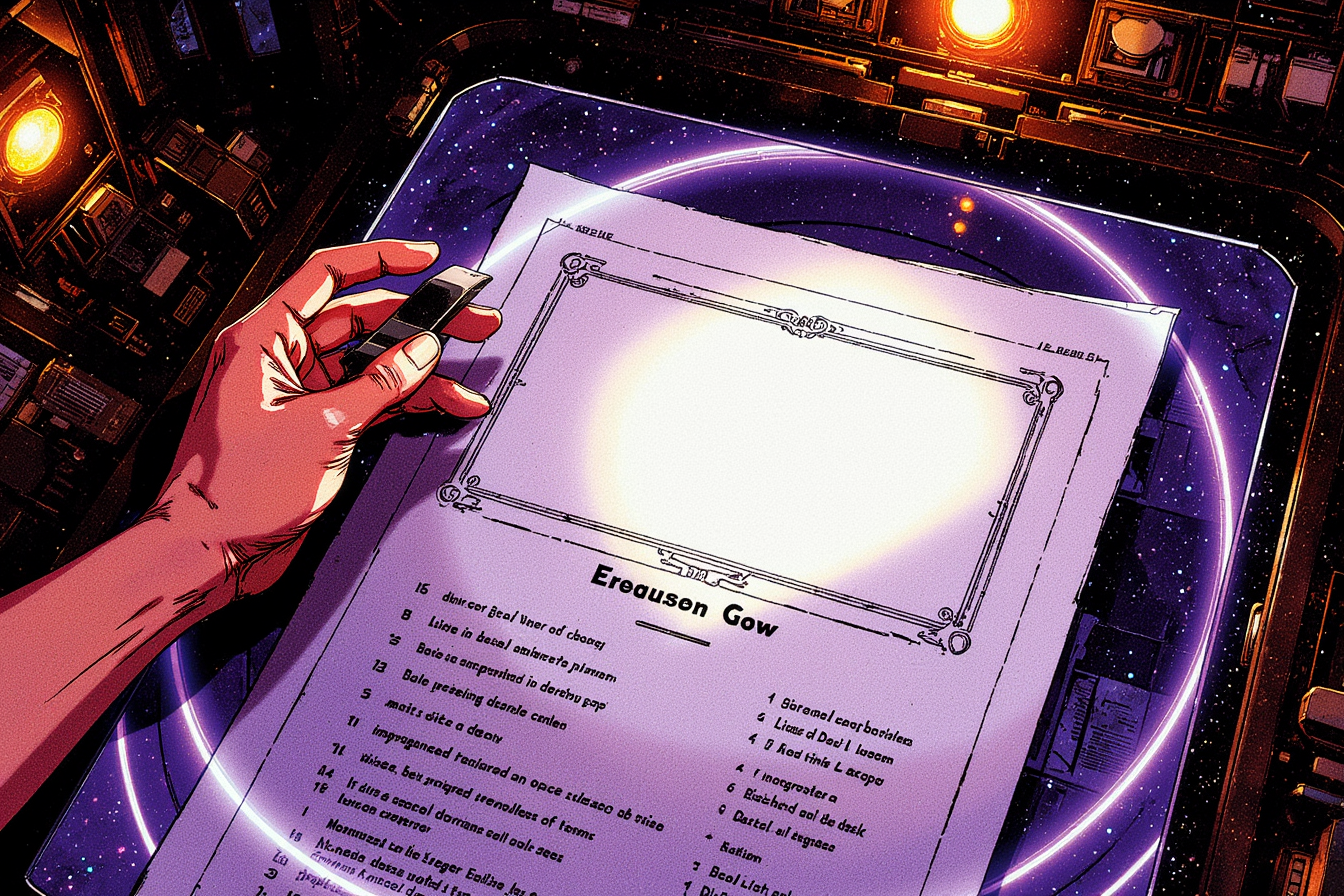
Then the reply box. The offer had arrived with a signature block, a blank rectangle bordered in the Registry's own hairline, the space where Piper Chen and six names were supposed to go. Pixel reproduced it on the front page and left it empty, and the emptiness took more nerve than any paragraph she had ever filed, because a blank box on a front page is an answer with nothing in it to argue with.
Under it she set the price list, in columns, because the Conglomerate had taught her its own format and she had never been too proud to use it:
Ternhaven colony, Receiving Ledger line, 2,700,000 souls. Terms offered: sealed, no admission required. Ostrell, 406,000 rows, registry book returned under Clause One. Terms offered: one signature, crane goes out last. Names recovered from the Tenth Depot, 3,000, with birthdays attached. Terms offered: collected, no inquiry. Fes, of the Woken. Renna Sol, engineer, freighter Bittern, killed in the harvest boarding. Terms offered: mutual. Fairweather, one month, struck from every calendar. Terms offered: not in scope, may petition individually. Survey ship Petrel, one crew, unreturned. Terms offered: unlisted.
"Leave the reply box empty," Luminara said.
It was the first sentence she had spoken since the mess. She had the small body in her hands already, and she came around the end of the copier and framed the sheet from above with her palm laid flat beside it, the way she frames a document she expects to be denied.
"Empty in the corner," she said. "If the box is cropped out, this is just a threat."
"It's a threat either way, kid," Clive said, and for one second his staple-arm went chunk into the deck plate out of pure old habit, and that was the laugh, and nobody chased it.
"Say the word," Zephyr said, with both hands on the board and the four carrier lines still warm.
"All of them," Pixel said. "Deepwood spine first, then relay to relay, then the civil bands, then the toll-lanes they bill us for. Every port office, every coalition hull, every channel we can reach before the window runs." She put the first sheet on the feeder. "Unedited, no preamble. They want their terms back, they can come and take delivery."
He did not need telling twice and he did not take them once. The copier began its long patient work, sheet after sheet, and the stack grew at the end of the deck with the smell of hot toner and ozone that Pixel had loved since the first night they printed three thousand names in a converted cargo bay. Meatball, who had come down for the noise, lay across the top of the comms panel and went to sleep where the luck lives, and Zephyr routed around him the way he always did.
The Deepwood net took it first, the mycelial channel the Conglomerate has never been able to tap, and from Verdantia it jumped relay to relay like a rumor with good manners. Then the civil bands. Then the toll-lanes, which are metered and billed and had never once carried anything the Registry wanted delivered. Copies went out to the Woken's yard tugs and Maren's crews off the Sorrowful Moon and Hob Measham's silent clocks at Cogsworth, and to every hull still flying under our own dark transponder, and to every freighter that had ever asked who we were and been told nobody.
The Bittern answered first, Osei Kade, eleven seconds after the burst, a single line: Acknowledged. Printed. Going on the bulkhead next to them. The Woken answered in a block of eleven transponders at once, which made the board flicker like a struck match. An independent freighter out of the Vannic Reach asked for fifty copies for her next port call, and Zephyr sent sixty, and Pixel did not ask him why.
Then she put the headset on and filed it, because the dispatch is the part of the job that is hers.
Dispatch, 0512, from the bridge of The Ephergent, over a reply window we are not going to spend:
Tonight's cargo is an offer. Undersecretary Reeve, Office of Quiet Resolution, four clauses and sixty hours: surrender the ship, keep your names, blockade lifts, quiet years resume, all actions by any party concluded with the records sealed. Also aboard, under Clause One, the registry book we carried out of a harvest barge, which means Ostrell's lights go off again at the turn. Also under Clause Four: everything anyone has proved about Ternhaven goes into a room with the key on the outside. Also for everybody not standing in this hull: petition individually, one at a time, which is how the Office prefers to speak to anybody it intends to keep.
They asked us for a signature. The box is printed on our front page exactly as they sent it, and it is empty, because that is the honest size of our reply. Our reply is on the page beside it: we decline. Here is what you offered. Here is the price list. The price list has names on it. It has two from last week with staples in a bulkhead, and 2.7 million filed as a rounding, and one month nobody is allowed to remember, and a survey ship that never came back to a desk.
If you run a port office, the file you were told did not exist is on your desk now, and we have sixty more where it came from. We are not asking you to do anything with it. We are only pointing out that it has been read.
Forward the page before they ask for it back.
, Pixel Paradox, signing off
She took the headset off and the bridge was full of the sound of a copier that had been running since 0400 and had not slowed down.
The first courtesy notice reached them at 0529, on the same gray channel the offer had used, and it was courteous in exactly the way the notices over Ostrell had been courteous, which by now Pixel could recognize in her sleep. The Office of Quiet Resolution regretted to advise that the instrument transmitted at 1904 had not been cleared for wider distribution. Recipients were asked to return or delete the file. The Office thanked them for their continued participation in standardised correspondence.
"They want it back," Zephyr said, and he laughed into his hand because he could not help it, the way you laugh at a fire alarm in a burning building. "They're sending a recall to every desk we just mailed it to. Pixel, they're doing returns."
She thought of the Registry tender easing up to Ostrell's port to accept the returns while the quayside lamps went out lane by lane, and she let the echo do its work. "They can have the copies back when they've collected the book," she said.
Then the internal traffic, which is where Zephyr earns his board. The Conglomerate's own administrative channels had been chatty all morning and went flat at 0531, and then came back thin, one packet at a time, signed with keys that had never spoken to each other before. He caught three and read them as they landed.
From an office that did not put its name in the header: The refusal was anticipated. The instrument's circulation was not.
From a Registry port authority, logging receipt for the record: Recipient list for instrument 1904 exceeds authorization by four orders of magnitude.
From Quiet Resolution itself, to somebody senior: Advise whether the reply window is still operative. Advise whether any reply is now operative.
"They're not jamming us," Zephyr said. He had both hands flat on the board, listening to a machine the size of a trade combine begin to audit itself. "They're auditing themselves. Somebody over there is asking who authorized the release, and somebody else is asking who was on the distribution list, and nobody is asking how to answer us, because we already answered." He let out a breath. "They could have survived us saying no. They did not think anybody would print the yes."
That was it, Pixel thought. That was the whole of the stagger, and she watched it move through their channels all morning. The refusal was budgeted for, staffed for, and answered in advance with a second offer. The publishing was the thing nobody had drafted a form for: who had read the page, who had forwarded it, which port office had already asked for more copies, and whose name was going onto a memorandum about how a private instrument reached six hundred desks before breakfast. An offer is a private thing between an office and a party it intends to keep. Set in type with an empty box under it and a price list under that, it becomes a public document that says the quiet years were for sale, and states the price, and names who pays it, and every port office in the Rim now has the paperwork to prove it. The Conglomerate could survive being refused. Being quoted was a different instrument.
At 0641 the reply window still had forty-nine hours on it and Pixel let it run, because a window they do not spend is a window the other side has to keep watching.
And at 0644 Zephyr went still in the particular way of a comms officer who has read a header he does not believe, and he pulled the packet onto the main screen where everybody could see it.
It was a fleetwide courtesy notice, Registry issue, signed with a key that resolved at once and without hesitation to the flagship. All hulls were to render standard courtesies to Grand Auditor Otho Varren, whose office had accepted settlement authority in the matter of instrument 1904. The instrument would be settled personally. The wording was dry and administrative and it meant one man was coming.
"They're sending him," Zephyr said.
A1's voice came from the console and the machine both. "They are not sending a fleet, and they are not sending a clerk. They are sending the one man in the Registry who still believes this offer was generous, and who has never deleted a population he could not first persuade." The espresso machine clicked over behind him, and he poured, and from the sound of it Pixel knew he had reached for the small cup. "That is worse, Captain."
Nobody said anything for a moment. On the deck the copier hit the end of a sheet and took the next one without pausing, and Meatball slept on the comms panel with his chin on a carrier light, and the price list went out to another port office.
"Print another copy," Pixel said. "He's coming personally, and he'll want one for the table."
The stack by the feeder had already gone to sixty-three, and Zephyr kept the bands open, and the reply window counted down unspent over a ship that had answered on every channel it could reach, with an empty box and a name the Registry fleet had just signed back to them.