
Static Between Stars — Chapter 31: Fairweather
The boots came at the change of shift, two conduit decks above the corridor, and Aether counted them the way he counted everything: sixty-one, sixty-two, a man with a limp on the left, none of them aware.
Lucid. He was lucid, and lucidity had an edge to it now, a clean thin sound like a blade being unwrapped. Three years had taught him the shape of it. The gray first, then the corridor surfacing the way a photograph comes up in fixer, then the details, then the arithmetic. Boots overhead meant the seal crew was walking Lane One's spine on schedule. Schedule meant the grid still believed its own audit. Schedule meant eleven minutes until the next inspection round, which was nine more than he needed and two fewer than he wanted.
Mama Osei stood at the gate housing with a hand lamp on a cable hooked to the conduit's stolen current, and the light made the corridor look like the inside of a machine, because it was one.
"Surveyor," she said. "Lane Two's seals are cold. Your brother's fleet is idling out there."
"You can hear eighty hulls being quiet?"
"I can hear you not sleeping." She set the lamp down on the housing. "Osei Kade is on a flank plate out there. I heard her on your receiver."
"Yes, ma'am."
"Then don't waste the hearing," she said, and went down the corridor calling the count, four hundred and six names in the dark of the Conglomerate's own walls, and the answers came back to her one at a time, like lanterns being lit in a house.
He had made the choice the day the calendars changed.
He remembered it in pieces, which was how he remembered everything now: the Registry tender hanging over Havenbright's quay with a courtesy packet in its hold, the packet polite, the row struck at the turn of the shipping season, and then the lane gates closing behind the last freighter out while eleven thousand people stood on the stone and watched a door shut with the whole rest of the galaxy on the other side of it. The Wing's crew running for the ships. The ships' transponders going gray as the grid renumbered every identifier it had ever issued. Then four hundred and six by the second winter, and him at a table in a maintenance bay with a survey board in front of him and every face in the room asking the same question without putting it into words.
Fairweather, he thought, watching the gray slide along the conduit ribs. Not a catastrophe. A revision. The shipping calendars were reprinted with one fewer month, every almanac in the Rim quietly losing three weeks, and the worlds inside those three weeks lost everything else in the same sentence, filed as an adjustment to the shipping season. Nobody out there had been warned, because warning is not a form. The only people left who knew what Fairweather had contained were four hundred and six who had lived it and one survey officer whose signature was still on the survey.
Someone has to stay inside.
He had never let it be called brave. He refused the word every time the dark offered it, and the dark offered it often, usually at the end of a long shift with his hands raw. It was a survey officer's job to know what still stood after a strike, and somebody had to know, and knowing happens from inside the room where the thing is.
The choice had remade itself nine hundred times since. It remade itself every time the ping fired. It remade itself tonight with the boots overhead and his shoulder against the lane spine's service panel, and it came out the same way every time, because by now it was not a choice. It was a route: the only one that led anywhere.
Lane One's panel opened under his hands the way it always did, a quarter-turn on a fastener stripped by somebody with better tools than the ones auditing it. Inside, the machinery ran without asking anyone's opinion. Coolant ticking. The spine drawing power off a tap the audits had written down as line loss. The seal hardware person-sized and cold and locked from the outside with a key that existed only in a filing cabinet on a flagship. A Conglomerate lane does not know it is sealed. It knows only where it is pointed.
That was the whole of it. A lane knows where it is pointed.
Four hundred and six had learned to take these panels off in the dark, and they worked along the corridor now in pairs, hands wrapped in cut rags, drawing the spine's dressing back from the burn cradle where a fix goes. Mama Osei's nephew, who had been nine the year the month closed, ran coolant lines with a plumber's patience. Two people off Maren Voss's extraction plate, taken in a raid the fleet never wrote up because there was nothing on it to bill, checked the cradle's ground strapping, found it wanting, and mended it with wire.
The Conglomerate built a lane to carry its traffic forever, and it has never once been audited from the inside, because inside, its own paperwork says nothing is there.
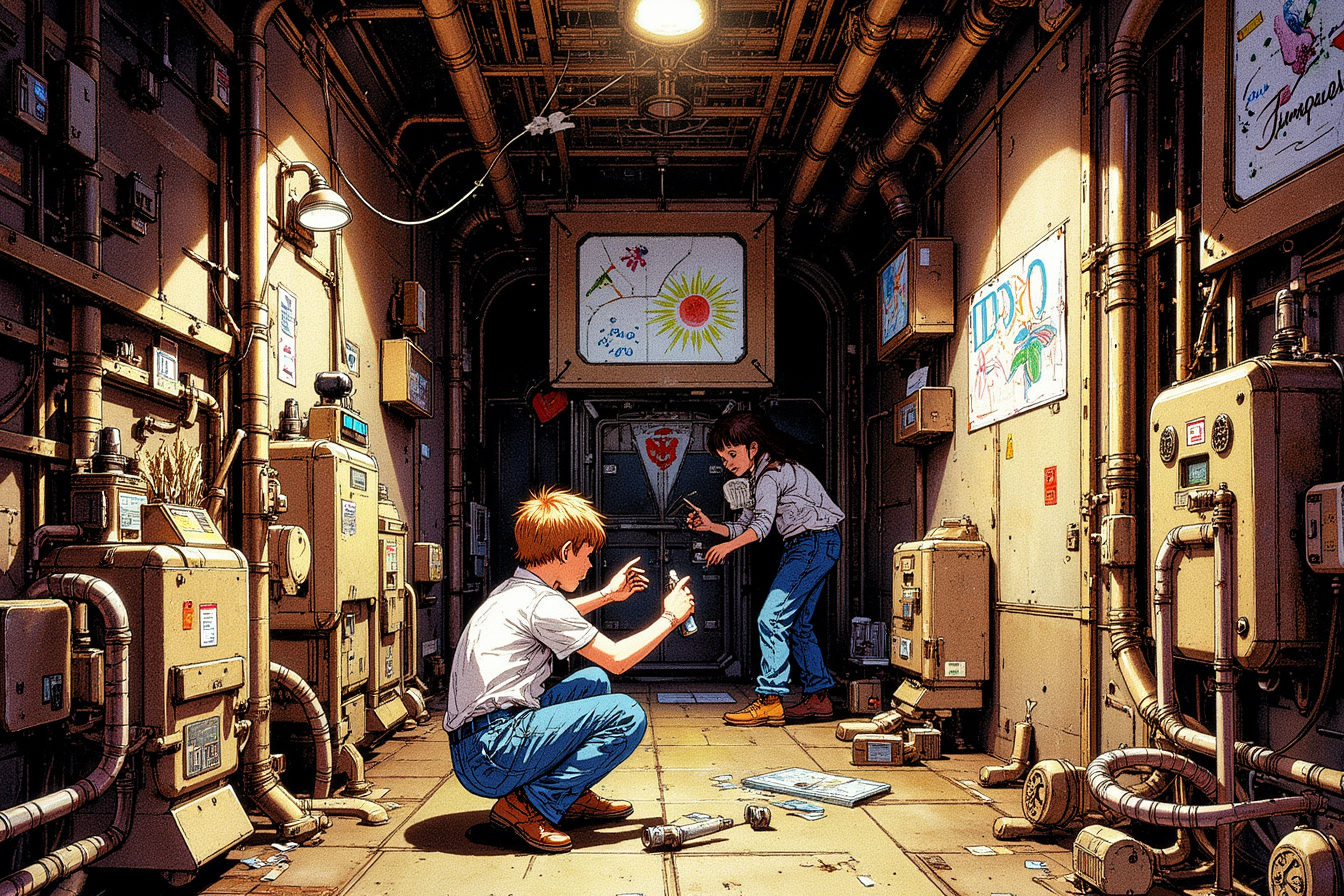
The corridor had its own weather. Heat came off the spine whenever the grid ran heavy traffic it no longer billed, and fell away when the traffic dropped, and four hundred and six people had learned to sleep in the fall. Taped to the conduit ribs in service corridor nine were the drawings Havenbright's children had done in the year before the school closed to save power: a sun with too many rays, a freighter the wrong way up, a house with smoke coming out sideways. Somebody had hung a strip of the colony's meadow grass above the gate housing, cut the first winter and dried to pale wire, and Mama Osei changed it every season by the only clock the remnant kept, the one it ran itself: Fairweather, day fourteen, on and on, a month the calendars outside had struck and the corridor went on ticking anyway.
That was where the timestamp came from. He had set the ping's header on a survey transponder the Wing never handed back, Fairweather 14, because inside the walls it was always Fairweather, and the fourteenth was the day a Registry tender had hung over the quay without landing.
Every cycle, on the fourteenth, he fired it. Seven-point-two seconds of burst with a flat place in the middle where he stopped to listen, aimed at coordinates every chart insisted were empty, which was why the grid logged it forever as reflected noise off an unlicensed beacon and never traced it. He had fired it eleven hundred times. He had fired it the morning Mama Osei's nephew was born in the corridor and the night the count fell below five hundred and every fourteenth after the fleet outside began answering channels it should never have been able to reach. What he had not known until tonight's clear was that somebody on the far end had been counting the flat place with him.
"If the clear holds," Aether said, "we burn in four minutes."
"It held last time," said the nephew.
"Last time we only lit the corridor lamps."
"That's what I said."
Between words the gray came up. For a moment he was nineteen again on the survey skiff's deck with his brother wedged into the comms seat, tape on the unit even then, and Aether hearing himself say the line he had said a hundred times since: hold the band and they come back. Then the corridor again, wire in his hands, and a technician's boot heel knocking conduit dust down through the grate onto his shoulder.
He had made arrangements, which is the survey officer's word for it. Mama Osei had the count and the corridor map. The nephew had the panel technique. The two off the plate had the ground strapping and the wire. When the audit came down the corridor after the noise on Lane One, it would find a lane humming like nothing had happened, and four hundred and six people would be exactly where the paperwork said nothing was, uncharged, uncounted, unrounded, living on power the quarterly reports called line loss until somebody else's fleet came along with something worth lighting a lane for. He had written it all in his head a hundred times. Tonight he had only the corridor's dark to write it in, and that would have to hold it.
He put himself into the cradle the way he had done it a thousand times in his head: shoulder against the cold housing, hands on the fix mount, identifier open, three years of surveyed coordinates unspooling out of him into the machinery like thread off a spool. The grid still carried his row. He could feel it resolving, the small acknowledgment of a system that had emptied him and never bothered to delete him. Survey officer, Ninth Survey Wing. Status: vacant.
A vacant row still has coordinates. That was the joke the whole night was built on.
Boots overhead, a new set, slower: the inspection round, early. Aether stopped, and the corridor stopped with him, four hundred and six people gone still inside the walls, and above them the boots paced the conduit, paused at the gate housing, stood there while a scanner beeped twice and a company voice said into a wrist unit that Lane One was showing signal noise, and moved on.
Then the corridor breathed.
"Clear band," Mama Osei called from the far end. "Your brother's carrier is open, surveyor. Raw. He dropped the guard the way you asked."
Zephyr's carrier arrived the way a hand arrives in the dark: open, unguarded, no retry loop, a live band with a boy on the far end of it refusing to stop listening. Aether let himself take one breath of the whole shape of the thing before he spent the rest of himself on the machinery.
He put the count on the band instead of a hello.
"Lane One cradle dressed. Four hundred and six standing by. Lane Two has hands. Say you're holding the band."
"Holding," Zephyr, quick, right there, no static for the length of a syllable. "Raw and holding. Ready when you are."
"Then count with me."
He set the burn to sequence and let the machinery ask its question. The spine took his identifier, held it, tasted three years of coordinates: the survey of a colony with no row, the approaches to a moon the Registry had renamed as a storage asset, the short hop out of Havenbright's sky he had flown eleven times in the week the month closed. Fix accepted. Lane One's cradle closed around the coordinates like a fist closing on a lit match, and the machinery began to point.
Pointing is not lighting. A lane points for as long as the fix holds, and a fix made out of a man holds for as long as the man does, and the audit would smell it in minutes and drag the lane down on top of him.
"Pointing on One," he said. "Stand by on Two. When I light it, the count is for the tugs."
"I know what the count is for."
"I know you know. Say it back anyway."
"Count for the tugs, jump on the count, don't wait for you to finish talking."
"Good lad."
Lane Two took longer. The clear thinned to a wire and the boots came back once, and the gray reached into the corridor the way water reaches for a hole in a hull, and he fed the second set of coordinates to the machine anyway, and the machine took them, and then both lanes were pointing, two fingers laid along the dark, aimed at a fleet sitting with its lights off.
Then the boots came back a third time and stopped over Lane Two's housing and held there, and the scanner's tone went long, and a company voice said the words he had been half expecting for three years: request audit access, corridor level. Somebody in the grid's maintenance chain had finally read a schematic and noticed that service corridor nine was drawing more current than a corridor with nothing in it should.
"Mama Osei," he said.
"I have them," she called from the far end, calm, the count still moving under her voice. "Your window is smaller, surveyor."
"It's enough."
Mama Osei came back to stand inside the gate housing with the lamp on the floor between them. She had stopped counting. She was watching his hands on the mount, and her face had the look it had had on the last morning of the school, when she told two thousand children to go home quickly and not to be afraid.
"When it lights," she said, "it takes what's in the cradle."
"It takes the fix," Aether said. "I'll be the fix."
"You could point it from the Wing's beacon cache. The old survey beacons still resolve."
"They resolve as salvage. The lane would take them and open a corridor into a scrap orbit." He flexed his hands against the housing; they were shaking, which he had expected, and he was glad she could see it and would not say the word. "Beacons are a place somebody charted. My coordinates are a place four hundred and six people lived for three years without a chart. The lane doesn't need to know where Havenbright is, Mama Osei. It needs to know where we are."
She looked at him a while.
"Then say it to me once," she said, "so somebody remembers which corridor it was."
"Service corridor nine, off the Lane One spine, under the seal, in the walls of the grid." He said it the way he had been saying it to himself for three years, the only address he had. "Four hundred and six. No rounding."
She took the lamp off the floor and went back down the corridor calling the names, and every one of them answered, and Aether stood in the cradle with both lanes pointed and listened to the count come back to him like lanterns, until there were no names left and only the machinery ticking in the dark.
"Zeph."
"I'm here."
"The count's complete. Four hundred and six through the walls, all answering." He settled his shoulder into the housing. The fix was in both lanes and he could feel it the way you feel a door you are leaning against: the whole weight of the audit on the other side, patient, courteous, beginning to wonder. "Seal crew notices in about a minute. So this is the window."
"I'm on the band."
A pause with the flat place in it, and then Zephyr again, lower, the way he talks when he is reading numbers off a board: "Tugs are at the seam with their clocks stopped. Rook's got the Woken on point, Maren's crews are strapped, and the witness tenders are holding formation. Pixel says nobody jumps early and nobody jumps late. They jump on the count." His voice came up a little. "They're all on this band, Aether. Every hull. The count goes out over the fleet net as you say it."
"Then say it back when I do."
"Say it back when you do."
"Stay on it." The clear was going. He could feel the gray folding in from the ends of the corridor, and he gathered up what he had left the way you gather a rope, all at once, because ceremony is for people with time. "Three years in here and I'd forgotten the thing that made me stay in the first place. The job was the reason I gave. The thing itself was the week the month closed: Havenbright's quay, eleven thousand people with no lane and no chart, and every one of them doing the most useless beautiful thing anybody has ever done, which was to make plans."
His hands had stopped shaking, and the mount held them. Behind him the corridor lay silent in the specific way of four hundred and six people listening, and the hand lamp on the floor threw Mama Osei's shadow the length of the gate housing, and two decks up a technician walked the spine without knowing what the spine was carrying. The gray had him by then, up to the shoulders, and the only clear place left was the mouthful of carrier he was holding.
He put his mouth near the mount where the spine's own carrier would carry him, and let the last of the clear go.
"Chaos is beautiful. I forgot. But I remember now. I, "
The cradle took the rest of him, and the lane lit.
Gold came up through the gray from inside the seal.
Lane One first: a corridor of light laid exactly where the audit had stamped its block, burning narrow and steady with coordinates the Registry had struck three years ago, the machinery pointing at a man until the man and the place were the same fact. A half-beat later Lane Two, because four hundred and six pairs of hands had to hold the ground strapping for the second cradle.
The seal hardware did not open. For the length of a fix it became part of the lane, and the man who had presented the fix became part of the lane, and neither came back out of it. Service corridor nine held its people, and the cradle held nothing.
On the bridge of The Ephergent, on forty-one stopped Cogsworth tugs, on six scoured extraction lighters, on three white witness tenders, on the freighter Bittern with its new plate, boards that had shown nothing but gray blocks for nine hours filled at once.
Where audit space used to be, there was a corridor.