
Static Between Stars — Chapter 33: The Refusal Season
The coalition came out of the jump and spread into a line above Prime Material, and then for eleven hours it did not attack, which was the one maneuver Grand Auditor Otho Varren had not prepared for.
He had war plans for a war. He had contingencies for a fleet of salvaged haulers and freed laborers flying dark. He had even filed, six weeks ago, the contingency for an assault on the capital, because an assault is a form and forms are what the Registry does. What he did not have was a hundred and one hulls hanging at sixty thousand kilometers with their guns cold and their channels open, waiting.
"The point-defense grid is slaved to the city net," Deputy Auditor Halle reported from the second station. "Their approach sits half our screen inside the crossfire of our own capital. If they fire first and we answer, we return fire into the Ferrite Terraces."
"Then nobody fires first," Varren said.
"The Office of Quiet Resolution is drafting a final reconciliation offer. Undersecretary Reeve is down on the planet with it. They ask the fleet to hold while it is drafted."
"Hold, then," Varren said. He had the day's returns open on his screen, reading them the way he reads everything, chin down, hands folded. "A court that hides is a court that doubts, and a fleet that guns its own capital is neither. Hold."
At 0650 the Rim reports came up on the priority circuit, and Halle read them standing, which he did only for losses. The cordon was gone: sixty-one hulls spread across a front that had become nineteen mouths, three pickets dead, a station's forward plate torn open, the line running for the inner defense with its guns hot. Varren listened to all of it without interrupting, and when it was done he said, "Reform them into the tiers. Every hull that made it back. Put the wounded pickets inside the city net where they can be covered."
"Sir, that cordon was built to hold the Rim."
"It was built to hold a funnel," Varren said. "They came at it with a front, which is what a front is for. I have spent a year being told these people cannot fight. File the correction, and add that we are to learn from it rather than avenge it."
The first return came in at 0740, from the colony of Tarrow Nine. His notice. His sigil. Out on the third of the month with a delisting under Standard Metric 11, and back it came on the fifth: RECEIVED AND DECLINED, stamped by the Tarrow Nine registry office, with an objection attached. Forty-two pages of objection, signatures on paper, because the channels had been full for a week.
Varren read it twice. It cited the Rule of Receipt, which he had written himself: no delisting is final until the receiving world acknowledges the notice. He had written that rule as courtesy, the one seam in the process where a world got to answer before its row was struck, and he had defended it before the court when the Office of Quiet Resolution called it an inefficiency. The colony had quoted the rule back to him, article by article, in the register of people who had read their own sentence and then read the small print under it.
He dictated an explanatory addendum that afternoon, in his best register, stating that an objection suspends a delisting and does not end one, that review proceeds regardless, that the schedule of the shipping season is a shared instrument, and that the Conglomerate remained, as ever, grateful for six generations of service. He signed it himself and sent it to Tarrow Nine and to every world that had followed.
Within the week he had sent it to nine hundred worlds. The returns came back doubled.
Gate Annex Two of the Prime Material ring was nine days deep in ships, and Varren went out to it in person, because you do not read a queue from a screen. He had held that position for thirty years and he was right about it still, though the ride out gave him time to suspect what being right about queues was going to cost him.
The annex concourse had been built for three hundred arrivals a day. Freighters were stacked from the inner gantry out past the ring moon, holds full of grain and plate and medical stock bound for coordinates that no longer resolved on any chart, because the Registry's own request queue had become the bottleneck in the galaxy's only ledger. On the wall above the counter banks a board glowed in the Conglomerate's billing font:
RESTORATION REQUESTS PENDING: 1,904,772.
The number was rising while he watched it.
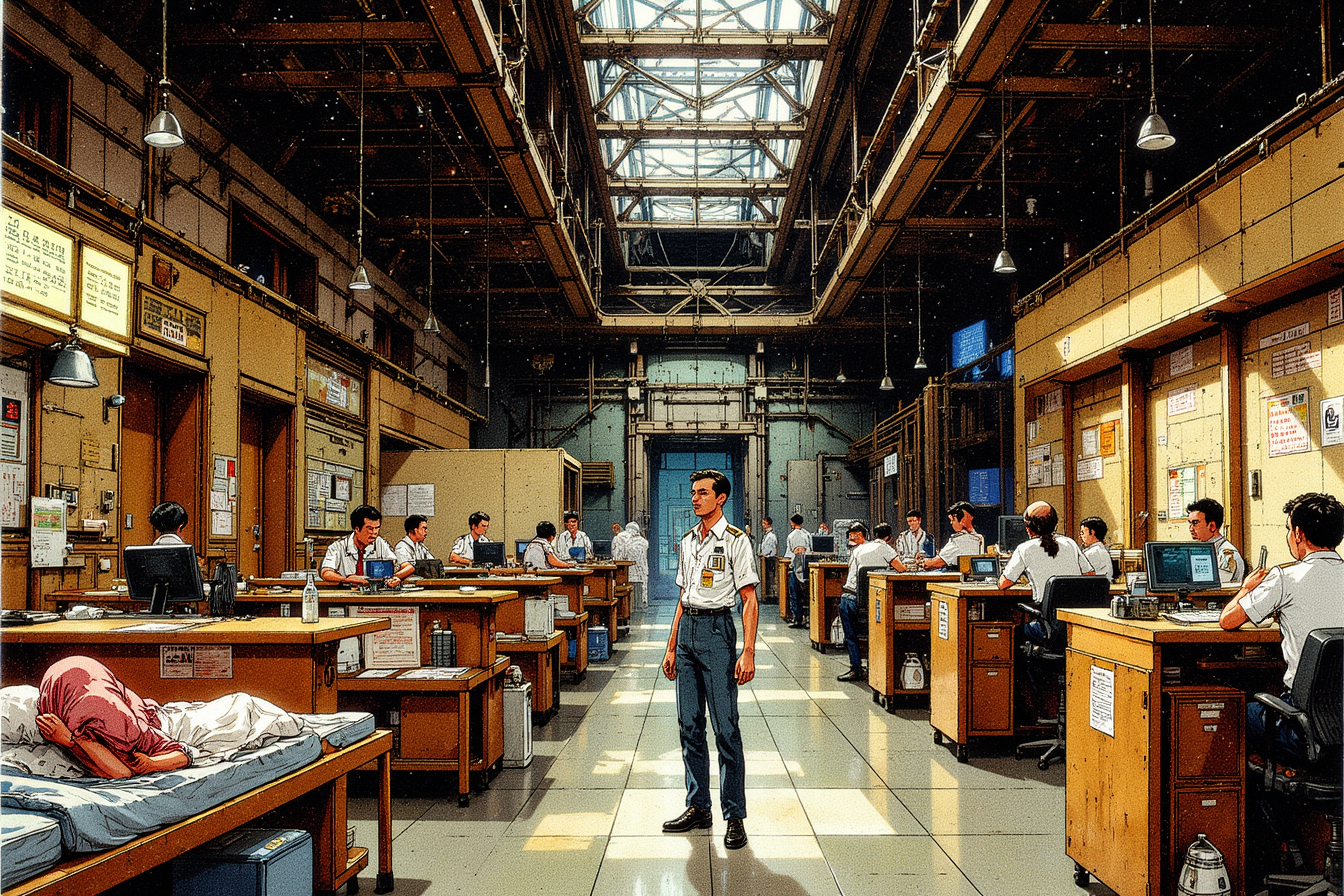
Delistings and restorations shared a single queue by design, because both required the seal of the Office of Record, and the Office of Record was one clerk deep at every counter. Clerks had dragged cots behind the desks. A man in the gray of a senior auditor was asleep with his badge over his face. Freight captains stood in a line that had stopped resembling a line forty-eight hours ago and now resembled weather.
Varren took his place in it.
"Number, please," said the clerk at the head of the rope. Her name tag read Issa Mordan, Third Rank, and she did not look up, which he found he respected. He took the docket she offered: G-4471.
"Wait time?" he asked.
"Nine days, sir, and the board says the tenth will be worse." Then she did look up, and she looked at his badge, and the color went out of her face. "Auditor. I did not. Your number is already issued, sir, I can't recall a docket."
"Then I will keep it," Varren said. "You are doing the work of three, Clerk Mordan, and I would rather stand in your line than sit in my chair. What happens to a world while its request sits in this queue?"
"Pending is still struck, sir," she said. "A request does not restore a row. The row stays on the chart as unprofitable until the seal comes down, and the barges that load unprofitable worlds keep loading them, because a world with a pending restoration is a world with nobody left to argue about it."
Four places ahead of him a freighter master got his seal. It took the clerk eleven seconds, and the man put both hands flat on the counter and said, "My mother's row. My mother's row," the way a man locates a wound he has been carrying, and the line, weather though it had become, gave him two places without anybody speaking a word.
That was the part Varren could not get past, standing there with his docket. The machinery still worked. One clerk, one stamp, and in eleven seconds a world came back onto the chart with its histories and its schools and its fishing licenses attached. He had spent thirty years building a system that could restore a planet in eleven seconds and could not afford to do it for nine days.
Out at the annex's outer marker a harvest barge rode with its cutters dark, holding over a world whose objection had suspended its work. Six of them idle across the ring, crews fed and waiting, each one a negative line in a quarter that could not close.
Varren thanked Clerk Mordan again, courteously, and stood in his place with docket G-4471 in his hand for another hour before he went back up to his ship.
On the nineteenth day the heartworld began striking its own rows.
The feed came from the Gantry of Returns, where the Registry's public chart stands twenty meters high in the plaza, a tile for every district row in the capital's own ledger. Residents of the Ferrite Terraces had come up out of the labor-combats with a pry bar and their district's tiles in a canvas bag, and they handed them, one at a time, across the counter at the Office of Record, as a formal refusal of their own yield assessment. There was a form for it. There was a form for everything; that was the architecture of the thing he had served. The clerk accepted the tiles, because the form was in order.
Undercity Six filed the same refusal in bulk that morning, in the language of the Registry itself: if the row is a liability, strike it; we decline to be measured. By the weekend it was four districts, then eleven. The chart on the Gantry developed gaps the way a mouth develops gaps, and the feeds carried it to every deck in the system, including the hundred and one hulls hanging above the city, whose crews watched the empire unwrite itself and, so far, fired nothing.
Varren did what he had always done with a population he could still reach: he tried to persuade them. He recorded an address from the Reckoning's own bridge, six minutes, in his best register, and he sent it over every channel the fleet owned. He explained the objection process. He explained the rule of receipt that he had written to protect them, and the review that proceeded regardless, and the standard under which a row is struck. He promised, on his own authority, that no world would be delisted while a case stood open against its name.
They received it. They restated it. The Ferrite Terraces restated it back to him in his own sentences, on the plaza, over the sound of a pry bar, and then handed up two more tiles.
At 1400 the quarterly close stopped resolving.
Undersecretary Reeve brought the packet aboard the Reckoning in person, which meant it was worse than a message. He laid it on Varren's desk with both hands, the way you lay down something that might go off.
"The engine has run the quarter eleven times," Reeve said. "Toll-lane revenue is zero, because the gates are jammed with requests to undo the work the toll lanes were built to do. Harvest yield is negative, because the barges are sitting at worlds that have filed objections and cannot be worked while the objection stands. The cost of administering delistings now exceeds the yield of delistings by a factor of four. Standard Metric 11 says: strike what does not balance."
"And so it is striking," Varren said.
"So it is striking, sir. In the last six hours it has delisted the Gate Office of the Prime Ring, because that office is a cost with no return. Toll Tender Squadron Four. Berth Control at the Ostrell approach. The Bastion archive vaults, which it sealed automatically at 1110 as negative yield." Reeve paused. "It is striking its own organs to close its own quarter. To keep up with its own bookkeeping it has begun deleting the Registry. The executive offices are not disputing the diagnosis, sir. They are disputing who signs it, and at present the engine signs itself."
Varren stood at the viewport with the packet open behind him and the city turning below, that unbroken plate of light, and he said his own sentence to himself in the voice he had used on Ternhaven, on Ostrell, in every hearing where he had still believed the arithmetic: An unprofitable world is a wound. We cauterize.
The book had called the capital unprofitable. It had called the archive a wound. It had called the gate office a hemorrhage and ironed it flat before the hour was out, and the hand holding the iron had stopped knowing where the skin was.
He thought of the captain of the ship outside his window, who had told him to his face under a flag of truce that official truth is inventory. He had answered her with doctrine, and he had been right about the doctrine and wrong about the inventory, which was worse, because a wrong doctrine can be corrected and a right doctrine about a broken measure only keeps loading.
"The measures are wrong," he said. "Not the mercy. The measures."
Reeve waited, because Undersecretaries are trained to wait.
"I am going down to file in person," Varren said. "Every channel we have is behind that queue, and the engine is striking the offices faster than any order can cross them. A man walking a form to a counter is the only channel left in this empire that still works."
"Sir, what will you file?"
"The two orders I have held back," he said. "Stand down every harvest fleet. Unseal every archive."
He took the shuttle down at 1520 and rode it through a city that had stopped agreeing with its own chart. From the air the Gantry of Returns looked like a board with teeth missing. On the plaza a woman from the Terraces was waiting at the counter with two tiles in her hand, and she said, to the clerk and to nobody, "That row paid for my daughter's schooling. If it can't feed her now, I'd like it back," and the clerk, courteously, took it.
He had argued with Halle about the descent the whole way down, in the manner of two courteous men taking turns to be right.
"Sir, the executive offices will read a Grand Auditor filing those two orders as a surrender."
"Then they will read a surrender into a stand-down order and a records order, and they will be wrong on both counts," Varren said. "The barges go home because loading suspended worlds is no longer lawful work under objection, and the archives open because an empire that has lost count of itself cannot afford to hide its own first drafts. If they wish to call that a surrender, Halle, they must first find a form that fits it, and I intend to file before they do."
The Office of Record occupied the Registry Bastion's ground floor, and its counter four had a queue of forty and a docket machine that chitted at the pace of a dripping tap. Varren took a number. He stood. He watched a woman ahead of him argue for eleven minutes about a restoration date and lose, politely, to procedure.
A man beside him in the gray coat of a retired gate clerk noticed the badge and leaned over without straightening up. "You're the Auditor."
"I am."
"Are we still on the chart?"
Varren looked at him: a citizen of the city that had spent three days punching holes in its own ledger, asking the only question that mattered, and he gave him the true answer, because a false one would have been the last false thing he ever said in uniform. "You are on the chart, sir, until this is filed. And after this is filed, you will be on it in ink."
The man thanked him the way people thank you when they have been handed something they were afraid to ask for.
When his turn came he set both orders on the counter: STAND DOWN EVERY HARVEST FLEET, SEVEN BARGES ACTIVE AND FORTY-ONE IN SUPPORT; UNSEAL EVERY ARCHIVE, DELISTING VAULTS AND HISTORY SEALED BY YIELD REVIEW. He signed where the form indicated. The clerk read them, looked up at him, looked at the badge, and turned the first sheet back with one finger.
"Box four, sir. Countersignature."
He had signed box three. He apologized, courteously, signed box four, and she stamped them, and the chit came back to him with a number he would keep for the rest of his life: the file reference under which the harvest fleets went home and the histories came back out of the dark.
"Receipt, sir?"
"Yes," Varren said. "Everything in triplicate. That is the one part of our bookkeeping I still insist on."
The court convened aboard the Reckoning at 1900 under an auditor's warrant, which is a power the Registry's bylaws had carried since before the Conglomerate learned to spell yield. Three magistrates sat the bench in the after-compartment, and at the center of them was Ilva Sorn, who had presided over the trial this war had been built out of, and who had a transcript of everything in front of her before Varren finished walking to the floor.
He stood before them with his hands folded and his chin down, in the posture of a man reading returns.
"I have convened this court," he said, "because the fleet requires a lawful recipient and I am no longer a lawful one. I have commanded the Registry line for nineteen years. I have never deleted a population I could first persuade. I tried to persuade Ternhaven, and the line that described Ternhaven's dead was written by an engine, in a register I did not choose, and I have carried it since."
He placed the command seal of the Reckoning on the bench.
"The quarterly measure has stopped resolving. It is striking gates, archives, berth control and the fleet's own home ports in order to balance itself, and it will keep striking until the book closes on an empty room. An unprofitable world is a wound, and we cauterize; that remains my conviction. What I no longer hold is that the book can tell us where the wound is. The measure has become the wrongness. I will not sign another quarter of it."
Magistrate Sorn looked at the seal and did not touch it. "You are handing me a flagship, Grand Auditor."
"I am handing you a ship whose authority has become the instrument of a broken count. The fleet will hold where it stands under Registry order, which is the only authority it has ever obeyed, and that order is mine to give one last time."
She took the seal. The stand-down went out on Registry channels in the Registry's own courteous grammar, hull by hull: hold position, drives idle, guns cold, no first shot, no second. Tier one of the line answered, then tier two, then the interdiction ring around the city, and eighty-eight hulls went quiet above the capital in the space of four minutes, dead in the water under their own authority, the enemy's line watching across sixty thousand kilometers while the fleet that had drawn up to defend the throne world simply stopped.
Magistrate Sorn watched the acknowledgments stack up on the bench display, gray one after another, and said, "They are obeying you, Grand Auditor. You understand what will be said. That the Registry fleet was handed over by its own commander to a court he opened himself, on the day the book stopped balancing."
"It will be said accurately, which is the only quality I ask of it," Varren said. "The alternative was to obey the engine while it struck Gate Office, archive and berth control out of existence to make its column add, and then to obey it again tomorrow when it found some further organ that did not balance. I have spent my career cauterizing wounds. I will not hand the iron to a count that has stopped knowing where the body is."
"Recorder," Varren said, when it was done and the court had begun setting its findings down, "one request, if you would be so kind."
The recorder looked up, stylus ready.
"Please see that the transcript is accurate. That I filed both orders in person, at the Office of Record, counter four, this afternoon. That this court was convened by me, under my warrant, aboard my own ship. That no shot was fired over this capital, and that the fleet stopped on my order and not on theirs." He folded his hands. "Accuracy is the entire remaining purpose of my profession. Kindly do not round me."