

The Score — Chapter 2: The Waystation
The Score — a novel of the planet Ephergent. Chapter 2 of 12.
They walked north-northeast for most of the morning with nothing but the journal and the pack Clive had built out of the crate's own wood and leather scraps. Chewy had protested the pack — it was crude, boxy, more crate than bag — and Clive had said, "You'll want your hands for the grade," and that had been that.
The grade came up slow. Prima's back streets thinned to allotments, allotments to scrub, and scrub to the first real switchbacks of the coastal rise. Clive took them without breaking pace. Its legs moved in a rhythm that had nothing to do with breath, and by the third switchback Chewy's lungs were burning and the automaton was looking back at him with what might have been patience.
"Regulate," Clive said.
"I'm regulating."
"You're gasping."
"That's how I regulate."
Clive recalibrated the brim of its cap and did not comment further. Somewhere below them Prima went on being Prima: the grid, the docks, the faint soot line over the refinery quarter. Up here the air was already thinner and tasted of salt and stone.
They passed a trail marker — painted iron, half rusted, the arrow long gone — and Chewy pulled out the journal. The cover was the same worn leather it had been since he'd found it stitched into the crate lining two nights ago, hidden so well he'd needed a seam ripper to get at it. He'd read every page twice already. His uncle's handwriting, close and even, filling the margins more than the lines. Contours. Elevations. A sketch of a ridge he recognized from the old survey plates. And nothing that looked like a message, because there was nothing that looked like a message yet.
"Waystation's ahead," Clive said. "Forty minutes. Maybe less if you stop reading and start climbing."
"How do you know there's a waystation ahead?"
"The journal knows. I read the journal."
"You read it once."
"I read it the way a surveyor reads ground: once, correctly."
Chewy turned the pages as he walked, which Clive had warned him about twice and stopped warning him about on the third. The margins were dense. His uncle had drawn small symbols next to certain elevations — circles with dots, tick marks, a glyph that looked like a stylized spire. None of it resolved. The ink was ordinary, black-brown, decades old by the feel of it. Nothing in it moved.
He closed the journal and kept climbing.
The waystation was a low stone building set into the hillside like a root, its door facing north with the particular stubbornness of structures built to outlast weather. Roof slate. A chimney with a bird's nest in it. The kind of place the old trail-service had put every twenty kilometers along the Prima rise, back when the trail-service had money and the mountain had hikers.
The door was unlocked. That was the first thing that felt wrong.
The second thing was the silence inside. Not dead silence — the particular silence of a room that has been waiting. Chewy stood in the doorway a moment, letting his eyes adjust, and Clive stood behind him and did not go in, which was also wrong, because Clive had not hesitated at any door since the workshop.
"You're not coming in?"
"I'm keeping the perimeter."
"You don't have a perimeter."
"I do now. It's this doorway. I'm keeping it."
Chewy looked at the automaton for a moment, then stepped through.
Inside: a stone floor swept clean. A hearth with cold ash, raked flat. Two bunks built into the wall, their blankets folded with a military squareness that he recognized — his uncle folded blankets like that. A table. On the table, a crate.
Not the crate. A smaller one, wooden, lid ajar. Chewy crossed the floor and lifted the lid.
Rations. Vacuum-sealed packets with his uncle's handwriting on each one in marker: Day 1–3. Day 4–6. Day 7–10. The dates meant nothing yet, but the hand meant everything. He picked up a packet and turned it over. The seal was perfect. Nothing had gone stale.
Under the rations: a child's boot.
Small. Leather, scuffed at the toe, laces replaced with a strip of cloth. Chewy held it up and felt the floor shift under him, though the floor had not moved. He knew this boot. He had owned this boot. He had worn it on the Prima rise when he was six years old and his uncle had carried him up the last kilometer because he'd refused to admit his legs were done.
He set it down carefully, as if it were still on a foot.
Under the boot: a sketch.
Pencil, on the back of a survey form. A boy of about six sitting on a stone, eating something, looking up at whoever was drawing him with the particular squint of a child who has been told to sit still and has decided to negotiate. Chewy's own face, fifteen years younger and already stubborn. In the corner, in his uncle's small close hand: North Prima rise, km 18. He made it further than he said he would.
Chewy stood a long time with the sketch in his hands.
The room was very quiet. The bird's nest chimney ticked with some small animal moving in it. He became aware, gradually, of a sound he had been hearing for some time without hearing it — a low vibration through the stone floor, so deep it was almost not a sound, more the idea of one. He crouched and put his palm flat on the floor.
The vibration was coming from outside.
Clive was still in the doorway, its cap straight, its compass pointing north at nothing. Behind it, down the slope the way they'd come, the hillside had changed. Something was there that had not been there when they'd climbed up.
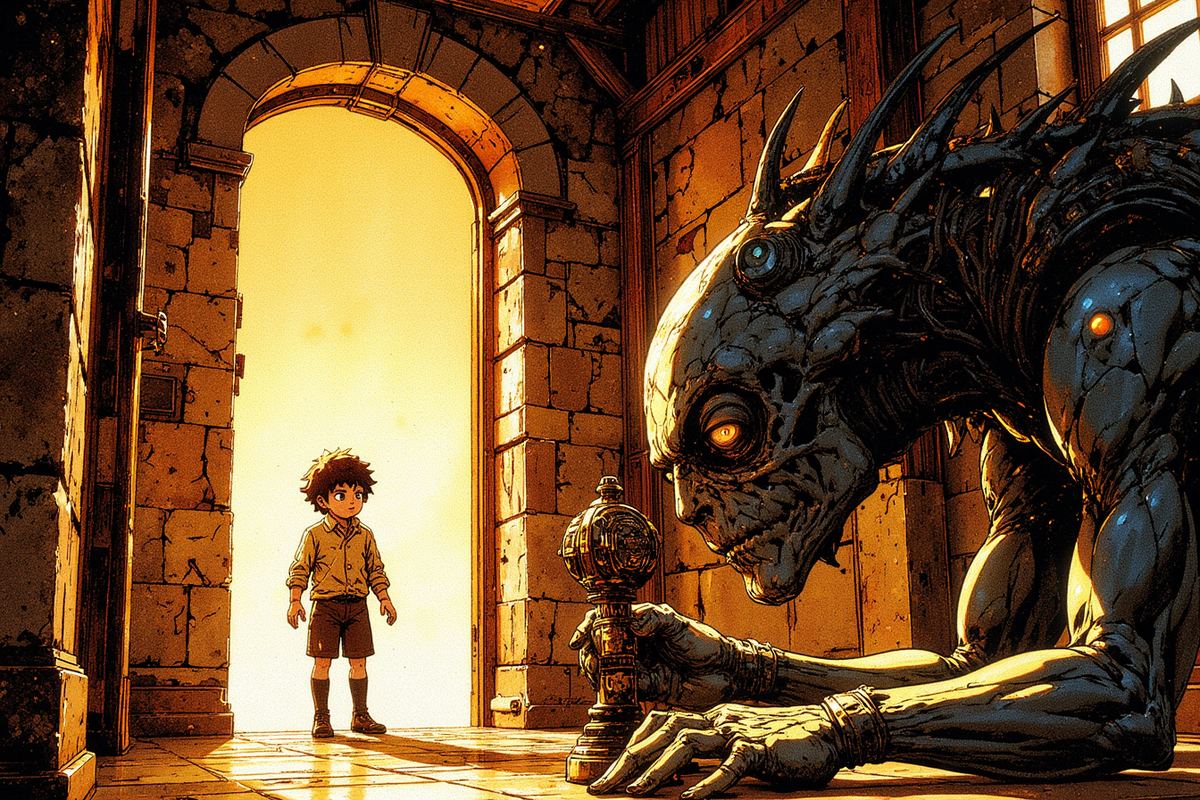
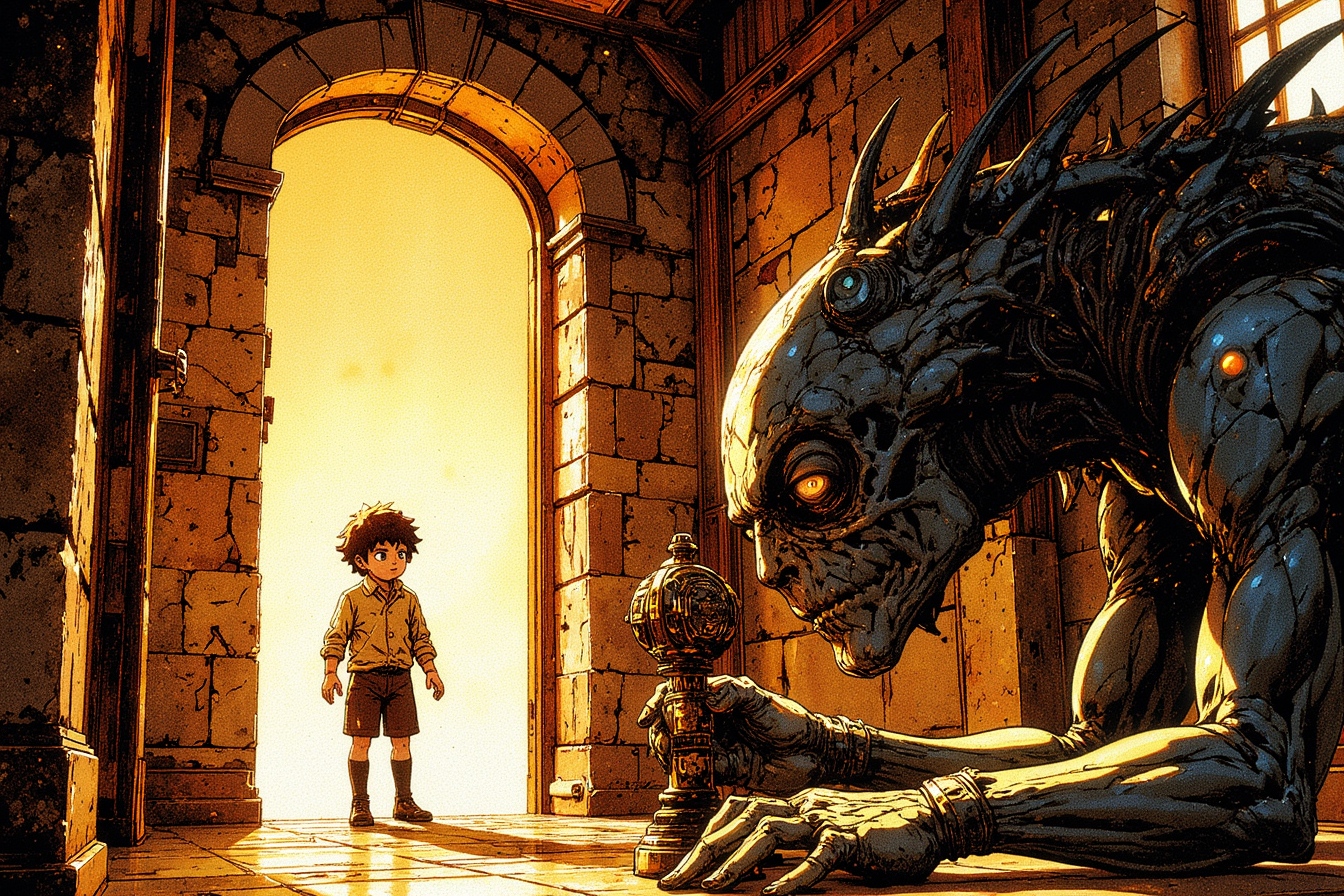
It was low to the ground, the size of a large dog, built the way a thing is built when it is carved rather than grown. Stone — the mountain's own stone, gray-veined, with a seam running the length of its spine where a spine would be. The seam glowed, faintly, a deep amber that pulsed in time with the vibration Chewy had felt through the floor. It had a broad brow, blunt muzzle, ears set high. It was pressing its brow flat against something embedded in the hillside.
The something was a spire-core relic — a fragment of one of the old spires, half-buried in the rock, its surface etched with the same glyph-work as the journal's margins. The creature's brow was against it and it was not moving. The glow along its spine brightened as Chewy watched, then dimmed, then brightened.
"That's an Ephergent," Clive said. It had not turned around. "They don't come this far north. Not usually."
"What's it doing?"
"Keeping something."
Chewy stepped out past the automaton. The Ephergent did not lift its brow. Up close the stone of it was warm, radiating a heat that had nothing to do with the sun, and the seam along its spine was not a painted line but a channel of light that moved when the creature breathed, if breathing was what it did. Chewy crouched a meter away.
"Hey," he said.
The glow shifted color — a half-tone toward blue, a flicker, then back to amber. The vibration through the ground changed pitch, dropping a step. It was not a growl. It was not a sound at all, exactly. It was the hillside changing its mind about something.
"You're keeping the relic."
The creature's brow stayed pressed to the stone. Chewy reached out, slowly, and let his fingers hover over the relic's etched surface. The glyphs were deep-cut, older than anything he'd seen outside a museum case. He pulled his hand back.
"If I take it, you'll be upset."
The glow went cold blue along the entire seam, and the vibration cut out so completely that the silence afterward had a shape. Chewy sat back on his heels.
"I'm not taking it. I don't even know what it is."
The blue held for a long moment, then bled back toward amber. The vibration returned, lower than before. The creature did not move its brow from the stone.
Behind him, Clive said, "It's chosen the relic. That's what they do. They find something and they decide it's theirs and they don't put it down."
"What happens if someone tries to take it?"
"Depends on the relic. Depends on the Ephergent. I've seen one keep a survey stake for eleven years. The stake rusted. The Ephergent did not."
Chewy looked at the creature for a while longer. It was, he thought, the strangest thing he had ever seen, and he had grown up on a planet where the mountains hummed. He did not try to touch it again. After a few minutes he went back inside.
The journal was on the table where he'd left it. He picked it up and sat on the edge of the bunk and opened it to the page he'd been reading on the climb.
Nothing.
He turned pages. Nothing. He went back to the beginning and read the first entry again, the way his uncle had written it, close and even, the margin notes in the small hand: Contour interval 20m. Base elevation 440. Wind from the sea, always from the sea, and the survey pins will tell you if I've lied.
He was halfway through the second entry when he noticed the word.
It was in the margin, next to a sketch of the waystation's chimney — the same chimney with the bird's nest, drawn from the hillside below, the way they'd approached it. The margin had been empty an hour ago. He was certain of it. He had read this page three times. Now there was a word there, in ink that was not black-brown like the rest but a deep gold, the color of spire-light, and it sat on the page as if it had always been there.
Chewy.
His name. In a margin that had been empty. He held the journal up to the window light and turned it, and the word did not fade or shift. It was ink. It was real ink. He ran his thumb over it and felt nothing but the tooth of the page.
He read the rest of the margin. There was nothing else. Just the one word, gold, in a place where there had been nothing.
"Clive."
The automaton appeared in the doorway. "What."
"Look at this."
Clive crossed the room and took the journal and held it at the angle it held maps — slightly away, as if the page might be ground that shifted. It looked for a long time. Then it set the journal down on the table, very precisely, and straightened.
"That wasn't there before," Chewy said.
"No."
"What does it mean?"
"It means the ink is resolving." Clive's cap brim went up a fraction, then down. "The journal's been waiting for spire-light. There's a fragment embedded in the hillside out there and it's been giving off a faint charge for who knows how long. The ink's been charging too. One word surfaced."
"One word surfaced with my name on it."
"Yes."
"That's not — that's not normal ink behavior."
"No," Clive said. "It isn't."
The automaton went back to the doorway. Chewy stood over the table and read his own name in gold and felt the hair on his arms do something it had not done since he was six years old and had seen the first spire wake from the Prima ridge, a pillar of light going up into the dark like a match struck against the sky.
He closed the journal and put it in the pack.
Outside, the Ephergent had not moved. The glow along its spine had settled into a slow, even pulse, and the relic under its brow was beginning to answer — a faint light of its own now, etched glyphs warming from within, casting a pattern on the stone that looked, if you squinted, like a staff of music.
Chewy stood in the doorway and watched it for a while. The sun was past noon. The trail north would take them into the Cupruma band by dark if they moved, and Clive had already started down the slope without being asked, its cap straight, its compass pointing north at nothing, as if it had somewhere to be that it had known about for a long time and had only now admitted.
He looked back at the waystation. The table, the cold hearth, the folded blankets, the boot, the sketch. His uncle's handwriting on the rations: Day 1–3. Day 4–6. As if someone had provisioned for a stay. As if someone had known exactly how long it would take and had laid it out in marker on vacuum-sealed packets and folded the blankets and swept the floor and then walked out the door and kept walking.
He stepped down off the threshold and pulled the door to behind him, not quite latching it, the way you leave a door for someone who might come back.
The journal sat in the pack with one gold word in its margin, and the word was his name, and the name was an address, and the hillside hummed under his boots all the way down.