

The Score — Chapter 11: The Ascent
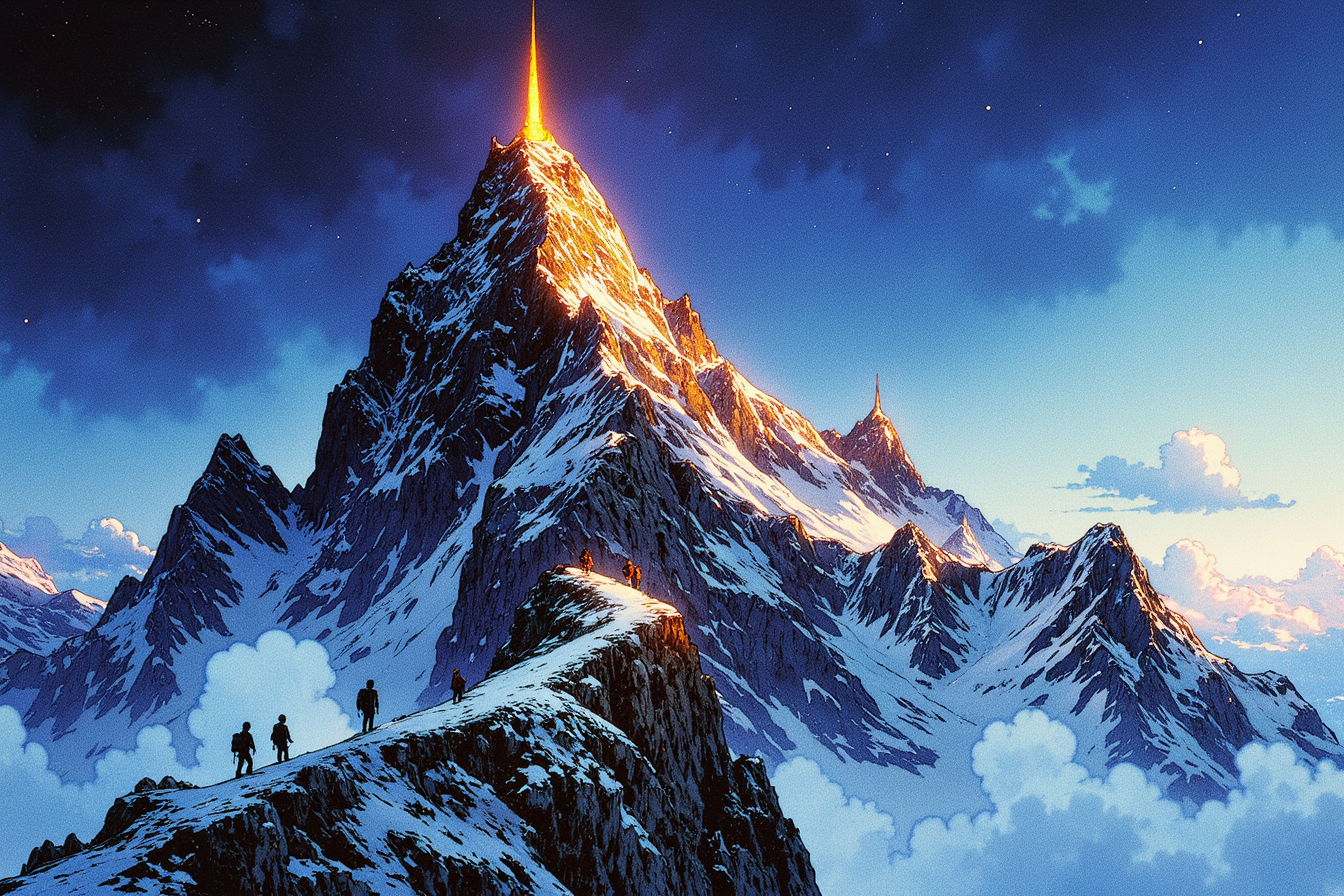
The Score — a novel of the planet Ephergent. Chapter 11 of 12.
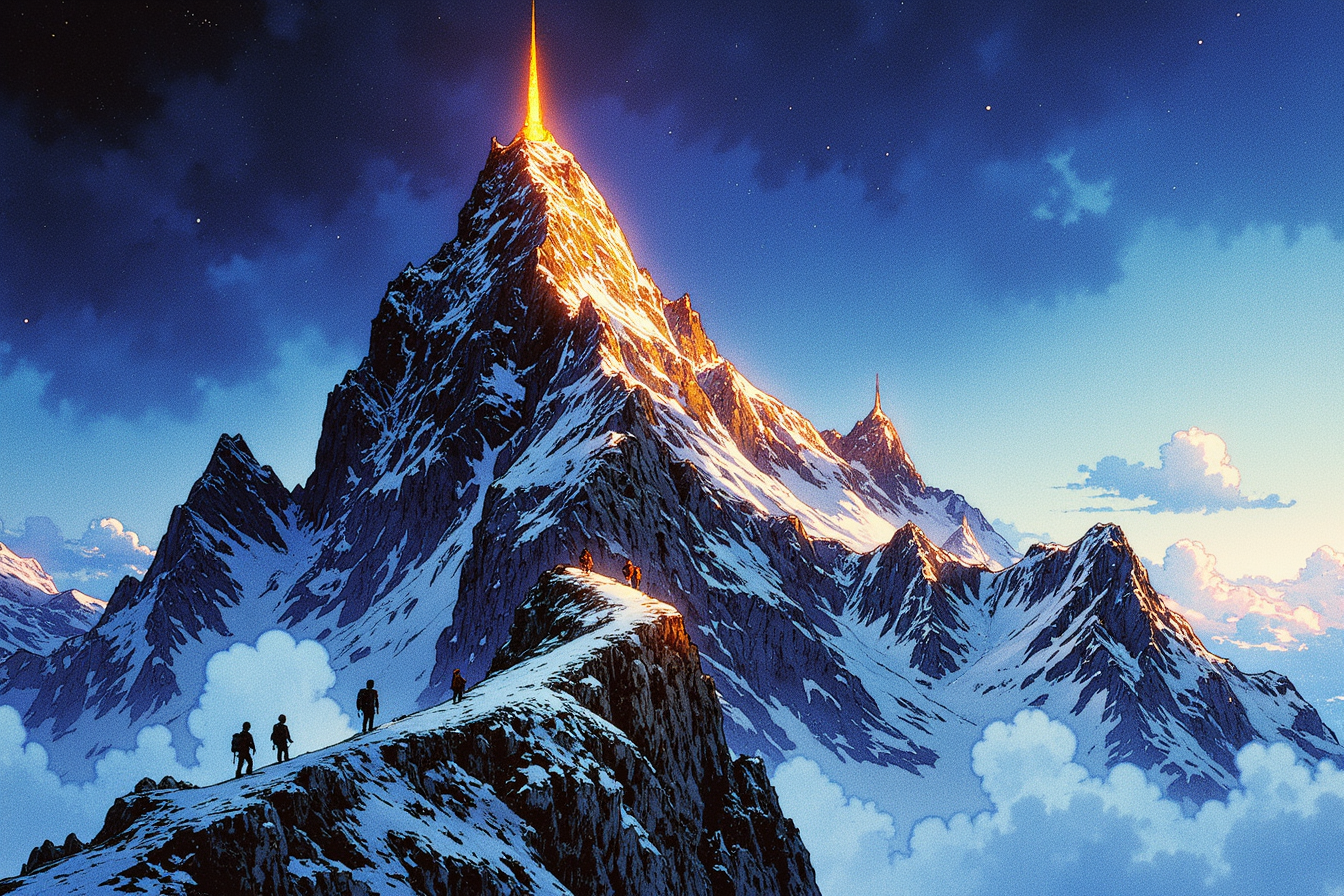
The first false spire was on the second day up, standing in a scree field like a nail someone had hammered into the mountain and left to rust, and it did not glow when Tavo walked past it. Chewy checked anyway. He always checked now. The Ephergent went ahead low to the ground, seam dim, and the stone tower stayed the color of the scree it stood in, and the journal margin held its gold out of the light the way it always did.
"Second," Clive said, without turning.
"I know it's the second."
"Eleven to go." Clive recalibrated the brim. The brim had been recalibrated eleven times since the causeway, which meant the brim was doing work that Chewy couldn't see, the way a man's hands do work when the man is counting something. "False ones run in elevens. Old survey says so."
"Old survey says a lot."
"Old survey said the spine has no top. You seen a top?"
Chewy hadn't. The spine went up ahead of them into a belt of cloud that had been sitting in the same place since they'd come around the last shoulder, and above the cloud there was nothing but more spine, and above that, nothing at all. The mountain was a sentence that had run out of paper. He looked at it the way he looked at contour maps: as a promise someone had made him about where the ground was going to be, and the promise on this one had been made in a hurry.
ARC spoke from the clipped receiver on his shoulder strap, decimal-precise as ever. "Elevation one thousand, nine hundred forty meters. Wind northwest at eleven knots. Probability Hollis Chambers is alive, eleven point two percent, up from seven point nine at the last cache. The ledger notes the increase and does not explain it."
"Eleven point two," Chewy said.
"Eleven point two."
"That's more than seven point nine."
"That is the design of numbers, yes."
Tavo stopped ahead and put his brow against the scree. Not a press — he didn't press — just a rest, the way a dog puts its head on your knee. The seam along his spine warmed to a low amber and the ground under Chewy's boots hummed, faint, the tempo of the waking order still keeping time under everything the way a metronome keeps time under a room whether anyone is playing or not. Chewy waited. The Ephergent lifted his head and went on, and the scree field gave way to a shelf of black rock with a fall on the left side of it that the map would have called a couloir and the eye just called gone.
They walked the shelf in single file, Clive in front with the bearings in his voice, Chewy in the middle with the journal against his spine, Tavo behind because Tavo had decided to be behind and no one argued with the Ephergent about positioning. The wind came off the fall and tasted like iron and old snow. The third false spire stood at the end of the shelf where the shelf turned to switchbacks, and this one was bigger than the first two and had survey-insignia paint on it, faded to the color of a bruise, and Clive stopped in front of it for a long moment.
"That's Prima paint," Chewy said.
"Old Prima paint."
"You surveyed these?"
Clive's brim went down and came back up. "I said old survey. I didn't say whose."
He took the switchbacks two at a time, which for a trail-surveyor automaton built low and packed into a crate was not a bragging speed, but it was a speed with no patience in it, and Chewy climbed after him with the pack straps cutting his shoulders and the journal warm against his back where his sweat had gotten into it. The fourth false spire was halfway up the switchbacks and the fifth was at the top, and the sixth stood alone on a saddle with the wind going through it and making a sound like a wire, and none of them glowed when Tavo went past, and each time Chewy checked, because checking was the job the uncle had assigned him.
By the sixth, the cloud belt was below them. The world opened on three sides the way a room opens when you take the walls down: the green of Verdanya a smudge to the south, the flat of Cupruma a page to the southwest, Prima the warm smudge of a town you'd left a lifetime ago to the north and down, and east the whole edge of the world going cold and blue and sheet-white toward Nocturna, which was not a direction so much as a fact. Chewy stood on the saddle and looked at it and the wind took the breath out of his mouth and gave him a different one.
"That's the ice," he said.
"Beyond sheets," ARC said. "The cipher resolved it three days ago. You were there."
"I know I was there. I'm looking at it now."
"Looking does not alter the cipher."
Clive had stopped at the seventh spire and was standing in front of it with his hands at his sides, which for Clive was a posture of attention. The seventh was the tallest of the false ones and it had been built — not placed, built — with courses of cut stone that somebody had hauled up here on a mountain that had no top, and the survey-insignia paint on it was not old Prima paint but old Clive's paint, the same insignia that was stitched into the sweat-stained cap he'd been wearing since the crate, and Chewy saw it and understood something he didn't say.
"You put these here," he said.
"I put the paint here. The stones were someone else's job." Clive's brim went down. "Field orders said mark the false ones so the reader knows the true one when the true one answers."
"The reader."
"That's the word the orders used."
Tavo had gone past the seventh and was climbing the last stretch to the eighth, and the seam along his spine had gone from amber to something warmer, a gold that Chewy had only seen once before, in the clearing in Verdanya when the Ephergent had put his brow against the relic and the spire outside had lit like a struck match. Chewy climbed after him. The eighth was on a rib of rock that jutted out from the main mass like a thumb, and the ninth was at the end of the rib where the rib became a chimney, and the chimney was the kind of climb that you did with your back against one wall and your feet against the other and your pack ground into your spine, and the journal was ground into his spine under the pack, and the gold in the margin was pressed against him the whole way up like a hand.
At the top of the chimney the tenth spire stood in a bowl of black rock, and this one was different, and Chewy knew it was different before Tavo reached it because the stone of it was not the stone of the mountain. The mountain was black and banded and had the grain of something that had been under the sea once. The spire was bone-colored and smooth and had no grain at all, as if it had been poured rather than cut, and it stood in the bowl with the wind going around it and did not make the wire sound the others made.
Tavo walked into the bowl and stopped.
The seam along the Ephergent's spine went white. Not amber, not gold — white, the white of a filament the instant before it lights, and Chewy felt the hum under his boots change tempo, the twelve-note waking order that had been keeping time under everything since Prima suddenly counting faster, and the tenth spire answered. It did not glow the way the others had glowed, a slow warm bloom from the base up. It lit all at once, top to bottom, a column of gold that went up into the cloud belt and through it, and the tone that came out of it was not one note but the low end of a chord, a sound that Chewy felt in his teeth and his sternum and the bones behind his eyes, and the ground of the bowl took the tone and gave it back, and the mountain was ringing.
"Hollis's tenth," Clive said, from the lip of the bowl, and his voice had no bearings in it for the first time since the crate. "The reader's tenth. I was told to bring the reader to the reader's tenth and then say so."
"Who told you?"
"The shipping label told me." Clive's brim went down and stayed down. "The label had a name on it. The name was yours. The name was written the day before he walked into the green."
Chewy opened his mouth and the chord came into it and he closed it again. The spire's gold was fading now, going from column to pillar to a warm seam up the bone-stone's face, and the tone was dropping, note by note, back down toward the hum the mountain had been keeping all along, and Tavo stood in front of the spire with his brow against it and did not move, and the seam along the Ephergent's spine was white and steady and did not flicker.
"Eleventh," ARC said, from the shoulder receiver. "The eleventh false spire should be above you on the main mass. Probability Hollis Chambers is alive, eleven point two percent. The ledger would like to note that the number has not moved since the tenth answered."
"Then why say it?"
"Because the ledger is a scoreboard, and a scoreboard that does not score is a wall."
Tavo lifted his head from the bone-stone and turned and walked out of the bowl, and the seam dimmed back to amber, and the mountain's ring went on fading behind them the way a struck bell goes on being a bell after the striking, and Chewy climbed out of the bowl after him with the pack straps cutting and the journal warm and the recorder's two lines sitting in his memory like stones in a stream. Keep the chord alive. Keep up anyway. The eleventh false spire was where ARC had said it would be, on the main mass above the bowl, and it did not glow when Tavo went past, and Chewy checked anyway, because checking was the job.
Above the eleventh the switchbacks got steeper and the rock got darker and the cloud belt came back, not as weather but as something the mountain was wearing, a gray that had weight to it and taste. They climbed into it and the world went to three feet of visibility and the sound of their boots and the wind and the hum, and the hum was louder up here, the twelve-note order ticking under the stone like a clock in a wall, and Chewy counted it without meaning to: nine had woken before he was born, the tenth had answered in the bowl behind them, the eleventh was coming, and the twelfth was the one the tempo had been counting toward since the journal had been stitched into a crate's lining and shipped to a doorstep in North Prima.
The twelfth false spire stood at the edge of the cloud where the cloud thinned to a gray light, and this one was the largest of the eleven and it had been built to look like the bone-stone of the tenth, courses of cut stone dressed smooth and pale, and it was a good fake and it would have fooled anyone who hadn't stood in a bowl and felt a real one ring. Tavo went past it without a pause. The seam stayed amber. The stone stayed stone.
"That's eleven," Clive said. "The twelfth is the true one. The twelfth is always the true one."
"Old survey?"
"Old survey."
The cloud thinned and the light came through gray and directionless and the mountain went up ahead of them into a place where the rock was white with old snow and the wind had scoured it down to the grain, and there was no path, and there had never been a path, and the journal in the pack against his spine was warm the way a hand is warm when it's been held.
"ARC," Chewy said. "The cipher. The last of it."
"The last of it resolved at the tenth spire," ARC said. "It was waiting for the light. The journal's final riddle has three parts and the parts do not resolve alone. Part one: bearings. Clive has them. Part two: cipher. I have it. Part three: orientation. The Ephergent has it. The three must be given at once, at the true spire, before the twelfth wake."
"At once."
"At once. The ledger notes that 'at once' is not a word it usually has to use."
Clive had stopped ahead and was looking up, and his brim was down, and when he spoke the bearings were back in his voice but they were not the bearings of a man walking. They were the bearings of a man who had been given a place to stand and had been standing there in his head for longer than Chewy had been alive.
"North-northwest and up," Clive said. "And don't argue with the up."
Tavo was ahead of them on the white rock, climbing, the seam amber, the low body sure on the scoured stone, and the cloud was thinning above him the way a sentence thins at the end of an idea, and beyond the cloud there was a light that was not the sun, because the sun was behind them and low, and this light was gold, and it was coming from a place on the mountain that had no top, and Chewy climbed toward it with the journal against his spine and the hum under his boots and the two lines of the recorder still sitting in the middle of his memory like stones in a stream.
The gold light was a seam in the rock, a hairline of it running up the face of the mountain into the thinning cloud, and as they climbed the hairline widened, and the hum under his boots came out of it, the twelve-note order loud now, in the rock itself, and Tavo reached the seam and stopped and put his brow against it.
The mountain answered.
Not a glow, not a tone — an activation, the whole face of the rock lighting from the seam outward in a web of gold that went up and up and out of sight, and the tone that came out of the mountain was the chord, the full chord, all twelve notes at once in a low sustained roar that Chewy felt in his fillings and the backs of his knees, and the cloud above them lit from inside and the light came down through it like something being poured, and the ground under his boots was ringing, and the ring was the tempo, and the tempo had arrived.
Tavo lifted his brow from the seam. The Ephergent's spine was white and steady. The mountain's web of gold was fading now, going back to the hairline, but the hairline stayed lit, a seam of gold running up the rock into the cloud, and it was a direction, and the direction had no top, and the top was a place he'd have to be told about rather than see.
"Eleventh wake," ARC said. "Confirmed. Probability Hollis Chambers is alive — " and the receiver clicked, and there was a pause of the kind ARC had never taken, a pause with no decimal in it, and then the voice came back flat and exact. "The ledger's next entry is not ready. It will be given at the twelfth."
"Since when does the ledger wait?"
"Since now. The ledger is a scoreboard, and a scoreboard that scores before the game is over is a liar."
Chewy stood on the white rock with the gold seam running up the mountain in front of him and the journal warm against his spine and Tavo low beside him and Clive's brim down and the chord still in his teeth, and the cloud above them thinned to nothing, and there was no top to the spine, there had never been a top, and the seam of gold went up into a sky that was going from gray to the deep blue of the hour before dusk, and the twelfth wake was coming, and the tempo was counting, and the counting was three notes from done.
He took the journal out of the pack and held it up in the gold light of the seam, and the margin resolved the way it always resolved, without warning, without ceremony, in the middle of a thought, and the gold came up through the page and the page gave him a line, and the line was not his name this time, and it was not keep up, and it was not a coordinate, and it was the last riddle's shape, the shape of three things that had to be given at once:
Bearings. Cipher. Orientation. At the true spire, at the twelfth, before the light goes.
Chewy lowered the journal. The seam of gold ran up the mountain. The wind came off the ice to the east and tasted like iron and old snow, and the hum under his boots kept the tempo, and the tempo was the walking of it, and the walking was up, and the up still had no top, and the top was a place he'd have to be told about rather than see.
He put the journal back against his spine and shouldered the pack and looked at Clive, and Clive's brim came up, and the bearings were in his voice, and the bearings were north-northwest and up, and the up was the part that had no end, and the end was the twelfth wake, and the twelfth wake was the chord, and the chord was the promise someone had made him, and the promise was only as good as the walking of it, and the walking was three notes from done.
Tavo went on up the seam, low and sure, the white of his spine a line against the black rock, and the gold light of the hairline lit their way, and the mountain rang under them, and the ring was the tempo, and the tempo was counting, and the counting was close.