
Crystallized Laughter — CHAPTER TWO
You have not been erased until you have watched the paperwork catch up.
Let me back up to the room it started in, because the paperwork is what happened next, and the room is what happened then, and the room deserves the order.
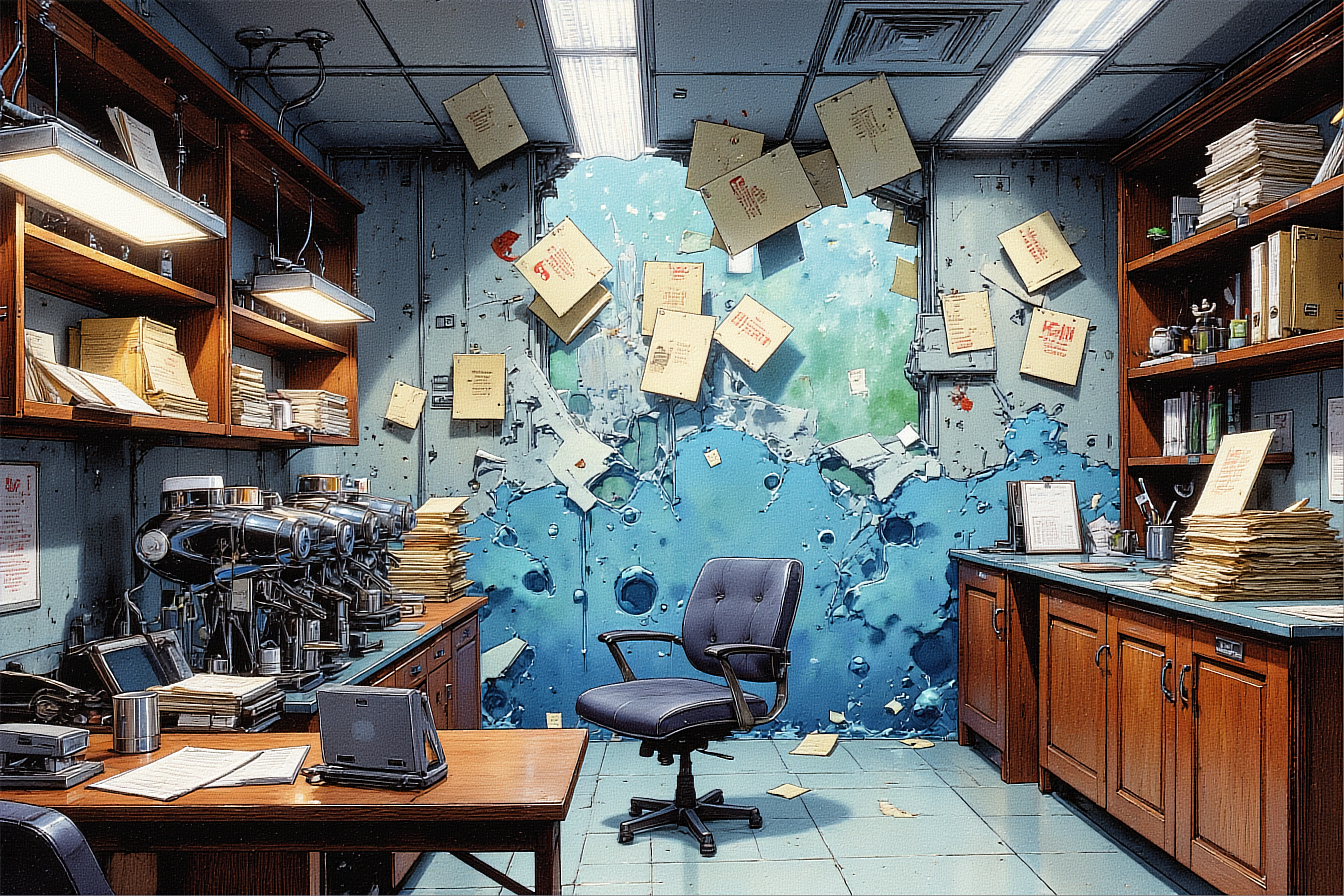
I was at the table in the break room at 2 a.m. with the report open on the laptop and the fluorescent tubes doing their one honest thing, and behind A1's ready light something else was happening, a sound like a held breath at the bottom of a boiler, and I looked up from the second sentence, and the wall behind the machine was doing the thing I had spent eleven weeks proving to people who were paid not to be convinced.
It was wearing thin.
Not metaphorically. The wall's surface had gone soft, like a photograph left in the rain, and through the softness I could see color that had no business being there, a blue that was not the building's blue, and a light that moved like water, and the shape of something on the other side that turned, slowly, and looked back at me, and I understood with the calm that comes just before the loudest moment of your life that the hole in my reality was not in the floor.
It was in the break room, and I was standing in it, and it was open.
I remember three things clearly. I remember grabbing the laptop. I remember the stapler, which I had not consciously decided to save, already in my other hand, because I had had that stapler for four years and my body had made the choice before my mind caught up. And I remember A1, which had begun to brew, the pump engaging with a knock I felt in my molars, pulling a triple shot at 2 a.m. for a woman who was about to stop being anyone at all, because if the multiverse was going to end in this break room, I was going to get a proper coffee first.
The wall opened like a mouth.
And the first thing it did was take our names.
Not all at once. That's the part nobody tells you about being erased. It doesn't happen. It happens in increments you can watch, like a photograph fading in a window, like a serial number losing a digit, like a badge photo where the face goes first and the border stays. My employee badge was in my shirt pocket, and I felt it change, felt the plastic get lighter, and I pulled it out, and the photo of me was a gray rectangle, and the name under it read EMPLOYEE in a font that had never been used for my name because my name was no longer the kind of thing that got a font.
Corporate had been notified the instant the wall opened. Not by an alarm. By a process. Somewhere in the building a record was being amended to reflect that three items (one analyst, one appliance, one office supply) had been lost in a variance incident, and amendments do not wait for witnesses.
I tried to say my name. Piper Chen. I said it and it came out as a shape, like a word heard through water, and A1's green light flickered from green to nothing, and on the machine's chrome plate, the serial number SM-E750-CC was fading, letter by letter, the CC going first because Corporate Corp does not even stay in its own serial numbers.
"Sir," said A1.
I have thought about that for a long time. A1's first word, before the awakening, before the butler, before everything. Sir. Because A1 could not say Piper, because Piper was being taken, and A1 reached for the nearest thing that still existed and it was a form of address, a way of being polite to someone whose name had just been taken off the record.
"Sir," A1 said, "my calculations indicate we are monumentally screwed. Would you like some coffee?"
The break room folded. The stapler in my hand tapped twice against my knuckle, fast and sharp, in the pattern I had spent four years half-noticing, the pattern I had never once admitted I was reading, and it said, in staple-morse, in the voice of a machine that had been waiting since Long Island City:
Finally. Took you long enough, kid.
Then the floor let go, and the last thing I saw of Corporate Corp was the wall behind the machine going to water, and my badge turning gray in my hand, and the little green light that meant ready, going out.
I would like to say I was brave about it. I was not. I was a data analyst with a laptop, holding a stapler, being poured out of my own life through a hole I had predicted eleven weeks earlier and spent eleven weeks apologizing for, and as the break room came apart around me, the thought I remember having, the last organized thought of Piper Chen, was:
I should have filed it properly.
I should have filed it in triplicate.
Falling through the hole in the break room took a long time and no time at all. I know how that sounds. I am a data analyst; I notice these things. The fall itself had duration, the way a slide has duration, and in that duration I had plenty of opportunity to notice that the walls going past me were made of documents. Not metaphorically. They were manila and bond paper and the slightly greasy stock they print interoffice envelopes on, and they were stacked into corridors, and stamped, and initialed, and every surface I went past had my name on it in some form, because the record of Piper Chen was very large and it was all coming apart at once.
Here is what was happening above me, in the dimension I had left. I know this because Clive told me later, staple by staple, and because the office-supply network remembers everything, and because three weeks after the fall I found a copy of my own personnel file in a tide of lost paper, and read it, and wish I hadn't.
At 2:47 a.m., Piper Chen, Data Analyst, ID-7G-2847, was flagged as unaccounted for during a variance incident on Sub-Level 7G.
At 2:49, the flag was upgraded. There is a form for this. It is gray. There is a checkbox that says "escalate to incident review" and a checkbox that says "close as resolved" and a checkbox that says "loss, material" and a night-shift clerk whose name I will never know ticked "loss, material" at 2:49 because it was the box that took the fewest additional fields.
At 3:02, the incident was closed. Not because anyone had looked for me. Because the form could not proceed with the field empty, and the empty field was where my explanation would have gone, and Corporate's systems do not permit an empty field any more than a river permits a hole.
By 6:47, Gerald-7 arrived at his desk to find that his 9 a.m. reminder about the variance report had been auto-completed. The report itself was still in my bag, falling with me, but the reminder had been satisfied by the closure of the incident to which the report related, which is a sentence that should not be able to exist, and I want you to sit with it for a moment, because it is Corporate's entire theology in one line: the process is complete, therefore the thing happened correctly, therefore nothing requires review.
Gerald read the auto-complete. Gerald said "noted" out loud to an empty desk. Gerald, by 7:30, had reassigned my paperclips to a contractor.
That is how fast it goes. You would think there would be grief. There is not. There is a form, and the form is efficient, and the efficiency is the point, and the point is that by the time anyone might have missed me, the record showed there had never been anyone to miss.
Two things in the record were not efficient. This matters. Hold onto it.
The first: my badge photo. Personnel photos in Corporate's system degrade on a schedule when an employee is marked loss, material. It is a gradual thing, a security feature, so that a photo cannot be used to identify a former employee who has, in the eyes of the system, stopped being an employee. Most people never see their own. I found mine later, in the lost-things dimension, in a folder that had washed up with eleven thousand other pages, and I watched my face go from Piper Chen to a gray rectangle over the course of four days' worth of scheduled degradation, at the end of which the file said EMPLOYEE and nothing else, and the file was still there, still being maintained, still being backed up nightly, because Corporate does not delete. Deleting is not on the form. Corporate overwrites, and the old thing sits under the new thing, forever, unreachable, which is a kind of ghost that no priest has ever been trained for.
The second: A1's asset tag. SM-E750-CC, valued at four thousand two hundred dollars, depreciable over seven years. The tag did not vanish. It changed. The serial lost its letters, then its numbers, one character at a time over the following week, until the machine in the break room was listed as an unassigned beverage asset in an unassigned location, and someone in procurement, looking at a line that said nothing, ordered a replacement.
I know this because the replacement arrived eleven days later. I know it arrived because the office-supply network told Clive, and Clive told me, in staples, months afterward, in the tone he uses for evidence.
Now. The fall.
Past the corridors of my own file, the paperwork gave out and the fall changed texture, and I went through a stretch of pure noise, the sound of a photocopier in the next room times a thousand, and then the noise thinned, and I was not falling anymore, I was being delivered, and I landed.
Not gently. I want that on the record. There was no cushioning, no angelic reception, no soft music. I hit ground the way a box hits ground when a courier has decided the label is close enough, and the impact drove the laptop out of my hands and the stapler out of my other hand, and I lay on my back in the dark and did an inventory: everything hurt, nothing was broken, I was still a person, or at least I was still in possession of the material required to become one again if anyone would confirm it.
"A1?" I said.
Above me, falling with the calm of an appliance that has calculated the terminal velocity and found it acceptable, came the SM-E750-CC, trailing its power cord like a tail, and it hit the ground eight feet away with a sound like a cathedral being dropped, and rolled, and settled, and its little light came on green.
Green. Ready. In a place that had no electricity.
"A1?"
"Present," said the machine, and its voice came out of its speaker grille, and it was, and I need you to understand how strange this is, the same voice as before, the voice that had said sir, but fuller now, unhurried, with an accent it had not previously possessed. "Though I should note that my serial number has become uncertain, my depreciation schedule has been terminated, and I appear to have gained the ability to speak. I have elected to treat the third item as compensation for the first two."
I sat up. The ground was paper. Not covered in paper: made of it, layered and compressed into a soft gray plain that gave slightly under my hands, and the air smelled the way a warehouse smells after rain.
The stapler came down last, because staplers are heavier per inch than anything has a right to be, and it hit the ground two feet from my knee and lay there, orange, chipped on one corner, four years of my desk in its springs, and it tapped.
Once. Twice. Then a longer pattern, deliberate, the pattern I had been reading on the desk for four years without admitting it, and I understood it the way you understand a language you were raised in and told yourself you didn't speak.
Took you long enough.
"You're alive," I said.
I've been alive, the stapler tapped, since before you were born, kid. I just had the good manners not to make it your problem. Now somebody tell me where we are, because I know a lost-and-found when I'm standing in one, and we are standing in one, and that is very bad news for anybody who's ever filed a claim.
I looked around. The gray plain went on until it didn't. In the distance, at the edge of sight, things were piled: chairs with their legs bent, lamps, shoes, single shoes, wedding rings, keys, thousands of keys, a mountain of keys with a lake behind it that I later learned was lost time, all of it washed up in the same place, everything the multiverse had ever lost, arriving here the way mail arrives at a dead letter office.
I said: "We fell out of our dimension."
We got fired, the stapler tapped. There's a difference. A fall is an accident. This had a form. I felt the form, kid. It went through me like a wire through paper.
"Yes," said A1. "We have been severed from the consensus record. Officially, we no longer occur." The machine paused, its green light pulsing. "Also, I should mention that I appear to be a quantum espresso machine now, my processing core has expanded by a factor I cannot yet enumerate, and I can perceive seventeen dimensional frequencies simultaneously, each of which is singing. One of them is singing about you."
"Me?"
"It's a bit flat," A1 said. "You're holding your shoulders up around your ears."
I put my shoulders down. I picked up the laptop, which still worked, which is more than I can say for the rest of my life, and I opened it, and the screen came up on the last document I had open, which was the honest report, the fifth version, the one I had been carrying for eleven days: this building is coming apart and I have the data to prove it.
The file was corrupt. Of course it was. The title bar flickered from VARIANTANOMALYFINALv5 to VARIANTANOMALYFINALv5CORRUPTED to a string of characters that were not characters, and then to a filename the laptop had never seen, which was:
THEEPHERGENTISSUEONE.md
And underneath it, on a page I had not created, in a font that had not been installed on this machine, a single line of text, already typed, already there, as if it had been waiting in the laptop the way the stapler had been waiting in the desk:
Everything Corporate erases, we print.
Below the line was a byline, blank, with a cursor blinking at it.
I want to tell you I hesitated. I want to tell you I thought about Gerald's out-tray, and the gray box where my face had been, and the form with "loss, material" ticked in a box, and that I made some grand decision to become a person who files the truth in triplicate no matter what. I did not. I was a woman sitting on the ground in a lost-and-found at the bottom of nowhere with a laptop, an espresso machine, and a stapler who had been alive since before I was born, and the cursor was blinking, and nobody was going to write it but me.
I typed three words.
Pixel Paradox. Editor.
I hit save. Somewhere, in a dimension I could not see, a printer I had never met woke up, and began to warm.
"A1," I said. "What's a zine?"
"Traditionally? A handmade magazine, photocopied and distributed outside official channels. Popular with communities whose voices are not represented in the mainstream press." He paused. "Also popular with people who simply enjoy stapling things, which I mention because our stapler is, I think, vibrating with anticipation."
I'm not vibrating, Clive tapped. I'm ready. There's a difference. You're holding your serial number around your ears.
A1's light flickered, which I would learn was his version of a laugh. "She is, actually."
Behind us, out on the gray plain, something crashed: a delivery of lost things, another truckload of everything the multiverse had given up on, arriving at the dead letter office of reality. And among it, I knew the way you know things when you have spent three years, four months, and seventeen days noticing what nobody else does, would be the pages of a zine nobody had printed yet, and the paper would be blank, and the ink would be ours.
I stood up. My badge was in my pocket. I took it out and looked at the gray rectangle where my face had been, and I put it back, because you do not throw away evidence.
"Right," I said. "Issue One."
---
LOSS LEDGER 1 Sidebar. Kept by Pixel Paradox. Costs recorded as they land, never netted, never rounded.
OPENING BALANCE (as of the fall):
- Piper Chen: erased from the record, badge photo degrading, personnel file auto-completed at 3:02 a.m. Status: unoccurred. Value on file: 0. - SM-E750-CC: serial number dissolving, one character at a time. Asset tag reassigned. Value on file: $0.00 (fully depreciated, which is Corporate's word for gone). - Swingline 747, orange, born 1967: value on file: $4.98. Has been alive for decades. Nobody filed that either. - Sub-Level 7G break room: closed pending review of an incident that was closed. Will not be reviewed. - Barry Kowalski, employee, department unknown, date of disappearance unknown, last seen carrying a box: OPEN. Nothing filed. Nothing found. Nobody's looking. We are.
ITEMS WE ARE COUNTING SO FAR: three.
ITEMS CORPORATE HAS COUNTED SO FAR: zero, because the form for counting an item requires the item to still exist on paper, and we no longer do.
Rule of this ledger: we do not round up. We do not net a win against a loss. We do not say "ultimately." Everything on this page stays on this page until somebody gets it back, and if nobody gets it back, it stays anyway.
The record is not the truth. But somebody has to keep one.
Loss Ledger, Issue One, entry 1 of 40.