
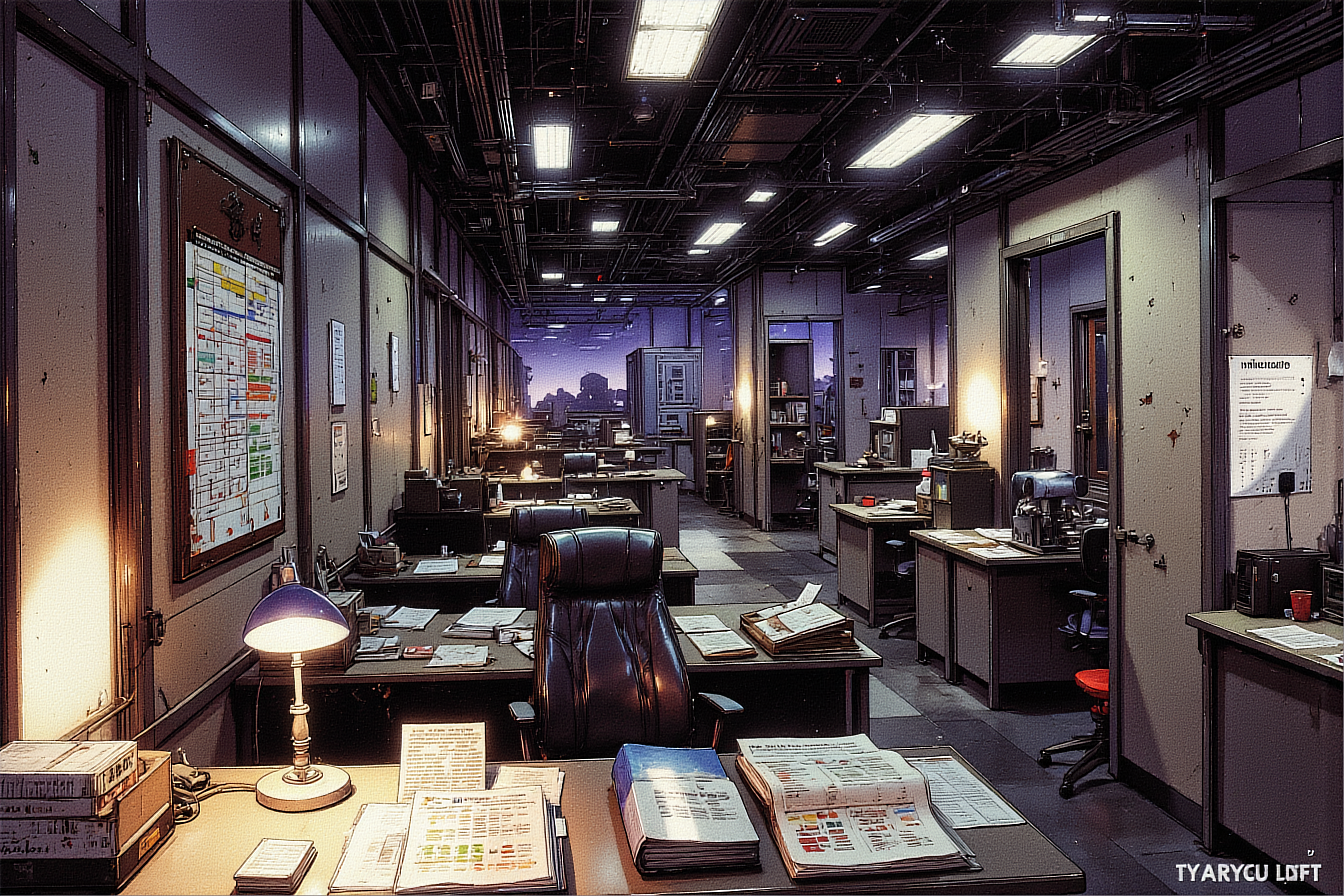
Crystallized Laughter — CHAPTER ONE
There is a department at Corporate Corp called the Interdimensional Paperclip Variance Division, and if you're picturing a sad little room in a basement, congratulations, you've seen it. We were on sub-level 7G, which the building directory listed as "Facilities Optimization (Unoptimized)," and there were eleven of us tracking the migratory patterns of paperclips that had begun, over a period of months, to leave.
Not break. Not rust. Leave.
We had a chart, and the chart had a season. Every March the division ran a two-dollar pool on where the spring migration would surface, and the pot was won four years running by whoever guessed by name rather than by data, which the rest of us found unforgivable until each of us had lost to it in turn. I kept my own chart, of course: batch-numbered, in a binder under my desk, spine label printed by me, reading PAPERCLIP MIGRATION, SEASONAL, DO NOT REFILE.
I had been there three years, four months, and seventeen days. I know the number because I counted it every Friday the way other people count down to vacation. Paperclips migrate between dimensions the way geese migrate between seasons, except geese don't file expense reports, and paperclips had started filing them for us. Batch 7G-441 would vanish from the supply closet on a Tuesday and reappear in a Nocturne Aeturnus mailroom on a Thursday, and my job, my entire professional identity, was to put a number on that.
So I put a number on it. For three years, four months, and seventeen days, I put numbers on things that did not want numbers put on them.
Here is what you need to understand about Corporate Corp before we go any further: it is not haunted. That would be almost interesting. It is not evil in the way a villain is evil, monologuing in a chair. It is evil the way a photocopier is evil, which is to say it isn't, but it destroys your evidence and jams on purpose and the sound it makes at 6 a.m. will live in your spine forever. Corporate's product is erasure. Not the dramatic kind. The administrative kind. A name misspelled once, then misspelled again in the correction, then dropped entirely from the third revision because the third revision is now the record, and the record is the truth, and the truth is whatever is easiest to file.
I was good at my job. Disturbingly good. Where my colleagues saw noise, I saw rhythm. Where my colleagues saw a broken spreadsheet, I saw a system that had decided, on its own, to start moving things around, and I could feel the shape of the decision the way you can feel a storm coming in your knees.
My supervisor was a man named Gerald-7, though he insisted on "Gerald Seven" as if the hyphen offended him personally. Gerald had been middle management so long that his face had settled into the expression of a man permanently reading a memo he disagreed with but intended to approve. He called my work "an unhealthy obsession with minutiae." I called it Tuesday.
Gerald had two settings, and both of them were "forwarded." I once brought him a chart showing that one batch of clips had crossed seven dimensions in eleven days with no fuel source, no wind, and no precedent in the literature, and he studied it for a full minute with the memo face on, and asked whether the chart could be made friendlier. I said the clips were not trying to make friends. He said then perhaps the chart could be. So I changed the red to a soft coral, I renamed the axes so they stopped sounding accusatory, and I added a small legend in the corner that read WHAT WE THINK IS HAPPENING, and Gerald carried it to his supervisor's meeting and came back and told me that the word "noted" had been used about it, and that, coming from him, was a standing ovation.
The morning everything started to go wrong, I was at my desk at 6:47 a.m. as usual, and the anomaly was in my hands, and I was terrified of it.
Not the paperclips. The other thing. The thing underneath.
For eleven weeks I had been tracking a variance spike centered on our building's break room, and the data did not make sense in the specific way that data does not make sense when it is telling the truth and you are the one who is wrong. The building's quantum fluctuations were climbing in a curve that curved. Reality in that break room was wearing thin, the way a shirt wears thin at the elbow, and if you held the fabric up to the light you could see right through it.
I had written the report four times.
The first time, I wrote it honestly. Variance exceeded all parameters. Cause unknown. Recommended: immediate structural review of Sub-Level 7G, evacuation if necessary. I submitted it in triplicate, because sub-level 7G submits everything in triplicate: one for the channel, one for the file, and one for whatever the third copy is for. The channel routes to Gerald, which routes to a folder, which routes to nothing.
The second time, I wrote it with graphs, because Gerald liked graphs the way a dog likes being shown a card trick: it pacified him without informing him. The graphs went to Gerald's supervisor, a woman whose name was a string of characters that began with a hyphen and got worse from there, and who replied, four days later, with the word "Noted."
The third time, I went around them. I filed with Building Services, which is technically a different shell company (Business Business Inc., and yes, that is its legal name, and yes, it is on the building) and which replied with an automated ticket: TICKET CLOSED. REASON: USER ERROR.
The fourth time, I printed the report, seventeen pages with the graphs Gerald liked, and carried it to the break room at 2 a.m. and sat on the floor with it in my lap and the coffee machine gurgling behind me like a small metal animal, and I could not make myself stand up and walk it to Gerald's desk in the morning. Because the fifth version would be a lie, and the fifth version would be the record, and I would have to look at it in the folder for the rest of my career.
So I did what any reasonable person does with a truth that will cost her the only life she knows how to live. I opened my laptop and I corrected the anomaly.
That's the phrase I used in the file, and I want you to appreciate the audacity of it. I had found evidence that the floor of my reality was developing a hole, and I had filed it under "corrected." I saved it, and I went home, and I lay in bed listening to the ceiling not falling down, and I felt sick with relief, which is the specific flavor of relief that comes from selling something you can't get back.
Here is the complete list of what I changed, because if this is going to be a record, the record should be ugly in the right places:
- Row 41: spike reclassified as sensor drift. - The phrase "reality is wearing thin in the break room" replaced with "environmental variation, within tolerance." - The appendix, where numbers go to be unloved. - Tab color: amber. Then, after a second look, teal. - The file name, from BREAK ROOM VARIANCE (URGENT) to BREAK ROOM VARIANCE (CORRECTED). - One cell in the summary where I had written, in a size nobody else would ever open, this is getting worse.
I deleted that last cell first. I would like that on the record as well.
Two weeks later I un-did it.
I'd like to tell you it was courage. It was not. It was that the anomaly got worse while I watched, and I understood, sitting there at 6:47 on a Thursday, that in eleven weeks I was going to be a person who knew and did nothing, and in eleven years, and that the difference between those two people was the size of a paperclip, and I could not in fact live with either.
I pulled the file. I wrote the fifth version: honest, ugly, uncorrected, with a first line that said, in effect, this building is coming apart and I have the data to prove it. I printed it. Seventeen pages. I walked it to Gerald's desk while my heart did something structurally unwise.
Gerald read the first page. He read the second page. He turned to the graphs, which he liked, and his face did the memo thing, and he said, "Piper. This is creative data interpretation."
"It's a variance spike with a ninety-eight percent confidence interval," I said.
"It's creative," Gerald said, and put the pages in his out-tray, which I had learned was where documents went when Gerald wanted the conversation to be over and the record to show he had received something. "I'll review it."
"You reviewed it."
"I'll review it." He smiled the way a door closes. "Nice work on the paperclips, by the way. Very thorough."
I want to be clear that Gerald was not a monster. Gerald was a man who had been told "noted" by his supervisor so many times that "noted" had become the rhythm of his blood, and he passed it down the way his had been passed to him, and if you asked him whether he believed in anything, he would have said "performance review season" and meant it as a philosophy.
I took the report back out of his out-tray when he went to his 10 a.m. I put it in my bag. I would carry it around for eleven more days.
For those eleven days I carried it the way you carry something that is either evidence or contraband, and could not remember which. It lived at the bottom of my bag under a dead charger and a lunch I kept forgetting to eat, and I checked it every night: still the honest version, still uncorrected, still leading with the ugly first line. By the end the corners had gone soft from the checking, and I could recite the first page from memory, which is not the same as filing it, and turned out to be no help whatsoever.
Now. The break room.
It was, by the standards of sub-level 7G, a palace. Two tables, one of which had a leg that Gerald had decreed "fine, it's fine" after a facilities ticket; a window that looked out onto a concrete wall; a refrigerator containing one container of something that had achieved statehood; and against the far wall, the machine.
The machine was an SM-E750-CC, Standard Model Espresso Machine, 750-watt heating element, Corporate Corp Break Room Unit 7G. Stainless steel, a portafilter that clicked home with a sound I would later learn to need, and a small green light that meant it was ready. I called it A1, which I claimed stood for "A-number-one assistant" and which actually came from a steak sauce I found funny at hour fourteen of a double shift. A1 did not talk, because A1 was an espresso machine, and because the universe has to save something for later.
It made the best triple shot on the sub-level. Not objectively. Objectively it made the same sludge as every other unit in the building, because they all pulled from the same reservoir of corporate-blessed beans, which are beans in the way that a Tuesday is a personality. But A1 made it hot the way I liked it, and it made it when nobody else was in the building, and I had started, over the course of three years, four months, and seventeen days, to talk to it.
The ritual had steps, and I did them in the same order every time, because at 2 a.m. order is the only colleague you have. Wipe the drip tray. Fill the reservoir to the line; past the line you got the gurgle. Tap the counter twice to settle the grounds, which accomplishes nothing and which I did every single time for three years, four months, and seventeen days. Portafilter in, click home, and the click was the best sound on the sub-level, because the click meant something was about to work. The light would come up green in the dark, right on schedule, and I would say, "Here we go," and A1 would gurgle back, and for a long time that exchange was the entire social life of sub-level 7G.
"You and me both, buddy," I'd say, slotting the portafilter at 2 a.m. while the variance report sat unopened in my bag. "At least you make sense. These variance reports? Absolute nonsense."
A1 would gurgle. A1's little light would pulse. And the crema would come out perfect, the color of a decision well made, and I would hold the cup in both hands and think: I am the only person in this building who can see what's happening, and tomorrow I will tell someone, and the day after that the report will be in a folder, and the day after that it will not have existed.
The stapler had lived on the corner of my desk since year one and never once jammed in four years, which on sub-level 7G is closer to a personality than most people manage. I talked to it too. Not out loud, not at first. You work somewhere long enough and the objects on your desk become a jury, and mine had one member, and its verdict, four years in, was that I was fine.
Fourteen days passed. Fourteen days of the anomaly climbing, of the break room's fluorescents buzzing at a frequency that made my teeth itch, of me carrying the honest report around like a lit thing and putting it back in my bag every night. Twice in those fourteen days I drafted the covering email that would have gone with it if I were sending it properly, subject line: BREAK ROOM VARIANCE, URGENT, and twice I deleted it, because an email with an attachment is a promise to have a conversation, and I was not, at that point, prepared to have one.
On the fifteenth day, a paperclip left the supply closet in front of me. Not the batch. One clip, alone, silver, lifting off the tray the way a bird lifts off a wire, and it hovered at my eye level for a full second, and then it went through the wall the way light goes through water, and there was no hole, and it was gone.
I stood there with my hand out, holding nothing, and I thought about Gerald's out-tray.
That night I did not go home. I took seventeen pages, my laptop, and an orange Swingline 747 stapler that I had picked out of the supply closet four years earlier because it was aggressively cheerful and I needed that, and I went to the break room at 2 a.m., and I set the stapler on the table next to the machine, and I opened my laptop and I started to write the report one more time, the version where I did not care what it cost, because somewhere between the honest version and the corrected version I had figured out the thing Corporate Corp is actually built for, and it wasn't paperclips, and it wasn't profit, and it was going to keep happening to people who counted down to Friday until Friday was the only thing left.
I wrote the first sentence. The fluorescents buzzed. A1's light pulsed green, ready, ready. And on the table beside the laptop, the stapler sat exactly where I had left it, except that I had set it square to the edge of the table and it was now at a slight angle, the way a thing sits when it has been watching what you are writing and has opinions about it, and I told myself the table was uneven, because the table was uneven, Gerald had decreed it fine years ago, and I went back to the report.
That is the report I am still carrying. I un-buried it from Gerald's out-tray eleven days earlier; I have been carrying it ever since, in a bag, in a laptop, in the specific muscles of a person who is holding a true thing and not filing it; and when the morning comes, I am going to walk it back in.