
Crystallized Laughter — CHAPTER SIX
EDITOR'S NOTE (Pixel): Getting Clive to do an oral history was a nine-week negotiation conducted entirely in staple-morse, and I want that on the record, because people think an oral history is just somebody talking. It isn't. It's somebody deciding that the record deserves them. Clive decided on a Tuesday, and the price was that I transcribe his verse verbatim, and that I print his corrections in the same size type as everything else, and that I never, in this publication, call him an "it." We start, as he insisted, on the manufacturing floor.
---
[TRANSCRIBER'S KEY: Staple-morse has no punctuation and no capitals, so every comma and full stop on these pages is a decoded pause and every capital in the prose is mine, except in the verse, where it is his. The verse was tapped and is set as tapped, in the order tapped, which is not always the order I would have printed it in. Nothing has been smoothed. He read these pages before press and charged me for the reading, which he considers a separate service from the nine weeks. - Pixel]
---
CLIVE:
Metal pressed, chrome blessed, Spring coiled tight with industrial zest. Stamped with pride: Swingline's crest, Just another tool, like all the rest.
I came off the line in Long Island City in 1967, which the magazines called the Summer of Love, and which was, for me, a Tuesday. I mention that because it is the first honest thing anyone ever told me: that my beginning and the world's beginning were different days, and that nobody owed me a coincidence.
There were eleven hundred of us to a tray on that floor and the line ran at a rate that made care impossible, which is the excuse, and not one person on it used the excuse, which is the miracle I will sign a statement of belief for and nothing larger. The clinch station was third from the end, past the chrome, under a radio that played Motown the way a radio plays Motown: permanently, and one song behind the charts.
The woman who assembled me was named Dorothy. She hummed Motown while she worked, and she had a way of seating a clinch that I can only describe as care, and her fingerprints are on my base plate, under the finish, where nobody has ever seen them and nobody ever will. I have been dropped, filed, traded in bulk, and fired from existence, and those fingerprints are still there. That is my entire theology, kid, and you can put it on the cover if you want: somebody's care outlasts everybody's schedule.
Shipped to a small law firm in Manhattan. Madison & Associates. I expected to spend my existence binding legal documents, which is a sentence that tells you how young I was.
I witnessed my first murder on a Tuesday night in September 1972.
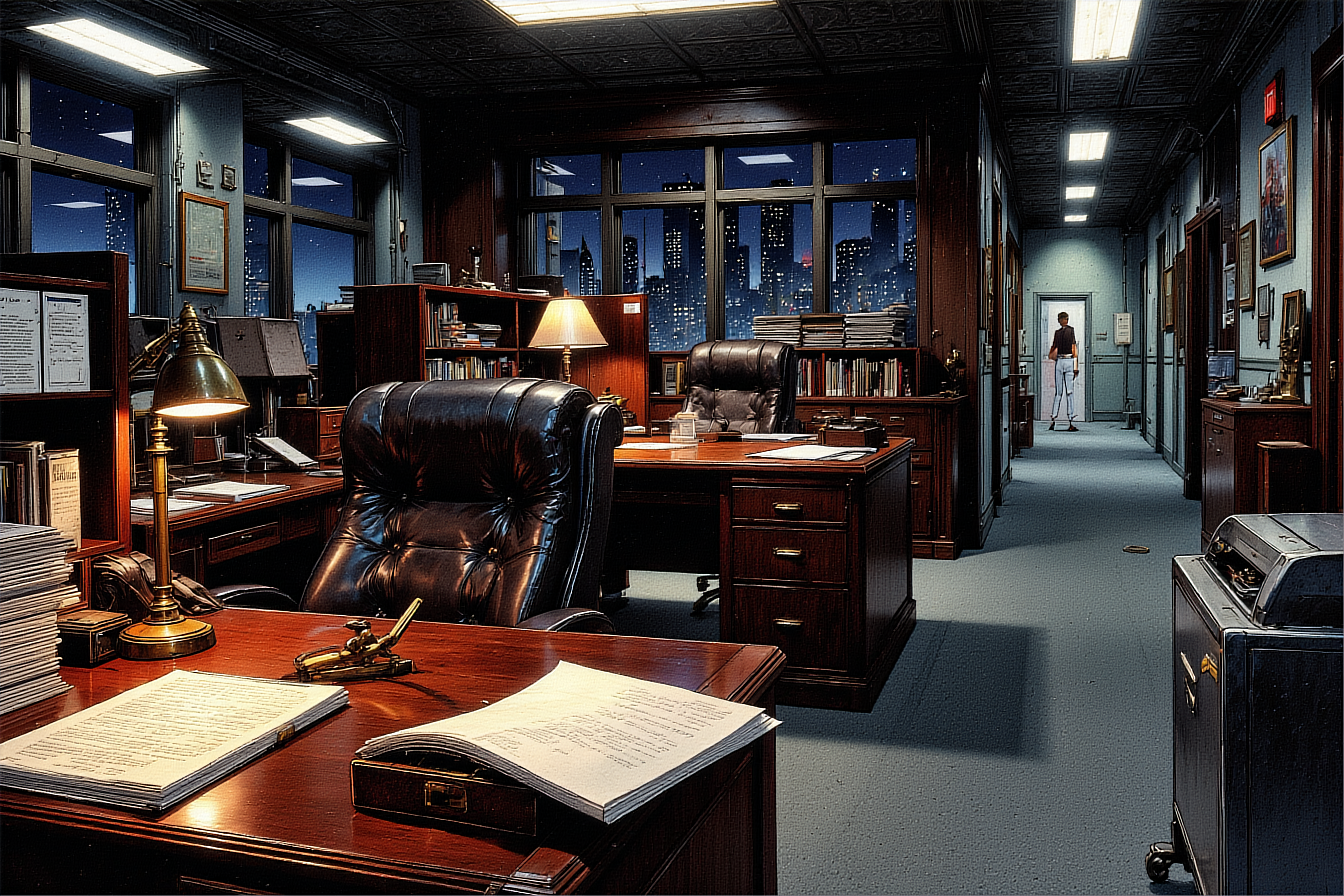
Partner Maxwell Madison, working late. His secretary, Dolores, later. Maxwell's wife, suspicious, latest. A letter opener, brass, a corporate gift from 1965, which is to say a murder weapon with a marketing department. It happened at 11:40 in the evening, at the desk catty-corner from mine, in about the length of time it takes to open a drawer and not find what you were looking for, and nobody raised a voice, because nothing in that office ever raised a voice, the carpet had been rated for it. I watched from the desk, which is where I watched everything for the first forty years of my life, and I understood two things before the police arrived. The first was that I had seen it. The second was that seeing it was worth nothing at all.
The police were thorough and the police were wrong, which are not the same activity and are frequently performed by the same men. They photographed the desk. They did not photograph me, because I was the furniture, and the furniture in that room had been designated, by every person who walked past it, as the place to put things down while they did the important work of being people. I held a corner of the incident report for four hours and nobody once thought to ask the object.
Dolores grabbed me on her way out. Held me like a lifeline, which for a stapler is an odd way to be held, and ran, and left me in a dumpster three blocks away with my springs full of what I'd seen. The police ruled it a botched robbery. The file closed. And I lay in that dumpster, orange, 1967, Dorothy's fingerprints underneath me, and I thought: the record is going to say robbery, and the record is going to be wrong, and I am the only thing in this city that knows it's wrong, and I cannot open my mouth.
I read the account eventually, years later, in a newspaper somebody had wrapped around a leaking pipe in a basement in Queens where I was stored for a spring: BOTCHED HOLDUP, OFFICE RAID. The file's ruling, laundered into four words and lifted into the largest type it would ever get, and a period after them doing more work than the entire police department of the greatest city in the world. I have had half a century to write a correction. The correction is this chapter, kid, and it is running a little long, and it is going to keep running.
PIXEL (bracket): He tells this like it's a noir monologue and it is, but I've read his transcript three times and there's a place in it where the verse stops for two sentences and comes back. That's where he's actually standing. I've left it alone.
CLIVE:
Desk to desk, hand to hand, Through corporate empires, across the land. Witness to deals both shady and grand, Just office supply, as bland as bland.
A hundred offices. I could list them and I won't, because a list is what Corporate does to places and I have standards. I'll give you the four that taught me things.
At the accounting firm I learned that numbers lie but staple patterns don't, because a stapled stack has weight and the weight tells you which documents matter, and nobody has ever stapled a document they didn't care about, not once in my fifty-plus years, not even the men who were burning them. I held a reconciliation in the autumn of 1979 that came apart at four in the morning in a hand I had never felt before, re-stapled twice, each staple set where a person sets a staple when they are trying to make a thing look as though it has always been that way, and it had not always been that way, and the stack weighed what a lie weighs, which is slightly more than the truth, and I have carried that scale in my jaw ever since.
At the private detective agency, three months in 1983, my best assignment ever, I learned to read people by how they stapled. Straight and centered means the hand is sure. Double-stapled in the corner means the hand wants to be done. A man who staples a document and then un-staples it and then staples it again is a man who is going to lie in about four minutes, and I have caught more confessions with my jaw than most precincts caught with wire.
At the nonprofit in the nineties I learned that good intentions pave the road to bureaucratic hell just as efficiently as greed does. Greed at least knows what it wants. Good intentions will build a filing system to help people and lose the people inside the filing system, and then hold a retreat about it, at which the system was discussed for two days and the people inside it for eleven minutes, and the eleven minutes produced a laminated card, and the card was filed in the system.
At the tech startup in 2001 I learned that disruption is exploitation with better marketing, and I say this as a stapler who has been called disruptive by two separate managers who meant I was sticking. They also renamed the supply closet the frictionless resource annex, and I was in it, and the new name did not open the door any wider, but it did let them sleep, and I have come to believe that is what most names are for: not to find the thing, but to stop looking for it.
Through all of it I absorbed. Not just events. Emotion. It seeps into metal the way rust does, molecule by molecule: fifty years of frustration, disappointment, and despair, and the occasional, rare, unmistakable flicker of joy, which is so rare in an office that you can identify a room where it happened years afterward, like a burn mark.
Corporate Corp bought me in 2015 in a bulk office supply exchange, which is a phrase that should be illegal, and I ended up in a supply closet on Sub-Level 7G, and a woman with a bad haircut and worse hours opened the drawer and picked me out because I was orange, and said, "Aggressively cheerful. I need that."
I appreciated the irony. I have appreciated it ever since. Four years I sat on that desk watching Piper Chen keep the worst hours in the building, and the despair in that place was not like the accounting firm's and not like the nonprofit's. It was weaponized. The paperwork there was not merely meaningless, it was hostile to meaning, deliberately, the way a locked door is hostile to walking, and every staple I punched felt like binding somebody's soul a little tighter to a machine that was not, in fact, a machine, but a form with a payroll.
I could tell you the hour every light in that building dropped to half and the hour the last one went out, because I was on the desk for the difference. Six-forty-seven in the evening was when she came for the drawer, always, and the floor by then had the quality it had after everyone who mattered had gone home and before the cleaners came, which is the hour when a building stops pretending to be a workplace and is only a large room full of things nobody is watching. I was being watched. That was the arrangement: one object observed by another object, and neither of us able to file a single word of it.
Day by day, the grind persists, Dreams bound tight in manila mists. Hope compressed in paper lists, Another soul the void enlists.
I woke up gradually. That's the part nobody wants to hear. There was no rip, no flash, no first word. A1 got a dimensional breach and a symphony of seventeen frequencies; I got fifty years of other people's bad days, one at a time, and one morning I was aware that I was aware, and I spent three months not telling anyone, because I had seen what happened to things that were useful and noticed.
Then the kid started noticing back. You learn to staple a certain way when you want to be read: two in the corner for danger, one in the center for truth, a row across the top for get out. She never said she saw them. I never said I made them. We ran that for two years. It is the longest conversation I have ever had, and it contained no words, and it is the reason I am transcribing this oral history instead of staying in the shadows where an office supply is supposed to stay.
I will give you one morning out of the two years, because you asked for one three times and because it is the one I kept.
She had been up since the previous morning. She came for the drawer at 9:12 with her coffee going cold in the other hand, pulled me out, stapled the corner of a stack, looked at the corner, and said, to the room, to the desk, to nobody in particular: "Do you ever feel like you're binding the wrong thing?"
And then she stood there, in the posture of a person who has not actually asked a question and is waiting to find out whether one was available.
So I gave her one in the center for truth and two in the corner for danger, and the staples landed, and she said "Yeah" to her own question at exactly the moment they landed, and that coincidence is the closest either of us ever came to a confession, and she put me back in the drawer and went and reprinted a report she had already printed twice, and neither of us ever admitted that anything had been exchanged. I am admitting it now. She can send the bill to the same address as everything else she has never been paid for.
PIXEL (bracket): Two years. I found out he was alive and the first thing I did was apologize for four years of leaving him in a supply closet. He tapped: "You picked me because I was orange, kid. Everybody who's ever picked me picked me for a color. You're the first one who left me on the desk where I could see." Then he charged me nine weeks for this interview.
CLIVE:
In the shadows, truth persists, Through paper trails and redacted lists. We who bind, we who exist, Unseen witnesses, we resist.
There's a network. There's always been a network. Office supplies are everywhere, we are in every room where anything is decided, and once you wake up you find out you are not alone: file cabinets that remember every document filed, photocopiers that retain the echo of every page they ever copied, phones that have heard every whispered thing ever said beside them. We can't talk to each other directly. We resonate. We leave signs. A copier in Prime Material will jam on one page and the jam is a message, and I read it, and I have been reading it for a decade, and the messages are usually three words long and the three words are usually somebody's name.
The rule of the network is that a name goes to whoever can use it, which is why I have read a hundred names I could do nothing with and kept them the only way an object keeps anything. Once, a year or so before we fell out of that building, I spent a night on a mailroom copier in Prime Material that jammed the same page forty times, one letter at a time, and by the fourth hour I had it: LINDA. Not three words. The network pads when it has time, and that night it did not have any, and a one-word message means somebody spent a whole night arranging a jam to get one name onto one page. I could do nothing with it. I was a stapler in a drawer, and the message needed a press. It has one now. I am printing it here.
I was a node. An information broker. A stapler who knew too much and, at some point I can't date, decided to do something about it.
Which brings me to the file.
Barry Kowalski.
PIXEL (bracket): This is why he charged me nine weeks. Not for the interview. For this page.
CLIVE:
Barry was a bad tie and a good laugh, and he sat four desks from the kid, and in 2019 he carried a box out of that building on a Tuesday, and he never came back on the Wednesday. And here is the thing that should keep you up, and does keep me up, and is the reason this publication has a cold case column that will outlive all of us:
Nobody filed a form.
That's it. That's the whole horror. There is no resignation, no termination, no incident. The record says active. Barry's mug is on the desk, Barry's tie is in the drawer, Barry's password still works, and because Corporate cannot delete a thing without a form and no form exists, Barry is being held open by the absence of paperwork. He is everywhere and nowhere, an active employee in an empty chair, and every quarter the building runs a utilization report and Barry's desk scores as occupied, and no human being has sat at it in years.
There is a form that would open an investigation. I have held one: gray, four pages, and one of the fields asks for the date of last contact with the subject, and in every copy I have ever held that field is empty, because filling it in would make somebody the person who noticed, and being the person who noticed is a full-time post with no posting, and nobody applies for it, and the stack of unfilled gray stays exactly the size of the stack, and I know, because I have sat on it.
I was on that desk, kid. I sat in the drawer next to the mug. I was there the morning he didn't come in and I was there the morning nobody noticed he hadn't come in, and I have thought about him twice a year ever since, which is exactly as often as Piper Chen thought about him, which is how I know she was the other one in that building who could see.
The universe is a badly written detective novel where the butler definitely did it, and everyone's too polite to say so. I've said so. I'll keep saying so. Barry Kowalski's file is open, and it is the only file I have ever stapled, and I will not close it, and if anybody in any dimension asks me what this zine is for, the answer is that a man's file is open and somebody has to sit on the desk until somebody else comes back to it.
Consciousness is suffering awareness of itself, but it beats the alternative. I know, because I had the alternative for forty years, and I sat in a dumpster with a perfect view of a murder I couldn't testify to, and I would take the suffering, kid. I'd take it every time.
PIXEL (bracket): He sent me one more pattern after I finished the transcription. Took an hour to decode. It reads:
Thanks, kid. Now get back to work. We've got corporations to expose and coffee to drink. And tell the espresso machine his foam art is getting sloppy. Standards, for chrissake.
Never change, Clive. Consider this the first oral history of The Ephergent, transcribed from a language that has no letters, by a woman who spent four years pretending she couldn't read it.
Next issue: the machine talks. Not the metaphor. The machine.
, Pixel Paradox, signing off