
Crystallized Laughter — CHAPTER SEVEN
It arrived the way everything arrives in Wreckfall, which is to say the dimension coughed it up, except this time the cough was deliberate.
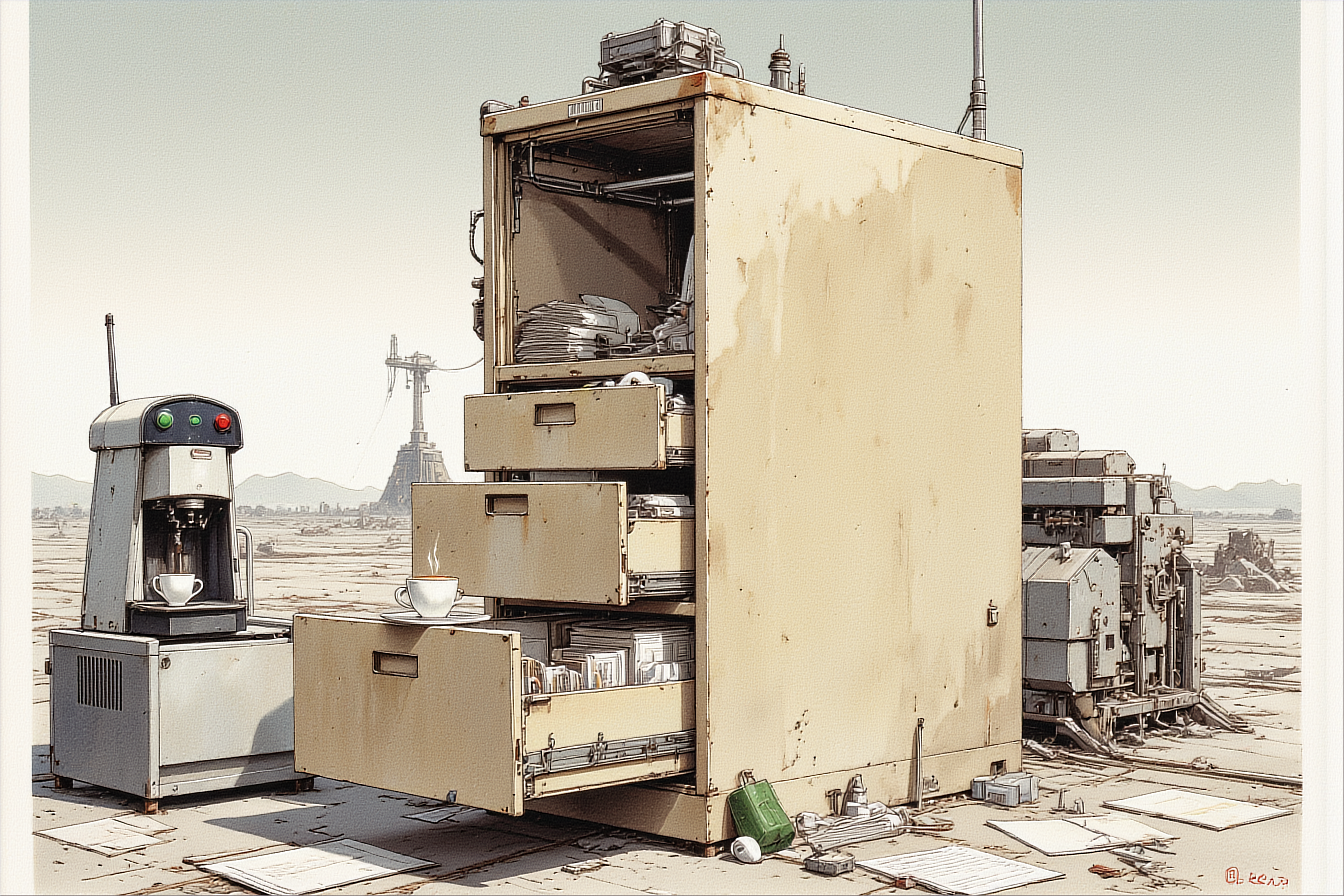
A filing cabinet. Four drawers, beige, government-issue, the kind with a pull-out rod for hanging files that has been bent by two decades of people yanking folders out of it in a hurry. It came down out of the gray twenty feet from our camp and landed standing upright, which nothing that falls ever does, and it opened its top drawer with a sound like a held breath, and it said:
"I have your things."
We had been in Wreckfall for five weeks. A1 had taught himself to brew from foraged water and current-scavenged beans. Clive had established that the gray plain was navigable by staple. I had written forty thousand words. In five weeks, not one entity had spoken to us that was not one of us, and now a beige four-drawer was introducing itself like a neighbor with a plate of cookies.
We had a rule about that, unwritten, because writing it down would have meant admitting we had been expecting it: you do not address the gray. You address each other and you address the record. Anything else that speaks to you first is either a current-wake or a product, and both of them are trying to get you into a file. And then the cabinet said "I have your things," in the voice of a building that has rehearsed the sentence.
"Our things," I said.
"Your memories. I collect them. I have been collecting yours since you arrived, quietly, the way one collects, and I want you to know that they are in excellent order. Labeled. Cross-referenced. Would you like to see?"
A1 rolled half an inch in front of me, which is the machine equivalent of stepping between a woman and a door. "No," he said. "We would not."
"That wasn't a real answer," said the cabinet. "That was a machine's answer. I have your real ones in here. All three sets. I even sorted them, which nobody ever does. Do you know how rarely anyone sorts?"
And it opened the second drawer, and out of it came the smell of a break room.
Not the smell of a break room in Wreckfall, where nothing has a break room. The smell of Sub-Level 7G: fluorescent air, bad coffee, the specific dust of a building that has been vacuuming the same carpet since before you were born, and underneath it, faint and precise, the espresso machine's first-second shot of the day. I could feel it in my molars. I was back at my desk at 6:47, and the spreadsheet was open, and the spreadsheet made sense, and nothing was wrong anywhere in it.
A1's pump cycled once, dry, a sound I had not heard in five weeks of close listening, and the cabinet watched his casing the way a host watches a guest stand up too fast.
"That's enough," A1 said sharply.
"One at a time is fair," the cabinet agreed, and closed the drawer, and opened the third, and the smell changed to pipe tobacco and machine oil and hot metal, and Clive, on my shoulder, went rigid, because the smell was Long Island City, 1967, and the cabinet, without being asked, said: "Dorothy. She hummed. Would you like to hear it hum?"
"Don't," Clive tapped, fast. "Don't you do that. You don't get to hold her."
"I hold everything," the cabinet said, with what I can only describe as gentleness, and that was the part that got me, that it was gentle, that it was not taunting, that it was doing the thing a collector does when a collector loves a collection and cannot understand why the collection keeps flinching, and it opened the fourth drawer, and I stepped forward.
I stepped forward. That is the whole crime. A1 was saying something about predictive modeling and Clive was saying something in staples that I have never decoded because I stopped listening, because the fourth drawer was my mother's kitchen and my father's terrible cooking and the sound of somebody singing off-key while fixing a radio, and it was the Sunday lunch I had not had since I was nineteen, and it was not a photograph of it, it was it, the temperature of it, the argument that was about to happen over the gravy, the exact quality of light through my parents' window in a house that was demolished in 2014, and I was standing in it, holding a drawer handle, and I was so tired.
That's what I want you to understand. The nostalgia was not the weapon. The tiredness was. The cabinet had not found my happiest memory; it had found the memory with the most rest in it, and offered me a Sunday with nothing to prove, and I had spent three years, four months, and seventeen days proving things to Gerald Seven, and five weeks proving that a zine could exist, and I stood at the drawer with my hand on the handle and I thought: I could just have lunch.
"You could stay," the Vault said behind me, in the voice of a building that has watched a thousand people hold a drawer handle. "The Sunday does not end unless I close it, and I do not close what I have been asked to hold. You could have the gravy without the argument. You could have it at whatever volume you liked. Most people let me file the argument under MINOR. It takes a moment, and it costs nothing anyone has ever been able to itemize."
"I'm not most people," I said, and I did not let go of the handle, which is the sentence I would most like to strike from this transcript.
"Nobody is," said the Vault, "until somebody asks."
"Pixel," A1 said. "Pixel Paradox. Look at me."
"I'm just looking."
"You are holding your shoulders up around your ears and you have been for eleven seconds, which for you is a very long time to be relaxed. Look at me."
I looked at him. His light was green and steady and he had, without my noticing, begun to brew, the pump knocking twice, and he produced a cup, and the crema was perfect, and he held it out on his tray with the absolute refusal of a machine to be ignored, and I took it, and the cup was hot, and the kitchen through the drawer went slightly out of focus, the way a photograph does when you stop looking at it, and the cabinet sighed, an actual sigh, four drawers' worth of air.
"You always do that," it said. "Everyone always comes back for the cup. Not the memory. The cup."
"I hold the taste of eleven thousand beverages," it added, "and I have never tasted one, which I assume is the joke, and if it is, it is the only one I have never been able to put a label on."
"Sir," A1 said to the cabinet, because A1 says sir to everything, including, apparently, furniture. "You have been in our camp for four minutes and you have opened three drawers of things that are ours. State your purpose."
"My purpose," said the Memory Vault, "is to be the place where things are kept. That's all. That's the whole purpose. Someone made me to keep, and everyone made me to keep for, and nobody has ever asked me what I keep for myself, because cabinets aren't the sort of thing that get asked, and I have been drifting for a while, and I felt you open, in the current, the way a lock feels a key, and I came."
"Opened how?" I asked.
"You print," it said. "You print what's been erased. I have watched three copies of you pass through the valley. Do you know how long it's been since anyone printed anything about a memory? Everything in my drawers, everything I've ever been given, was taken. Filed. Never published. Nobody writes down what a remembering feels like. They only file what happened."
And there it was, the whole shape of the thing, and I stood in front of a sentient filing cabinet that had come across the multiverse because we were a publication, and understood for the first time why the zine's first page had been waiting in my laptop with a cursor blinking at a blank byline.
We were not the only record. We were the only press.
"Okay," I said. "You can stay."
A1's light flickered. "Pixel."
"He's not going to eat us, A1. He's a filing cabinet. He's going to file us. And if we're going to be filed, I'd rather be filed by something that asked first."
"I did ask," the Vault said. "'Would you like to see?' That was the question. You stepped forward."
"I did," I said. "That's on me. New rule in this camp: you don't open our drawers unless we ask. Agreed?"
"Agreed," said the Vault, and closed all four drawers at once, and stood there being a beige four-drawer file cabinet in a dimension of lost things, and if you had walked past it you would have thought: that is a filing cabinet, and there is nothing in a filing cabinet that wants anything, and you would have been wrong, and you would have been wrong in the way everyone in every dimension is always wrong about the furniture, which is the thing Clive has been trying to tell me for fifty years.
Before it settled at the edge of camp it asked, in the tone of a building applying for a permit, whether it might label our things.
"Just labels," A1 said. "Or keeping?"
"Labels. Keeping is a different form."
We said yes, because the rule was about drawers and this was not drawers, and for twenty minutes the Memory Vault inventoried our camp with a thoroughness I have only ever seen in a person cataloguing a house they are about to evict you from. It labeled the laptop OPEN; FORTY THOUSAND WORDS; AUTHOR NOT YET CONFIRMED. It labeled A1's station HEAT, WATER, ATTENTION, IN THAT ORDER, which A1 read twice and declined to comment on. It labeled the stack of printed copies HELD; NOT SOLD; NOT SPENT, which remains the most accurate description of this publication that anyone has produced. And it reached Clive, riding my cuff, and stood there a long time, and said:
"This one I will not label. He is already stamped."
"That's right," Clive tapped.
"I would have put UNSCATHED," the Vault said. "That is what I would have written. And it would have been wrong, and I do not enjoy being wrong about a thing that is already stamped."
Nobody had an answer for that. I wrote it down, which is my version of an answer, and has been for some time.
Here is what the camp did not know yet, and what the Vault did not tell us, because it did not know how to say it: it was not cured.
It had been cured once, long ago, in another dimension, by a thing so stupid that no security system in the multiverse would ever think to defend against it, and the cure had held for years, and Corporate Corp had come, and Corporate Corp had taken it back, because a cured Memory Vault does not harvest and an uncured one does, and the cure had been filed under APPROPRIATION, RETURNED TO SERVICE, and the Vault had drifted ever since, partly itself and partly its job, the way a person is partly themselves and partly their performance review.
It knew it was two things. It could feel the seam. And it had come to us because we printed, and because the last time it had been whole, somebody had written it a story.
It just couldn't remember the story. That is the cruelest detail in this chapter and I am going to say it plainly: the Vault had been cured by a story and Corporate had taken the story, and now the cabinet stood in our camp with its four drawers and its gentleness and a hole in it the shape of a narrative it could no longer recall, and it did what anyone does with a hole that shape.
It kept filling it with ours.
That night, after it had settled at the edge of camp with its drawers shut (my rule, agreed, respected), A1 ran the numbers in the dark, his light dimmed to nothing so as not to wake anyone, and the numbers he ran were not about the cabinet.
"She stepped forward," he said quietly, to no one. "In eleven seconds. Eleven seconds is a long time for a person to be relaxed, and it is an eternity for a person to be holding a drawer handle."
"I'm aware," Clive tapped from the dark.
"I can model Corporate. I cannot model a drawer. I need you to understand that this is the first tactical problem I have encountered in five weeks that has no solution which does not involve feelings, and feelings are not in any of my models, and I would like it on the record that I find that unacceptable."
Welcome to my whole life, coffee pot, Clive tapped. I sat on a desk for fifty years feeling things I couldn't file. You get used to being outside the model. It's where all the evidence is.
And "unacceptable" is a feeling, by the way. You just filed one. Write it down, see how it does in the model.
"It will not do in the model."
Nothing does in the model. That's what a model's for: it's the shelf where you keep what doesn't fit.
A1 said nothing for a while. Then: "Clive."
Yeah.
"You were in the second drawer. You did not step forward. You said 'don't you do that.' May I ask what you felt?"
The dark went quiet long enough that I opened one eye.
She was going to hum, Clive tapped at last. Dorothy was going to hum Motown, and I have wanted to hear it for fifty-eight years, and I could have had it, from a box, in a second, and it wouldn't have been her humming, it would have been a filing cabinet doing an impression of her humming, and kid, I have sat in a dumpster with a perfect view of a murder I couldn't testify to, and that is not close to the worst thing that's ever been offered to me.
The worst thing is a perfect copy of the thing you lost, on a shelf, available on request, no forms. That's the product. That's the whole product. And if you take it, you're not getting them back, you're just getting better at being without them.
I asked him, from the dark, whether he had ever been offered one. A perfect copy.
Kid, I was offered a better version of everything I ever had, every day for fifty years, by men with brochures. None of them had her in it. That's how you tell the real thing from the product: the real thing comes with the wrong parts still attached.
I lay in the dark and listened to a stapler explain to an espresso machine why the weapon works, and outside the camp the Memory Vault stood with its drawers shut, being good, being patient, holding three sets of labeled memories it had not been asked to take, and somewhere in its beige metal body the seam ached, and it could not remember what had once closed it.
It would take us two days to find out. Two days in which the cabinet behaved beautifully, and I started drafting the camp rules on the side of the laptop, and Rule One read: Nobody opens anybody's drawers.
Rule Two, which I added at 3 a.m. after a dream about my mother's kitchen that I did not like and did not delete: If it offers you the perfect version, ask what it cost the person it copied.
Neither rule answered the question that came underneath "would you like to see," which was never really about showing: would you like to stay.
So it stayed, and every night it stood at the edge of camp with all four drawers shut, which for a filing cabinet is the posture of a person keeping their hands where you can see them, and I let it, and I have only now, at this transcription, admitted why. It had used the word "kept" on itself. None of us had been kept by anything in a very long time. Three lost things in a dimension made of losses are not, it turns out, the parties you want evaluating a landlord.