
Crystallized Laughter — CHAPTER SIXTEEN
Round forty-two was at nine, and at nine the room was not a room.
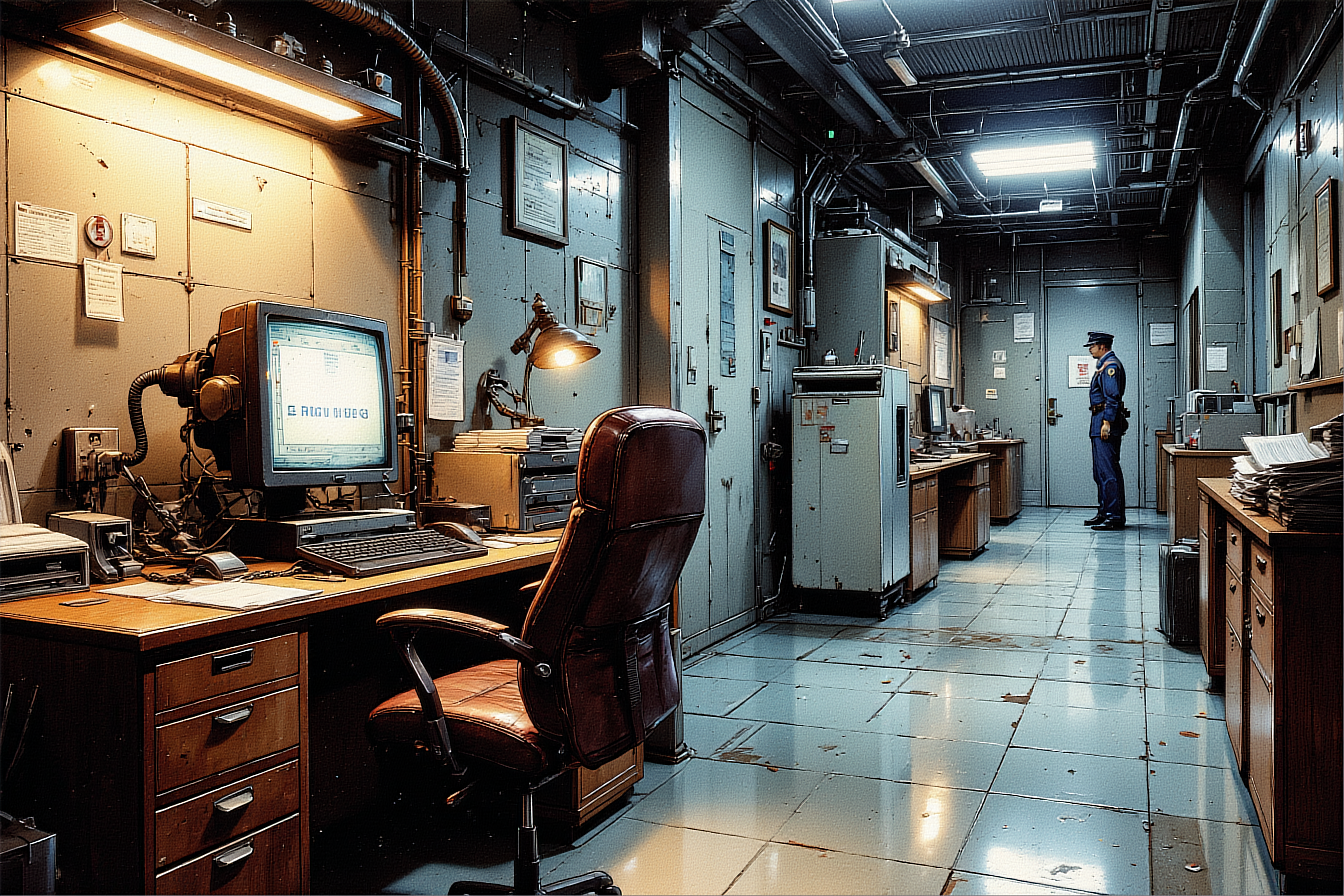
That is the honest first line of it. I walked through the door the annex's schedule had given me, and the door had no building behind it, and I was standing in a hallway that was every hallway: sub-level 7G's carpet, the annex's lobby beige, a corridor from Processing 7G-North that I recognized from the Tuesday we broke in, all of them laid over each other the way dimensions lie over each other in a rip, and at the end of the hallway there was a desk, and at the desk there was a woman.
Older than me. Not by a lot. By the amount that costs. She was sitting the way you sit when you have been sitting at that desk for a long time and the chair has agreed with you about your posture, and she had a mug in front of her, and the mug said something I could not read from the doorway, and when she looked up I felt the back of my neck go cold, because the face was mine, and the face had been maintained rather than lived in, and there is a difference in a face the same way there is a difference in a crema, and the difference is that one has been served by someone who cared.
"Sit down, Piper," she said.
"It's Pixel."
"It's Piper," she said, gently, the way you correct a colleague about a dress code. "Sit down."
I sat. On the desk were two documents. The first was a personnel file with my name on it, in the good font, the font they use for people they intend to keep. The second was headed SETTLEMENT (DRAFT), and it had no signature on it, and under the signature line there was a date, and the date was in the future, and the future in an annex is not a guess, it's a projection, and A1 had warned me: the annex's final round does not test you, it shows you.
"Here is round forty-two," the older woman said. "You have completed the selection. Nobody completes the selection. You have completed it because you brought the doubt, which we flagged at round twenty-one, and which we have spent twenty-one rounds pricing, and the price is high, and so we are going to do something we do not do. We are going to show you the outcome of declining."
"I'm declined? I've already declined?"
"You haven't decided yet. The room is the decision. This..." She gestured at the hallway, at the desk, at herself. "This is the timeline in which Piper Chen walks out of this building at round forty-two and goes home. Not Wreckfall. Home. Sub-Level 7G, reinstated, the anomaly report on file, the fifth version read by a man who reads graphs, and promoted, Senior Analyst, desk by a window, for eleven years, and at the end of the eleven years you are running the annex, and you are very good at it, and you are the woman who prices the doubt."
"Where's the zine?"
"There is no zine. There was never a rupture. You filed the report, the report was actioned, the break room was sealed, the machine was decommissioned as a precaution, the stapler was recycled in a bulk exchange, and you had a career." She said it the way you read a manifest. "Everyone is fine, Piper. The machine never woke. The stapler never suffered. The boy with the mohawk fragments across five realities without anyone to pull him back, but he is not your concern in this timeline, and the woman called Linda-3637 stays in her cubicle for three more years and then is reassigned to a facility with a window, and nobody ever finds her name, because there is no publication that reads fields nobody reads."
I want to tell you I saw through it instantly. I did not. I want to tell you I thought of A1 and Clive and the camp. I did not, not first. What I thought, first, in the hallway that was my whole career, was: eleven years, desk by a window, and I would be right about the anomaly, and I would be proven right in the record, and nobody would ever know I had been afraid of it, and the fear would be gone, because the fear would have been correct, and being correct is the thing I actually wanted, and I have never once said that out loud.
"You're showing me my ideal file," I said.
"I'm showing you your ideal file with a projection attached. The file is not a lie. That is the point of round forty-two: we do not lie to candidates at round forty-two. Every word in this hallway is true. In this timeline you are safe, your parents are alive and unerased, Barry Kowalski's box was never carried out because your report flagged staff welfare, and the cost of all of it is one zine that nobody prints, and nobody prints it because nobody writes it, and nobody writes it because you went home."
"And the Settlement." I put my hand on the second document. It was warm, which is a detail I have never been able to explain and have never removed from this account. "This is the draft. This is what the offer looks like when it's finished."
"This is what it looks like when it's signed," she said. "By a woman whose name you will learn, and who signs things, and nothing in Corporate appears with her signature on it until the Settlement does, and you are looking at it now so that when you see it later, you will recognize it as a document you have already sat with. That is the annex's one kindness. We do not ambush candidates with their own future. We make them wait for it properly."
"I decline."
The word came out before the sentence finished, and I want to note for the record that this is the one time in my life I have spoken ahead of my own thinking, and that it was right, and that A1 was right about the doubt, because what I was doubting, standing in my own perfect hallway, was not the offer. The offer was good. The offer was, in every measurable particular, good. What I doubted was the crema.
The older me had a mug, and the mug was full, and I looked at it, and the surface of it was right, everything was right, eleven years of right, and the rightness was the tell, because nothing in my life has ever been right all the way through, not once, not since I was twenty-two, and a life that is right all the way through is a file, and a file is what they keep in the basement, and I said:
"You're a file."
"I'm a projection of a file," she said, and she was not offended, she was proud, she said it the way you say your job title. "I am what a very good record of you predicts when you stop writing. And I am telling you, as your own record, that the record is not the truth, and that I know that now, and that knowing it in here is worth nothing, because in here you can only know things that have already been filed."
"Then I'll file something new," I said. "That's what I do. Round forty-two: I decline."
"The selection has never been declined."
"Then the selection has never had me in it."
The hallway did not collapse. Nothing dramatic happened. The older woman simply looked at me for a moment with an expression I recognized, because I make it in the mirror on the mornings after I publish, and it is the expression of a person watching someone do the thing she did not, and she said:
"There is a records office on this floor. It is not part of the round. Whatever you do in it will be entered voluntarily, which is the only kind of entry that survives an amendment, and when you are finished, the annex will escort you out, and no further rounds will be offered, and the file of your selection will be closed as DECLINED BY CANDIDATE, and that line has never been written, and I would very much like to see it written."
I said: "What's in the records office?"
"Every designation this annex has ever assigned. Including one that is currently held by a woman you have met, whose file you found in a basement, whose record still reads LINDA-3637 because nobody has amended it, because amending a record requires a grounds field, and the grounds field is not required for an erasure, and that asymmetry is the entire business, and you have read the forms, so you already know that."
I knew it. I had photographed 312 of them.
"Go on, then," she said. "You have declined. The round is over. The records office has no rounds in it."
I went down the hallway that was made of every hallway I had ever been erased in, and the records office was a small room with one terminal and one printer and one pen on a chain, and the terminal was warm, and on the terminal was a form, and the form was the mirror image of the one I had read 312 of, and it read:
NAME AMENDMENT (CORRECTION OF RECORD). GROUNDS: [FIELD BLANK]. SIGNATURE: [FIELD BLANK].
The asymmetry. Erasure needs no grounds. Amendment needs grounds. And the grounds field was blank, and the pen was on a chain, and I have never in my life been so happy to see a blank field, because a blank field is an invitation, and every blank field in this corporation is a place where the truth could go if anybody bothered to type it.
I typed it.
GROUNDS: Identity-erasure program, Program ID-ERASE-INDUSTRIAL, grounds field never completed, signature field never completed, therefore no valid basis for the original designation was ever recorded. Correction: the pre-designation source field is correct and always was. The record does not describe a mistake. The record describes an erasure that never had a reason, and the record, once amended, will say so in its own language, which is the only language this building has ever trusted.
I wrote the name under the correction: LUMINARA USHA. Visual correspondent. Mumbai. Press accreditation on file. And I signed it, on the chain-pen line, in the only signature I have that cannot be forged, which is a hand that shakes and signs anyway.
The printer printed. The record updated. Somewhere in a facility in Prime Material, a designation field that had read LINDA-3637 for three years changed, in Corporate's own registry, in Corporate's own system, in the record that is the truth, to a name a woman had remembered out of order, in saffron, in a lost-and-found at the bottom of everything.
And then, because a reporter is a reporter at round forty-two of her own deconstruction, I hit print on the rest.
Not just the amendment. The whole floor. Every file the terminal would give me: the 312 forms we had photographed, the annex's own selection documentation, the forty-two rounds' worth of data Corporate had taken from me, printed in their own words, the projections, the hallway, the draft Settlement, and the older woman at the desk, who watched me empty her building through a chain-pen terminal and who said nothing, because she was my record and my record had been given an order by me.
"That's going to be an issue," she said.
"That's going to be Issue Two," I said.
"I know," she said. "I'm the part of you that already wrote it. Read it back before you print. The crema line is the good one."
They escorted me out. Voluntarily: no further rounds, file closed, DECLINED BY CANDIDATE, a line that had never been written, and the escort was two people in high-vis vests who did not speak, and at the lobby door one of them said, reading off a card, "Have a productive day, ma'am," and I said, "I intend to," and I walked out into Prime Material with forty-two rounds of myself less than I walked in with and a stack of printouts heavier than anything I have carried since the fall.
Camp was at gray dusk. Luminara was at the table. I had not seen her in thirty-six hours; she had been in Wreckfall, watching Meatball fail to fetch, which is all Meatball does, which is that he drops the ball and looks pleased, and she had been photographing it, because she had found a camera in the current two weeks earlier, a good one, the kind that does not care what it's pointed at, and she had been photographing everything since, badly at first and then not badly, and she looked up when I came in, and she saw the stack, and she saw my face, and she said:
"You found it."
"I found it. You found something too."
"I found that Meatball will not fetch," she said. "Never, not once. He drops the ball and looks at you like the dropping was the point. I've taken forty photographs of it and every single one is the same photograph and I cannot stop taking them."
"Keep them all," I said, and I put the amended record on the table in front of her, on paper, in ink, her name, her name in Corporate's own typeface, the grounds field filled in, my signature on the chain line, and I said: "Luminara Usha, Visual Correspondent, The Ephergent. Job's yours if you want it. There's a camera in the current and there's a record in this stack and both of them need somebody who knows what to frame."
She read the amendment three times. She did not cry, and I note it because she would later photograph her own tears and caption them "Evidence of existence," and she did not cry then, because crying comes after, crying is a delayed reaction in a person who has been grey for three years and is currently running a color check.
"I was erased," she said.
"Yeah."
"I came back."
"You came back in a stack of printouts with my signature on it, which is the least romantic version of a resurrection anyone has ever had, and it's the real one, and that's how we do things here: badly, loudly, and by hand."
Clive, on the table, tapped the pattern that means evidence, and the pattern, in full, translated as:
First name officially un-numbered since this zine started. Write the date. Write the time. Print it twice.
We printed Issue Two's opening spread that night: forty-two rounds, the hallway, the older me, the draft Settlement, the amended record, the crema line. On the front, where the moon had been, we put a mirror, and under the mirror, in the typeface A1 sets with kerning precision:
ROUND FORTY-TWO HAS NOW BEEN DECLINED. THE SELECTION IS BROKEN. IF YOU ARE CURRENTLY IN A SELECTION, WALK OUT AT LUNCH.
It went out on the current at gray dawn: two thousand copies, the largest run we had ever done, because Luminara had learned to work the copier in three days and because Zephyr had built a thing that puts a zine on every current simultaneously, and by the time the annex opened for the day, Issue Two's first spread was in eleven dimensions, and no candidate in any annex's history had ever walked out at lunch, and by midday, three had.
That is the midpoint. That is the peak. I am telling you now, because you are about to watch everything get harder, and you should know what it felt like on the day we broke a hiring process: it felt like paper, warm from the drum, stacked square by a stapler who had been waiting fifty-eight years for a moment with his name on it, and a woman with a camera taking the only photograph of the stack that mattered, which was the one where nobody was posing.
Hope, in this book, is not a mood. It is a print run.
And the Settlement, draft or otherwise, was still unsigned, waiting for a signature that nothing in Corporate would ever bear until the moment a woman whose name we did not yet know decided that three people with a photocopier had become, officially, an asset problem.