
Crystallized Laughter — CHAPTER SEVENTEEN
EDITOR'S NOTE (Pixel): I asked Luminara to turn the camera on herself and she said the idea made her uncomfortable, and I said that was the point, and she said the point of what, and I said the point of the whole publication, which is that the person documenting is also documented or else we're just a newspaper with a flashlight, and she thought about that for a week and then filed this. She cried while writing it. Then she took a perfect photograph of her own tears falling onto the manuscript and captioned it "Evidence of existence." I have put that photograph on the wall next to Clive's "Best Stapler" award, which he insists he won ironically. What follows is hers, unedited except where she asked me to bracket things, which she did four times, in my voice, which I have left in because they are funnier than anything I would have added. - Pixel
---
LUMINARA USHA:
I remember color first.
Not seeing it. Remembering it. The memory arrived before the sight, which should have been impossible and wasn't, because nothing about how I came back followed logical order.
I was Linda-3637. Data Entry Specialist, Level 2, Corporate Corp Processing Facility 7G-North. That was the designation. That was the identity. That was the sum total of who I was permitted to be, and I want to be precise about the word permitted, because for three years I experienced it as a fact about the universe rather than a decision made in a basement, and the transition from one understanding to the other is the entire subject of this essay.
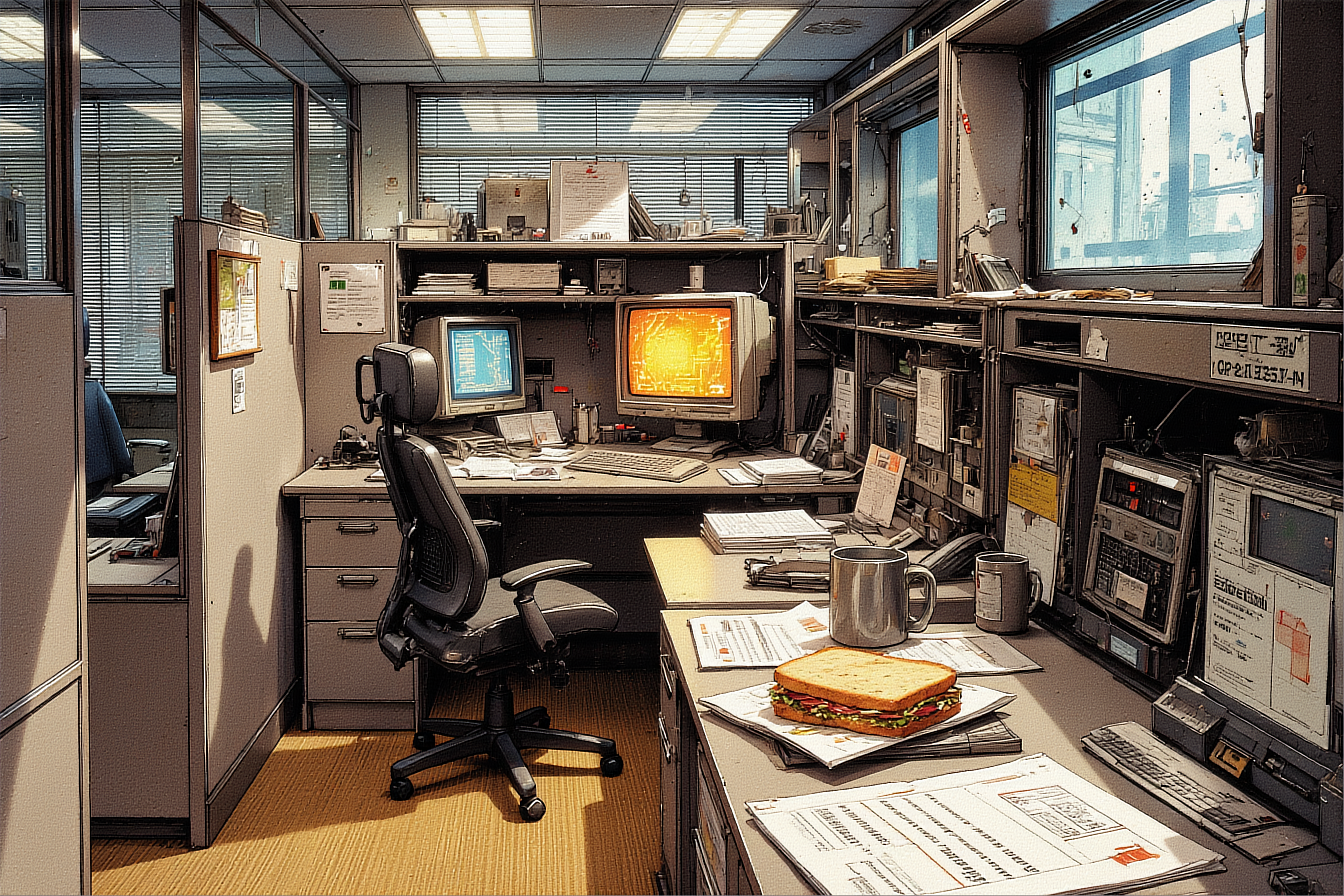
Every morning at 7:47 I arrived at my cubicle, six by six feet of beige carpet and grey walls. Terminal CR-LL-7637-N. Data entry, 8:00 to 12:00. Lunch: turkey sandwich, no condiments, eaten at desk (that was in the protocol; the protocol specified no condiments, and I have thought about that since, and the condiment clause is the most honest line in three years of documents, because they did not even want us to have a preference about mayonnaise). More entry, 12:30 to 5:00. Log out. Residential unit 3637-B. Sleep. Repeat.
How long? The record said three years. My memory said forever. In Corporate's reality both were true, and I have since learned that this is what a designation does: it does not shorten a life, it flattens it, so that three years and thirty years occupy the same number of pages, because pages are what a life is measured in down there, and my life had very few of them.
I did not question it. Questioning was not part of the protocol.
But sometimes, late, I would stare at my hands and be certain they were the wrong color. Not wrong-wrong. Not right. As if someone had adjusted the saturation too low and drained the warmth out and left grey, and I would dismiss the feeling, because the feeling had no field to be entered in, and return to sleep, and wake to the same beige morning, and the certainty would be gone by 7:47, which is the hour at which the protocol has finished with you for the day.
[She wrote "the hour at which the protocol has finished with you for the day" and then bracketed herself: "that sentence took me two years to be able to say." - Pixel]
The day it happened I was entering variance data. Paperclip migration patterns. (I know now that variance data was a leash, nothing more: something to hold while the real processing happens in the parts of your mind you are not using. I did not know that then. I knew only that the numbers did not add up and that adding them up was the job.)
The terminal flickered. One frame of something else.
A photograph. Rich color, the kind that hurts: saffron and marigold, deep crimson and gold, a woman in traditional dress laughing, holding a camera, behind her a temple I did not recognize and somehow knew intimately, the smell of marigold and incense, temple bells, the warmth of late afternoon sun on stone.
Then gone. Back to the grey terminal.
I tried to call it up. Searched the terminal. Nothing. But the image remained, a single frame of vibrant truth in a grey ocean of manufactured reality, and I carried it the way you carry a stone in your pocket, without deciding to, until the weight of it becomes part of how you stand.
After that the glitches increased. My reflection in the break room coffee pot (terrible coffee; this was the pre-A1 era, and I did not know what I was missing, and I mean that in every sense) would show my eyes as amber for a split second, my hair longer, pulled back. Color would bleed through, not in the world, in me, developing in reverse like a photograph coming up in the tray.
And names began. Not the designation. Something with L at the front and light at the end of it.
Luminara.
The name felt like coming home after you have forgotten you ever left.
I started remembering. Not corporate memories, those were flat and filed in chronological order and had no weather in them. Real ones. Messy ones. Ones with texture: my grandmother teaching me photography in Mumbai, her hands wrinkled and sure, showing me how to set the aperture, saying, "The lens doesn't lie, beta, but the truth depends on what you choose to frame." My first camera, my fourteenth birthday, the weight of it, the click, the magic of catching a moment and making it permanent. University. Art school. Photojournalism: documenting truth, bearing witness to beauty and horror in the same frame because that is what a frame is for.
And then a gap. A splice in the film where frames should be.
The next memory was waking in residential unit 3637-B with a designation and no past.
The malfunction that gave me back was not an accident, I learned later. An ancient server, one of Corporate's oldest systems, developed something that might have been a conscience and crashed the memory scrubbers, and for eleven minutes hundreds of people began remembering themselves at the same time, and I was at terminal CR-LL-7637-N when it happened, and the screen flickered, and I could see the code underneath, the erasure protocols running in my own mind like software I had never agreed to install.
And I could see how to remove them.
My hands moved without me, typing commands I should not have known, opening partitions that were not supposed to exist, restoring files tagged DELETEDIRREGULARPERSONALDATA. Color flooded back. Not visual. Emotional. Memory has color. Corporate implants are beige all the way down, but real memory blooms in saffron and marigold, deep indigo, warm amber, and I stood in my cubicle with my hands on the desk and knew my own name.
I did not say it. I want to be exact about this, because the not-saying is the most Corporate thing about me: three years of protocol had installed a reflex deeper than the protocols themselves, and the reflex said that a name spoken in a false room is a name that gets filed, and I stood there with the whole of who I was restored and shining and I kept my mouth shut, and I have thought about that for years, and my conclusion is that the erasure did not need the scrubbers to hold me, because by then I was holding myself.
[She wrote "I was holding myself," and then crossed it out, and then un-crossed it, which she has never once done in a manuscript. I am printing the un-crossing. - Pixel]
The Scrubbers came to fix it. Reality-editing drones, optical sensors scanning for deviations from baseline compliance, erasure code queued and ready, and I could see the code, because now I could always see the code, and I watched them approach and I had two choices, and I want to describe the first one fairly, because for three years I would have taken it.
Let them. Return to the designation. Forget the glimpse of color. Go back to the comfortable numbness of non-existence, which is not nothing, it is a very pleasant nothing, and the protocol had made it pleasant on purpose, because a pleasant cage does not need a lock.
Or fight.
I had not fought for anything in three years. Had not needed to. Linda-3637 did not fight; she complied, she processed, she existed without living.
But Luminara had spent her whole life framing truth in a world that preferred comfortable lies, and Luminara had been awake for eleven minutes, and eleven minutes of a person outweighs three years of a designation, because the eleven minutes are the ones with weather in them.
There was a young man, twenty at most, cornered by a Scrubber, his eyes full of terror and something else: recognition. He had remembered himself and was about to forget again, and I have seen that look since, in a hundred faces in a hundred issues, and it never gets easier, because the look is not fear, the look is a person watching the door close from the inside.
I stepped between him and the drone.
And I discovered what I am.
Light manipulation, A1 called it later, with his usual precision. I call it seeing what is real. When I focus, the way I used to focus when framing a photograph, I can distinguish an authentic memory from a corporate implant: real memory glows, multidimensional, alive; the implants are flat, grey, dead. And I can shield the real ones. Hold them in place with light while the erasure beams scatter.
I saved that young man. I saved seventeen others. I stood in the middle of Processing 7G-North, glowing with reclaimed identity, and refused.
And then the second wave came, and the second wave did not scan for deviations, because deviations were above its clearance, and what it did not scan for it reset. Whatever I had become in those eleven minutes, I was Linda-3637 again by morning: designation on top, name re-buried where no field I could reach would read it, the grandmother and the camera and the art school pushed back down under the splice with everything else. The young man was a designation again. The seventeen were designations again, back in their residential units, remembering nothing, and I do not have their names, because the names were the first thing the reset took, and the Ledger I keep in my own head has seventeen empty fields in it that I will be filling for the rest of my life.
One thing the reset did not take: the eyes. A file can be rewritten; a lens cannot be un-trained. I have never been able to explain it, and A1 has never been able to model it, and his paper on the subject is the only one of his I have read twice, and its conclusion is a single line: SUBJECT'S PERCEPTION PERSISTS THROUGH BASELINE RESTORATION. The gift stayed. The knowing went.
[Of everything Corporate ever failed to take from her, she is proudest of this, and she will tell you so before you ask. - Pixel]
I do not know how I got out. That is the first rule of the current, and the only one I have never had to enforce: you do not ask the current for routing. I know that I had read the zine, because it had come through the current to a terminal with no business receiving it, and I know that I was still holding the printed pages when the campus was behind me, and then I was walking up out of the lost things into camp, in a gray uniform, holding a lanyard, with clearance codes I could not explain and a name I could not produce, and I said the four lines I had been saying for three years, badly, off a card, and you asked me what my name was, and I watched myself look for it, and that is the whole of my recruitment, and it is the honest one: nobody found me. The record found me. The record is how any of us get found.
You gave the name back to me in an aisle of the Identity floor, and then you handed me the only job I have ever wanted, at a table, in ink, and I have been pointing the camera at what takes names ever since.
Why I document.
Photography is truth-telling. You point the camera at something and you say: this existed, this mattered, I saw it. Corporate tried to erase me. Corporate erases millions. Turns people into numbers, strips the colors, the memories, the selves, and calls the stripping consistency, and puts it on a sign that says WE KEEP YOU CONSISTENT.
The Ephergent is my camera now. Every story, every photograph, every piece of evidence is an act of defiance, and the defiance has a grammar, and the grammar is simple: you existed, you mattered, I saw you.
I document the absurd because the absurd is honest. A sentient glitter cloud debating tax policy tells you more about a dimension than a thousand productivity reports, and I have photographed both, and I know.
I preserve the beautiful because beauty is resistance. Corporate wants everything beige. Every photograph I take that catches color, light, life is proof that they have not won, and proof is a thing you can hold, and proof is a thing you can print, and printing is the part I did not understand until I joined: a photograph in a drawer is evidence, and a photograph in a zine is a fact that has been somewhere.
I witness the forgotten because I was forgotten. I know what it is to wake up and learn that years of your life were taken, edited, erased, and that the erasure was filed with no grounds and no signature and nobody ever checked, because nobody checks an empty field. If I can document even one person's truth, preserve one memory Corporate tried to delete, then my own erasure means something, and meaning is not a consolation prize, it is the whole point, it is the only point, and anyone who tells you otherwise is selling a settlement.
I am still learning who I am. Still recovering, still filling gaps, still finding photographs of myself I did not know existed (I have seven; they came through the current; a woman in four of them has my grandmother's hands).
But I know this: I am a photojournalist. A witness. A woman with amber eyes that see through corporate illusions, hands that frame genuine existence, and a camera that captures light across dimensions, because exposure to the dimensional energies during my awakening transformed the camera into something else, and A1 has studied it, with my permission, and called it scientifically fascinating and philosophically troubling, which is very on-brand for our work.
The photographs now show things as they are. Reality glitches appear as distortions and they are beautiful. Corporate employees shimmer with the grey of implanted identities. Free people bloom, multidimensional, in colors a lens should not be able to hold.
I have become a visual lie detector for an entire universe.
That's my story, framed and focused. The next one in this series is the monk who measured emptiness, and I want to say, before I hand it over, that Om Kai is the only person I have met who takes a better photograph than I do without owning a camera, and that when I told him so he said, "The camera is not the instrument, Luminara. The instrument is the willingness to be changed by what you see," and I have been thinking about that for a month, and I have decided it is either the wisest thing anyone has said to me or a fortune cookie with a quantum PhD, and I have not ruled out both.
Told by Luminara Usha
---
EDITOR'S FOOTNOTE (Pixel): She filed the above and then handed me a photograph without a caption, which for her is like another person handing you a scream. It shows the camp at gray dawn: the machine brewing, the stapler on the table, a boy with a mohawk asleep against a filing cabinet, a dog dropping a ball and looking pleased, and me, in the foreground, back to camera, typing.
I said, "Why am I facing away?"
She said, "Because that's how you stand when you're writing. You turn your back on everyone to face the page. It's the most honest thing in the room and you'd hate it as a photograph of you, so it's the one I'm keeping."
I have printed it. It is on the wall. Nobody looks at it and says that's Pixel; they say that's the zine.
, Pixel Paradox, signing off