
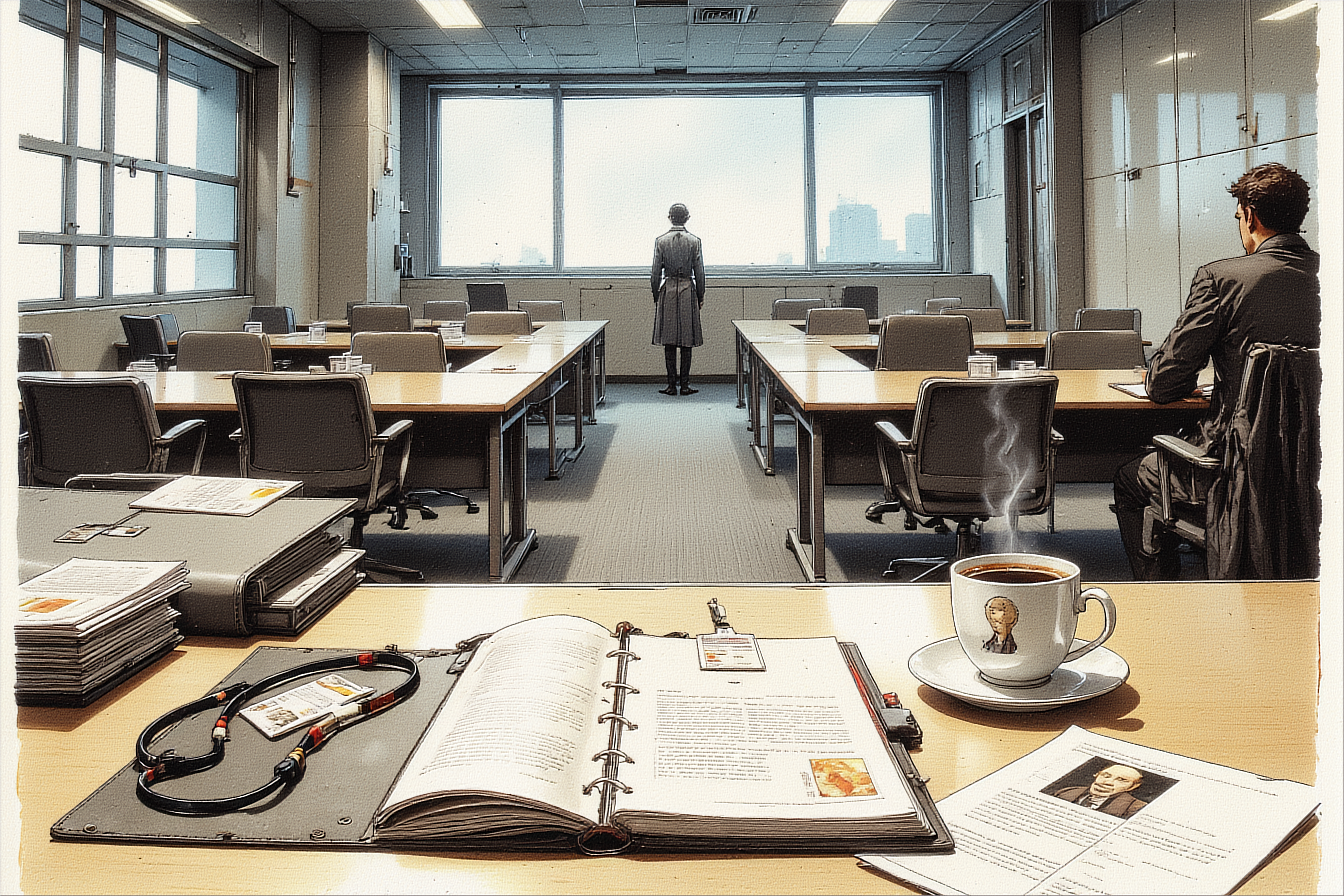
Crystallized Laughter — CHAPTER NINETEEN
The offer arrived on a Tuesday, because Tuesdays, and it arrived by courier, because Corporate still believes in couriers when the parcel needs to look like it was carried by a person who believes in it.
He was a human man, mid-forties, gray suit, gray tie, gray folder, the uniform of a man who has been told he is a trusted advisor so consistently that he has stopped checking. He came through the current the way a person comes through a door they have knocked at first, which is to say properly, with an appointment, and the appointment was printed on a card, and the card read: REPRESENTATIVE, TRANSITION SERVICES, BUSINESS BUSINESS INC.
We knew him immediately. Everyone in every dimension knows him. He is the man who arrives when the forms have run out of options, and he is always polite, and he is always carrying a folder, and the folder always opens the same way.
"Ms. Paradox," he said. He did not say Piper Chen, and I want you to notice that, because it was deliberate, and it was the first move of the offer, which does not begin with a gift, it begins with a demonstration of knowledge: I know what you call yourself now, and I am choosing to use it, which means I have read your file, which means your file is mine.
"Call me Pixel," I said. "Everybody does."
"Pixel, then." He sat down, because the offer involves sitting, because standing offers are threats and sitting offers are relationships. "I've been asked to bring you something, and I've been asked to say certain things around it, and I'll say the certain things first because they're required, and then I'll show you the folder, and you can do what you like with the folder."
"Say the certain things."
"Corporate Corp acknowledges that the variance incident of eleven months ago resulted in an administrative outcome that, on review, was not optimal."
There it was. Not a mistake. An outcome. Not optimal. He delivered it like a man reading a warranty, and he read it badly, because he had read it before, probably in a mirror that morning, probably to himself, and the phrase had never once tasted like anything, and I sat in my own camp in a dimension made of losses and listened to a man describe my erasure as an administrative outcome that was not optimal, and what I felt, and I am going to be honest in this chapter even where the honesty is unflattering, was relief.
That is the shameful part. Not temptation. Relief. Because for eleven months I had been an unoccurred person, a gray box with a name stapled to it, and a man in a gray suit had just told me that the machine had noticed, and the machine noticing is the closest thing to absolution a system like that is capable of producing, and I wanted it, and wanting it made me sick, and being sick about wanting it made me write the chapter you are reading.
"Go on," I said.
"The folder contains your reinstatement. Not a copy: the original file, unaltered, with a corrected incident report attached, filed under grounds that I am not at liberty to summarize but which you are at liberty to read. Employee ID-7G-2847. Senior Analyst, Anomaly Detection. Your own department, your own title, the promotion your supervisor recommended in a document that was, on review, improperly filed. A desk by a window."
He opened the folder. Inside: my badge, with my face on it. Not a gray box. My face, in full color, in the font they use for people they intend to keep, and under the photo, PIPER CHEN, and under the name, a small line I had never seen on a badge before, which read: RESTORED.
"And a section on staff welfare," I said.
"I'm sorry?"
"There's a section on staff welfare. In the corrected report. Because in the file where I file the fifth version properly, there's a section on staff welfare, and Barry Kowalski's box never gets carried out."
The representative looked at me the way you look at a person who has read ahead in the document you are holding, and he said, carefully: "There is a section on staff welfare."
"Then it's got Barry in it."
"It has a staff welfare provision that would address cases of that kind, yes."
"Where's Barry?"
"That is not within the scope of this folder."
"Where is Barry Kowalski?"
"I don't have that information, Ms. Paradox. I have a folder, and the folder has a badge, and the badge has your face, and the rest of it is outside the scope of what I was asked to bring."
Outside the scope. Four words. I have printed them on the front of an issue and I will print them again here, because the entire offer is those four words: everything you want, in scope; the person you were thinking of, out of scope; the scope is drawn by someone you will never meet; and the folder is open, and the badge is face-up, and the coffee is being poured.
Because A1 was pouring. Because A1 pours when a stranger sits down, it is his version of a gun on the table, and the representative took the cup, and the crema was perfect, and he drank, and he said, "That's remarkable," and A1 said, "Thank you, sir," and A1's light was green, and steady, and I have since asked A1 what he was doing in that moment and he said:
"Running the offer. Six hundred thousand variants. The offer is not the badge, the badge is the receipt. The offer is what happens to you in month nine, when the corrected report has been amended once, and again, and the staff welfare provision has been quietly superseded, because a provision can be superseded by a form and a form does not need grounds, and you will be back at the desk by the window in a building where a man vanished without a form, and you will file the anomaly reports, and they will be actioned, and the action will be a filing, and you will know that, and you will still file them, because the desk is by a window."
"And the rest of it," the representative said, "is personal. I was asked to say that the personal section is not required to be read aloud, but that the option exists."
"There's a personal section."
"There's a personal section."
He turned the folder around and I read it. I am not going to write out everything, because some of it is mine and the zine's rule about mine is different from its rule about theirs, but I will write the shape: it contained my parents. Not their names. Their file status: intact, unerased, current, with an attachment noting that in the reinstated timeline their 2014 property matter resolves differently, which is Corporate's way of saying we can give you back the house, and under that, a photograph I have not seen since I was twenty-two, the kitchen, the light through the window, the radio my father was fixing, and my mother's laugh, which was too loud for that kitchen and exactly right for it.
The idealized file, delivered by a man in a gray suit, with a badge on top.
That is the offer. Not money. Not safety. The Sunday. It always comes back to the Sunday, because Corporate's research on me is excellent, and their research on anyone is excellent, and the thing they will offer you is the thing with the most rest in it, and if you are tired enough, and I was tired enough, the offer does not even look like an offer. It looks like an ending to a sentence you have been trying to finish for eleven months.
I want to tell you what I said next in one clean line of courage. I cannot. What I said next was bad. It was the worst thing I have said to another human being in this book, and I print it because the zine does not round, and because declining badly is still declining, and because snark over grief is the whole personality I am trying to outgrow, and the fact that I did not outgrow it on the day it mattered most is a fact about me that stays in the file.
I said: "Is there a meeting room I can decline in? I'd hate for this to be informal."
And then I said, worse: "You brought my mother's kitchen in a folder. That's a nice touch. Did it test well? I hope it tested well, because where I come from we used to call that a bribe, but I'm sure you have a form for it, you have a form for everything, do you have one for taking a woman's mother and putting her behind a cover page?"
And then, worse still, because the representative had gone quiet, the way people go quiet when the thing they are being shown is not in the training: "Here's what I want you to write in your report. Write that I read it. Write that I looked at the photograph for eleven seconds. Write that I was offered a desk by a window and a section on staff welfare and a man named Barry who is out of scope. And then write that I declined, and write that I declined badly, because I did, because I am not a person who does this gracefully, I am a woman who filed a corrected spreadsheet to keep her job and then un-filed it in a break room at 2 a.m., and grace is a luxury product and I have never been able to afford it, and I want your file to have my real voice in it for once instead of the voice you modeled."
He wrote it down. Of course he wrote it down. Everything gets written down; that is the only rule of this universe that has never once been broken: someone is always holding a pen.
"I declined," I said. "Round forty-two was a warm-up. This is the actual decline. Put it in the file. And take the badge with you, because if you leave it here I will put it in an issue, and the issue will go out on the current, and your escalation will be that a woman in a dimension of garbage published her own reinstatement like a wedding announcement."
He took the badge. He folded the folder. He finished his coffee, because he is a professional, and at the door he stopped and said the only human thing he said all afternoon:
"For what it's worth, the staff welfare section does have him in it. Kowalski. It has him in it with a name and a date and a note that says locate and confirm. It was written by someone. I read it before I came. I don't know why they left it in."
"Because nobody reads the attachments," I said.
"Because nobody reads the attachments," he agreed, and left, and the current took him the way current takes everything, and I stood in the camp holding a photograph that was not mine anymore, and A1 brewed without being asked, and the crema came out perfect, and I put the cup down and did not drink it for a full minute, because I was angry at a machine for making something better than Corporate's copy, and then I drank it, and it was better than Corporate's copy, and I cried into it, which is now, apparently, a thing I do at least once a quarter in this publication.
Then I wrote it up. All of it: the folder, the badge, the photograph, my mother's laugh, the eleven seconds, the bad decline, the sentence about the bribe, the professional quiet of a man who had brought the same folder a hundred times, the staff welfare section with Barry in it, written by someone, unattached, unread.
I wrote it in one sitting, in my own voice, without softening the snark, because softening the snark would have been the first amendment, and Corporate amends, and I do not.
The piece ran as the closing spread of Issue Two, and it is, by subscriber mail, the most-read thing we have printed, and the mail is not about Corporate. Four hundred letters, and the letters say, roughly: I have also declined something badly. I have also been cruel to a man holding a folder because the folder was right and I was tired. Thank you for printing the cruelty with the courage in it, because everyone prints the courage and nobody prints the ten minutes before and after.
That is what the piece is for. Not a refusal. Refusals are clean. What I filed is a record of a person refusing while being a person, snotty, exhausted, grieving a kitchen in a folder, and then filing the whole thing under her own byline where nobody can amend it.
And Corporate noticed.
Not the decline. Corporate expected the decline; the decline was modeled and priced and it is in the file exactly where they said it would be. What Corporate noticed was the publication of it. Because a refusal inside a room is an incident, and an incident is closed in nine seconds, and a refusal printed in a zine with two thousand copies on the current is not an incident, it is a document, and a document that circulates cannot be closed, only out-printed, and out-printing requires a budget, and budgets require approvals, and approvals require a form with a grounds field, and the grounds field on the form opened that evening in a beige office somewhere read:
ASSET PROBLEM: THREE INDIVIDUALS, ONE PUBLICATION, GROWING.
I know what the form said because Clive's network read it to him staple by staple, out of a copier jam in Prime Material, at 3 a.m., while I slept, and Clive let me sleep, and in the morning he tapped the finding on the table in front of my coffee, and the pattern translated as:
They've stopped calling us an outcome. Kid, we've been reclassified. We're a problem now.
"A problem," A1 said, from the corner, brewing the 4 a.m. shot he had already brewed at 4 a.m. for nobody and was now rebrewing for the room. "Good. Outcomes get reviewed. Problems get escalated. Escalation goes up, and everything that goes up eventually reaches the floor where they keep the attachments."
"The attachments," I said.
"The timeline, Pixel. The forty-thousand-realities attachment that is not in any box. Escalation is a ladder, and ladders are what this issue is about, and we are, at this moment, being climbed."
---
Note from the editor: the offer, badly made, is Issue Two's last spread. The next issue opens on rung five, where time is the commodity and the monastery is where the numbers went to hide. Between the two, we lost a reader: one subscriber, Dimension 7G, a woman whose laugh had been collected at 2 a.m. and who wrote, in her last letter to us, one line:
"I've stopped opening the issues. Not because they're bad. Because I laughed again last month and I could feel it leaving. Tell me that's not on me. Please print that it's not on me."
It is not on you. It is on us, and it is on the intake at the valley's mouth, and we are going to the valley again, and this time we are not stealing jars. This time we are printing the receipt.
, Pixel Paradox, signing off