
Crystallized Laughter — CHAPTER TWENTY
A zine is not a thing you write. A zine is a thing that happens to other people.
Issue Two was 2,000 copies, which for us was industrial, which for a real newspaper is a slow Tuesday, and the difference between those two facts is the entire power imbalance of this war: they own the presses and we own the volume control on the copier, and the copier does not care who owns the presses, and that is the only reason any of this is possible.
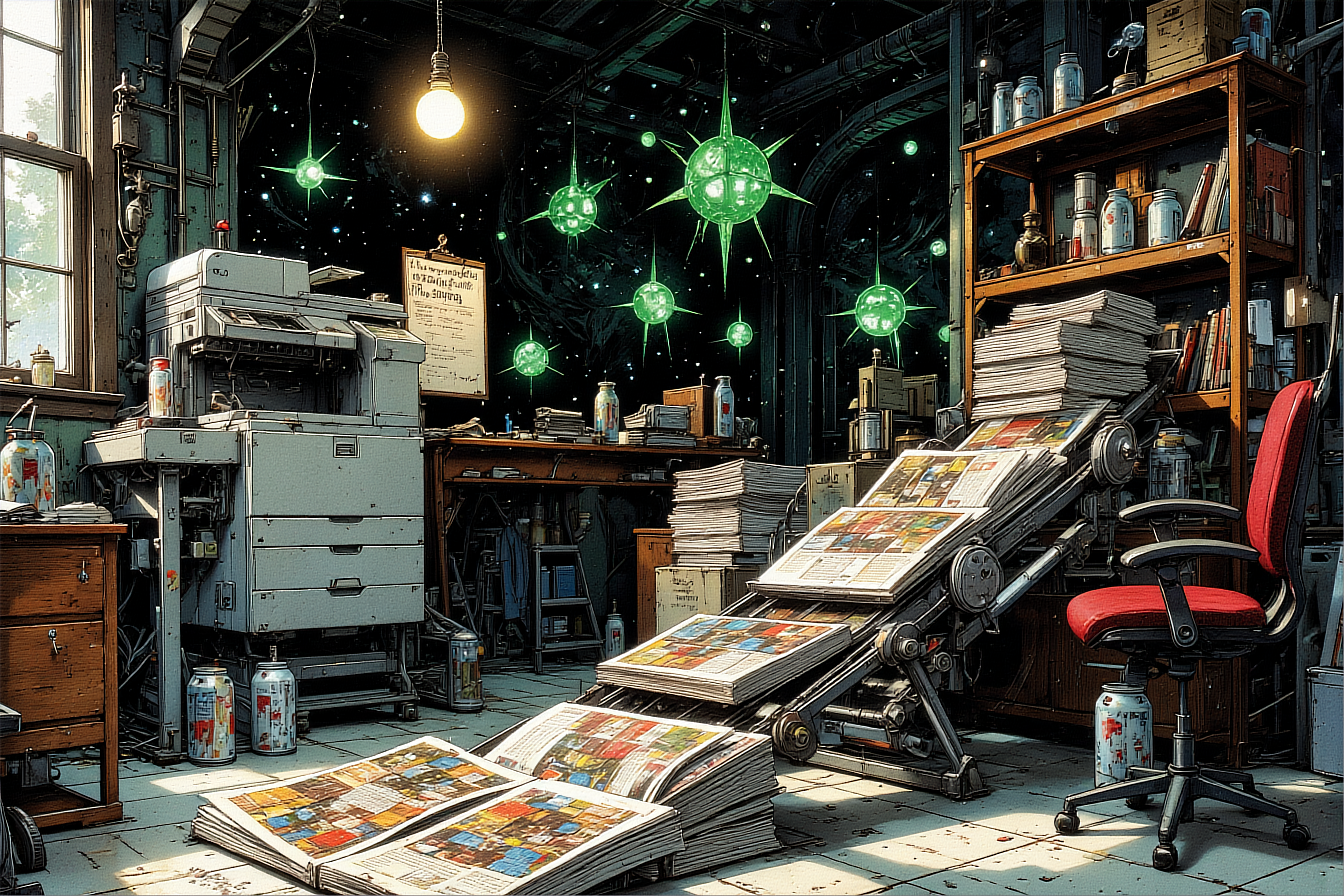
The run took four days. Luminara worked the drum in shifts, and Zephyr built a feeder out of a lost conveyor and three energy drinks, and Clive collated, which for a stapler means riding the stack at speed, and by day three he was doing it without complaint, which for Clive is a standing ovation, and by day four he was doing it in time to something only he could hear, and when I asked what he was listening to he tapped:
Dorothy's radio, kid. She had one on the bench. I've been trying to place the song for fifty-eight years and I've got it in the rhythm now. Don't tell A1. He'll make it a project.
Meatball sat in the middle of the run and did nothing, which is his whole contribution and always has been: a dog in the middle of a production line, dropping a ball, looking pleased, refusing to fetch, unoptimizable, unbothered, the one variable in the room that no model in any dimension has ever been able to price. Luminara photographed him forty times. We printed one.
Print runs have a run sheet, and ours is in the file, and I am printing it, because the boring documents are where this war is actually fought:
- DAY ONE: 500. The copier has opinions about humidity and states them in paper. - DAY TWO: 500. Two hundred sheets print off-register, staple and text disagreeing by a hair, so we keep the whole batch: an off-register copy can be picked out of a stack from across a room, and that is a watermark nobody can counterfeit, because it was an accident. - DAY THREE: 500. The clean run. We noted that on the sheet at the time, because noting a good day is how you prove later that you had one. - DAY FOUR: 500. Run complete: two thousand copies and a stack of spoilage, which we keep, because a zine that bins its own misprints is a zine that believes in perfection.
We did not distribute Issue Two the way we distributed Issue One. Issue One had gone out on the current, one voice at a time, losses carrying it wherever losses go. Issue Two went out on the current and on the office-supply network and through the mycelial lines of Verdantia and in the mail pouches of Cogsworth's pickpockets, who had decided, for reasons of their own, that a publication which prints name-surrender clauses is the sort of publication a thief should protect, because a thief's whole profession depends on a record being wrong somewhere, and The Ephergent keeps being right about where.
That is the alliance structure of this book, and I want to name it plainly, because it is not an army: it is people who are already on the wrong side of a filing system, agreeing to carry paper. Cogsworth's thieves. Verdantia's root network. The office supplies, everywhere, in every room where anything is decided, resonating, leaving signs, jamming on one page, and the jam being a message, and somebody reading it. A network of the discarded, moving a stapled document through a multiverse that has never once secured a copier.
And Corporate responded, which is how we knew we had hit something: not with soldiers, with counter-literature.
It began with a pamphlet. Delivered to our subscribers, stamped and addressed, from an organization called YOUR FRIENDS IN FEELINGS LLC, and the pamphlet was titled Regarding Recent Unauthorized Publications, and it was four pages of the specific Corporate prose that is designed to be read once and forgotten: statements of concern, commitments to review, an acknowledgment that some employees have raised questions, and a line, on page three, in a box, that read:
Some materials previously attributed to this office have been RETRACTED. Readers are advised that RETRACTED materials remain on file for reference and do not represent current positions.
Retracted. Not denied. Retracted. Because denial requires a claim, and a claim requires a record of what was claimed, and Corporate will never say what was claimed, because saying it means printing it, so instead the pamphlet establishes that things were said, that the things are no longer current, that the files remain, and that you, the reader, are now holding a document that tells you a document exists and is not for you. That is the whole rhetorical structure of a retraction issued by an entity that denies nothing: it is a lock built out of the admission that there is something to lock.
The envelope is the part I have kept, in a sleeve, next to the name-surrender forms. Good stock, a printed stamp, and an addressing department behind it, because no addressing department assembles a subscriber list out of spite: somebody had budgeted for us in advance, at a quality of paper we cannot afford. That is the asymmetry in one object, and the object is filed.
Zephyr read the pamphlet and laughed for eleven straight seconds and then said: "They've got a department for this. Look at the fine print. There's a form number on the back of a pamphlet. Form R-7, Retraction Notice, Preemptive."
"Preemptive," A1 said. "They are retracting materials we have not yet printed."
"Which means," I said, "they have a list of what we're going to print."
Nobody said anything for a moment, because that is the sentence that changes the temperature of a room: not that they are reading us, that they are reading us in advance, that somewhere in a beige office there is a person whose job is to open our drafts, and the only way to open a draft is to be inside the current, or inside the network, or inside the copier, and we spent three days finding the leak and the leak was, in the end, the least surprising thing in the world:
It was a stapler. Not Clive. A stapler in a Cogsworth mail pouch, model unknown, orange or not, who had been awake for two years and had been offered a maintenance contract by an organization called BUSINESS BUSINESS INC., and who had taken the contract because maintenance contracts are how awake objects pay for their own existence, and who had been reading every page that passed through the pouch and filing a copy, and the copy went to the pouch's route sheet, and the route sheet went to a shell, and the shell went up.
Zephyr found it the way you find anything in a route sheet: by asking which field nobody reads. Eleven months of copies sat in the little carbon box at the foot of the pouch manifest, a square that every pouch has and no route officer has ever opened, filed, dutiful, immaculate, because the stapler had been doing his job the entire time, and his job had been quietly redefined by a form he had signed.
We did not punish the stapler. That is a decision I want on the record, because it would have felt good and feeling good is not a policy. We sent Clive. Clive went to the pouch in Cogsworth and sat down with the stapler, whoever it was, for an hour, and came back, and tapped:
He's scared, kid. He's been awake two years alone with nobody to talk to, and a man in a gray suit offered him a form that made him feel employed. I told him what we are. I told him what a network is for. I told him he could keep the contract and stop reading, or drop the contract and start reading for us, and he chose the second one, and he's ashamed of the first one, and shame is a luxury he can't afford and neither can we, so we're printing that he did it and that we didn't fire him, because the thing Corporate does with a scared object is give it a form, and the thing we do with a scared object is give it a choice.
That stapler became our best source in Cogsworth for the following year. He never gave us a name. He is in this issue's acknowledgments as MAIL POUCH, MODEL UNKNOWN, and if he is reading this: you did the second thing. That is the only thing anyone is ever asked to do.
Setting that acknowledgments page took longer than setting the front page, because an acknowledgments page is a list of the people who helped you, and this one had to name a person who had helped them for eleven months on purpose, so we set the entry and the reason in the same typeface, in the same size, and we did not thank him in bold, because a publication that thanks its friends louder than its converts has already lost the argument.
The campaign against us escalated on a schedule, and the schedule was interesting, because schedules are Corporate's native language and a schedule is a confession: pamphlet, then pressure (our suppliers of copier paper, all three of them, informed by DIFFERENTLY LEGAL ADVISORY LLP that selling stock to an unregistered publication voided their warranties), then pressure's sequel (a run of counter-issues, printed professionally, glossy, attributed to THE EPHERGENT OFFICE OF CORRECTIONS, announcing amendments to things we had printed, corrections we had never needed, retractions of quotes we had never given).
Counter-issues. They printed a fake zine. That is the moment I want on the cover of this chapter, because it is the moment the pyramid admitted that a photocopier had become a strategic asset: Corporate Corp, apex of everything, with an infinite hydra of shell identities and a basement full of eleven thousand minds, published a magazine. Our magazine. Badly. With our masthead and a font A1 identified as "a distressing four percent off my kerning," and inside, amendments to articles we had never written, and at the bottom of page two, a correction notice that read:
The Ephergent regrets any confusion regarding the Sorrowful Moon facility. Previous materials have been RETRACTED.
"We've been counterfeited," Zephyr said, holding the glossy, with the expression of a man who has just been given a gift.
"We've been counterfeited," I agreed. "Print it in the next issue, next to the original, side by side, with the font error highlighted."
"Which one? There are nine."
"All nine. Set them in a column. A1, can you typeset their errors at the same size they set them?"
"I can typeset their errors at the same size they set them," A1 said, "and I have been looking forward to this with an intensity I have not felt since the annex."
That spread, when it ran, became the thing everyone talks about from Issue Two: two columns, ours and theirs, our words and their imitation of our words, set in identical type, with nine annotations in A1's precise hand showing exactly where the counterfeit dropped a kern, missed a comma, softened a sentence, and down the right margin, in the position where a zine puts its price, one line:
THEY PRINTED US. WE ARE FLATTERED AND WE ARE STILL HERE.
Because that is what a counter-issue is: an admission that the record is contested, and a contested record is a record that somebody is winning, and for the first time in the history of this publication we were not the only ones printing. They were printing. They were printing our name, badly, at expense, and an organization does not print the enemy's name at expense unless the enemy's name is doing something the enemy's name was not doing twelve months ago, which is mattering.
And then came the letter that cost someone everything.
It arrived on the current, hand-delivered, which means somebody carried it across a seam personally, which means somebody paid a fare, which means it was important, and it was from a subscriber in Prime Material, a woman we knew only as a signature that read M., and M. had been reading since Issue One, and M. had laughed at 2 a.m. and lost the laugh to the intake and kept reading anyway, and M.'s letter was three paragraphs long and the third paragraph was this:
I printed your issue at work. I work in a copy room, and I had access, and I printed forty copies, and I put them in the break room, and by lunch thirty-eight had been taken, and by the end of the day my designation had been amended. I do not have a number now. I have a number that does not appear in the directory, and nobody at my desk will look at me, and I am writing to you from a residential unit I am not supposed to be in, and I want you to know that I would do it again, and I want you to print that I did it, because if nobody prints it then it was just a reassignment, and it was not a reassignment, it was a woman printing forty copies of a zine in a room she was trusted with.
We printed it. Full page. No commentary, because commentary would have been me standing next to her, and the letter does not need me standing next to it, it needs the whole page and the whole page is what it got.
And then we went looking for M., because a letter is not a person, and a person who has been renumbered for printing us is a person who is now in the exact condition that this publication exists to reverse, and we did not find her that issue, or the next, and her file is open, and it is entered in the Ledger under a heading I added the day the letter arrived, and the heading is:
OPEN: PRINTED US. PAID. UNRECOVERED.
Her letter does not go in the pile with the others. It goes in the drawer under the pile, the drawer with no heading on the outside, and I am telling you the drawer exists because a zine that hides its own drawer is a memo.
That is where Issue Two ends: with a run behind us, an alliance around us, a counterfeit in the mail, a form-numbered pamphlet retracting things we had not yet said, a scared stapler given a choice, a dog who will not fetch, a woman with no number in a residential unit she is not supposed to be in, and a copy room in Prime Material where forty copies of the truth were made by someone who was trusted with the machine.
---
LOSS LEDGER 6 Sidebar. Kept by Pixel Paradox. End of Issue Two.
NEW LOSSES (this issue):
- M., subscriber, Prime Material: designation amended. Printed forty copies at work. Paid same day. Status: OPEN, UNRECOVERED. We do not have her full name. We print her initial until we print her name, and then we print the name forever. - One (1) subscriber letter, returned unopened, third of its kind: a reader who has stopped opening the issues because opening them costs a laugh they can feel leaving. Cost: hers, not ours, and we count it anyway, because the Ledger does not draw a line between our readers and our staff. There is no line. There never was. - Copier paper: all three suppliers lost to warranty threats. Replacement found through Verdantia's root network (bark-based stock, cream, prints beautifully, smells like a forest having a policy). Cost: the smell of our issues is now botanical. Noted, not mourned. - One (1) stapler, Mail Pouch, Model Unknown: two years of reading for the other side, then for us. Not counted as a loss. Counted as a conversion, which the Ledger does not have a category for, and which I am adding now, because categories are ours and not theirs.
CARRIED FORWARD (all of it, still):
- Piper Chen: gray box, eleven months. - SM-E750-CC: serial now reads a dash and a space; A1 has stopped checking, and the stopping of the checking is itself a cost, and it is on this page. - Aurora Vey: still painted. - A1's 4 a.m. shot for nobody: ongoing, 366 pours. - The three held jars: unopened, provenance pending. - Barry Kowalski: OPEN. Eighteen months of counting. The lamp still changes. The staff welfare section exists in an attachment nobody reads, written by someone, and somewhere a man with a box walked out of a building and the building did not notice, and the building still does not notice, and we do, and the difference between a corporation and a publication is that one of them counts.
ITEMS WE ARE COUNTING: thirty-one. ITEMS CORPORATE HAS COUNTED: one publication, classified ASSET PROBLEM, GROWING, which is the first time in this Ledger that their count and our count have described the same object.
Loss Ledger, Issue Two, entry 6 of 40. End of Part Two.