
Crystallized Laughter — CHAPTER TWENTY-ONE
Time in Cogsworth Cogitarium is not a river. A river you can get in. Time in Cogsworth is a toll road with a barrier arm, and the barrier arm comes down every hour on the hour, and if you are standing under it when it comes down you lose the hour, not to sleeping, not to waiting, to billing: the hour goes on somebody's account, and if the hour is yours it is debited, and if you did not spend it, that is a you problem, and the city's transit authority would like to remind you that unspent hours are forfeit at the end of the fiscal quarter.
The city posts a notice at every barrier arm. I copied this one off the post at the loading end of the Bureau's own street, verbatim, because signage this honest should be reproduced at full size:
HOURS ARE BILLED FROM THE MOMENT YOU NOTICE THEM. QUESTIONS MAY BE ASKED DURING BILLABLE TIME. UNASKED QUESTIONS ARE ALSO BILLABLE.
We had been to Cogsworth before, in Issue One, for the joke: the password123, the newts, the pickpocket selling eleven Tuesdays. This time we came for the warehouse.
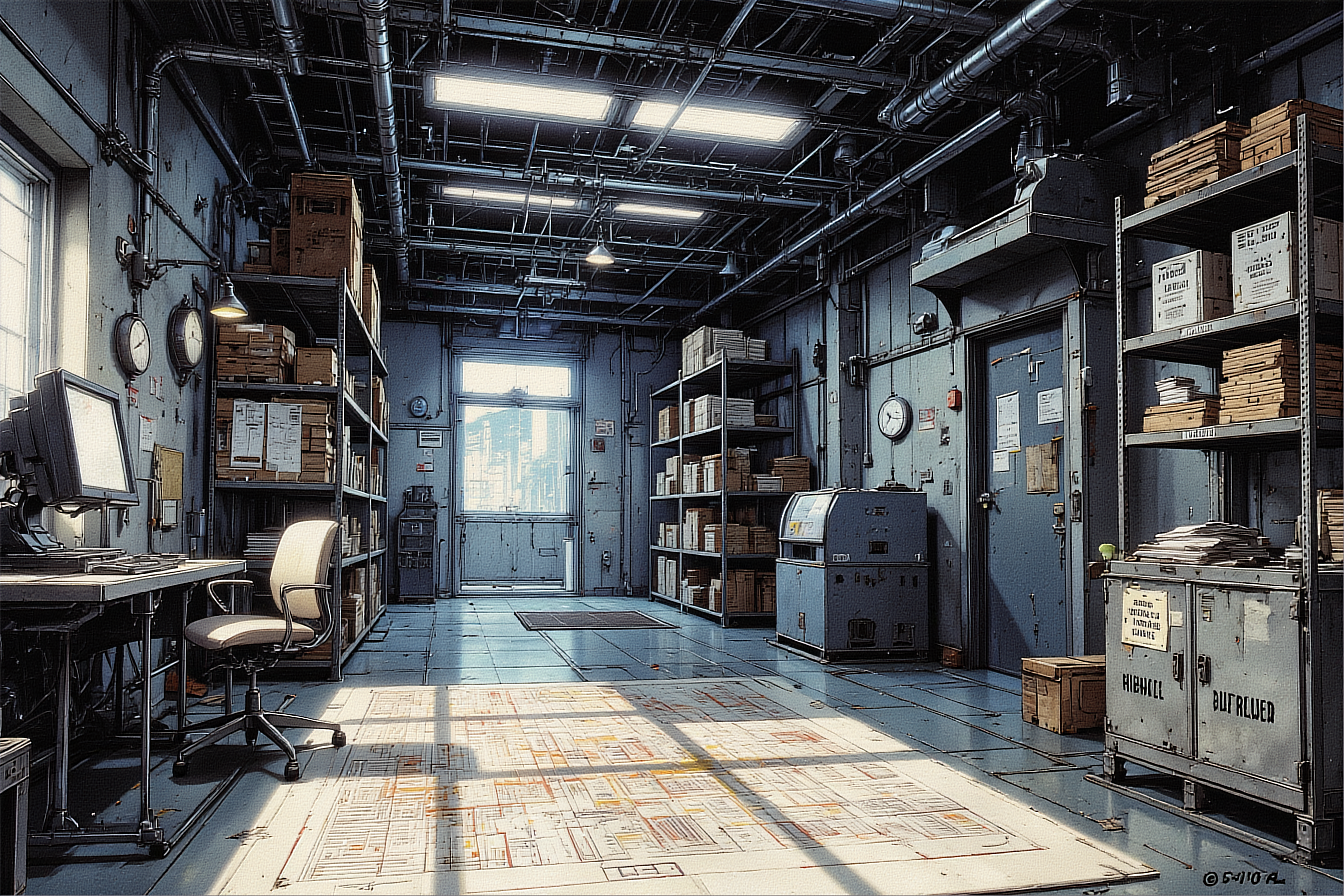
Because that is where rung five keeps its take. Emotions go to a valley; time goes to a warehouse, and the warehouse is in the only part of Cogsworth where the clocks run backward, which the city's signage describes as an OPTIMIZATION, and which a clockmaker in the market district described to Luminara, off the record, with her camera off, as follows: "Backward is where we keep what we've taken. A clock that runs backward can't be audited, because the audit runs forward, and if you cannot audit it you cannot be asked where it came from."
The warehouse is called the Bureau of Returned Hours. Returned. Not stolen, not collected: returned, in the sense that a debt is returned, and everything in Cogsworth is named by the person holding the clipboard, and we had by now spent a year learning that the single most reliable intelligence in the multiverse is the name Corporate puts on a door, because the name is written by whoever is proudest of what happens behind it.
We went in with a crew. That is new for this issue, and it is worth noting, because Issue Three is where the zine stops being three objects in a garbage dump and starts being a going concern with personnel: Pixel (editor, distracting, holding the clipboard they will inevitably hand me), A1 (tactical, folded to tabletop, running the timing, because a heist in a city of clocks is a heist run by a machine who counts everything), Zephyr (reality-hacker, six energy drinks deep by methodology, opening things that should not open), Luminara (camera, and the eyes, because she can see the difference between an hour that belongs to someone and an hour that has been taken, and in a warehouse of hours that distinction is the entire map), Clive (network, riding the mail, coordinating the office supplies inside the building, of which there were, by his count, two hundred and forty), and Om.
Om Kai joined us eleven days before the heist, in a dimensional thin spot in Nocturne, where he had been meditating for six months with a probability matrix in front of him and butter tea in his hands, and I fell through a reality tear into his meditation circle, because that is how I enter every room, and the drones that had been following me experienced a cascading probability failure when he offered me his cup, and I drank, and said "this is terrible," and offered him a job, and he said "I was going to ask you the same question," and that is the entire recruitment and I am telling you now because he is in this chapter and he does not appear from nowhere.
What Om brought was the numbers. He had been running them alone for a year, the same 2.7 million figure that had made him quit Corporate's research division, but he had kept running them, and the number had grown, and the number now had a shape, and the shape was a schedule, and the schedule was the attachment we did not have.
"The forty thousand realities are not the plan," he said, on the morning of the run, in a voice like someone reading a weather report they have read many times. "Forty thousand is the pilot's first quarter. The plan is the Simplification, and the Simplification has a timeline, and the timeline is held in Cogsworth, in a billing office, in a city where time runs on schedule, because a plan that can be delayed is a plan that can be stopped, and Corporate does not put its deadlines anywhere they can be stopped."
"In a backward clock," A1 said.
"In a backward clock," Om agreed. "The Bureau of Returned Hours. I have the floor plan. I have had the floor plan for four months. I have been waiting for someone who prints."
The floor plan came out after that, drawn by hand on the back of a billing statement, annotated in three inks, with two levels marked. Above was the institutional floor, where the city's hours are racked by fiscal quarter and moved out on export manifests by the pallet, and below it, in pencil, the level Om called the shelf.
"That is where the personal accounts sit," he said. "Not offices, not shifts. Single afternoons taken from individual people by the city's clock and never resold, because there is no market for one Tuesday belonging to one ordinary person, and an hour with no market is an hour nobody audits, and an hour nobody audits stays where it is until the quarter closes."
"Until it is forfeit," Zephyr said.
"Until it is forfeit," Om said, "and the forfeiture is entered as usage, so the person it was taken from goes on record as having spent it. The accounting is the crime. What Corporate does after that is logistics."
The heist, in order:
Zephyr went in first, at the hour the barrier arm rose, which A1 had calculated to the second, because in Cogsworth you do not choose a moment, you inherit one. He phased the loading dock's lock (spoofed work order; BUSINESS BUSINESS INC. had by now been filed as an employer of record in four dimensions, which is either terrifying or hilarious and we have never settled which), and he was inside for eleven minutes, and in eleven minutes he did what Zephyr does, which is read the building like a system: the intake ledgers (who brought hours, whose hours, when), the export manifests (where hours go: to Prime Material, to the annex, to offices where people work late because their evenings have been sold and they do not know it), and the schedule, the thing we came for, the timeline of the Simplification, held on a terminal in a backward room, in a file whose name Zephyr read aloud to the current twice and then deleted from his own memory, because some strings you do not keep in your head, you keep in the mail:
PALIMPESTMASTERTIMELINEQ and under it, in the friendly font: PILOT PHASE, 40,000 REALITIES, ROLLBACK WINDOW: NONE.
Rollback window: none. That is the line that decided the rest of this book. Not the forty thousand. NONE. Every other document Corporate writes has an attachment, a review, a remediation period, a signature field waiting for somebody brave or stupid. The master timeline has a field that says the window for undoing this is not available, which in Corporate's language means someone already checked the box, and the box was checked before the pilot began, and the person who checked it knew that a thing with a rollback window can be argued with, and a thing without one cannot be argued with, only stopped.
Zephyr came back out through the loading dock at the end of the eleven minutes, at the second A1 had marked, and he came out at an angle, the way he moves when something inside a building has got into him, and the door shut behind him, and he stood there with his hands on his knees for a moment before he straightened up.
"The room is cold," he said, "because there is nothing in it but a terminal and a chair. The rest of that building is down on the shelf, and the room is only where the storage is pointed. Somebody sits in a cold room and points at other people's afternoons, and that is the whole job, and I would like to go and be sick now."
Then Om walked in the front door.
That was the part I did not know about until afterward, and Om told it to me in his own voice, in the monastery, two days later, and I have argued with him about the omission for a year and he has never once conceded it was an omission:
"I walked in because a man in lotus position walking into a municipal billing office looks less like a heist than a citizen with an appointment, and I had one. I had made it myself, four months earlier, under a name that Corporate's system still lists as active, because I resigned without filing a form, and a resignation without a form is an appointment the system never cancels."
"So you still had an appointment."
"I still had an appointment," Om said, "at 4:47 on a Tuesday, with a clerk who had been told to expect me for four months, and the clerk was delighted, because a clerk whose appointment book has held one name for four months is a clerk who has been waiting to be useful, and I sat with him, and I drank the butter tea I had brought, which I offered him, and which he accepted, because a person who offers you tea at 4:47 on a Tuesday is not robbing you, and while he drank it I read the wall."
The wall of the Bureau of Returned Hours is a display, floor to ceiling, and the display shows the city's hours as they are spent, live, and what Om saw on it, with the scientific precision of a man who has spent twenty years measuring suffering, was the flow: hours leaving Cogsworth in a stream that went one direction, upward, into a column that had no destination label, and the column was the rung, and the rung was being climbed, and every hour in the column had been billed to somebody's evening.
"I have photographed it," Luminara said, "from the dock, at the same moment. You can see both: his wall, and our stack of the same data from Zephyr's eleven minutes, and they agree, and they agree to the second, and two independent readings of a theft matching to the second is what a case looks like before it is a case."
We came out with the timeline, the export manifests, two hundred and forty hours that Clive's network had located in a sub-basement shelf belonging to a retired watchmaker named (I print it because he asked us to) Fernand, and the beginning of Issue Three's evidence file, and nobody was chased, because in Cogsworth you are never chased, you are billed: the barrier arm came down behind us at 6:47 and took the hour, and A1, who had been timing the whole operation from the dock, said:
"The hour they just took from us was billed to an account with no owner. Do you see? The city's own clock has just stolen an hour and filed it to nobody, and a filing to nobody is a document that cannot be reconciled, and an unreconciled document is the first thing I have ever found in this multiverse that Corporate cannot process, because reconciling is what it does, and you cannot reconcile a void, and the void stays, and it grows, and it grows one hour at a time."
"So we give them voids," Zephyr said.
"We give them voids," A1 said. "Every hour we take back and refuse to re-file is a hole in their accounts that their own auditors will find, because auditors find holes the way I find crema, and I would like to be audited for once. I would like very much to be audited."
We counted what we had before the walk back, on the loading dock, with the manifests laid flat on the concrete and Clive's supplies holding a ring around them, and the count took four minutes, and nobody spoke during it, because talking in Cogsworth is time somebody can meter, and when it was finished A1 said the total out loud, and Zephyr said, "So we're thieves," and Om said, "We are repossessing," and I said, "Print it and let the readers argue about the verb," and we did, and the verb argument is the only controversy in Issue Three that I have enjoyed.
The watchdog, on the way out, was not a dog. It was a schedule: the city's own enforcement, a moving wall of punctuality that sweeps the streets at every quarter hour and stops anyone whose hours do not add up, and we did not outrun it, because you cannot outrun a quarter hour, we hid inside a lie.
The sign had been on Om's knee since the loading dock. He made it out of export-manifest cardboard with a marker left on the manifest desk, and he wrote it while we were still arguing about the route out, and when I asked him why he had brought a sign to a heist he said, "A heist is a thing you get caught doing. This is a thing you get found not doing. The signs are different," and he was right, and I hated that he was right, and A1, who had been timing the sweep since the corner, said without looking up: "Eleven seconds."
Om sat down in the middle of the street, in lotus, with his butter tea, and held up a sign he had made, and the sign read: DOING NOTHING, ON PURPOSE, UNBILLABLE.
And the wall of punctuality passed over him, because the wall bills hours that are spent, and a man doing nothing on purpose is not spending, and an unbillable hour is a void, and the wall cannot find a void, and it flowed around him like water around a stone, and we walked out behind him, and the city's clock struck six, and the city stopped for exactly one second to agree upon the hour, and in that second nobody was being billed for anything, and the second was free, and I have thought about that second every day since: one second in a whole city where the machinery agrees to pause, and in the pause there is no extraction, because even Corporate's schedule needs a heartbeat, and the heartbeat is where we live.
Fernand lives four floors above a shop in the market district that has been shut so long the shutter has become part of the architecture, and we carried the hours up in a cardboard export carton with the manifest still taped to the side, and by the third floor Clive was tapping the count, and by the fourth A1 was carrying the box without being asked, which is as close as A1 comes to being gentle with an object.
Fernand got his hours back. We hand-delivered them, because hours do not go on the current (A1: "an hour is not a loss, it is an absence, and absences do not wash up anywhere, which is why nobody in Wreckfall has ever found a Tuesday"), and Fernand, who is ninety-one and has been billing his own retirement for thirty years, put them in a jar on his shelf and said: "I don't need them back. I need to know somebody is keeping the ledger of who took them."
"That's the publication," I said.
"Then print me," Fernand said. "Print me as a man who got his Tuesdays back and did not spend them. There's your economics. An hour that is not spent is an hour they cannot tax, and I have been not-spending for a decade, and it is the most subversive thing I do before breakfast."
We printed him. Fernand, watchmaker, Cogsworth, holder of unspent time, on the front of Issue Three's first section, next to a clock with its hands in the wrong position, and under it, the line A1 set with his kerning:
THE SCHEDULE HAS A HEARTBEAT AND WE FOUND IT.
And in the Ledger, under holdings, three new lines: two hundred and forty hours, unspent; one timeline, PALIMPESTMASTERTIMELINEQ, rollback window NONE; and one free second in a city of billable ones, which we cannot prove and will never give back.