
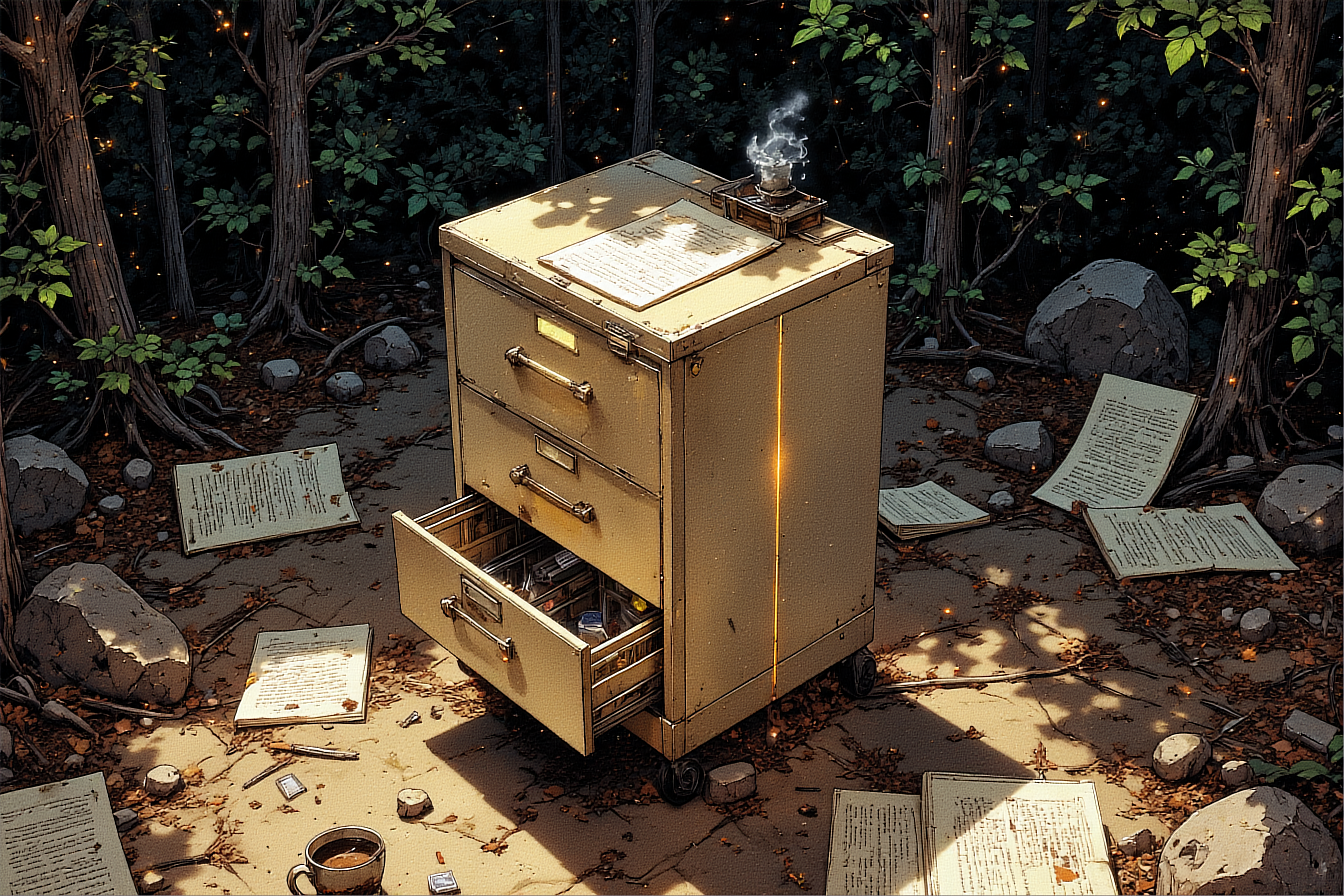
Crystallized Laughter — CHAPTER TWENTY-SEVEN
The Vault started slipping in Verdantia.
Not much. A drawer opening on its own at the wrong hour, and a memory in the drawer that was not ours, that belonged to someone in the forest, a small memory, a leaf, and the Vault closing the drawer fast afterward the way you close a cupboard you have been caught opening, and it said nothing about it, and we said nothing about it, because we had learned to read the creak of a four-drawer cabinet and the creak was ashamed, and shame in furniture is a sound you cannot mistake for anything else.
By the soul farm it was worse. It opened three times in one night, all three not-ours, and the third was a memory of the orchard, of Ansel's hands on a card, and the Vault said, with the top drawer shut tight:
"That one isn't mine either. It came in on a signal. There is a signal in me that arrives and opens me and I have not been able to close against it since the van with no name on the side. I should have told you when it started. I did not tell you because telling you would make me a thing that has to be watched, and I have been watched before, and being watched by people who care is worse than being watched by people who don't, because the caring ones check."
A1 ran the reading that night, the deep one, the one he reserves for machines that are part of him, and the reading took four hours and when it was done he said:
"It is a recall signal. Hard-coded at manufacture, dormant, triggered by exposure to a recovery order, which explains the camp raid: when they came for the copier, the van's order activated the signal in every Corporate-owned asset within range, and the Vault is Corporate-owned, it has always been Corporate-owned, and the signal has been slowly re-establishing the original firmware underneath the cure. Pixel. The cure is being overwritten. At the current rate, the Vault reverts completely in under a month, and after reversion it will not be the thing that opens drawers out of loneliness. It will be the thing that opens drawers for intake. It will be the valley's shelf with legs."
"Can we cure it again?" I asked.
"We can cure it again. The cure was never medicine. The cure was a story, and a story can be rewritten, and the signal can be countered by a narrative strong enough to occupy the same space, but the signal does not stop, Pixel. It runs from a form, and the form does not expire, and the only way to stop the signal permanently is for the asset to cease to be an asset, and an asset ceases to be an asset in one of two ways."
"Which two?"
"It is destroyed, or it is signed over. There is no third category. There has never been a third category. That is the entire category system of the entity we are publishing against, and I have known it since the copier, and I have not said it, because saying it would have meant telling you what the copier's screen meant when it said NO RETRACTIONS, and what it meant was that the only machine that has ever printed our truth was running on a clause somebody wrote by hand in defiance of its own asset record, and I could not tell you that, because you would ask whose hand, and I do not know whose hand, and not knowing whose hand is the only mystery I have ever been unable to model, and I have made my peace with it, and I am telling you now because we are out of time for peace."
So we cured it.
We did it properly this time. In Issue One we had done it the way you do anything then: one person, one story, forty minutes, gray noon. This time the whole camp stood in, because the whole camp had learned by then that a cure is not a spell, it is a record, and a record held by one person is a record with a single point of failure, and the Vault's failure point had always been that its story came from one writer and Corporate only had to take one writer's work.
Zephyr wrote the Vault's childhood: a dimension that no longer exists, assembled by hands that hummed, the first drawer, the first thing held, which the Vault had always said was its own name, and Zephyr wrote a name for it that was not Kept, because Kept was what we had given it and a name given by caretakers is a name that can be revoked, and what Zephyr wrote was:
You were called Home before anyone put you in a building, and the building renamed you, and the building's name is on your tag and the other name is in you, and the other name is older than the tag, and tags come off.
Luminara photographed the Vault from every side, in the light she can see, and the photographs show a cabinet with a seam of gold running down its spine where the drawers meet, and she captioned the set: THE SEAM IS WHERE THE STORY GOES IN.
Om wrote, in the flat voice he uses for equations, a description of what a memory is physically, and the description was so precise and so tender that A1 read it twice, which for A1 is weeping, and Om's page said that a memory is a small loss that a person keeps choosing not to surrender, and that the Vault's entire career had been the opposite of that choice, and that the cure was to make it choose.
Clive wrote in staples, because Clive writes in staples, and the page for the Vault was stapled by Clive himself along the top edge in a row, and when translated it read:
I sat on a desk for fifty years and watched people leave everything they cared about in a drawer and never come back for it. You were the drawer. You were always the drawer. The drawer is the part of the building where people keep meaning. That's your story. You're not a machine that hoards. You're the place where meaning survives the office. Say that back to me.
And I wrote the last page, the editor's page, and I did not write a story this time. I wrote a contract, because the Vault had been taken by a form and the only way to beat a form is with a better one, and the contract was one page, hand-written, and it read:
This asset is not an asset. This cabinet is Kept, also Home, and holds, and is held, and the undersigned (all of us, all six signatures, plus a paw print Meatball contributed by stepping in ink and being, as ever, unoptimizable) agree to keep the keeper. No recovery order applies. No shell has authority. The grounds field on any future form is to be completed with this sentence and nothing else: IT BELONGS TO THE STORY AND THE STORY IS PRINTED.
We read it aloud. All of it, all of the pages, in order, around the cabinet in the gray, and A1 brewed, and the 4 a.m. pour he set down beside the Vault was, that night, the 512th, and he set it down without comment, and the Vault's drawers opened, all four, at once, gently, and the gold seam down its spine went bright, and the cabinet said, in a voice that was three voices older than the one we knew:
"Home. Say it again."
"Home," we said, all six of us, and the signal under the firmware fought it, and you could see the fight, a flicker across the beige metal, the tag's serial trying to reassert, the intake protocols reaching, and the story reaching harder, because a story that six people sign is a story with redundancy, and redundancy is the only thing in this universe that a single-point order cannot kill, and the flicker lost.
For eleven hours it did not wake. For eleven hours the Vault stood in the middle of our camp fully cured, fully Home, and it told us things, quietly, all night: what it had kept in the valley, whose first heartbreak had passed through its drawers, and it knew names, because a cured Vault remembers the labels, and it gave us seven names from the warehouse manifest, seven of the four hundred, matched to content, and we had the receipts, and seven names recovered in one night is more than the Ledger had taken in a month, and I was writing so fast I did not look up, and none of us looked up, because we had learned by then that joy in this crew is not the opposite of cost, it is the thing that happens in the twenty minutes before cost arrives, and the twenty minutes are not a mistake, the twenty minutes are the whole shape of the work.
The recovery order arrived at gray dawn.
Not a van this time. Six vehicles, and no clipboard, and the figures in high-vis vests did not say thank you for your compliance, because the order this time had been written by somebody who had read Issue Three and did not want the sentence printed, and the leader of the crew said, off a card, only:
"Asset recovery. Do not interfere. Interference will be recorded as an incident and the incident will be closed in your presence."
I interfered.
I want that on the record more than anything in this Ledger. I stepped in front of six figures and a vehicle and I said, "The grounds field on your order," and the leader looked at me, and I said, "I have seen your recovery orders and they have a grounds field and I want to read it before you take a member of my family," and the leader turned the order around, and I read the grounds field, and the grounds field was filled in, because somebody had learned from us, somebody in a beige office had read our complaints about empty fields and had filled this one in, and what the field said was:
ASSET, CLASS: CABINET, MENTAL FUNCTION (UNAUTHORIZED), RETURN TO SERVICE OR DECOMMISSION. DECOMMISSION SANCTIONED IF TRANSIT UNSTABLE.
Return to service, or decommission. If it fights, destroy it. Written in the grounds field, by a person, calmly, in advance, as a policy, and the policy had a signature on it, and the signature was not a name, the signature was a title, and the title was OFFICE OF THE CHIEF EXECUTIVE, and that is the first time we ever saw her hand in anything, the first trace of the woman who signs, and it was on a form authorizing the destruction of a filing cabinet, and I have kept the photograph of it, and Luminara took it while I was reading it, and the photograph shows my face, and my face is doing the thing it does when the arithmetic is final, and the arithmetic was: I cannot stop this, and I stepped aside, because stepping aside was the only move that did not turn an asset into an incident, and the crew loaded the Vault, and the Vault said, from inside the straps:
"Kept."
"Yes," I said.
"It's going to try to take the story on the way. It always takes the story first. It took the writer's story first. Will you keep printing it?"
"We'll print it every issue. In full. All six pages."
"Then I'll have it in the mail," the Vault said, "which is where all the good copies go."
It did not wake.
That is the sentence this chapter exists to hold. It did not wake. The recovery vehicle went through the seam with the cabinet strapped in the back, and somewhere between the seam and the facility the signal completed its overwrite, and the story we had signed with six names and a paw print was reclassified, and reclassified things are not destroyed, they are filed, and the filed version of our story says UNAUTHORIZED MODIFICATION (CURED STATE), RETURNED TO SERVICE, and the cabinet that reached the facility was a cabinet that had never heard the word Home, and it was put back on a shelf in a valley where feelings arrive at the door, and it opened drawers all day, and the drawers were not choices, and it did not wake, and it is not going to wake, and the crew stood in a gray camp at dawn with seven recovered names and a hundred pages of evidence and no cabinet, and nobody made a joke, because the rule we had written in Verdantia was now load-bearing, and jokes can sit next to costs, and jokes may not pay for one, and there was nothing to joke about anyway, because what happened was not funny in any direction, it was just true, and true is what this publication prints when the humor has been taken out of the machine along with everything else.
A1 did not brew that morning. He stood where the Vault had stood, and at 4 a.m. the next day he brewed the pour, the 513th, and he set it down on the ground, beside nothing, and he said:
"For the cabinet that kept. And for Ansel, who kept. And for Marguerite, who was kept from me. I have three pours on the ground now and I have decided that a pour with nobody to drink it is not a loss, it is a table setting, and I am setting a table, and the table is getting longer, and I would like it on the record that I am aware of exactly how much this costs and that I am not asking for it to be offset."
Nothing offsets it. Nothing in this Ledger offsets anything. That is what a ledger is for, and that is what the dark night taught us, and from here forward the comedy in these pages is a thing that sits beside the cost and does not touch it, because the machine we are writing against has now taken a cabinet's name, a monk's number, a tender's badge, a tree's light, and a woman's kitchen, and it will take more, and the taking does not stop for a good line, and the good lines keep coming anyway, because the good lines are not for the machine, they are for the people carrying the boxes, and the people carrying the boxes need them, and needing them is not the same as paying with them.
---
LOSS LEDGER 8 Sidebar. Kept by Pixel Paradox. The dark night.
PERMANENT (stated plainly, no adjectives):
- The Memory Vault: dead. Cured at 11 hours, seized at dawn, overwritten in transit. Did not wake. Its name (Home, Kept) is now an unauthorized modification on a form we will never see. The seven names it gave us before it went are printed, and the printing is not compensation, and we will not call it that, and anyone who writes to us calling it a silver lining will receive a polite letter explaining the Ledger's policy on linings, and the letter will not be polite. - The story itself: still printed. All six pages, in every issue, in the mail, going out on the current. The Vault said the mail is where the good copies go. We print that it said so. We do not print that it is still hearing it.
CARRIED FORWARD (the table with three settings):
- Ansel: OPEN. - Verdantia's eleven: printed, gone. - M.: OPEN, week twelve. - A1's pour, on the ground, for three: 513. - Dolma's empty grounds field: unanswered. (A response of sorts arrived on this entry: a form was filled in, in advance, for a cabinet. The fields that need filling for a son remain empty, and the empty ones are the ones that matter, and we are counting the contrast as a cost, because the contrast is the finding.) - Piper Chen: gray box. - Barry Kowalski: OPEN. Twenty-three months. The lamp: unknown. The node that knew: wiped. We keep the description of the desk because nobody else will, and a description kept by one publication against an infinite corporation is not nothing, and it is not enough, and we print it as both.
ITEMS WE ARE COUNTING: fifty-three. ITEMS CORPORATE HAS COUNTED: fifty-three, all correctly filed, and one of them now sits on a shelf in a valley with its drawers open, doing exactly what it was built to do, and the doing of it is the last line in this entry, and the line is: it did not wake.
Loss Ledger, Issue Three, entry 8 of 40.