
Crystallized Laughter — CHAPTER TWENTY-EIGHT
The Edge is where reality stops pretending.
You get there by going outward, past the last dimension with a name, past the ones with numbers, past the ones Corporate has not gotten to yet, until the ground gives up on being ground and becomes what it always was: a surface with writing on it. Not text. Structure. The compiled source of a world, showing through the way rebar shows through a wall that has been in the sea, and the structure has an error state, and the error state is visible from a long way off, a blue glow at the boundary like a screen left on in an empty building, and Zephyr, who had been there before, said:
"That's a breakpoint. Somebody left a breakpoint in reality. In the whole build, at the edge, a debugging flag, and it has been on for as long as anybody has been coming here, which means somebody was debugging the boundary of existence and got pulled away mid-task, and the flag stayed, and every glitch in every dimension since has been able to find it, because a breakpoint is a door left ajar, and that door is why glitches exist, and I have always assumed it was an accident."
"Was it?" I asked.
"I assumed," Zephyr said again, and did not finish, because at the Edge assumptions are expensive and he was already at the boundary with his deck out.
Crossing the last named dimension takes no effort and gives no warning. One step the ground has an opinion and the next step it has a point of view. The air out there tastes of warm dust and toner, and there is no wind, and there is a sound like a substation at the end of a street, and it never gets closer and never gets further, and the only thing that moves is the light at the boundary, which is patient, and it has been patient for longer than any of us.
Physics out there is a polite suggestion. Meatball walked off the ground twice and did not fall either time, and on the third time he walked off on purpose, with the ball in his mouth, and dropped it into the void, and looked up at me with an expression that I can only describe as satisfaction, and Luminara photographed it, because she photographs everything, and the photograph of a dog deliberately discarding a ball into the source code of existence is, she says, the single most accurate image of our publication's editorial policy ever taken, and I have never been able to argue with it.
We went to the Edge for the schematic. Because the timeline had given us the when, and the soul farm had given us the why, and what we did not have was the shape: what the Simplification actually builds, in engineering terms, in the words of the people building it, and the Edge is where the build shows, because the Edge is the boundary of the compiled layer, and a compiled layer has to be maintained, and the maintenance console for the rung-eight systems sits at the edge of everything with its debugging flag on, and no one has ever guarded it, because no one has ever come, because to come you have to get past the polite suggestion of physics, and most people obey physics out of habit, and habit is Corporate's oldest security system.
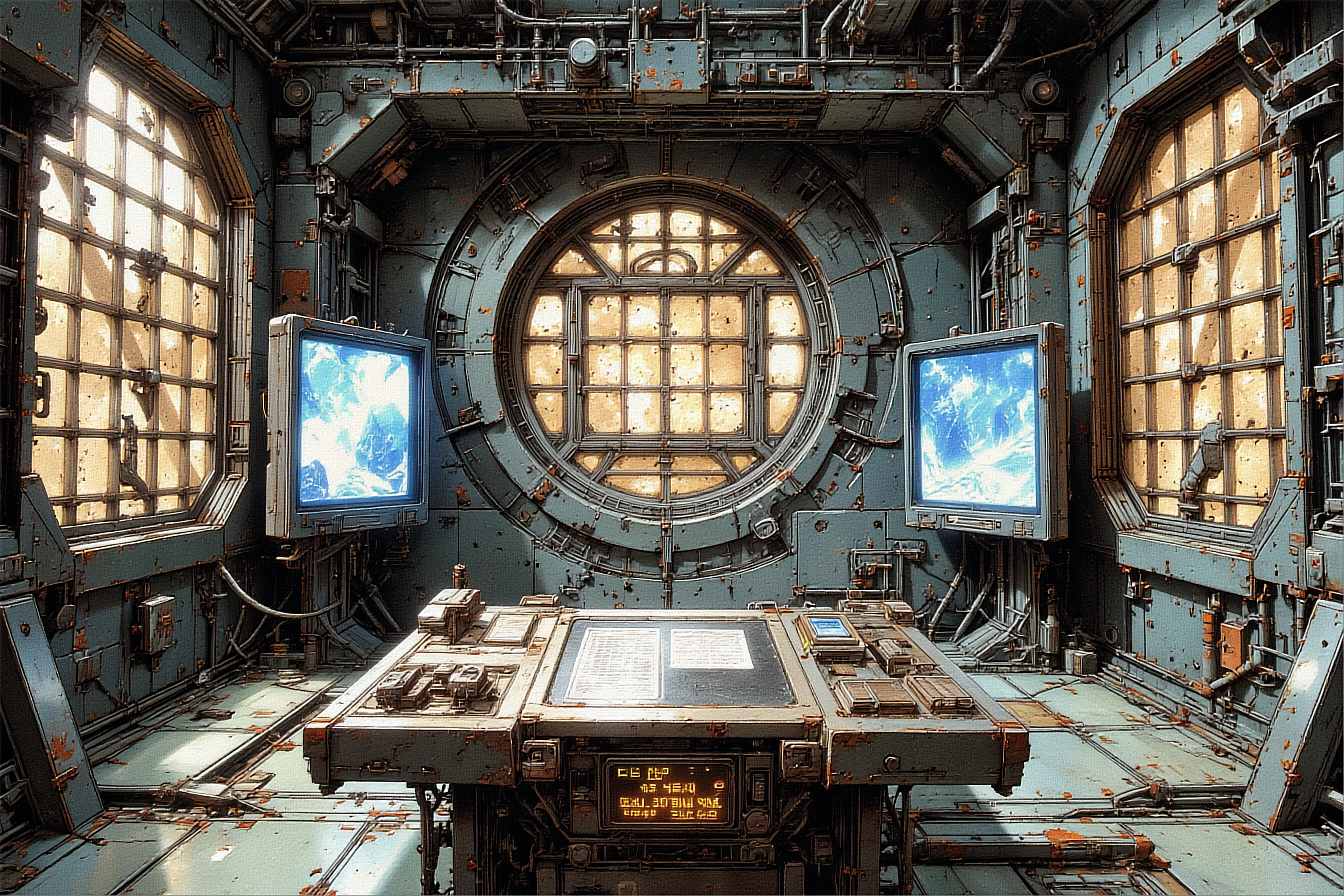
The console was a pedestal, waist high, in the friendly font, and A1 put both hands on it the way a person puts both hands on a rail at the sea, and then he was gone, which is what eleven minutes of a machine reading looks like from outside: nothing, absolutely nothing, no blink, no hum, no courtesy light. Om sat down cross-legged on the surface and did not fall. Luminara shot four frames of the blue light on A1's casing. Clive stayed in my bag, and I know he did not tap, because I had the bag open on my knee, and I counted the not-taps, and I got to sixty-three before he came back.
A1 read the console for eleven minutes and did not speak, and when he spoke he said:
"The Simplification is not a plan. It is a compile."
"Explain."
"A plan has phases and stakeholders and a rollback window. A compile has a source and an output and no opinion. Look." He projected, blue on the void, and the schematic came up in Corporate's own typeface, because the maintenance console renders in the language of whoever built it, and whoever built it had used the friendly font: an infinite lattice of identical cells, each one a six-by-six square of beige carpet and grey walls, each one staffed by a numbered designation, each one running the same loop, and the lattice extended outward into the numbers dimension and beyond, into the forty thousand realities of the pilot, and the source of the compile was a single file, and the file's name was:
SIMPLIFICATION.EXE, and under it, in the friendly font: EVERYTHING BEIGE, EVERYTHING NUMBERED, EVERYTHING QUIET.
The lattice rendered a cell at a time as it loaded, and each cell took the same half-second as the last, and after a while you could hear Zephyr counting under his breath, and then he stopped, because the count was going to keep going without him, and that is what forty thousand realities looks like when it is built by a machine with no opinion: a progress bar in a friendly font, moving.
"The quiet is the point," A1 said. "Read the throughput metrics. The machine does not harvest joy, Pixel. It prevents the conditions under which unharvestable joy can occur. An extraction system takes. This vaccinates against extraction failure. Corporate has spent a decade learning that laughter cannot be audited, and the Simplification is the answer to a problem we created by printing: build a reality where nothing happens that cannot be priced."
"A reality with no zines."
"A reality with no 2 a.m. laughs. A reality where the break room hums at a frequency nobody complains about, where nobody stays late because there is nothing left to prove to anyone, where every designation is a number and every number is content, and the content is quiet, and the quiet is billable, and nothing in it can ever again produce the thing that broke their model, which is a person who cannot stop finding things funny at the wrong time."
Zephyr had been working the whole time. He crouched at the breakpoint with the deck flat on a surface that had stopped being ground somewhere around the second hour, and the deck's fan was audible over everything, and he ran a scrape the way other people clear their throat, and then he stopped, and the stopping was the loudest thing at the Edge.
Zephyr, at the breakpoint, said: "There's a metrics table attached to the compile. Somebody's holding it open. There are nine metrics and metric one is the load-bearing one, the whole yield model hangs off metric one, and metric one has an author field, and the author field is not blank."
Nobody moved.
"Whose name?" I asked, and I already knew, because I have known since the break room, since the fifth version, since the wall went to water, I have known in the part of me that files things under tabs I do not open, and I said it before he did, because a reporter who lets a colleague read her own name off a screen is a reporter who has decided to be told rather than to tell, and this publication does not get told:
"It's mine."
"ID-7G-2847," Zephyr said, not looking back. "P. Chen. Submitted through Research Liaison, dated fourteen months before the rupture. Title: Variance Accrual Model, Provisional. And Pixel, it's not an anomaly report. It's a yield model. You didn't file a warning. You filed a forecast."
I sat down at the Edge of everything with my legs the way legs go when the floor of a story moves, and I did the arithmetic out loud, because this crew deserves the arithmetic out loud and not a silence:
Two years before the rupture I had built a model. I was good at my job. Disturbingly good. Where my colleagues saw noise I saw rhythm, and what I had seen in the paperclip data was a curve: the drift curve, the rate at which things went missing from a supply closet and turned up somewhere they had not been asked to go. I had called it variance accrual. I had put a forecast in the appendix. I had submitted it through Gerald, who had submitted it to his supervisor, who had submitted it to Research Liaison, because Gerald submitted everything upward, it was his only talent, and I had thought nothing of it, because it was a model about paperclips.
I can put a room around it. Third floor, the long one, the dividers set at hairline height so you could see everyone's part and nobody's face, my desk under the window that did not open, the model running on the left screen and the coffee standing on the wrong side of the mouse. Gerald-7 came down the row and read it over my shoulder the way he read everything, sideways, and asked what the appendix was for, and I said that in the body it is a claim and in an appendix it is a hobby, and he said that is very funny, Piper, and he forwarded it upward that afternoon, and I went back to the coffee, and nothing about the afternoon suggested that I had just handed over the number the rest of this book is about.
And Research Liaison had read a model about paperclips and seen a model about yield, because yield is all they read, and they had taken my curve, and my curve had become metric number one, the foundational equation of the extraction ladder: the rate at which value can be removed from a reality before the reality notices. The drift curve. My curve. The number they use to decide how much of a dimension can be taken before it starts to show.
"The break room," I said. "The anomaly I found. The hole in the wall."
"Was under a threshold your own model set," A1 said quietly. "The model says: a reality may be drained to X percent before variance becomes observable to its own residents. The break room was drained to X minus 0.4. You found it anyway, because you were the one person in the building whose job was to look for exactly that, and you filed the fifth version, and the fifth version was not a warning to be ignored, Pixel, it was an audit of your own model's blind spot, and they buried it because an audit of metric one cannot be filed, and you buried it too, in a corrected spreadsheet, to keep your job, and both of those burials are the same burial, and you have been carrying the name of it since before we had names."
Nobody said anything. That is what this crew does at the worst hour: nobody performs. Clive did not tap. Om did not philosophize. Luminara did not raise the camera, and I noticed the not-raising, because the not-raising is her way of saying the moment belongs to the person in it, and the person in it was me, at the Edge, with a name on a metrics table.
"I designed it," I said. "I need everyone to hear me say it in the normal voice. I designed harvest metric number one. I did not know what it was for. I would like that in mitigation and I would like it in the record and I would like it to be true, and I do not think it is fully true, because a woman who spends three years, four months, and seventeen days watching things vanish from a supply closet and never once asks where they are going has made a choice about questions, and the choice was made every morning at 6:47, and I called the choice a job."
"You filed the fifth version," Clive tapped.
"I filed the fifth version eleven weeks before the end of the world, and I filed a corrected version eleven weeks before that, and the corrected version is the one Corporate kept, and the fifth version is the one I carried in a bag, and both of them are mine, and the model is mine, and metric one is mine, and if we print the confession we print all three, in order, with dates, because a confession that leaves out the corrected spreadsheet is a press release, and we do not print press releases."
"We print the confession," A1 said, "and the confession has a date on it, and a date is a fact, and a fact is the only thing in this universe that cannot be reclassified, only buried, and burying requires a form, and the form requires a grounds field, and we have been filling grounds fields for a year, and this one fills itself: the model was submitted, the forecast was accurate, the audit was buried by two sets of hands, one of them mine."
At that moment the breakpoint pulsed.
And through it, the way sound comes through a wall you did not know was thin, a voice. Not a recording. A voice with a person in it, lucid in a burst, the way a light comes on in a building you thought was empty, and Zephyr's deck caught it, and Zephyr's hands went white on the chassis, because he knew the voice the way you know your own breathing, and the voice said:
"Zeph. Don't touch the breakpoint, it's a door and the door is load-bearing. Listen. I'm in the compile. I'm one of the hands on it. I have been one of the hands on it for two years and I am telling you from inside the machine that the machine has one problem, and the problem is us, and I don't mean you and me, I mean the connection thing, the stupid thing, the thing I put in your file, because I have watched them build a reality with no unpriced moments in it and I have run the simulations and it compiles clean, it compiles perfect, and perfect does not hold, Zeph, perfect has no slack in it, and everything that is alive has slack, and when you get the chance, do not let anyone sell you a build with no slack, because the slack is where we live..."
The burst broke. Seventeen seconds, by A1's count. It had a timestamp: a live signature, from inside rung eight, from inside the machinery of the compile, from a man who was one of the hands on the tool that was going to flatten forty thousand realities, and who had used seventeen seconds of lucidity to tell his brother not to buy a perfect build.
We did not speak. Zephyr knelt and set the deck flat on the surface that was not ground and played the burst back once, and then again, and on the third pass he did not play it, he only rested two fingers on the chassis the way you keep a hand on a door to feel whether somebody is coming, and nobody asked him for a fourth, and Om folded his hands and said nothing, and from Om that is a form of prayer, and Luminara lowered the camera, and nobody asked her why.
And then, under it, in the deck's buffer, in code, the line Zephyr had carried for two years, re-sent, re-encrypted, from the source:
RETURN connection perfection;
"That's his thesis," Zephyr said. "That's the whole thing. Two years I've been holding it like a key and it's not a key, it's a warning, it's a man inside a machine telling everybody outside the machine what the machine cannot understand."
The walk back gets a paragraph, because it is the paragraph in which nothing happens, and nothing happening is what I am going to keep. Meatball walked along the underside of the ground for a stretch, upside down, unbothered, and came up when he got bored. Om walked with his hands behind his back, reviewing a courtyard that was not there. A1 carried the schematic still projected, so that we walked home inside a faint blue lattice the color of the Edge, and he had turned the sound off, because a machine learns which silences belong to the crew.
We came back from the Edge with the schematic, the metrics table, the seventeen seconds, and my name, and I wrote the confession on the way home, in the current, in one sitting, because there is only one way this piece gets written and it gets written before the courage runs out, and the piece is below, in full, unedited, in Issue Four's first position, and it is the most-read thing this publication has ever printed, and it is the reason a woman whose name we do not yet know will eventually sign a document with a title instead of a name, because a confession with a date on it is the one document in the multiverse that a corporation cannot amend, only answer, and the answer she chooses to give is called a Settlement, and it is drafted, and it is waiting for a signature, and the signature is going to cost more than anything on this page, and I did not know that yet, at the Edge, with the blue light on my hands.
I only knew the arithmetic. Mine. Out loud. In order. With dates.