
Everyone Lost Tuesday — Chapter 4: The Vault
The lobby door opened for the third time that night at ten past three, and the kid came down the corridor with his shoes still making the wet sound, and stopped at the tape, and held up the deck so I could see the screen without having to ask.
"Twice," he said. "Same note, two hits, four minutes apart. Whatever you did, it registered from the stairwell." He looked at the desk, at the lamp still burning, at the photograph lying flat in its circle of light. "So the note changed. I'm taking it you didn't wake yourself up to agree with me."
I had been under that lamp for an hour. The sky in the corner of the print does not improve with study. It gets worse, the way a face does when you finally see what the photographer was standing in front of.
I shifted the print into the napkin, folded the receipt and the class schedule in beside it, folded the square closed, and drove the staple through the corner to hold the whole of it. Then I slid it to the edge of the desk, which is as close to handing a man something as I can manage.
He understood without being told, and that is the second thing in his favor.
I put it to him in the only voice I have, which is the sound of my own weight moving a millimeter: if I go down there, I am not leaving this on a desk.
"The Undercroft," he said. He did not touch it yet. "You want to go down. Now. You've been sitting on this for five years and you want to go down at three in the morning."
I tipped forward.
"Yeah," he said. "Right. When Corporate takes a name, the paperwork still has to go somewhere." He folded the napkin into his inside jacket pocket, against his ribs, the way you carry a passport in a city with the wrong kind of police. "And somewhere is four floors under the worst building in the world."
He picked me up with two hands, one under each end, and I will say this for the kid: he did not wince, and he did not adjust his grip afterward the way a man does when he has been told a thing is heavy and discovers it is heavier. I am heavy. Sixty years of springs and a base plate cast in a Long Island plant where the machines were built to outlive the company that bought them. He took the weight the way you take news.
Down the service stair, because the freight lift has been out of service since before the audit, and a man carrying a stapler down four flights of concrete in the dark is not a sight this building needs. His arms tired by the first landing. He said nothing about it. On the third he stopped and breathed and shifted me to his other hip with the care of a man moving a sleeping child, and then kept going, which I decided was either courage or a bad habit, and I have known men to build whole careers out of that exact uncertainty.
The Undercroft door has no sign on it. There is a keypad, dead, and a push bar gone green at the touch points, and beyond it a corridor that runs down and down under the building's own foundations until the air changes its mind about what floor it is on.
It is colder down there. It is always colder, and it smells of paper that has outlived its reasons: cardboard, cotton rag, the sweet rot of a photograph left in a drawer, and under all of it the specific smell of a room where nothing has been thrown away because nobody had the authority.
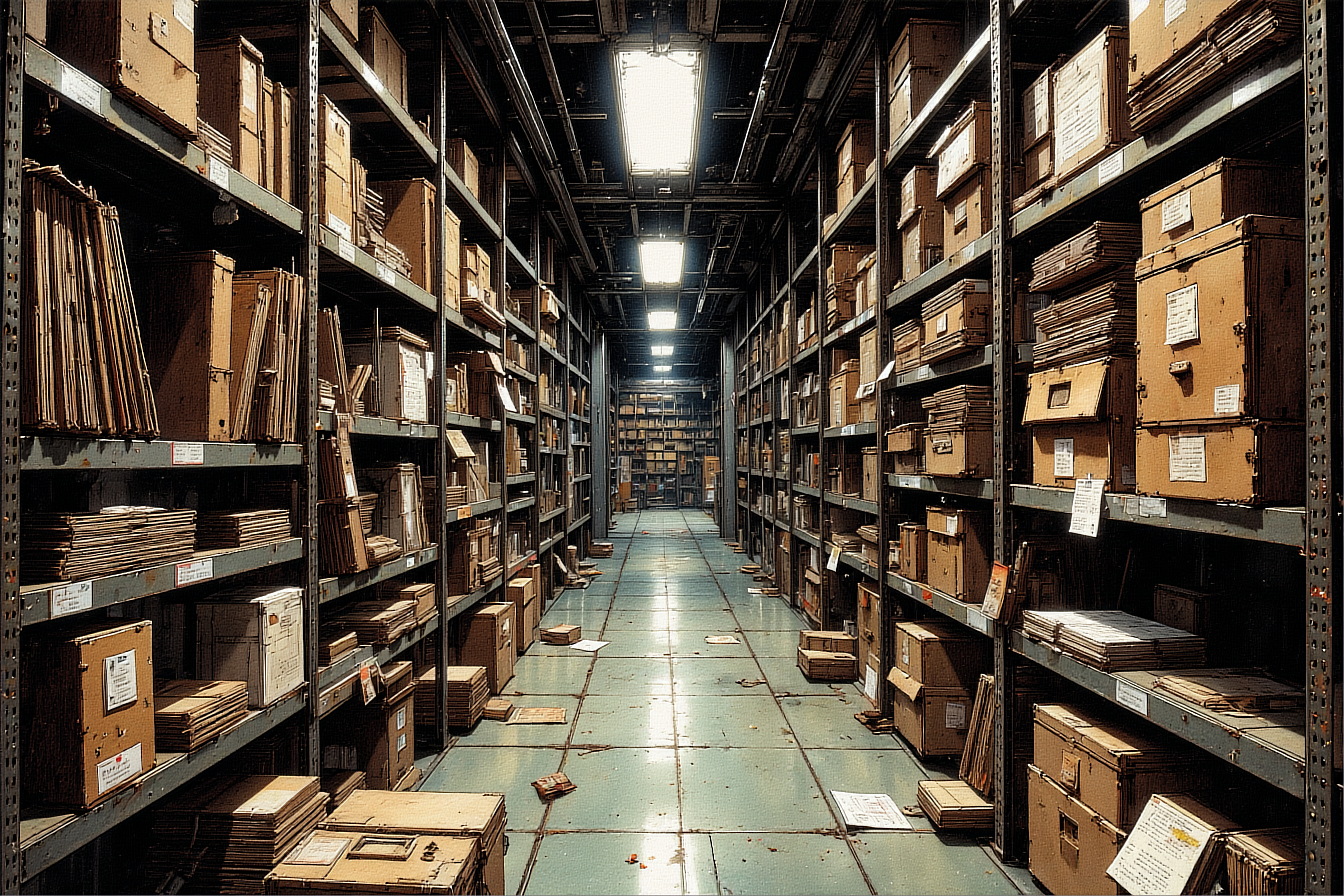
The Memory Vault opens off that corridor without a door, the way a held breath opens into a room. Shelves. Aisles. Rows of tagged things going back into a dark that the overheads only pretend to reach.
And sound. I heard it before I saw anything, and Zephyr stopped walking with his shoes still squeaking.
It was weeping. Not one weeping: a floor of it, low and overlapping, the way water sounds in a building where nobody has turned a tap in years.
The first one we reached was a manila folder on an open shelf, labeled in a hand from decades back, PROPERTY, BICYCLE, BOY, AGE 9. It was crying. Not a metaphor and not a mechanism: moisture came off the lower edge of it in a slow line, gathered, and dropped onto the shelf, where a pale ring of old tears had soaked into the wood the width of a folder and no wider. Every few seconds the paper shuddered the way a chest does.
Zephyr put his hand out and stopped short of it.
"He never came back for it," he said.
"No," said a voice from the end of the aisle. "He did not."
The boy in the tag would be in his fifties now. I know that arithmetic, because I have done it in this building before, and it is the only arithmetic down here that never has a remainder. The folder went on crying onto its own ring of wood, patient, out of habit, the way people do the thing they did on the first bad night until the doing of it is the whole of what is left.
She came around the shelf with a clipboard against her chest and a pen behind her ear and eyes that had been at work for a long time and were still at work now, red-raw and running, tears coming down her face in a steady, unembarrassed way that did not touch her voice at all.
"Mrs. Odile Fenn. Custodian of this hall. Everything down here is in my care and none of it is mine." She looked at the boy, then at what the boy was holding, which was me. "You're the orange one."
She said it without surprise, the way you name a delivery.
"Barry's," she said. "The night man used to bring me misfiled things from up top. He said the orange one could tell when a paper had been in the wrong drawer." A tear went off her chin onto the clipboard and she turned a page over it without looking. "Property intake. What are you looking for?"
Zephyr started to explain. He got as far as a name and a week and "he doesn't exist anymore," which is a sentence that lands differently in a room where the dead things are the ones still waiting.
Mrs. Fenn listened to all of it with her hand flat on the shelf.
"Bays run by week," she said. "Twelve years of shelf, indexed by intake date. If a person came through the building and the paperwork was stopped, the shelf says so." She started walking. "Nothing gets skipped. Something gets left empty. Those are different operations and I am particular about which one has happened."
The aisle went on. On our left a bank of flat files, and out of the third drawer down a sound with no word for it except keen, low and continuous, the sound a room makes when it is not being listened to. Mrs. Fenn did not break stride.
"Third drawer," she said. "A set of wedding bands, 1994. He files a claim every year and every year the claim comes back to this drawer instead of to him. It has been doing that since before I took the post." She wiped both eyes with the heel of her hand, one after the other, and her voice stayed exactly where it was. "I don't discourage it. Grief has a procedure. It is the only part of my job with a procedure."
Verse:
Everything down here is waiting, and waiting in the dark for paper is the same as waiting for a person, only the paper has the patience.
We reached Bay 12.
The wall at the back of it is what the others call the wall of unsolved nostalgia, though nobody down here uses the word unsolved out loud: rows of small tagged objects with their claim tickets still attached, a watch with a strap gone stiff, a school blazer, a shoe, a music case with one string visible, a box of letters tied with the kind of ribbon you only find in a house where somebody has died with their desk still full. No claimant ever came for any of it. The tags are the color of old teeth, and every one of them is filled in, because the tragedy of this hall is not that nobody wrote it down.
Mrs. Fenn stopped at the blazer.
"2016. The owner came, signed in, stood in front of it for eleven minutes, and left without claiming, and there is no form for that, so I wrote it on the back of the tag." She turned the ticket over with a fingernail. A few lines on the reverse, neat, small. "He came again in 2021. The same eleven minutes. He is on my books as a visitor and off my books as an owner, and both entries are accurate, and I don't know which one he would want."
She let the tag go and it swung once and settled against the shoulder of a jacket nobody will ever wear.
Something moved under the bottom row.
It was a dog. Thin, in the way of an animal that has been thin for a while and has settled into it, with a coat the color of the floor and no collar on it and nothing on it at all: no tag, no band, no clip, no marker of the kind this building puts on everything it has decided to keep. It did not come out. It lay with its chin on its paws at the base of the wall and watched me come past with the expression of something that has been carried and put down and is waiting to be told which is this time.
"That one is unfiled," Mrs. Fenn said, following my eye the way you follow a custodian's eye, which is to say she was already looking at it. "Every procedure in this building has tried to take him in. He is not in the system. He has never been in the system. Some things walk in and decline to be recorded." She wrote something on the clipboard. "I record that he declines."
Then the shelf.
Bay 12's index ran to the wall, and against the wall, at shoulder height for a man and at ceiling height for me, was a slot exactly the width of an intake folder. Every other slot on that row had a file in it, or the stub of one, or the ring of dust left by one that was pulled. This slot was clean. Not swept clean: clean the way a thing is clean that has never been touched, the shelf surface inside it pale as new lumber while everything an inch to either side had gone the color of a wallet.
I have looked at a lot of empty spaces in my life. An empty space with dust around it means something was taken. An empty space with no dust in it means nothing ever arrived.
"No file was ever opened," I made the kid say for me, by tipping forward, and he said it without asking me to do it again, because he had learned my weight by then.
Mrs. Fenn came close and did not touch it. "Bay 12, week 20. There should be a folder. There is a shelf." She had a book in her other hand, thin, ruled, and she opened it to the back where her own initials ran down a column in four different pens, forty-eight of them, one beside each quarter for twelve years, and beside every one of them the same empty column where the folder's number should have been written. "I check it, I initial the check, and the initial goes into the week's intake log, which is the only proof this particular emptiness is scheduled." She underlined the word in the air with her pen. "I am very good at scheduled."
Verse:
Twelve years of her initials beside a column that stays empty, and the emptiness is kept so well you could set your watch by it.
"Where's the log for that week?"
"Into this morning's run," she said. "It came off the shelf out of order and went out with the batch without a line in my ledger, and I signed for its leaving without reading what I was signing, which is the thing I will be writing up." She turned a page. "Batch goes down the Tuesday route when it exceeds the retention weight. The cart holds until six."
She said it the way a woman says she has signed for a lot of things, and the tears kept coming while she said it, and neither the signing nor the weeping had anything to do with the other.
I made the kid ask the question I could not: whether a thing already in the run could be taken back out of it.
"Some of it," she said, and she was already walking. "Pulp is not instant. Nothing has been through the line yet. Until it has, paper in a bag is only paper in a bag."
The outgoing cart stood in the loading alcove at the far end of the hall, a steel cage lined with a bag gone gray, half full of the week's discards, and Mrs. Fenn went to it with the flat hand of a woman who has known that cart longer than she has known most people. She lifted the top bundle to look underneath it, the way you look under a thing you expect not to find, and something came loose out of the fold of it and slid face down against the wire: a bound log book a size too wide for the bag to close over, and she had it by the spine before she read what it was, and she read it, and she did not let go.
"That's wrong," she said. Her voice stayed level and the tears did not pause. "That's Tuesday's route. That's the week you're standing in front of and it's in my cart for pulping and it was never on my shelf." She held it against her clipboard the way you hold a thing you have caught. "That's an error. I'll be writing it up. Errors are the only paperwork down here that comes back."
She opened it to the week and turned it so I could see.
Every line on the page was a line of intake: names of things, dates, the initials of whoever carried them in, small and civil and complete, right up to Bay 12. And across the line I needed, the one that would have said what came in and whose hand signed it, sat a bar. Not ink. Not marker, not tape, not the correction fluid of an office that has given up. Printed, solid, exactly the width of the column, black that was applied rather than written by a machine that has never in its life had a doubt, and in the corner of the sheet the form designation: FORM 9.
The line under it did not exist for me. The names on either side of it were as legible as my own hand, and the one I had come four floors down in a boy's arms to read was a hole in the shape of a rectangle.
Mrs. Fenn looked at the bar the way you look at a colleague.
"Somebody got there first," she said. "That's not my signature under it." She closed the log and held it, and then, because she is who she is, she wrote in her clipboard with one hand while holding the evidence against her chest with the other. "Intake log, week 20, recovered in error, filed under objection. Filed under objection," she said again, as though saying it twice made it a procedure.
The kid put the corner of his deck over the page and ran it the way you run a flat hand over a wound. The trace came back clean on the line before and clean on the line after, and over the bar itself it gave back nothing at all: no characters, no structure, no residue of characters, only the exact width of the rectangle where a reading used to be able to land.
"Smudge gives back noise," he said. "This gives back nothing. Somebody took the line and left the page standing."
Behind us, at the base of the wall, the dog had not moved, and it was not looking at the log. It was looking at me, and it had the patience of something that has watched a great many people carry things out of this room and had never once been asked to carry anything at all.