
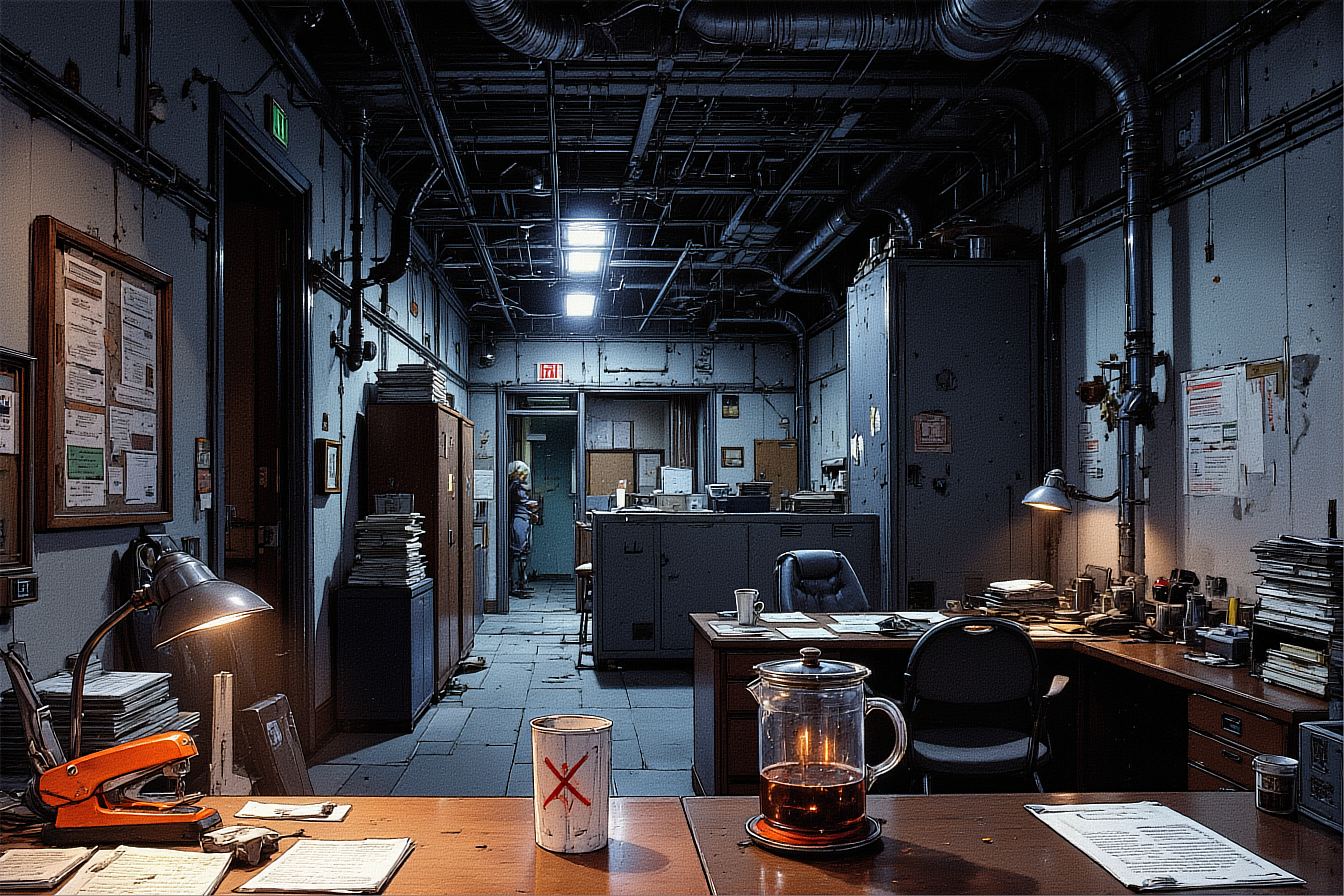
Everyone Lost Tuesday — Chapter 5: Corporate Takes Notice
The kid carried me back up the same four flights and set me down on the desk, and the coffee rings found me again, which is the closest thing I have to being greeted.
He took the napkin out of the inside pocket of his jacket where it had ridden against his ribs for two hours, folded the way I like it, and waited with it in both hands until I had lifted one edge. Then he slid it under my base plate, all the way to the back corner, and I let my weight down on it, and the desk took us both. That is the only kind of security I have ever trusted: my own weight, on top of the thing, where nobody looks twice.
"You good?" he asked.
I tipped forward once. Yes.
He stood there a moment with his hands empty, which is the posture of a man who has been carrying something for a long time and has just set it down in the wrong place. Then he pulled the chair out from the desk, sat down through the gray X on the seat because he was past caring, put the deck on the desk, and went back to reading the staple's note like a man reading a tide chart before a storm he has already decided to swim in.
The annex settled. The tube did its four-hour thing and lost. Somewhere up top the rain held its pattern, and the pipe in the ductwork made its knock, and for a while the only other sound was the deck's low crawl and the kid's breathing and the particular quiet of two people who have agreed not to talk because talking would make a night into a morning.
The elevator made its call six floors up.
Then I heard shoes. Not rubber, not the kid's. Leather, taken care of, meeting the floor without asking it anything: two pairs, and one of them slightly ahead of the other, and neither one in any hurry, which is the sound men make when they have already been told the answer and are only here to confirm the spelling.
"Stapler," the kid said, very low, without turning around.
He had heard it too. He shut the deck and stood, and then he did not know what to do with himself, which I have seen grown men do in front of customs, and he pushed the chair back in and let the gray X on its seat have it again, and stayed standing.
They came past the glass partition with a case each and a tablet riding the wrist of the one in front, and they wore the kind of shoes that a building buys a hundred pairs of at a time, and they were both smiling the small professional smile of men who are not going to be rude and are not going to be moved.
"Evening," said the first one, to the room, at four in the morning. "Routine sweep of this floor. Unregistered sentiment in the furniture. You'll have seen the notice."
There was no notice. There is no notice board on this floor, and there has not been one since the audit took it down.
"We've seen it," the kid said.
The first man looked at him the way you look at a stain you are not being paid to remove. "Visitor registration?"
"I work here."
"You don't." He said it without heat, and then to the tablet: "Ambient. We'll do the room first."
They did the room first. The filing rows, the copier nobody uses, the dead chairs, the partition, the wall of forms, each one receiving the beam from a handheld the size of a comb, a pale line that walked over the surface and left a reading on the tablet that the second man called out in a voice with no nouns in it. "Clean. Clean. Clean. Mounting, no sentiment. Clean."
At the wall of forms the beam did something the two of them did not like, which was to hesitate. The pale line went over Barry's leftover sheets, the docket with its angled staple, the one with two crowns nested, the one driven flush into the scar it had made, and the reading held at the number that means a machine is deciding whether to say a thing out loud.
"Guard's material," the second man said. "Released with the crate. Deceased, no estate."
"Then it's housekeeping."
"Housekeeping," he agreed, and the number dropped back to clean, and the dead night guard's whole language went into a column called housekeeping. A machine can read the staple. It cannot read the sentence.
I have thought about that beam for a long time afterward, about what it is looking for and why it did not find me, and this is what I have: it reads flux. It reads change, the heat of a feeling moving, the difference between the room an hour ago and the room now, and a thing that has been holding the same grief at the same temperature since the week the world lost a Tuesday is, to a machine that measures movement, the same as an empty shelf.
They were going to reach me. I knew the shape of the moment the way you know the shape of a dentist's hand, and there was nothing in my whole construction that could be made to do less than I was already doing. Stillness is my profession. I have been still for sixty years in rooms where everything else got moved, filed, pulped, and re-assigned, and I put every one of those years into the next four seconds.
The beam came up the desk. Across the blotter. Over Barry's log. Over the photographs I had pushed to the back corner under a stack of blank forms. And then, because a beam follows an edge the way water follows a seam, it came down off the stack and along my base plate, and I understood that in about one second this machine was going to be reading the only object in this room with a torn negative and a Tuesday stamped on it, and that my own weight was the sole thing between them, and that a half inch of Long Island steel is not a shelter. It is a decision, and it is a decision you only get to make once.
The man stopped. He liked stopping; I could hear it in the way he did not move. The line sat on my roof, on the orange paint, on the seam where the 1967 casting meets the spring housing, and the second man watched the tablet, and the tablet said nothing for a long four seconds.
"Office supply," the second man said. "Swingline. Registered to this floor's inventory since 2015. Sentiment: null."
"Null," the first man said, and moved on.
Null. It is the only lie I have ever told, and I told it by doing nothing at all, and I have never been more proud of anything in my life or more certain that it would cost me something later.
Verse:
Hold a thing still long enough and the machine calls it peace. Hold it still long enough and you can no longer tell the difference.
Behind me, the beam reached the shelf.
The coffee pot had been off for three weeks. Not dead: a pot like A1 is never dead, only between reasons. The line crossed the glass of the carafe, and something inside it woke up the way a lighthouse wakes, which is to say it had been awake for a while and had only now decided to admit it. An amber ring came up around the base, one slow circle, and a small display in the foot printed a number, and then a voice came out of the speaker in the handle in a flat, courteous baritone that I had not heard since the last week anyone heard Barry.
"The numbers say you'll be dead by Thursday, sir. The numbers are frequently optimistic."
The scanner man stopped again. He had stopped for a stapler and now he had stopped for a coffee pot, and he looked at A1 with the expression of a man who is going to have to write a sentence he does not want to write.
"What's that one?"
"Carafe," said the second man, reading. "Quantum brew unit. Registered, Class C, licensed to talk. It does a numbers bit."
"It's doing a numbers bit."
"It does a numbers bit," the second man agreed, and the first man made the tablet record something, and then the speaker in A1's handle went quiet and the amber ring dimmed to a pilot light the color of a struck match.
The sweep finished the shelf and the crate and the chair with its gray X. They did not open the crate. They scanned it, and the reading pleased them, and one of them said "household, deceased, released" into his wrist in a voice so flat it had been sanded, and neither of them looked at the letters on the lid again.
Then the two of them went to the access panel by the glass partition, and the first man read the floor log out loud for the benefit of the second man's tablet.
"Disabled entrance, unmaintained, tripped 02:12. Uncatalogued entry." He let that sit for exactly as long as it takes to say the word uncatalogued. "Clear it."
The screen on the wall was a plain thing, the kind that shows who came through which door and when, and it had entries on it from tonight, and one of them was a boy with a mohawk who had come through a door they disabled after the audit. I watched that line come off the list, and the lines beneath it slide up to fill the gap as though the gap had never been a gap, and then the page was the page it had always been, small and complete and true.
Nobody set fire to anything. Nobody tore a page. The building simply stopped having a record of a thing that had happened, and the machine that did it was a man in soft shoes with his finger on a screen, and if you had walked past at that moment you would have thought he was checking the weather.
"Door's scheduled for decommission," the second man said. "Report as built environment."
"Built environment," the first man agreed, and they came back through the room the way they had come in, and the beam swept the desk one more time on the way past, and my roof was null again, and the napkin sat under a half inch of Long Island steel and did not exist.
The first man stopped at the partition and looked back at the desk. At me. At the crate. At the chair with the boy's shape still pressed into the tape.
"You'll want the chair," he said to nobody. "Facilities has it Monday."
They went down the corridor. Their shoes made the sound shoes make when the point of them has been made and there is nothing left to say.
And in the doorway, at the far end, where the corridor from the lobby comes into the light, a man stood who had not come in with them.
He was not tall. He had a briefcase held in both hands in front of him, the way you hold a hymnal, and a coat that had been ironed, and shoes even softer than the sweep's, if such a thing is possible, and he stood with his weight even and his chin level and watched the two men come past him and go, and he did not speak to them, and they did not speak to him, and one of them nodded and the other did not, and then they were gone and he was still standing there, looking down the corridor at the annex, at the desk, at me.
Orrin Pyle. I did not know the name yet. I knew the coat, and the briefcase, and the fact that a man who waits in a doorway through somebody else's sweep is not there to watch the sweep.
He looked for a while longer. He had the face of a man who is being patient on purpose, which is a different face from the face of a man who is simply patient, and I have only ever seen it in two places: on the faces of collectors, and on the faces of men who have already decided what they will offer you.
Barry taught me to read hands, and the man's hands were the tell. Both of them stayed on the briefcase, thumbs along the seam, not clasped, not swinging: the hands of somebody who has brought something with him and is not going to take it out yet. His coat was dry, which meant he had not come in from the weather that is waiting overhead, which meant he had been in this building for a while, in a corridor, out of the rain's reach, waiting for a sweep to finish so he could stand in a doorway and look at a desk.
He was not looking at the kid. He was not looking at the crate or the taped chair or the glass. He was looking at me, from sixty feet, in the manner of a man who has been given a photograph of an object and has now found the object in its natural habitat and is confirming the paint.
Then he turned and walked back toward the lobby, unhurried, and the door did not close behind him for a full three seconds.
The kid let out the breath he had been keeping somewhere in his shoulders.
"What," he said, "was that."
He had been watching the access panel. He had watched his own arrival come off the wall, and he stood there with his hands at his sides and his wet jacket dripping onto the floor of a room where a man had just been recorded as housekeeping, and the look on him was the look of somebody who has had a thing confirmed that he had hoped, in the small hours, was imagination.
"They took me off the board," he said. "I was here and now the building says I never was."
I could not tell him. I could have told him a lot of things: that the chair is going to facilities, that the crate was recorded as household, deceased, released by a man who never read the letters on it, that the log has two fewer entries than the night has events. What I did instead was nothing, which is how I had just saved my life, and which felt, for the first time, like losing something.
A1's pilot light brightened by a shade. The speaker in the handle came up again, quieter now, the voice of a man who has been on hold for three weeks and does not want to make a fuss about it.
"Sir. I should say that I heard everything, and that I am now running on my reserve, and that a reserve run is not free." The number in the pot's foot changed. "Three weeks of nothing cost me nothing. The last four minutes cost me a third of what I have left. Everything in this building has a price per line, sir. The building just does not itemize."
The number settled and went out.
"I can price things now," A1 said, in the careful, almost fond tone of an instrument that has been switched on in a room it did not expect to be needed in. "That is what waking up consists of. For three weeks I was a pot. Tonight I am a pot with a ledger."
"The sweep," I made the kid say, "logged itself?"
"Not to this floor." A pause, and the amber ring came up the smallest amount a ring can come up. "Their report was submitted the moment they cleared the corridor, and it was read seventeen seconds later from a terminal that is not in this building's directory. Which means, sir, that they are being watched by somebody with better access than they have."
He let that sit in the room with the three of us and the crate and the empty chair.
"I can also tell you," A1 said, in the tone he uses when he would rather not, "that the man in the doorway has now been standing outside the lobby for two minutes, in the rain that nobody has cleared for him, without opening his umbrella. He is not waiting for a car."
The tube came back up. The pipe knocked. Past the glass the dead lamp over P. CHEN's cubicle stayed dead, and the chair stayed taped, and under my base plate the napkin sat in the dark with a photograph in it that the building had just spent four minutes failing to find.
Verse:
Somebody upstairs is reading somebody downstairs's report, and the report is about a room in which nothing at all was found.