
Everyone Lost Tuesday — Chapter 11: Crystallized Laughter
The transit mouth between Prime Material and Nocturne Aeturnus is a service corridor that Corporate tiles the color of a form being ignored, and it runs for four hundred yards with no doors, and at the end of it the air changes temperature the way a room changes its mind.
Zephyr carried me under one arm in the napkin with the photograph staple still in the corner, and he had the deck slung across his chest and A1 in a canvas market bag on his back, because a quantum carafe cannot walk and will not be left behind, and A1's optics glowed through the weave of the bag like a man reading in the dark. We had gone down four floors, across two loading bays, and into the mouth of the corridor without incident, and the incident was waiting at the far end with its shoes on.
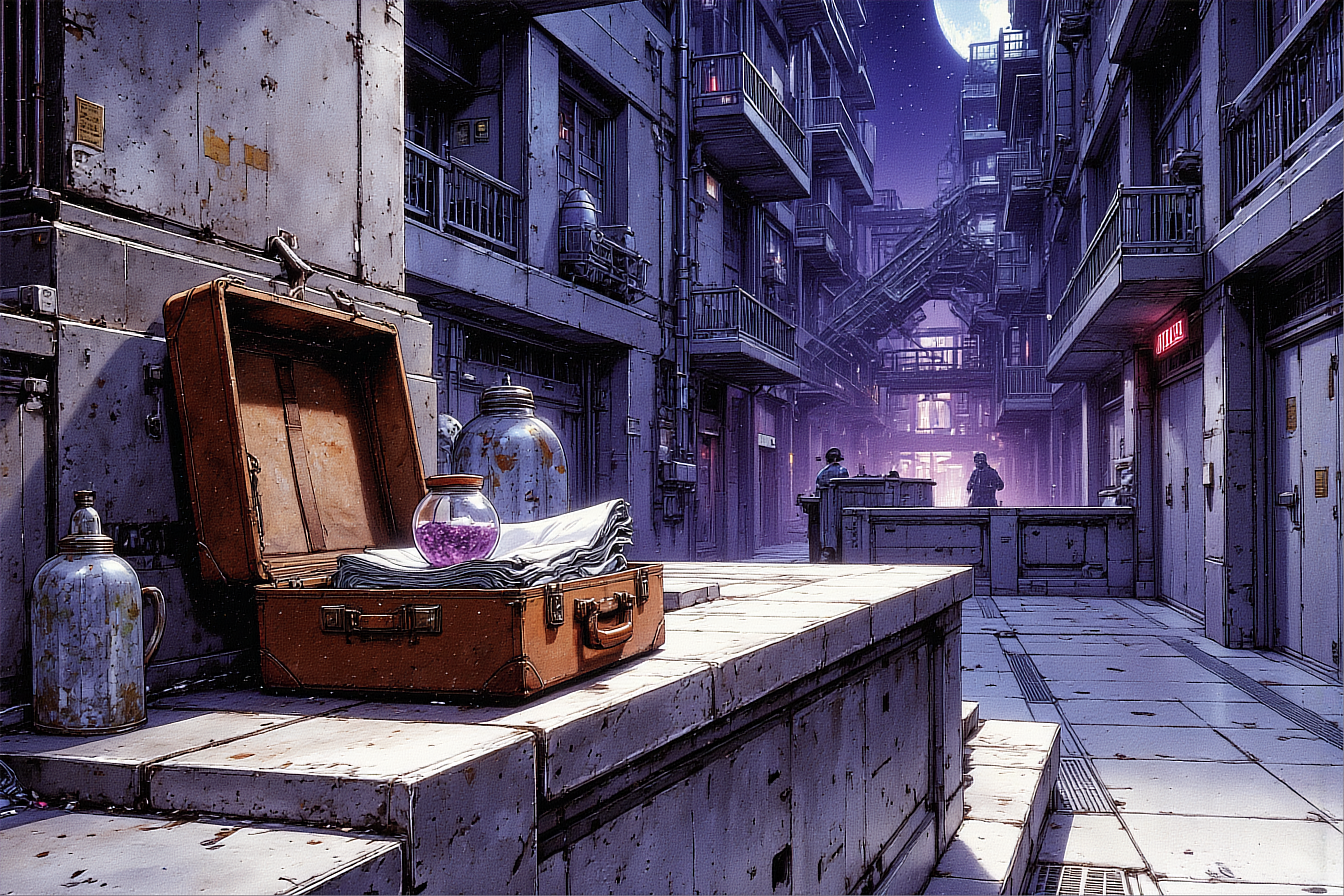
Nocturne Aeturnus does not have weather. It has a state. The sky is the color of a lamp left on in a room where somebody has been crying, and it does not brighten and does not darken, and it has been that color for as long as the district has existed, which is a length of time the district does not measure. There is a moon over it that the people here call the Sorrowful Moon, and the moon is not luminous so much as present, a pale coin hung in a ceiling that nobody has finished, and the light it makes arrives at things sideways.
And the air comes down in flakes. Not snow. Zephyr put his hand out and caught some on his sleeve and held it under his glasses and said a word that was not a word, and I shifted my weight to see, and what was on his cuff was a small hard grain, clear as old glass, with a faint shape inside it the way a bubble is a shape inside ice.
"Sighs," A1 said from inside the bag, his voice coming through the canvas thin and clinical. "The district's atmosphere particulates ambient vocalized distress. It crystallizes on contact with the cold. Do not inhale deliberately."
"So that's people's sorrow falling on us."
"That is a simplification," A1 said. "It is people's sorrow falling on us, and then being measured."
The flakes came down through the twilight in a slow drift that never reached the ground so much as settled onto it, and the district under the moon was a district of lockers and low buildings and windows with the lights kept at the level of a room where somebody is waiting for bad news, and somewhere past the first row of buildings a bell was working, not ringing, working, the way a bell works when it has been asked to mark a thing nobody wants marked.
We were eight steps out of the mouth when the voice arrived, and the voice had been there before we arrived, which is the trick of a man who has decided to be standing where you are going.
"Gentlemen. And the piece of furniture. Good evening."
Orrin Pyle had a briefcase. That is the first thing I will say about him and it is the thing I keep: a briefcase of the exact brown that means nothing, held in the left hand with the strap doubled once around the wrist, and shoes on his feet so soft that the corridor floor had not been informed of his weight. He was standing at the junction where the corridor opens onto the first street of the district, with his shoulders slightly forward, the posture of a man who has been waiting politely and does not want to have made it a point.
"Mr. Glitch. Thank you for the walk down. I know it's out of your way. May I?"
Zephyr did not step aside. Zephyr squared up to him with the deck coming off his chest the way a kid brings up a hand, and A1's optics came through the canvas to full, and the moon did its sideways light, and Pyle waited through all of it with his weight on his back foot and the briefcase hanging.
"Corporate is not hostile," Pyle said. "I understand that is how it reads. It reads that way because people misread forms. A Form 9 is not an act of malice, it is an act of tidying, and tidying looks like violence to the person being tidied. I don't expect that to land. I offer it as context."
"Context for what," Zephyr said.
"For this." Pyle set the briefcase on the low wall beside him, unclipped it, and opened it facing us the way a man opens a book rather than a trap, and there on the folded grey cloth inside was a jar.
I have bound a great many documents about a great many things and I have never once been asked to bind one about what that jar looked like, so I will do my best with the language I have. It was glass, sealed under a wax lip the color of an old bruise, and it was small, and inside it was a light that had been poured. Not glowing. Settled. The light sat at the bottom of the jar the way sugar sits, granular and patient, and it moved a half-turn when the jar moved, and when it moved it made, in the back of my springs, in the place where I keep what I am, a sound I can only describe as the inside of a good afternoon.
Enough CLX to buy a corridor. I did not know the figure yet. I knew it the way you know a price before the tag is turned, which is by the way your hand goes to your wallet, except I have no wallet, I have a base plate, and something under it went tight.
"This is Crystallized Laughter," Pyle said. "Some people call it CLX. It is not contraband, it is not traceable, and it is not conditional. A sealed jar is a sealed jar." He looked at me, and the looking was the first time in the scene that he had addressed anything other than the two humans. "I was asked to bring it to the party that has sentiment issues. That is the phrase in the memo. I raised an objection to the phrase and was overruled, so here it is, and here I am, and nobody is asking you for anything."
Nobody is asking you for anything. A price with no price attached is the only product Corporate has ever manufactured that I have never seen go stale.
"A retainer," I made Zephyr say, by tipping my margin at him and holding until he read it.
"A courtesy," Pyle said. "Retainers imply a relationship with terms. There are no terms. Consider it an apology in advance for the number of forms you are about to encounter." He closed the briefcase's lid halfway and left it standing open at the elbow, the way a man leaves a door unlocked so nobody has to decide whether to knock. "If it's never spent, it costs you nothing. If it is spent, it was yours to spend. I'll leave it on the wall."
Zephyr's hand was shaking slightly, which in a kid of twenty-one means either fury or the onset of understanding, and he went with fury because fury is the first language he learned.
"I'll smash it," he said. "Right now, on the stones. Whatever that does to your memo."
"It would make a very loud noise," A1 said from the bag, "and a great deal of very quiet money. Zephyr. Put your hand down."
The bag's zipper was already open an inch. A1's beam came out of it and went over the jar in a slow pass, and the light inside the jar turned in the beam the way flour turns in a sifter, and the pot ran his numbers in the silence that follows the sound he makes when he is genuinely interested, which is no sound at all.
"Untraceable," A1 said. "Confirmed. There is no serial, no issuer mark, no ledger entry for the manufacture of the contents, and no receipt. Joy keeps no receipts, which I had assumed was a figure of speech." Another pass. "Odds that spending this places you under obligation: certain. Odds that the obligation is ever stated, written, or even acknowledged by the holder: low. That is the mechanism. You will not be bought. You will simply have bought something, and the man who sold it will know exactly which door it opens, and you will have shown him which door it opens by walking through it, and you will call that walking your own idea."
"Then we don't take it," Zephyr said.
The kid looked at me. Eight steps out of the transit mouth with the sighs coming down on his mohawk and the Sorrowful Moon doing its sideways work and a Compliance man standing open-jawed at his briefcase like a man at a marriage proposal, and Zephyr Glitch looked at a stapler in a napkin to find out what the answer was, and that is the moment I understood that the team is me and that nobody has mentioned it out loud.
I tipped toward the wall. Two degrees. Hold. Take.
"That's a bad idea," Zephyr said.
I tapped twice through the napkin: trust.
"He's taking it," Zephyr said.
"I heard," A1 said. "And for the record, sir, I did not endorse it. I endorsed the arithmetic. The arithmetic says the jar is the cheapest thing in this district, and the arithmetic is correct, and cheap is how these transactions are designed to feel."
Pyle did not gloat. I have watched a lot of men hand over a lot of things and the ones who gloat are amateurs; the professionals do what Pyle did, which was to close the briefcase, click both latches, and step back from the wall so that the jar was unattended and therefore ours.
"May I say one thing about it," he said.
Zephyr picked the jar up by the wax lip with two fingers, the careful way, and held it away from his jacket, and the light inside turned and made that sound in my springs again, and I wanted it the way you want a window in a room you have been kept in, and I filed the wanting in the place where I file wanting, which is now a place with prices on the door.
"Say it," Zephyr said.
"Some men keep records," Pyle said, in the mild voice of a man commenting on the weather, "because nobody ever offered them a quiet life." He picked up the briefcase and doubled the strap around his wrist and gave a small nod that took in Zephyr and A1 in the bag and the jar in Zephyr's hand and me in the napkin, the whole absurd inventory of it. "Good evening. I hope your case goes well. I am instructed to say that Corporate wishes you every success, and I am permitted to add that I said it."
He went back up the corridor the way he had arrived, which is to say he was simply no longer at the junction, and the soft shoes never told the floor a thing, and the sighs came down where he had been standing without disturbing anything.
Zephyr had the deck out before the junction was empty. He ran the corridor's transit log twice, once at street resolution and once at the resolution he uses for things he does not want to find, and the screen showed our two signatures coming down the mouth and the district's ambient traffic and a gap where a third party should have been standing for the length of a conversation.
"He wasn't logged," Zephyr said. "He walked four hundred yards through a monitored mouth with a briefcase and the log has nothing. No entry, no exit, no shoes."
"Pyle is not in the registry as transit personnel," A1 said. "He is not in the registry as anything. He is in the registry as a correspondent, which is a classification the district grants to a person who writes to it and is never seen arriving."
"Compliance doesn't use the transit logs."
"Compliance does not appear in the transit logs," A1 corrected. "There is a difference, and the difference is the entire reason for the corridor." The beam swept the junction once, and the jar at the bottom of the bag made its small sound in my springs. "He knew our route, our timing, and our composition, sir. Two humans, one pot, one stapler, one napkin. He had been briefed on the napkin."
Zephyr stood there holding the jar until A1 said "You may put it in the bag, Zephyr, at the bottom, in the fold, and you may keep your hand on it for exactly as long as that helps you," and the kid put it in the bag, and he did keep his hand on it, and we walked out into the district.
Here is what it means to carry a bribe you refuse to spend. It rides with you. It rides in the bag next to the coffee pot that runs the odds on your death and the deck that can feel a staple at four hundred yards, and every so often the bag shifts and the light inside the jar moves, and my springs do the thing they did at the transit mouth, and I let them, because a man who does not permit himself to want has no way of proving that he declined.
In the file under my base plate, at the back, where exhibit A will go one day if the case keeps its shape, I have opened a space the exact size of a small sealed jar. Not in the folder. In the arrangement. I have been arranging paper for sixty years and I know what an exhibit is: it is a piece of evidence that has been placed where it can be found again, by you or by a stranger with a warrant, and its job is to sit there being what it is. The jar will ride in the bag until the bag is put down for the last time, and when it does, the space is there, and the tag is there, and the tag reads EXHIBIT B: SEALED JAR, CLX, OFFERED, UNCLAIMED, UNSPENT.
The bribe I keep to remember that I was offered one.
Verse, on the street under the Sorrowful Moon:
They sent a jar with a wax lip and no invoice, which is the invoice, and I signed for it by carrying it.
We went deeper. The district opens out past the first row of lockers into a low street where the buildings have the look of municipal architecture built by a committee that was only ever told about grief secondhand, and the flakes came down harder there, and Zephyr stopped talking, which is what Nocturne does to people who arrive with a loud intention. Somewhere ahead, past the weigh station and the intake shed, past a row of windows kept at the level of bad news, was the district's evidence lockers, where feelings that have crystallized are tagged and shelved and given a number, and the number is the only thing anyone down here ever gets, and we were walking toward them with a jar of laughter at the bottom of a market bag that nobody was going to spend.
A1's beam swept the street once from inside the canvas, reading doors.
"Lockers ahead," he said. "Roughly six hundred meters. And sir, for what it is worth, the jar's odds have not moved. It remains the cheapest thing we own and the most expensive thing we have not done."
"Which one are you voting for," Zephyr asked him.
"I don't vote, Zephyr. I report. The chairman votes." A short pause, and the bag shifted on his shoulder. "The chairman has voted to keep it, and to not spend it, and I have logged both, and neither of you will admit that this is the most prudent decision anyone on this team has made in a week."
The moon hung. The sighs came down, clear and small, and settled on the street and on the bag and on the napkin over my base plate, and ahead of us the lockers waited in the dark with their tags on, and one of them, six hundred meters on, had a column in a ledger with nothing written in it.