
Everyone Lost Tuesday — Chapter 10: The Case Is Open
The ceremony of one stapler and two witnesses took nine minutes and I have replayed every one of them, because a case should be opened the way a door is opened, which is once, on purpose, with somebody standing behind you to say it happened.
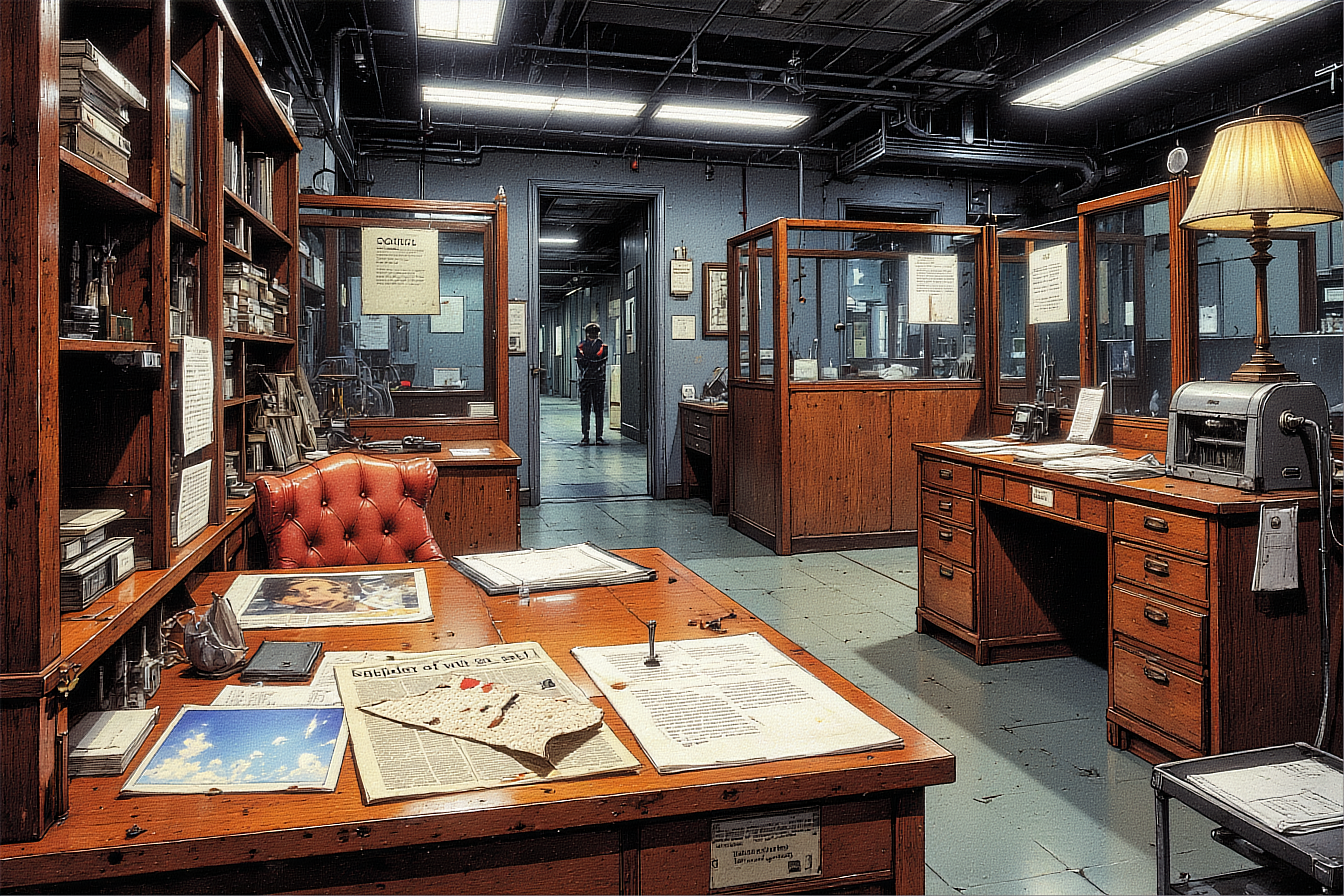
Zephyr laid the napkin on Barry's desk. He did it the way he does everything, too fast and then very slow at the end, smoothing the grease-spotted square flat with the side of his thumb and easing the photograph out onto the wood so the staple in its corner would not catch. The photograph sat where routing sheets used to sit. Half a face into frame. A corner of sky that matches no precinct. A photographer's name torn off the negative with a blade, by hand, at a bench, by somebody who is still somewhere.
A1 came all the way up for it. The pot slid himself two inches to the desk edge with the small grinding sound he makes when he moves, which he dislikes, and positioned his optics at the height of a man leaning over a table to sign, and he said nothing, which from A1 is attendance.
I was carried the last distance by Zephyr, who set me down behind the photograph with the care of a pallbearer and stepped back out of the sightline, and I looked at the page for a while, and the page looked at the ceiling, and the tube did its dim, and then I put my crown over the corner of the napkin and I drove it.
Forty-five degrees. Doubled. Flush.
Two staples through napkin and photograph and into the old wood of a desk that has taken ten thousand of them, my own pattern, the signature I have been re-driving on blanks for five years, driven through the picture that came to me at two in the morning in a grease-stained square from a kid I did not want to help. The arm of it went into the corner and aimed outward, the way Barry's aimed, into the room, at the open floor, at the glass partition, at nothing anybody could put a name to.
Under my base plate, where they live, were the contents of both files: the routing sheet with Barry's last pattern in its corner, the two photographs, the napkin's grease coming through on the older page, the cutting from 1972 folded the wrong way on purpose, and the blank sheet I re-drive the pattern into when the hinge needs the exercise. All of it rode down onto the wood with me the way it always rides, and when the staples went in, all four layers of me flinched together, the metal and the paper and the man and the case, and there is no sensation in my archive I would trade for that one, and I have just been reminded what trading costs.
TUESDAY, I said to myself, has no number. They do not file what they delete, and so the case gets the title the company gave it by omission: a day with no entry, a folder with no field, a name in the second box. No number. Cold and open at the same time, which is the condition of a file held by a man who cannot close it.
"It's open," Zephyr said.
I tapped once on the desk: yes.
"Feels like nothing happened."
I tapped twice: trust. And then I drove a single staple into the desk pad at an angle of caution and left it standing there for him, because what was about to happen required him to understand that I had not decided this lightly and that the deciding was not the dangerous part.
Because here is the thing I had to set down. The Vault. The wall of what was taken. The carbon with the amber tape and the line that should have been there and the bar that had been there instead, and the price I had paid to read it, and the sentence I had gotten back for my money, which was the sentence that moved the case out of the annex and gave it an address: AETHER, C. INTAKE VOIDED SAME NIGHT BY ORDER OF THE EDGE. No filing. No claim. Reference suppressed at source. No appeal.
I was setting it down. That is the only way I can put it, and I want to be careful, because what happened next is the part of this account where the account itself becomes a witness.
The words did not come out of me. I do not have words that come out. They assemble in me the way everything assembles in me, in the exactness, in order, and I have always assumed the assembly is mine, because it is in my voice and my cadence and my refusal of every easy sentence, and the page I keep is the one place where a stapler is not furniture. I was three sentences into the wall, into the tags and the umbrella and the book with no claimant, when the fourth sentence came back to me already ruined.
Where my account of Barry's last weeks should have sat, on the page, in my own hand, in my own voice, there was a bar.
[REDACTED , FORM 9]
It did not arrive from outside. Nobody printed it on me. It rose out of the middle of my own sentence the way a bruise rises out of skin, flat, black, without edges, and the words that had been around it went on standing there, and the words underneath it were gone, and the gap in my own prose read exactly like the gap in the carbon: not covered, absent. My account of the three weeks before the deletion. My account of the man. Barred, by something that had reached into the place where I keep what I am.
I want to record what I felt, since I have started recording these things. Not fear. The first feeling was offense. Sixty years I have been the one who holds pages down, and something had held one of mine down, and the offense was so pure and so immediate that my crown came down flush on the desk before Zephyr had finished taking his hand away from me, flush being danger approaching, and the danger was a bar on the page of a stapler.
"Clive." Zephyr had both hands up. "What is it. What's wrong."
The kid could not see it. Of course he could not see it. The bar is mine; it is printed in me; A1 got nothing when he ran his optics across my housing, a flicker and a null, and Mrs. Fenn had been right three days ago in the Undercroft when she said the light does not argue with a Form 9. The light does not even get shown the Form 9.
I had paid before. I knew the counter. I had watched a bar open in a carbon for the sound of a man laughing, and I had tested the shelf afterward and found it dusted, and I had logged, in my own way, what the transaction cost, and now the same counter was open inside my own narration with my own history lying under the bar, and the price had been posted before I asked.
This is the bargaining, and I will put it down the way it went, without arranging it into something nobler than it was.
I went through the drawers. That is the honest shape of it. A man at a counter with a posted price does not refuse; he shops, and the shopping is the shame, and the shame is fast. Dorothy's hands: no, and the refusal was instant and total and the bar did not move. The dumpster: no. The wet sound: no, and I found I could not even hold it out as a candidate, because some files are load-bearing and take the roof down when you lift them. The two years at the annex with Barry, I tried to open that drawer, and the drawer came back to me full and shut and heavy, and I understood with the cold clarity of a hinge at its limit that I was being asked for something out of the middle rather than something out of the edge, and the middle costs more, and the middle is where he is.
I took hold of his left hand.
Not the hand that lifted me. Not the hand that set coffee down or held the log or pointed across an open floor at a cubicle with a nameplate. The left one, the one with the watch, the battered diver's watch with the bezel worn to shine on two corners, always five minutes fast because Barry had told some person, in some year I have never been able to place, that a man who is five minutes early is never late and never surprised. The look of it. I traded the look of it. Not the memory that he wore one, which I still hold, and not the fact of five minutes fast, which I still hold, but the sight: the specific way the skin sat over those knuckles, the hair gone gray at the wrist, the second finger with the callus from the clipboard, and the watch face, and the hour on it.
The look of Barry's left hand. The watch he wore.
I let it go the way you let go of a page you are feeding into a slot, square, committed, without a second tug.
Price paid: the look of Barry's left hand, the watch he wore. Logged.
The bar became text.
It came back the way the Vault's came back, cold and typed and this morning's, and it was my own sentence in my own voice, which is the part I will not get past no matter how many times I write it: the recovered line was mine, and I had written it, and something had taken it out of me and put a price on it and now gave it back for the money.
Three weeks before the deletion, Barry pulled a night manifest. Not the routing sheet with the four crates. The manifest underneath it, the one that lists the whole shift, and he took it off the spike at the end of the round, and he wrote a name on the back of it, in pen, in the hand I can still see in my interior with the watch missing from the wrist, and the name is not on the manifest now. The manifest was pulled and filed and reduced, and the back of it is a clean rectangle in my account where a name used to be, and the name is gone in the specific way of a name that has been charged for: not misspelled, not smudged, not torn. Logged.
He wrote a name. That is what survives. A night guard took a pen to the back of a document three weeks before the company deleted a day, and the company has spent five years making sure the document and the day and now my account of the document agree with each other, and they do not agree with each other, because I am still sitting here holding the shape of the writing, and the shape is his, and the letters are the one thing I have been charged for and did not receive.
I said so. Flat, the way A1 says a number he dislikes, and in the only voice I have, which is the one you are reading: the page turned on me, it is in my voice, it has been in my voice the whole time, somebody has been reading ahead in me and now they are editing, and I am going to keep writing anyway.
Then I gave the room the whole of it in the only language it can take from me: four drives in sequence into the corner of a desk pad, caution and trust and caution and flush, the entire grammar, and I held the last crown down until the hinge bottomed out. A1's optics tracked each drive the way he tracks a line of code, and when it was over he was quiet for the length of a boil, and then he translated for the kid, dry, without looking at him.
"His account has been edited, Zephyr. His own account. He is aware, and he intends to continue."
"That's insane," Zephyr said.
"Yes," A1 said. "He is aware of that too."
Verse, since the counter has run twice now:
Keep the file and the file keeps a hole where you stood; I am the archivist and the archive's bad debt.
Zephyr wanted to burn something. He wanted to take his deck to the Vault's carbon and his deck to my housing and his deck to whatever prints a Form 9, and A1 talked him down the way A1 talks everything down, with a number: the probability that a second attempt would recover the same line, nil, the probability that a second attempt would cost additional material from the same drawer, high, and the probability that the machine had logged this transaction and flagged the account for a follow-up, rising. He did not say dead by Thursday. He did not have to; he ran the number and let the silence do it.
Then the annex made its four a.m. noise, the long one, the building clearing its throat before the last round, and from behind the desk, from the cabinet where Corporate keeps its administrative hardware, there was a sound none of us had asked for.
The shredder cycling.
It is a low machine, a departmental one, the kind that sits under a credenza and eats half-sheets and sticky notes and the occasional page somebody decides not to keep, and it has been in that cabinet since before I came to this floor, and it has never once run on its own. The maintenance log shows a manual override at 4:01 a.m. There is no maintenance log entry for tonight, because there does not have to be: the machine simply started, ran its eleven-second cycle with nothing in it, and stopped, and the cabinet sat there with the smell of cut paper coming out of the vent, and nothing was in the chamber, and nothing had gone in.
Zephyr got to the cabinet before either of us could tell him not to, which is his whole biography in one gesture, and he opened the front panel and put his hand in and drew out the chamber and held it up so A1's optics could get the interior, and the chamber was empty, clean, with a smell of cut paper coming off the teeth and a single static-charged fleck of something drifting in the bottom that was too small to be a document and too square to be dust.
He put it back. He closed the panel. He stood in front of the cabinet with his hand still on it for a moment, and I watched the back of his neck do what the back of a neck does when the person attached to it is deciding whether the last thirty seconds happened.
"Nothing in it," he said.
"Nothing in it," A1 agreed. "Eleven seconds, four o' one, manual override, no feed. The machine has logged it against itself."
"Why would a shredder run itself empty."
A1's optics went to half, which is the pot thinking in public. "Because it is not a message to the contents of the cabinet," he said. "It is a message to whatever is in the room while the cabinet runs. Corporate does not write notes, Zephyr. It schedules them."
A machine that shreds nothing at four in the morning is a machine telling you what it is for.
I sat on Barry Kowalski's desk with the photograph stapled down in front of me and the bar gone out of my own sentence and the price of it sitting in me where a watch used to be visible, and I did not tip and I did not shift and I did not drive another staple, and the case, which had no number and no filing and no claim, was open, and the building, which had all three, had just put its hand on the door.