
Everyone Lost Tuesday — Chapter 13: The Ad-Verse
The sighs ran out at the water and the jingles began, and there is no place in any of the five precincts where you can stand and watch a district change its mind as completely as you can on the Haulage Bridge, because the bridge is the seam, and on the Nocturne side of it a man can hear his own grief settling in the gutters, and on the near side a woman's voice is telling four thousand people that she remembers her first dance and so can they, for a price, for a very reasonable price, financing available.
The Ad-Verse does not have buildings the way other districts have buildings. It has advertising that has achieved structural integrity. The facades are screens, and the screens are tenants, and the rent on a wall is paid by whatever the wall can sell between the hours of noon and midnight. A man walks under a porch made of somebody else's summer. A woman waits for a bus inside a painted mouth selling cigarettes to nobody in particular. Up top, between the gargoyles and the aircraft warning lights, the billboards run other people's memories in a loop: A MOTHER'S KITCHEN, SUMMER 1971, STARTING BID. YOUR FATHER'S HAND ON YOUR SHOULDER, GRADUATION, ASKING. A boy's first bicycle, mid-fall, eleven seconds, licensed for public nostalgia.
Zephyr read a couple of them out loud while we walked, in the flat voice he uses when he wants me to know he is disgusted rather than tempted.
"This one's nice," he said, stopping under a board the size of a building's face. "Man's last clear thought before an accident. Three seconds. They've got it on a loop with music under it." He looked down at me in the crook of his arm. "You want to buy a man's last clear thought? They'll finance it."
I set my weight to the side that says keep walking, and he kept walking.
Evidence in the Ad-Verse is not kept. It is quoted. The district does not hold a copy of anything; it holds a copy of a copy, and the copy has a price on it and a return policy. The police notices are slogans now. The missing posters have a buy-now mark in the corner. A summons and a coupon arrive at the same address with the same amount of hope in them, and a man who wants to prove where he was on a given night has to purchase the proof back from a broker who may already have sold it to someone else that morning. Corporate does not have to burn a record in a district like this. It only has to let the market do what the market does, which is to find the highest bidder for a truth and deliver it there.
And somewhere in it is the one witness we have: a data courier named Ambrose Fell, night route, who booked a grief in Nocturne five years ago and then never came back for it.
We started at the night route exchange, which is a window in a brick face with a schedule printed on glass and a dispatcher behind it who has the particular patience of a man who answers the same question in different hats. Zephyr showed the man the booking entry from Ashby's index, and the dispatcher looked at it the way you look at a name you expected to see and did not want to.
"Fell," he said. "Fell's route's been day side since the spring. Best route in the house. Somebody's got it. Everybody knows somebody's got it." He wrote the number of Fell's old route card on the back of a grease bag and slid it through the slot without explaining why he was helping, which is itself an explanation. "Card's got his photo. He ate at the Grub most nights before the run, night side, four years straight, never missed. If he's still got the habit you'll find him on the stool by the window."
The grease bag said AMBROSE FELL, ROUTE 9, NIGHT, and under it was a photograph of a man with a narrow face and a courier's lanyard and the look of somebody who has spent five years being reliable in a district where reliability has no market.
We took the bag and we took the street, and the street sold us three things on the way to the Grub, and I watched a man come out of a pawnshop holding a receipt for his own first kiss, which he had just sold, and he was smiling the smile of a man who has been told the price was fair.
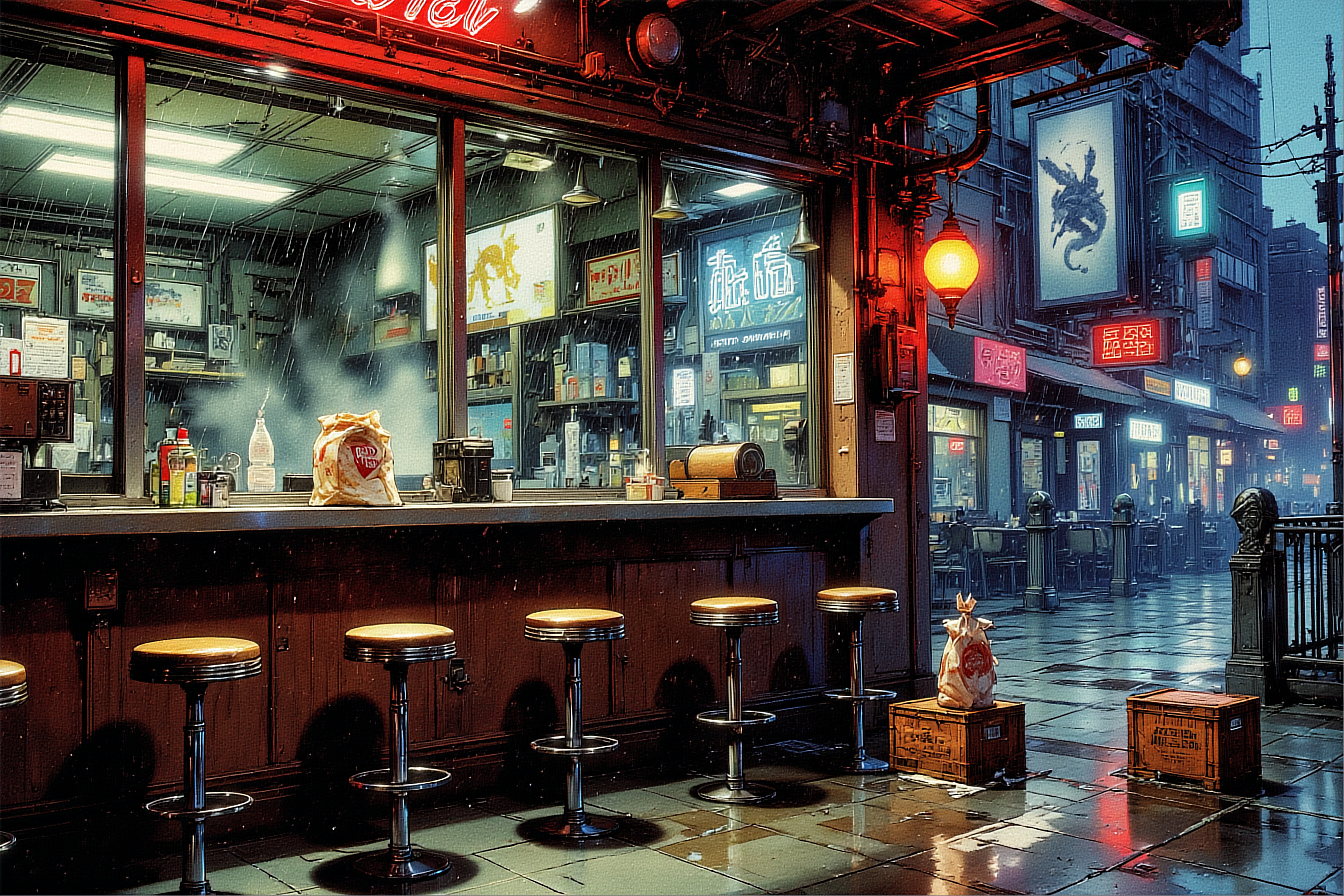
The Glitch Grub is a counter with a window and six stools and a light in the shape of a soft drink that has not existed for thirty years. Inside, night people ate with the focus of people who eat standing. We took the window stool, and Zephyr set me on the counter beside the napkin dispenser, and A1's optics came up for the first time since the district, because a pot that has not been asked to brew in two days will wake for the smell of broth alone.
I was asking Zephyr, in the manner of asking, which is to say he watched me tip twice and then answered out loud, whether the dispatcher's route card had a forwarding on it, and he was halfway through turning the grease bag over, and the conversation we were having was an ordinary conversation and I mention that only because it was the last ordinary conversation I had in that district.
Above the window, outside, a billboard went dead.
Not dimmed. Not between advertisements. Dead: the whole face of it dropping to a gray that has no content in it at all, the kind of blank that a screen reaches when the thing it was showing has been removed from the world rather than switched off. And out of the dead frame, the way a thought comes out of a man's mouth before he has decided to say it, a girl dropped.
She came down eight feet and landed on a crate of broth concentrate that had been left under the window for exactly the wrong hour, and she did not spill it, and she sat on the crate with her boots still wet from a rain that only falls in one precinct, and she looked through the glass at me, and she did not say hello.
"You're going to staple the route card," she said. "Upper left corner. Forty-five, doubled, flush, aimed at whoever you want to warn. You'll do the corner first because the corner is where you check that the paper is still where you left it."
The counter went on being a counter. A man two stools down went on eating. Zephyr's hand went on holding the grease bag, and it stopped in the middle of holding it.
Nobody had told her. Nobody could tell her, because I had not done it yet. I had not stapled anything since I came into the district, and the only record of my signature pattern that exists in any archive in five dimensions is a routing sheet that was pulped, a photograph in a napkin, and a stack of forms I have never admitted to, and none of those are things a girl can read off a dead billboard at four in the afternoon.
She watched me not move, and she had the decency not to enjoy it.
"Pixel Paradox," she said. "That's the name I've got, and if you go looking for it you'll find the space where it should be, and that's the whole of my pitch, so I'll say it once and then I'll stop talking and let you think, because I can see you thinking and I'd rather you did it with the facts."
She was twenty, maybe. Hair that had been cut with a knife and confidence. A jacket with too many pockets and not one of them closed. And her eyes did something on the walk from the crate to the stool that I have never seen a pair of eyes do, which is to track a line in the air that was not there, the way a man tracks a crack in a window he knows is about to go.
"Nothing exists on me," she said. "No file. No address history. No school, no syndicate, no debt, no badge, no next of kin, no health record, no transit log, no customer profile, no priors. I was deleted before I was ever built, or built and deleted in the same afternoon, I don't know which and it doesn't matter. What matters is the procedure. A witness gets impeached by producing his record and finding it does not agree with his mouth. Nobody can produce mine. A procedure has to have a subject to serve, and there is no subject. You can't cross-check me. You can't impeach me. You can't subpoena a blank." She put her hands flat on the counter. "The system ate my file years ago. That's the one thing it ever did for me."
"And you want in," Zephyr said.
"I want to be useful," she said. "There's a difference, and the difference is that useful people get to decide when they're done."
Then she looked at me again, and she said the thing she had not said and was not going to say, because she was going to leave it lying there on the counter where I would have to decide what to do with it. She said: "I've been reading the office-supply resonance for years. The furniture talks, you know that. File cabinets carry, copiers repeat, phones carry things they were not asked to carry. And a stapler who thinks in verse is loud. You're loud."
She reached into the pocket with the open closure and took out a folded sheet, paper, real, photocopy paper, and she unfolded it and turned it around so I could read it, and it was my hand. Not my handwriting, which I do not have. My interior, in somebody else's block letters, transcribed off a line, off the resonance, off the office-supply network that remembers everything that is said in front of the furniture:
The rain doesn't fall, it files, waits on a supervisor's initials, hangs there over the chrome the way a name hangs in the second box.
"Fourteen pages of these," she said. "Some of them you thought in the Vault. Some of them you thought in a district I've never been to. I've got one you thought forty minutes ago, walking over the bridge with your jaw set, about grief being a mineral." She folded the sheet and put it back. "I never printed the last one for anybody but me."
The bar in her voice on the word printed was a lie, and she knew I would hear it, and she had left it in on purpose, which is either a confession or a piece of theater, and a man who has spent his life reading staple patterns for the difference between a warning and a welcome knows that the two are the same art.
I resented her and needed her in the same breath, and I did not have to choose between them because they were the same breath. A woman with no file is the purest witness in five dimensions, because no procedure can impeach a record that does not exist, and she will never be caught out by a discrepancy between her testimony and her past, because she has no past to disagree with her. And a woman with no file is also the most dangerous thing that has ever sat on a crate next to me, because the one thing I do, the only instrument I have, is the check against the record, and she is the record's negative. If she wanted my case to say something it did not say, there is no ledger in five dimensions I could open to catch her.
I set my edge to the counter and drove a staple into the laminate at an angle. Caution. Not aimed at her. Aimed at the air between us, which is where the caution belongs until a person gives me a reason to move it.
She read it in under a second. She looked at the angle, and she looked at me, and she did not say "caution," which she clearly wanted to, and she did not argue with it, and that restraint is the reason she is on a crate and not in the street.
"Fair," she said.
Zephyr, who has spent his life in the same dark and does not share my superstitions about records, wanted to know what she could see. So she paid him in the only currency she had, which was her eyes.
She took us out into the street to show us, and this is what glitch-sight looks like from where I sit, carried at the height of a man's chest with a jar in the bag and a pot on his back. We stopped at a corner where a street name had been changed at some point by somebody who was not careful. The letters of the old name were still in the plate under the new name, and where the two alphabets overlapped the metal did not join, and Pixel put her finger on the seam and did not touch it, the way you do not touch a page you are afraid to crease.
"That one's an edit line," she said. "The street was called something else and then it wasn't. Most people can't see why the letters look wrong when it rains. It rains wrong there too, because the rain doesn't have a record of falling on that corner."
Two blocks on, a man in a good coat walked past us and the coat was gray and then, without the man stopping or the light changing, the coat was the color of a bank's carpet, and the man did not notice, and the change did not hold. "That one's live," she said. "The district is photographing him and rewriting him at the same time and neither version is winning." She pointed up at a memory board where a woman's face was running in a loop, smiling at a lake. "And that one's for sale and the seller's been gone for two years. The board doesn't know. The board's been selling a dead woman's afternoon all week and it'll keep on selling it, because down here evidence is replaced by copy and the copy never asks who authorized it."
She sees the seams where reality has been rewritten. That is the whole of it, and it is worth more than anything else in this district, because in a place where every surface is a copy of a fact, the only valuable person is the one who can show you where the fact used to be.
I did not thank her. I have not decided what she is, and thanking a witness you have not cleared is how a file starts to lean.
Verse came up out of me in the middle of the block, the way it does, without permission:
A file with no subject in it is a lock with no door, and a woman who can't be checked has already been believed.
"She's clean," Zephyr said, which is the kid's way of telling me he has already decided. "You heard her. Nothing on her. Nothing to impeach."
"Nothing to impeach," I agreed, in the only way I have, by driving a doubled staple into a flyer on the wall beside us for a man's lost dog that had been replaced by an advertisement for a dog-shaped lamp, and the hole I left in the flyer was trust and the hole I left in the air was doubt, and both of them stand.
Pixel saw the double. She did not comment on which half of it she was.
We went on toward the route, four of us now, and the district went on selling. At the corner of the block, by a scaffold where a wall was being repainted into an offer of beer, Pixel stopped and put her hand out flat in front of us without turning around, which is a gesture people use for a dog or for a cliff.
"Look at the two men crossing," she said. "Don't look at their faces yet. Look at the walk."
There were two of them. Both in courier's jackets, one older at the seam. Both crossing on the green with the same patience, the same half-second pause at the curb where a man checks a street he has crossed ten thousand times. In the left hand of each of them, a paper cup from the same window, held at the same height, at the same level of full, with the same two inches left in it. And each of them, on the fourth step into the crosswalk, favored a right leg the way a man favors a leg that has been telling him the weather for a decade.
Same walk. Same coffee. Same limp.
Zephyr looked at their faces then, and the grease bag with the route card in it crumpled a little in his hand, because one of those two men was the narrow face under AMBROSE FELL, ROUTE 9, NIGHT, the man who booked his sorrow under the word UNCLAIMED and left a forwarding address in a district that sells other people's memories.
"That's Fell," he said. "That's my witness."
"That's Fell," Pixel said, and she was already watching the other one, and the other one was also, in every particular a man can be a particular, Ambrose Fell.
They reached the far curb in step, and they turned the corner in step, and the wall behind them finished repainting itself into a glass of beer without either of them looking up, and I have been carried into worse rooms than that street, and I have never in sixty years been carried into one where the first question was which of two identical men was the one the case could use.