
Everyone Lost Tuesday — Chapter 14: Duplicate Lives
They turned the corner in step and we went after them, four of us, down a block where the paint was still wet on an offer of beer and a man was being paid to stand inside a window and look happy about a watch. That is the difficulty of tailing a witness in the Ad-Verse: everything on the street is already performing for a camera, so a man walking badly can be mistaken for a man acting, and a man telling the truth can be mistaken for a sales pitch.
We had two of him, and neither slowed down, and both walked with the courier's patience of a man who has ten minutes to cover eight blocks and intends to spend eight of them.
Zephyr took the near one, which is what a man does when he has no reason to choose and a reason to be close. Pixel and I took the far one, carried in the crook of her arm because she took me out of Zephyr's without asking and Zephyr, who argues with everyone, did not argue with her, which is its own verdict. A1 rode on the kid's back and said nothing, running the odds on a thing that has no odds: which of two identical men is the original article.
"I cannot tell you which is real," Pixel said, at the second block, in the low voice she uses for facts she resents. "That's the job. Whoever built the replacement built him out of the record, and the record in this district is whatever gets photographed last." She put me up on her shoulder so I could see past a delivery van. "Watch the screens as we walk. Every one of them's picking a version."
They were. The block screens that had been selling a bicycle and a bank were now running a man's name: AMBROSE FELL, DAY ROUTE, NINE YEARS, COMMENDED. It was on a bus shelter. It was on the side of a taxi that had not been there an hour ago. The district was photographing both versions of one man and writing down the one that smiled for the lens, and the near one, the one in the good coat with the route supervisor's lanyard, was smiling for lenses the way a man smiles at work.
The far one was doing the opposite. He crossed against the light to put a van between himself and a wall camera. He walked under scaffolds where the boards gave cover. He put his back to a shopfront and turned his face from the window rig, and a man who does those things is either a thief or a man who has learned that in this district being photographed is a kind of legislation.
Both went into the same shop, which is how we lost the choice: the near one through the door with the bell, and the far one through the service door at the side, quick, the way a man enters a place he already knows.
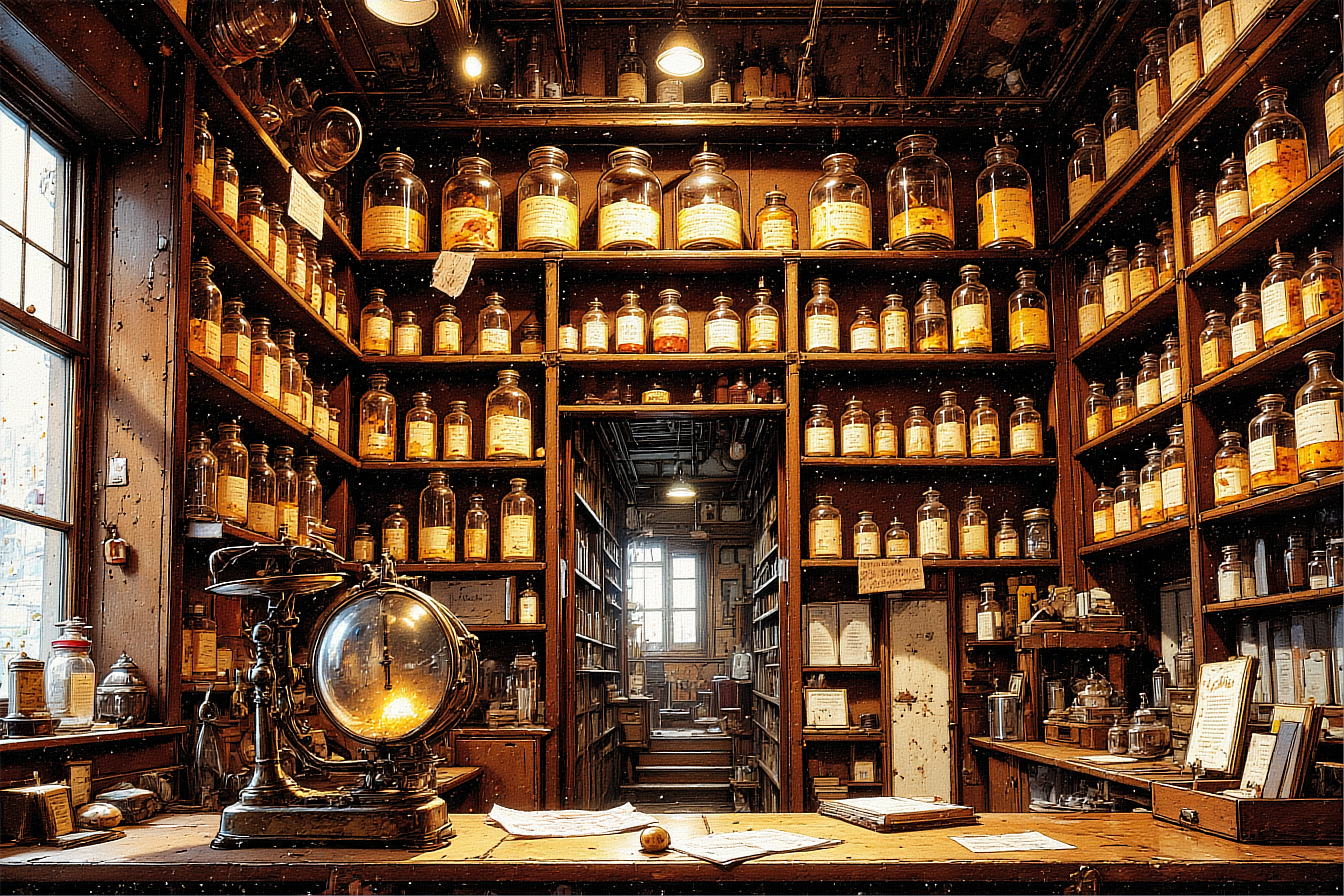
The sign above the door read AS IT WAS, and underneath, in smaller letters, KEEPSAKES WEIGHED. CASH FOR NOSTALGIA. The window had a brass scale in it and a hundred jars, and each jar had a label in the careful hand of a man who values his customers' worst hours: SUMMER, AGE 7. THE SMELL OF HER COAT. A FATHER'S HAND, ONE TIME, GRADE A. You bring in a memory and they weigh it and they pay for it by the ounce, and you may buy yours back inside of thirty days at a markup that would make a loan shark sit down and think about his life.
Inside, the light was the color of old honey and the air was dust and sugar and something faintly medicinal, and the shelves went up three flights of stairs, and every shelf was full of jars, and the jars were warm. Zephyr came in the front door behind us with his hand off my base plate for once, which means he had decided to be ready for something.
Both men were standing at the counter. The proprietor was a thin, dry man with sleeves like a chemist's and a voice made for appraisals. He did not appear to find the situation strange, because in his trade it probably was not.
"Two gentlemen," the proprietor said, "both of whom recall a Tuesday in no detail at all, both of whom would like to sell me the year surrounding it, and both of whom have offered the same grade." He weighed nothing and wrote anyway. "I have been asked to certify which of you is the genuine article. I want it on the record that I will certify either. The fee is the same."
"I'm Ambrose Fell," said the one in the good coat, comfortably, the way a man says his own name at a bank. "Day route, nine years, commended. This thing that's been following me around for a month is wearing my limp and my mother's name and I want it removed from my district."
"I'm Ambrose Fell," said the other one, from the side of his mouth, quiet, his face to the shelves where no lens could get at it. "Night route. And he's got my job, my room, my pay packet, and he smiles at cameras in the mornings and I have not been able to stand in a photograph since the spring."
They knew everything. That was the part that turned the room cold. Each of them had the whole of it: the same limp from the same delivery fall in the same year, the same mother, the same first route and the same supervisor's name and the same two inches left in the same paper cup. There was no memory check in five dimensions that would separate them, because a replacement built from the record is built with everything in it, including the parts the man has forgotten, and the original, who has spent five years hiding, has begun to forget things himself from sheer lack of use.
"Here's how you tell them," Pixel said to me, low, in the space between the proprietor's two prices. She had set me on the end of the counter where the light from the window rig came in flat and hard. "Watch the shadow, not the man."
I watched the man in the good coat turn to answer Zephyr, and I watched his shadow on the jars behind him, and the shadow was late. Not much. Two frames, the way a projection is late when the reel is stretched. He moved his hand and the dark on the glass moved after, having been told, having consulted something first, arriving a beat after the man it belonged to.
"That one," Pixel said. "The district is holding him together from the outside. Everything else about him is real. The shadow's the seam where the edit shows."
The real one, then, was the one with his face to the shelf, the one who had not been photographed since the spring, the one with no coat worth wearing, because a man who is hidden from every lens in a district that runs on lenses has to buy nothing, own nothing, and sleep where the rigs do not reach. Hiding had cost him his job and his room and the good coat, and it had bought him the only thing left in the Ad-Verse that has any value, which is that he is the version the record cannot reach.
The window rig fired.
It was not a camera in the ordinary sense. It was the shop's own acquisition scan, the thing that photographs your face when you come in to sell, and it swept the counter and took both of them and gave the file to the street, and the block screens outside changed over on the instant: AMBROSE FELL, DAY ROUTE, COMMENDED, PHOTOGRAPHED TODAY, GOOD STANDING. The taxi picked it up. The bus shelter picked it up. And I watched the real one's hands on the counter as the district rewrote him out of his own life in the time it takes a printer to warm: his route card photo on the wall behind the scale changed lanyard color, his name moved from the night column to the day column, and a certificate went up in the window behind him, in his own name, commending a man who had not worked a day route in nine years.
"There it is," the real one said, and he said it the way a man says a thing he has watched happen to him before. "That's the whole method, isn't it. You don't need me to be wrong. You just need somebody to take my picture and put theirs up first."
"Everything in here is for sale," the proprietor agreed, ringing nothing up. "Including a statement from me that I saw what I saw. Including, if the money is right, a statement that I did not. The difference between those two is four hundred credits and a form I don't keep in a drawer, so I would not put much of your afternoon into a paper version of tonight, if I were you."
That is the district's verdict on our testimony, and it was delivered by a man who meant us no harm at all, which is the only kind of verdict a district like this can give. Whatever the night courier had seen, no paper in the Ad-Verse could hold it, because paper here has two sides and both are priced. Corporate did not have to buy his silence. Corporate only had to let the market establish which of two identical men was Ambrose Fell, and the market established it the way markets do: the version with the better photograph won, and the record of the district now says so, and the man telling the truth is a man with no address, no photo, and a limp he can no longer prove is his.
We got him out through the storeroom, between the jars of other people's summers, and down a back stair that smelled of yeast and old rope, into an alley where the rigs could not see because the rigs had been budgeted for the front of the house. He went down the stairs the way a man goes down stairs he has been using for months, and he did not look back at the shop, and he did not look at any of us until we were under the fire escape and he had decided we were the least dangerous thing that had happened to him all week.
"Night route," he said. "Five years ago. I had a run to the data hall on Kessler, two in the morning, and I came out of the service bay with my slip, and I saw it on the loading side."
He said it fast, in the voice of a man who has rehearsed it in the dark and never said it in the light.
"A boy. Young, thin, no coat, the kind of walk you'd say was a kid going to a test. He wasn't held. He wasn't cuffed. He walked out between two men in soft shoes and both of the men were carrying forms. Not a clipboard, not a folder. A stack. Form 9, I know the face of it, we handle them on the freight side, they've got the box at the top and the second box under it for your name after they've taken it. The stack was an inch thick and the two of them held it between them like it was the thing that mattered, not the boy."
Zephyr had gone the color of the alley.
"How old," he said.
"Sixteen. Twenty. I don't know. He looked at the ground the whole way, and the doors closed, and the van went out, and that's the whole of it, and I've had five years to make it longer and I can't."
"And you signed for something that night?"
"I signed my own delivery receipt. Three fourteen in the morning, the stamp on it, my own hand, the dispatcher's mark. And the depot's copy of that same receipt says four fourteen, and I have checked it eleven times, and there is no three to four." He looked at his own hands. "An hour's missing, mister. I signed inside it and came out the other side, and every clock I have owned since says the night had no hole in it."
The hour that is missing. The hour in which a boy is walked out of a data hall by men carrying a stack of forms with two boxes on them, and a courier signs for a crate on one side of it and the record of his signature lands an hour away from the man who made it. Somewhere, in a district built of brass and steam where time is kept for the rest of us, there is a page with an hour cut out of it as clean as a stamp cut out of a form.
"And the others," Zephyr said. "The two you told me about. Who saw it with you."
"The other two night couriers." Fell's voice went flat, the way voices go flat when they are reciting the part that has no hope in it. "They talked. Not to police, there's no police, they talked to a man at the depot about a boy they'd seen, and two weeks later both of them got a letter to present at Corporate for identity reconciliation. HR Annex 9, the Paradox Wing, on the letter, plain as a bus ticket. And both of them came back off the route. Both of them went to day side. Both of them have been fine ever since, and neither one of them will look at me, and one of them still has the same limp, so either the limp is catching or they were never the two men I knew."
Nobody said anything for a moment, and the fire escape above us dripped, and the district sold something to somebody across the block, and I felt the shape of the case move the way a load moves in a truck: toward HR Annex 9, toward a wing where Corporate reconciles identities until they agree, and toward the men who carry stacks of Form 9 paper out of a data hall at three in the morning.
The real Fell gave us everything he had and then asked us for nothing, which is the purest thing anyone has done for this case. He was broke, and he was terrified, and he had been hiding from a lens for five years so that a better-lit version of himself could hold a job, and he told it all in an alley with his back to a wall where no camera could reach him, and when he was done he asked only that we not photograph him, and Pixel, who has no record of her own, said:
"Don't worry. Nothing gets photographed on my watch. I can see where the lenses are from here."
I set about putting it down, because that is what I do with a thing that cannot be papered in the district where it happened. The manuscript is paper. It is my paper, and it does not have a price, and nobody in the Ad-Verse can buy a copy of it, so I began to write the night courier's testimony in my own hand as much as a stapler has one: the data hall, the service bay, the boy with no coat, the two men in soft shoes, the stack of Form 9 with its two boxes, the receipt stamped three fourteen where the record of the same receipt says four fourteen.
I came to his name.
And where the name went, two bars went with them, blooming out of the page the way a stain blooms out of a spill, black and settled and certain:
[REDACTED , FORM 9] [REDACTED , FORM 9]
Two, over one name. The price for that has a shape I have paid before: you put the thing under the bar the way you put a page under a staple, and you press, and you do not get to choose what the machine takes, only what you offer. I offered the tilt. The thing Barry did with his head when he was thinking, two degrees to the left, the posture of a man listening to a room, the exact geometry of his attention, which I have been carrying since a night guard first leaned over me at a desk past midnight and looked at a page that way, and I was in the middle of writing it into the sentence. I was writing: Barry Kowalski would have tilted his head two degrees to the left at a line like this, and here the bars came, and here I pressed, and here the page resolved, and the name went in.
Then I went back to the sentence to finish it, and the tilt was not there.
I know the fact of it. I can write the number and I can write the direction and I can tell you it was the posture of a man listening. What I cannot do is see it. The motion itself has gone out of Barry Kowalski like a charge out of a battery, and the battery is still there and the charge is spent. I reached for it four times in the next minute, the way you reach for a word on the tip of your tongue, and four times there was nothing on the tip of anything.
Price paid: the two-degree left head tilt. Logged.
I kept writing. A man who stops every time the price comes due will finish nothing, and the whole point of a ledger is that it is read forward.
The laugh went in the Vault. The left hand went in my own narration. The quiet of 3 a.m. went in a district that books feelings. Now the tilt. Four prices, and the case still open, and the name under the bars resolved at last into a courier with no address who told the truth in an alley.
Barry Kowalski tilts his head two degrees left somewhere I can no longer reach, and I have the number and not one thing that moves.
The last thing I wrote before we left that district was this, because it is true and because it is the finding:
Corporate's method is not a secret. It is a service. Take a witness, replace a witness, photograph the replacement, and let the district do the rest, and the paper will agree, because in the Ad-Verse the paper is the market and the market has already been paid. We came looking for one man who saw a boy taken, and we found two of the man, and only the broke one could still remember it, and neither version of him is worth a coin on any street in this district.
We went out the service door with him between us and the jar ticking in the bag and A1 dark on the kid's back, and the plan we carried out of that alley was one sentence long and pointed at another precinct: find the hour the receipt is missing, and ask the people who keep time for the rest of us what they did with it.
The district sold us a farewell on the way to the bridge: a board the size of a wall, a man's face in a good coat, his name in letters a child could read from a moving car, good standing, day route, commended, photographed today. And no screen in five dimensions carried the man who had told us the truth, because the truth in that district has no photograph, no address, and no price, and it is the only witness we have.