
Everyone Lost Tuesday — Chapter 16: Interview Paradox
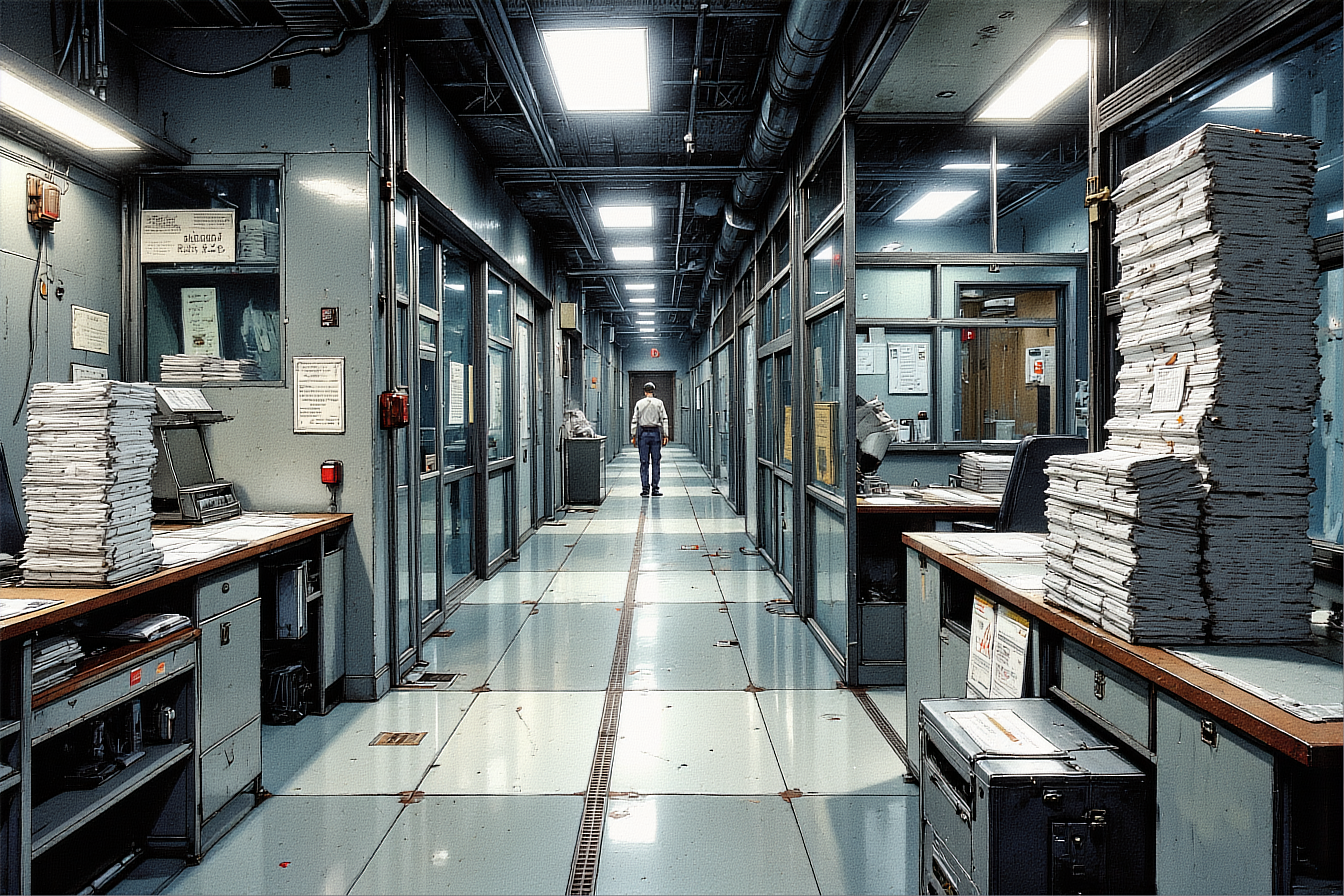
HR Annex 9 is the kind of building that has been designed by a man who found decoration morally suspect. Prime Material is full of them: a lobby of gray stone, a directory in a metal frame where the floor numbers have been changed twice without the holes being filled, an elevator that arrives with the reluctance of an appliance that has read your file. Floor nine is the Paradox Wing, and the elevator gave us up to it without comment, and the doors opened onto a corridor with carpet in it that had been worn into a single visible path by feet walking the same forty feet for a very long time.
The sound of the Paradox Wing is a voice saying the same three sentences. Not one voice: a dozen, out of sync by a few seconds, so that the corridor holds the words three and four times over each other, arriving and departing, arriving and departing, like a station where every train is the same train.
Zephyr got us past the badge door by following a staff member through it with his shoulder squared and his mouth going, and nobody stopped a boy carrying a coffee pot with a stapler in a canvas bag beside him, because a procedure is a filter for things that look like procedures, and we did not.
The reception desk of the wing was staffed by a woman with a trolley of transcripts and the patience of a man who has been asked the same question by a hundred families.
"We're looking for two couriers," Zephyr said, and he gave her the names from the letters Fell had, and she pulled them in a drawer the way a pharmacist pulls a bottle, and what she put on the counter were two thin folders, and each folder had a green tab, and the green tab is where the horror in a place like this lives, because the green tab meant complete.
"Reconciled," she said. "Both. Released to day routes, both. They come back for their quarterly check and they're doing fine, they're both doing fine." She said doing fine the way other people say a word they have stopped hearing. "Is there anything else, because the wing is very busy this week."
While she was saying it, the door of the interview room at the end of the path opened, and a woman came out, and a man in a gray suit came out behind her with a folder, and the woman walked twenty feet down the corridor, and the corridor gave her back, and thirty seconds later she came out of the same turn she had gone into, and the door of the same room opened for her, and the man in the gray suit, who had not moved and had not stopped looking at his folder, looked up as though a new appointment had arrived.
Pixel said nothing. She put her hand flat on the counter the way she does when she is seeing something, and she watched the woman come back around the turn, and what she was watching was not the woman.
"That's the seam," she said. "Where the corridor gives her back. The edit line's right across the carpet, and it's been walked so many times it's gone soft. That whole stretch of floor is re-written on a loop, and so is the page inside, and so is the man in the suit, I think. He's not stupid. He's restarted."
We went down the path to the glass panel of that room, and we watched, and I want to put down what a loop looks like from the outside of it, because the outside is where I live and the outside is the part that a person inside the room cannot see.
She was forty, perhaps. She had a rangefinder camera on the table in front of her, a battered body with brass at the edges, and the man in the gray suit had never once asked her to move it, and I understood then that the camera was permitted because a procedure does not fear an object, only a record, and the camera had been photographing this table for five years without anything happening.
"State your name for the record," the man said.
"My name is Luminara Usha," she said, and her voice had the wear of a thing that has been said four hundred times and has never once been believed by the room.
"That name is not on file." He turned a page. "You were assigned a designation on intake. You will confirm the designation and the reconciliation will close." He read the designation out: Linda-3637. And she said her name again, in the same words, in the same order, with the same patience, and he stamped the page, and the door opened, and she walked out into the corridor, and the corridor gave her back, and thirty seconds later she sat down again in the same chair and he looked up as though a new appointment had arrived.
"Four hundred and six," A1 said. The pot's optics had been counting since the corridor. "Four hundred and six completed reconciliations against the same subject over five years, at a mean interval of one hundred and ninety seconds. She has been interviewed, in total, for approximately twenty-one days of continuous time, not one hour of which is recorded anywhere outside this floor." A pause. "A procedure that has to be repeated four hundred and six times is not reconciling anything, sir. It is holding something open."
The stack of transcripts on the desk was the stack: four hundred and six pages, one per cycle, each stamped complete, each superseded by the next, a tower of paper whose only purpose was to arrive at a fresh copy of the same ending. And the ending always said the same thing. The name at the bottom of every page, in the stamp, was Linda-3637.
Zephyr was already looking at the top of the door frame, where the release sensor sat under a plastic hood with a light in it that went amber every time the cycle completed.
"The reset's in the sensor," he said. "The door releases her, the sensor sees her out, the sensor arms, the next one comes in and the room thinks it's a new day. I can jam it. I can jam it for as long as the pot can count."
"How long is as long," Pixel said.
"The rest of her life, if nobody comes down this corridor."
I had Zephyr set me on the desk, at the end of the transcript stack, and I have never in sixty years wanted anything as much as I wanted to put a staple in that stack, and I want it on the record that the wanting was not rage. The stack was the machine. Four hundred and six ways of saying the record is closed, each one waiting to be carried out and filed and superseded by another, and the only way to stop a record from being refiled is to make it one with the furniture.
Pixel called the seam from the glass. "Twenty seconds," she said. "The page is going to crawl back to the top in twenty seconds, and the door will go amber in eleven, and he'll reach for the stack at fifteen. That's your window."
Zephyr went up the frame with a strip of quantum tape and a wire off his deck and burnt the sensor's little light out, and the amber never came.
The man in the gray suit reached for the stack at fifteen, and the stack did not come, because I had driven my signature through the whole of it into the desk: forty-five degrees, doubled, flush, four hundred and six pages and the desk beneath them, corner, corner, corner, the pattern I use when a man I trust has told me to mean it. The tower went rigid. The top page tried to leave and could not, and the man in the gray suit looked at his own hand as though it had arrived from somewhere else, because his procedure said now take the transcripts to be refiled, and the transcripts had become office supply.
"That's the stack," Pixel said quietly, from the glass. "That's the restart. The page wants to crawl back to line one and the stack wants to leave for the vault, and it can't do either." She looked at me. "You've got about a minute before somebody comes down the path who isn't a machine."
The room did not know what to do. The loop had stopped and the room had not, and the man in the gray suit sat with his hand on a stapled tower and a script in front of him with one line left in it, and he read the line, because a man reading a line is what the room is, and the line was the ending, and the ending was the designation.
"Your name will be entered as Linda-3637," he said, "and this reconciliation will close."
And the woman who had said her name four hundred and six times without once changing the stamp put her hands flat on the desk, in the posture of a person who has waited five years for a room to run out of paper, and she said it once more, into the pause where the reset used to be:
"My name is Luminara Usha."
The notary at the side table, who had been sitting with the seal in his hand all afternoon the way a man sits with a pen he is paid to use, looked at the transcript in front of him, and at the stack that could not be refiled, and at the dead sensor, and he did what his guild is for. The Cogsworth Notary Guild stamps what is in front of them and edits nothing; that is the whole of their constitution and the reason Corporate files its reconciliations with them, because a guild seal from Cogsworth is cross-jurisdiction and runs to The Edge itself, and the men who built the loop wanted their loops enforceable everywhere. He stamped the page. He dated it. He wrote his name under the date in the hand of a man who has signed ten thousand pages and is about to sign the first one that matters.
The page said: My name is Luminara Usha.
And the loop had no next cycle to overwrite it.
I have spent five years holding two files: a man and a day, both cold in their different ways, and both of them mine by way of what I cannot put down. The thing on the notary's table was the third kind of page, and I did not have a word for it yet. It was not evidence of something that had happened. It was evidence that a person existed, stated by her, in her own voice, sealed cross-jurisdiction, in a room where Corporate's own procedure had been present and had failed to stop it. Notarized, Corporate cannot un-say it. Notarized, no shredder in five dimensions touches it. Notarized, the first page of a case that the machine is not permitted to edit.
Then the door at the end of the path opened the rest of the way, and a supervisor came in, a Compliance man with soft shoes and a folder that had clearly been waiting for exactly this event, because the folder was already open.
"This session runs under standing continuation order," he said, to the room, to the notary, to the boy with the wire hanging out of the door frame. "Identity reconciliation for the subject is not subject to interruption by visitors. I will ask you to remove yourselves from the wing while the order is re-armed."
He put the order on the desk, face up, and laid his hand on it the way men do when they believe the hand is the important part of the document, and I looked at the order to see who had authorized the ending of a woman's name four hundred and six times, and where the ordering authority should have been signed, the page had two bars across it, black and settled and certain:
[REDACTED , FORM 9] [REDACTED , FORM 9]
Two over one name. I have learned what that count means and I learned it the hard way, in the Vault and in my own narration and in a district that books feelings: two bars buys a name out from under them, and the machine does not haggle, and the machine does not care what you put on the counter, and it takes what it takes while you are still deciding you can afford it.
I put Dolores under the bars.
That is what it cost. Not the running, which I keep. Not the hand on me in the dark of a law office in September of 1972, which I keep, nor the sound of the street after, nor the smell of the dumpster three blocks away where a secretary left me with my prints wiped and the weight of a murder inside my housing, which I keep, all of it, every mean and sordid inch of it. Only the face. The woman who picked me up when the world went wrong, because people grab what is nearest, and who ran with a stapler in her hand instead of a coat or a photograph or anything of value to anyone else in five dimensions: her face went under the bar, and the bar lifted, and the page resolved.
I went back for her afterward, the way I always go back. I stood in my own narration where a woman's face had been a week ago, and I found the place, and the place was smooth, and I could tell you her name and her job and her fear and the fact that she never came back for me, and I could not assemble her, and I do not get to complain about that, because the complaint would also be a face and I have spent it.
Price paid: the face of Dolores from 1972. Logged.
She ran out of a law office holding me, and I have spent her face on a form that has no name under it at all, and kept the running.
The order resolved, and the supervisor read from it as it resolved, and what was under the two bars was not a man. There is no man in the signature block. The block has a routing header, a department field, a floor field, and a re-assignment line at the very top of the page, the topmost line, above every other line on the document, and the topmost line read:
ORCHID DESK.
"That's not a person," Zephyr said. He had his deck out and he was already three searches into it, and I watched the searches fail one after another, because a code that is not in the directory is not a code that can be found in the directory. "Every order in this building starts with a department. That's not a department. There's no floor for it in the registry, there's no roster, there's no purchasing record, there's nothing." He turned the phone so I could see the screen, and the screen was empty in the particular way that empty is a result rather than an absence. "It points up. Look at the field. Every other field on the form routes down to a desk, and this one routes the whole document up, to a desk that isn't in the building, that isn't in the registry, that isn't in Corporate at all."
Points upward. A code above the department that runs the loops, above Compliance, above the annex, above the soft shoes and the floor numbers that have been changed twice: ORCHID DESK, topmost line, taking delivery of everything and giving its name to nothing.
The supervisor stood there with his hand on a document that had just told him who he worked for, and he did not pick it up, and I understood something about men like him that I had only suspected before: he had never seen under the two bars either. He had been enforcing an order he could not read. He went out of the room and did not come back, and nobody came to re-arm anything, and the corridor stayed quiet in the way that a corridor stays quiet when the trains have stopped running.
The notary gathered his pages. He looked at the stack in the desk, four hundred and six transcripts held together by my corner, and at the live page with her name on it, and he put the live page in his inside pocket and the stack under his arm, and he said, in the flat voice of a man stating a fee schedule: "Cogsworth will hold this. The guild does not lose a notarized page, and Corporate does not arrive at our door asking for one, because our door is in another jurisdiction and has always been very difficult to find."
Luminara had not moved. The camera on the table had not moved. She looked at the notary's pocket, where her own name was, sealed, for the first time in five years in a place that could not be reopened, and she looked at me, and I set my weight toward her, which is the only thing I have ever done that reads as welcome.
"Four hundred and six," she said. "I have said it four hundred and six times and written it once. Do you know the difference?"
I drove a single staple into the desk beside the ring her coffee had left: angle, forty-five, held. Caution. The difference is that paper forgets on command and people do not, and I have been on the wrong side of that sentence since a law office in 1972, and today, for the first time in this case, the arithmetic ran the other way.
The laugh went in the Vault. The left hand went in my own narration. The quiet went to the district that books feelings. The tilt went to a courier with no address. Dolores's face went to a form with a code at the top of it. Five prices, and the file on my base plate now holds a page with a woman's true name on it, sealed by a guild in a district Corporate does not govern, and no bar in five dimensions will cross a seal it cannot reach.
I had Zephyr staple that page into the file beside the booking receipt from the lockers and the route card from the grease bag, so that the case now has a third exhibit, and the exhibit is a sentence, and the sentence says the simplest thing anyone has said in this investigation: My name is Luminara Usha.
The corridor was quiet. The pigeons of another district were somewhere keeping the hour, and the sighs of another were setting in the gutters, and the billboards of a third were selling a dead woman's afternoon, and the clock on the wall of the Paradox Wing had been correct all afternoon, which in that building is the most suspicious fact I have encountered in five years.
One lead went out of HR Annex 9 and it went the way arrows go, which is to say it did not go down. It went up, through a code that sits at the top of every order form it touches, in a desk with no floor, no roster, no address and no registry, above Compliance and above the annex and above the man with the soft shoes who did not know what he was enforcing.
ORCHID DESK.
The page under my base plate is notarized and it is not for sale, and for the first time since Zephyr came in out of the rain with a napkin, what I have, the machine cannot take back.