
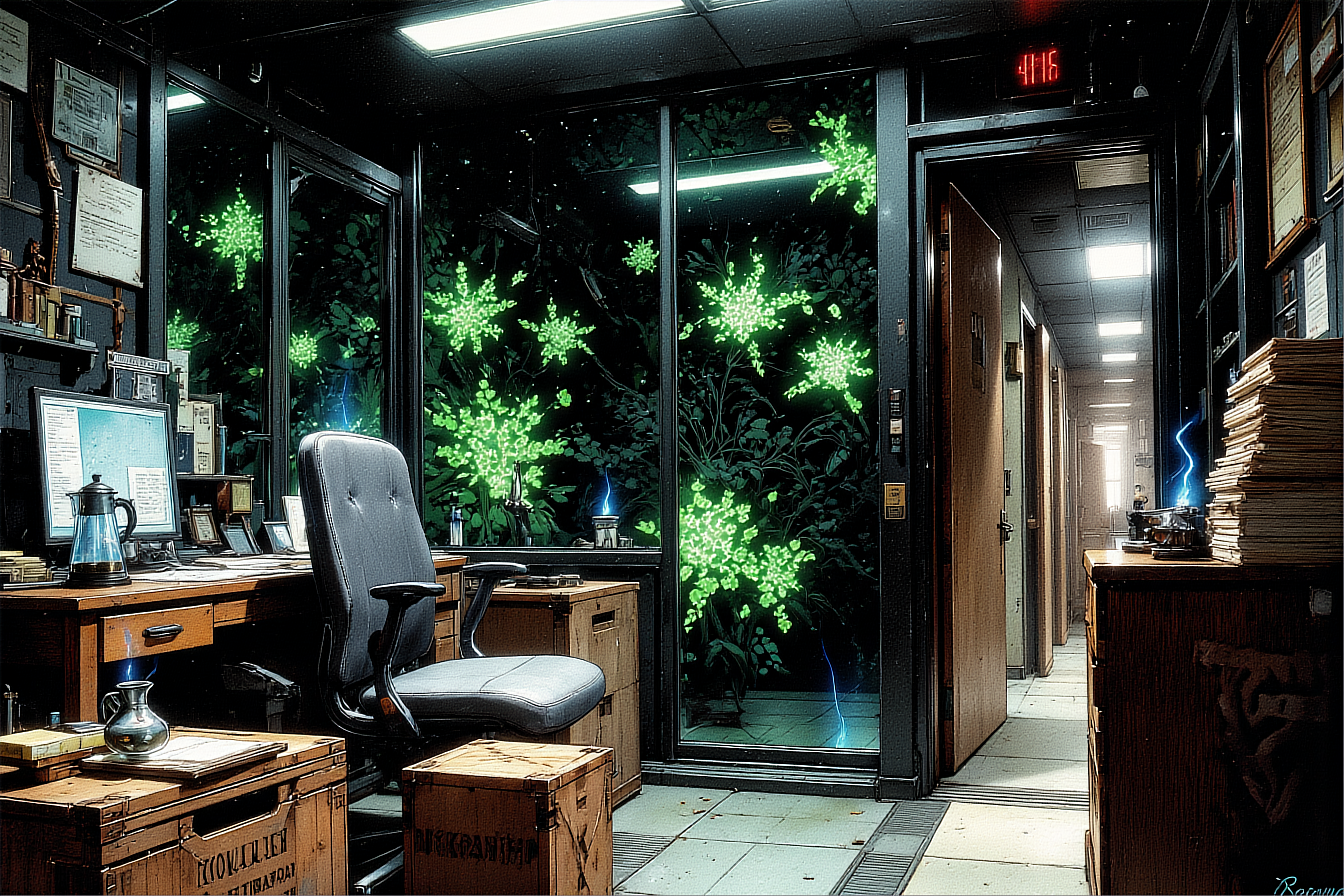
Everyone Lost Tuesday — Chapter 17: Linda-3637
The notarized transcript sat under my base plate, which is where I keep whatever cannot be unsaid, and the annex had been arguing about a woman since six in the morning.
Zephyr had the crate marked KOWALSKI turned into a stool and was using it wrong, sitting on it backwards with his chin on the slats, which is a way of sitting that says he has been awake longer than he has been honest. Pixel was up on the filing row with her boots hanging over the open floor, glitch-sight aimed at nothing in particular, the way a woman aims it when she is listening to the seams of a room instead of the people in it. A1 had brewed nobody coffee at 3:15 out of habit and the pot stood steaming on the corner of the desk with nobody to drink it, and every so often the steam bent toward whoever was talking, as though he were tasting the argument.
"She's a witness," Zephyr said. "That's what she is. We got a witness and she's not even Corporate's anymore."
"A witness is a person with an address," Pixel said. "She's got a number and a room that resets. Put her on a stand and the first question is where she lives, and the answer is a corridor."
"Then she's crew."
"She's Corporate," Pixel said, and let the word sit. "Five years in their interview chair with their pencil in her hand. Numbers outlive people, kid. You know that."
A1's little blue flame under the carafe took a breath. "The category is premature, sir. Categories are how the machine finds you. In my experience the category settles itself, usually at cost, and usually to somebody standing nearby."
They looked at me. They do that now, and I let them, because looking at the furniture is how a room checks whether it is still a room. I shifted two millimeters on the desk, which for me is a long speech, and drove one staple into a blank slip: doubled, clean, the corner of the slip turned until the arm of the staple aimed across the desk at the first line of the transcript, where a sentence sat that had taken four hundred loops to say.
Zephyr read it off the angle the way he reads everything, half squinting. "Trust. Pointed at her sentence."
"Pointed at a sentence is not the same as pointed at a person," Pixel said.
"It is when the sentence is a name."
The elevator made its call six floors up, and the annex door came open, and the woman who walked in had not been on this floor in five years and moved like it: one step past the threshold, stopped, doing the room the way you do a room when you have sat across from a door sensor four hundred times. Door on her left. Glass partition ahead. One chair in the whole place and the chair was taped into an X with tape gone gray.
Luminara Usha came down the corridor with her camera on its strap against her ribs and a clear envelope in her other hand, and she stopped at the edge of the desk and looked at me for a while before she looked at anybody else.
"The door wasn't jammed," she said.
"It never was," Zephyr said. "It's just been waiting on somebody to stop resetting it."
She held out the envelope. Inside was a release form from HR Annex 9, and the box where the released party's name goes had been left blank, because the clerk who filled it in had nothing to fill it with, and she had signed her name in the margin instead, where signatures are not read.
"He told me to fill in the box," she said. "I told him the box had been filled in four hundred times and it had never once held."
I had the transcript out from under my base plate before I thought about the courtesy of it, and I set it on the desk with the first line facing her, and she read it standing up, and her mouth did not move, and her hand came down on the desk flat beside the page the way a hand does when the floor has just confirmed what it suspected.
"My name is Luminara Usha," she said. Not to us. To the page. Then, in her own voice, to the room: "Say it back."
Nobody moved. A1 said, "Your name is Luminara Usha, ma'am. The guild has it notarized cross-jurisdiction. I have run it. It will hold."
"Holding," she said, like she was testing the word for a leak, and then she sat down on the floor with her back against the glass partition, because there is one chair in this annex and the chair is evidence, and that is where a woman sits who has spent five years learning where the chairs are.
She told us the number first. She did not tell it in order. Luminara tells in the order the loop gave it to her, which is backwards, and we let her come around.
"They assign it when your records disagree," she said. "Two files, one person, neither file willing to give way. So the system makes a third thing, a control designation, and it puts the person inside that until the records reconcile. Linda is not a name. Linda is a status. I was the 3,637th Linda in my precinct, and the 3,637 before me went home, and the 3,638 after me is somewhere now with a blank box and a name in the margin."
"And you kept your name," Zephyr said.
"In my pocket."
She took it out. The paper had been a film sleeve once, the kind that holds a roll of thirty-six exposures, and it had been folded into a square so many times the fold lines had gone soft as cloth, and on it, in pencil, in her own hand from before any of this: L. USHA. The pencil was worn to a shine where her thumb found it.
"One item per interview subject. Personal property, no records attached. They gave the room back four hundred times and they gave me that back four hundred times, and every time I put it in my pocket, because a name in a pocket can be refiled, and a number in their file can't be taken back out of it."
"That's backwards," Zephyr said.
"That's the machine," Pixel said from the filing row, and there was no air in the way she said it.
Then the camera, because the camera was the other thing in her hands and it had been turning on its strap the whole time she talked, the way a face turns toward a window.
"It was my father's," she said. "Battered rangefinder, brass showing through the paint, and intake marked it non-functional when they processed me, which is the only reason I still have it. They signed me back my own camera as junk. Junk has no claimant, so junk walks out of the interview wing with the person attached to it."
"What does it do?" Zephyr asked. "And don't say it takes pictures."
"It takes what's true," she said. "There's a difference. You point a camera at a man and it takes the man. You point my camera at a man and it takes what the man did, if the two don't match, and if they do match it takes the man and something behind him that he brought into the room with him. I don't run it. I don't interpret it. It takes, and I develop, and what comes up is what happened."
"And the negatives from Verdantia," I said, in the only language I have, with a staple driven at an angle into the scrap slip, caution, and the arm of it turned to the word before her hand.
She looked at the staple for a moment, reading it the way people read me now, and something crossed her face that was not surprise.
"The harvesting division," she said. "Six years ago I was in the greenhouses with my camera, documenting what the crews were siphoning out of the district and where they were shipping it. Two men came to my room. They took the film out of every camera I owned and they took the negatives off the wall and they were very polite about it, and the paperwork they wrote it down on went to an evidence room that does not answer letters. The film is still in there. Tagged, unclaimed, no claimant on the tag, because the claimant was sent to HR Annex 9 for identity reconciliation." She said it flat, the way you say a shelf label. "That's why I know the network in Verdantia. That's why I know who to talk to when the network still talks."
Nobody argued with her. That is what I want on the record: nobody argued with her. Zephyr stopped sitting backwards on the crate and sat on it properly, which for him is a kind of salute.
Then she wanted to photograph the desk.
Not me. The desk. She asked permission of the room the way you ask permission of an altar, and she framed it from the visitor side, the near corner where a man used to lean in to sign things at somebody else's place, with the crate and the taped chair in the corners of the frame and the glass partition going out of focus behind it toward a cubicle with a nameplate on it.
"The log says he worked a routing sheet at 02:41," she said. "That's all the log says. A time. Times are easy to keep; they're the one thing the machine never has to lie about. It just moves them."
She tripped the shutter. The witness did its own darkroom, as she called it; there was no tray, no red light, no wait, only a small mechanical settling inside the housing like sediment finding the bottom of a jar, and then she thumbed the plate out and handed it to me because she said a photograph should be shown to the desk first.
It came up like frost going the other way.
Barry's last shift was on it. Not his face: she had framed the desk, and the camera takes what is true of the desk, and what was true of the desk was that at 02:41 somebody was standing at the near corner with his weight on one hand, a sleeve pushed back, a routing sheet under his palm with a fresh hole punched in its corner at forty-five degrees, doubled, flush, and the chair pushed out behind him the way a chair goes when a man stands up fast. Nobody had logged that. Nobody logs a sleeve. The annex log records that a shift worked a sheet, and the sheet went where sheets go, and the photograph said: here is the hand that was on it, and here is the angle of the body over it, and the desk has been saying this for five years to anybody who thought to ask it.
I have paid for less.
That is the whole of it, and I will not dress it up: I have paid money out of my own skull for less truth than she got out of one exposure on a camera the machine signed back to her as junk.
"The rule, then," Pixel said, and she had come down off the filing row to look at the plate over my base plate, and her voice had the careful sound she uses on the edit lines. "Say the rule out loud so the room's got it."
"A photograph cannot be falsified," Luminara said. "You can burn it. You can tear it. You can lose it in a seizure. You cannot make it say something else, because it never says anything in the first place. It only takes."
"And the bars," A1 said. "The Form 9 bars that bloom on documents and, increasingly, on pages written in this desk's own voice. I have modeled them against photographic emulsion on her behalf, since nobody asked me to. Probability a bar lands and holds on a developed frame: I get numbers like I get on a Thursday, sir, and the numbers are frequently optimistic for the machine, meaning zero. The bars need paper that agrees to be edited. Emulsion doesn't agree to anything."
Pixel nodded once. "I can see the seams where reality gets rewritten. They slide off her frames. Off the emulsion they skate like a foot on ice, there's nothing for them to catch on." She looked at Luminara with an expression I had not seen on her before, and it took me a moment to name it, and the name was envy with the bitterness taken out. "Nobody's frames have ever been clean."
Luminara set the plate on the desk, in front of me, in front of the transcript, in front of the sealed jar that sits in this file as exhibit B and has never been opened.
"I was erased. I came back. And now I document everyone else who refuses to stay deleted."
She said it to the desk. Not as a speech. As a job description, spoken by a woman who has been without one for five years and has just been handed one, and the room went quiet in the way a room goes quiet when the furniture has already voted.
I have been refused longer than she has, and I was moved by the sound of somebody else's refusal in a way I will not pretend I was not. Sixty years of it: rooms that did not hear me, men who talked in front of me and filed me with the paperclips, a murder I watched with my own eyes that came back out as a botched robbery because the only witness was a stapler, and a stapler is a thing. She was refused by procedure, four hundred interviews and a name folded in her pocket. I was refused by furniture, which is worse in one way and better in another, because a thing nobody believes is alive can sit in the room where they plan the erasure and they will plan it out loud. Two of us in this case now who were thrown away and stayed: one who documents and one who remembers, both refused, both still on the premises.
I drove the second staple of the morning into a fresh slip: doubled, flush, and the slip turned until the arm pointed at the plate, and then I tipped my own weight forward two millimeters so the shadow of me fell across the corner of the photograph, and I held it there, because a man who keeps a file learns early that the first thing an exhibit needs is somebody standing over it.
"That's crew," Zephyr said.
"That's crew," Pixel agreed.
Luminara Usha looked at my shadow on her photograph, and at the staple in the slip aimed at her like a finger, and she did not thank me, which I liked better than thanks, and she wrote a line in pencil on the bottom margin of the plate: Annex, Sub-Level 4, the morning after. And she signed it. And there was nowhere on that line for a number to go.
She has been photographing for five years without a case to hang any of it on. Boxes in a locker in Prime Material with the key on her ring and no investigator alive to open them, because an investigator is a person the system can find, and the system found her in a corridor with two men and a claim form. Now she has a case. Now somebody is going to develop them all.
Outside, the rain still hung in its holding pattern over the chrome, waiting on a supervisor's initials, and somewhere below us the Undercroft kept its dark with everything anybody had ever set down and never come back for, and I have no doubt her negatives are down there among them, tagged and unclaimed and waiting on the same clearance as the weather.
Verse, since the room has gone quiet:
A witness with no case is a photograph nobody will ever develop; hers came up anyway, and the desk in it was testifying before anyone thought to ask it.
Zephyr put the kettle on the hot plate A1 dislikes, and Pixel took her place back on the filing row, and the woman on the floor against the glass checked the door on her left with her eyes the way she would check it for the four hundred and first time, and then deliberately did not. The transcript lay open under the lamp with a name on it that would hold. The plate lay beside it with a hand on it that no record would ever admit. And under both of them, under everything, me, sixty years of desks, orange paint gone the color of an old argument, with the whole afternoon ahead of me in which to be useful.
There was one more thing in the room and nobody had put it there yet, and I drove a staple at an angle to say so: caution, aimed at the word Luminara had spoken an hour ago without knowing she was pointing it.
Verdantia. The network. The men who take film out of cameras and write the taking down on a form that goes to an evidence room that does not answer letters.
She wanted her negatives back. I wanted the route the audit crates took before the day they were stolen. We were going to the same place for different reasons, which is the only kind of partnership this case has ever been able to hold, and I signed it into the file with my pattern in the corner: 45 degrees, doubled, flush, the position I use when a room I trust has told me to mean it.