
Everyone Lost Tuesday — Chapter 19: Old Arrangements
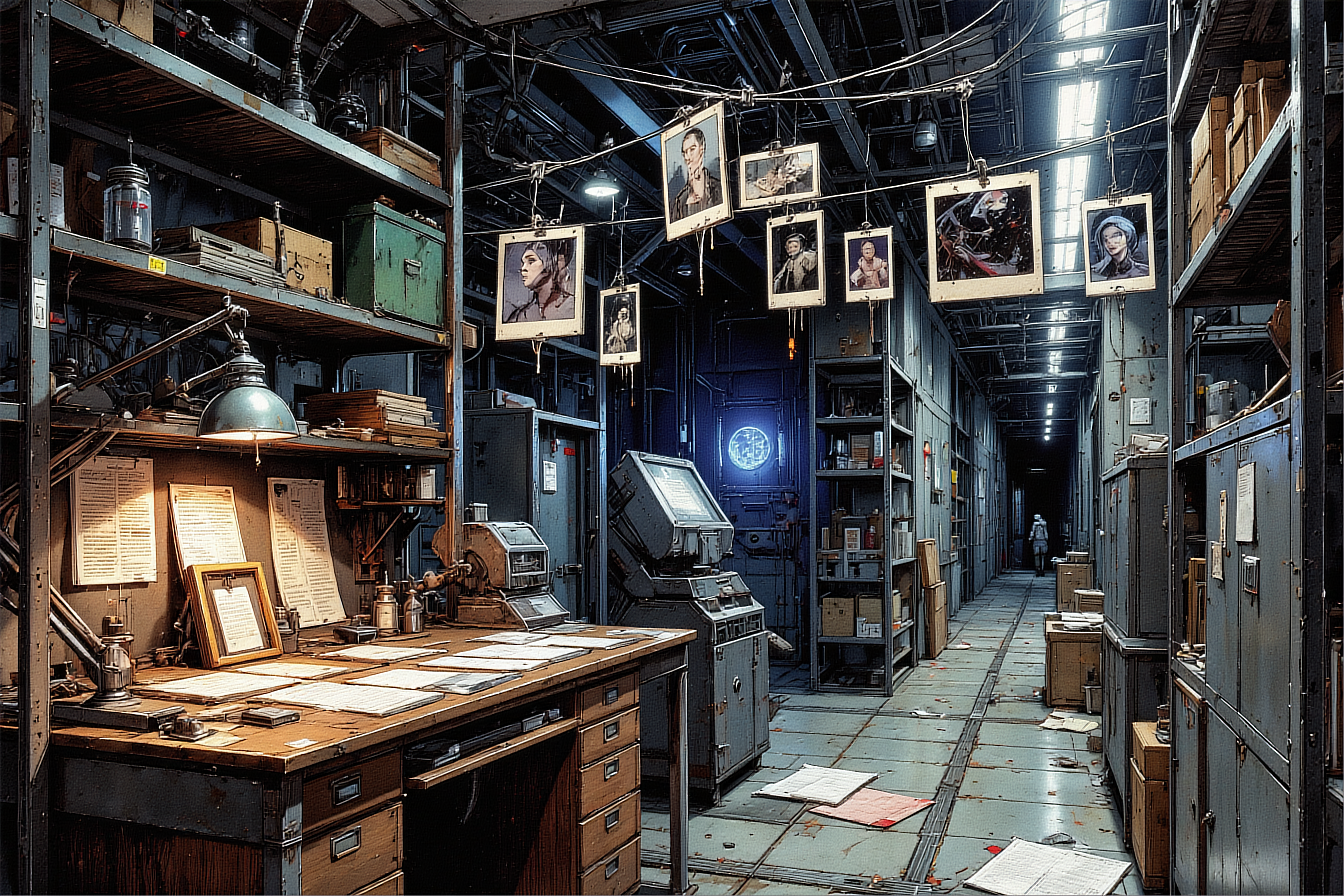
Luminara had strung a proof wire between the filing rows and the annex smelled of fixer, which smells the way an old wine smells when it has stopped being a drink and started being a fact. Six wet frames hung from the wire in a row, and the woman who owned them sat on the floor under them with her back against the steel, and nobody had spoken in eleven minutes, because the last person who had spoken was Zephyr and he had spoken badly.
He was on the crate again, backwards, which is his bad mood posture, and he had come in at it sideways from the transit platform: her shutter, her frame, her receipt, and none of the page.
"You shot them," he said. "You got a picture of a man writing a receipt. Congratulations, we've got a portrait of the crime in progress and the crime is still holding the page."
"The page was never ours once the root chatter reported us," Luminara said. She did not look up from the frames. "Thistlewick said eight minutes. We had four of them. The camera got two."
"The camera got two of what? They're still wet."
"They're done," she said, and took the first one off the wire and laid it on the desk in front of me, and Zephyr stopped talking, because the frame showed what frames show when they are not interested in winning an argument: the ordinary man's hand, the clipboard, and the receipt half written out, and the stamp he had already pressed into the paper, a small clean mark with the shape of it legible at this size, the mark Corporate puts on everything it touches.
Luminara put the second frame beside the first, the close one, the one she had taken at the hip while she was still moving left: the intake stamp in full, a series number under it, and the registry glyph.
"That," she said.
"That's the closure mark," Pixel said from the filing row. She had been up there since we came home, hood on, boots tucked under her, saying nothing about seeds, and that was the first sentence she had offered, and it came out rough, the way a voice comes out when it has been sitting on something. "The same glyph the district's ledger had on the empty day. I can see the seam of it from here. It's the same stamp, it's just wetter."
"The shipping line that moved the audit crates was registered at The Edge," I said, in the only language I have, driving one staple at an angle into the corner of the frame's mount: caution, and then a second, doubled, aimed at the glyph, and Zephyr read it off for the room because reading me is a skill he has decided to be proud of.
"She's saying three things, three marks, one hand. Ledger closure, shipping registration, seizure intake. All Edge registry, all in one box." He looked at the frames a moment longer, then away, the way you look at a photograph of somebody else's house fire. "So everything's The Edge. That's not a lead, that's a wall with a direction on it."
"Every road's a wall until you draw it," Luminara said, and she took the frames back off the desk and hung them on the wire again to finish, and she did it with the tenderness of a woman who has been developing pictures alone in a corridor for five years and has finally got a room to develop them in.
Zephyr went at that the wrong way, because he is twenty-one and the wrong way is the direction his hands point when his hands want to be doing something. He came over to the desk, and what he wanted to say was that he had been holding the bag with my base plate against his ribs and two men had taken a page out from under me while he stood there with his palms up, and what he said instead was aimed at the camera.
"Pictures aren't pages. You know that, right? Your thing can't be falsified, can't be barred, fine. It also can't be read aloud in a records bay. It can't be a route."
"It can be a date with a stamp on it," she said, unruffled, and that was when he hit the desk with the flat of his hand, and the jar of CLX jumped, exhibit B, sealed, and the sound of it went around the annex like a small door closing.
Then he heard himself, and I watched him hear himself, and he looked at the jar he had nearly knocked off its own exhibit and sat down on the crate the right way round and put his face in his hands and said, into his hands: "I'm not angry at you. I'm angry at a tree."
"You're angry at me," Pixel called down from the filing row, "and you should be, so it's fine."
"I'm not."
"You are, and it's misfiled, and you know it's misfiled, which makes it worse."
Nobody took that further, and A1, who had been running numbers all day with his little blue flame down to a needle and reporting none of them, said from his corner of the desk: "The odds on him being angry at the correct person are not good, sir. I have been running them silently. Silently is the only way they come out whole."
"Run them out loud," Zephyr said, into his hands.
"No," A1 said, gently, and let the flame go back to nothing, and that is how the day went: the wrong people being snapped at, the right people saying nothing, and the pot holding his sums like a man holding a letter he has not been asked to open yet.
It was Luminara who broke the quiet, hanging the last frame. "The receipt's got a countersignature block at the bottom. Every seizure in a Corporate division goes out with a bookkeeper's mark on it, because a division that documents everything documents the documenting." She held the frame so the sap-light of the bulb caught the wet paper. "I can't read the name from this. The name's underneath the stamp in a hand I don't know."
"I can read it," I said, with a staple at an angle, and I had Zephyr turn the frame a quarter for me, because my eyes are where my base plate points and no farther, and the block at the bottom of that receipt had a name in it the way a ledger has a name in it: not printed, countersigned, the mark of a man whose job was to put his hand to other people's totals.
But I did not read it that minute, because my own file had come out from under me first.
The KOWALSKI file lives under my base plate the way a debt lives under a floorboard, and when Zephyr's hand went in to shift me he knew the drill: two fingers on the left of the stack, lift the weight, don't fold the photographs, and slide. He slid the night manifest out onto the desk, the page of Barry's I have read four thousand times without once reading it right, and he laid it under the lamp, and I looked at it with the chapel still in my head.
Received at the Chapel of the Quiet Margin, six crates marked AUDIT, consigned by night from Dock 9.
Barry's manifest, five years cold:
02:00 D-9 RECEIVE, six, no numbers given 02:22 CHAPEL HOLD, QM, wait on clearance 02:41 DRM 4 TRANSFER 02:58 ROUND
I had read it as a list of shipments. A night guard writes a list; lists are what a night guard has instead of a voice. D-9 was Dock 9, which I had never had reason to match to anything, and CHAPEL HOLD QM was four words on a page that meant four words on a page, and DRM 4 was this floor, this annex, this desk I am sitting on, and the ROUND is the round he did not come back from.
Chapel. Dock. Form stack. Annex. And underneath the annex line, nothing, except that after 02:41 there is a fresh hole in the corner of a routing sheet at forty-five degrees, doubled, flush, and the arm of that staple points out through two panes of glass and a gap in a filing row, at a cubicle with a nameplate on it.
Route, then. Not a list. A route, with my own desk for a stop and Piper's cubicle for the last.
I built the model on the desk the way Barry taught me to build a thing you can't hold: four slips, one point each, and a staple in each slip so the arms could point at each other across the desk. Chapel here. Dock there. Form stack, six crates deep, in the middle. Edge at the top with its closure stamp showing, because a stamp is just a signature that has given up on handwriting, and every mark in this case was that same signature. Then the manifest laid across the bottom, and the manifest ran the route for me by itself, because Barry had written it out years before I was awake enough to read it, which is a sentence I am going to have to sit with.
"You're pointing four staples at a wall," Zephyr said, watching. He had come over when he saw me working, and his voice had gone quiet the way it does when he is watching me do the one thing I do better than any of them. "What do you do when you get there?"
"You follow the money up," Luminara said, "or you follow the grief up. Grief's the one they couldn't move without leaving a mark."
"Both," A1 said, and the flame came up a little. "The closure mark's series can be traced to the last holder of record, since Corporate never lets a stamp go unowned. I have been running it since the platform. Silently." A pause, and the pot did the small brewing motion he does when he is pleased with himself. "The last holder of this series countersigned grief entries in the district ledger by day and feasibility work for Corporate by night, and was defrocked for it, which is the only kind of firing that keeps a man in the building. His name is Om Kai."
"Where do we find him?" Zephyr asked.
"At the Order of the Still Sum, in Nocturne," A1 said, "which is where he told the district clerk he would be, for anyone who came asking about his stamp. He has been sitting there waiting for somebody to come asking. The clerk passed the message along the week you booked your grief, sir, and I did not report it then, because you were not ready to be a man who seeks out bookkeepers, and now you are." The flame tilted toward me. "That's what I've been running. Not the odds. The clock. When to tell you."
He was right. A week ago I had been a file with a folder under it and a partner under that, and a bookkeeper was a thing other people had.
Then Pixel came down off the filing row, and the annex went a degree colder, and the scene I had been putting off walked into the middle of my desk on its own two feet.
She had her notebook with her, the one with the transcriptions, and she set it on the desk not like evidence but like a bird she was tired of holding. "You've been reading my margins," she said. "Since the platform. Since before, but you didn't have reason until now."
"I read your margins," I said, with a staple at an angle, caution, and then I drove the second one and left the arm pointing at the page itself, and she looked at the pattern a long time.
"Doubled and pointed at my own handwriting," she said. "That's you asking, so I'll answer, and then I want it filed and I don't want it brought up again unless it saves somebody."
She opened the notebook to a page she had marked with tape months ago. The entry was dated six months before Zephyr ever walked through the lobby door, and it read: GLITCH-LINE, AD-VERSE, BLOCK 77. PATTERN PRESENT. UPPER LEFT, 45, DOUBLED, FLUSH. NO ORIGIN.
"Your signature," she said. "Punched through an edit line in a block of reality Corporate had rewritten, with no stapler anywhere near it, because there was no stapler anywhere near it. Your pattern, sitting in the seam of a thing that was deleted, and every few weeks another one, always Palimpsest stock, always your angle. I catalogued them. They're in here, back to back, all dated before this case, all yours."
The room had the good sense to stay out of it.
"I knew before the kid came in with the napkin," she said. "I knew your hands had been on it. I've known how your hands sound for years, I transcribe them the way other people transcribe music, and when I saw the pattern in the seams I knew exactly whose it was, and I said nothing, and I have had six months to think about why, and the answer is the worst thing about me."
"Say it anyway," Zephyr said.
"Because the truth about his hands would have broken him," she said, and looked at me, and did not blink. "You were the witness. You were the only person in this building who remembered anything, and you were building a case out of fidelity, and if I had told you that you had stapled the paperwork that erased them, you would have had to stop being the detective and start being the evidence. So I kept it. I kept it the way you keep a thing you are stealing from somebody for their own good, which is the way everybody keeps a secret they have no right to, and I'm not asking you to call it loyalty because it isn't, it's just the shape my loyalty takes."
There it is. There is the whole of her, laid on my desk next to Barry's manifest with the route on it.
I did not forgive her, because forgiveness is a transaction between two parties and I am one party and I do not have the currency. I did not condemn her, because condemnation is what you hand a person instead of a file, and I am the last thing in five precincts that will not trade a file for a feeling. What I did was take her notebook page and the manifest and the four-point model and drive one staple through the whole corner of the stack, clean, doubled, flush, and leave it in the TUESDAY file where it will still be when the question comes around again, which it will.
Filed, is what I drove. Filed, and not forgiven, and not condemned, and not dropped.
Pixel read the pattern and put her notebook back under her arm and nodded once, and went up to the filing row, and the difference in her when she sat down was that her hood stayed down.
Luminara was still at the proof wire with the receipt frame. She had the name under the stamp read now, and she wrote it in pencil on the margin of the print, and turned the print around so the desk could see it: OM KAI, countersignature, seizure series, Edge registry.
"One name," she said, "and every road in the room runs into it: the chapel he blessed, the crates he counted, the stamp he pressed, the ledger with a hole in it." She let the frame hang. "So who is he?"
A bookkeeper, is what he was. A man who kept the totals for two masters in the same weeks, and who booked my own grief into the district's ledger without ever once asking me what it was for, and who then went and sat in an order of monks where the sum doesn't move, and left word for whoever came asking.
On the desk the four staples still pointed at each other across the slips: chapel, dock, stack, Edge. The manifest ran underneath them like a rail. And at the end of the rail, past the annex, past the glass, past the gap in the filing row, a cubicle with a coat on the hook, which is a question for another night, because tonight the route had a name at the head of it and the name had gone and sat down in Nocturne waiting for a stapler to walk in and ask him what he had counted.
Verse, while the proof wire dripped:
You keep the file and the file keeps you, and the route runs out at last under somebody else's stamp, and he's been sitting in the sum holding your grief in his hand, waiting to be asked.
Nobody had eaten. Zephyr went for coffee he would not drink, Luminara clipped her frames to the wire to finish them, A1 let his flame down to a needle again, and I sat on my own desk with the model built and the cold file open beside it for the first time in a week, because the chapel and the dock were never TUESDAY's to have alone. They were his. He wrote them on the last page he ever worked, at 02:00 and 02:22, with an hour to live in the job and no way to know it, and I have been holding that page for five years the way you hold a door shut on a room you are not ready to go into.
The door could stay shut. The route could stay a route. But there was one shelf in Corporate's own records bay where those three weeks were still stacked in paper waiting for pulp, and a way in sat across the glass in a cubicle with a coat on the hook, and a man does not build four staples and point them at a wall and then go to bed.
We would go to Nocturne first. We would take the bookkeeper's number and hold it up against the memo he had counted into, and after that there was a records bay with somebody's borrowed credentials written all over it.
But that is two nights, and the annex has to be crossed one at a time, and the lamp over P. CHEN's cubicle went off at its usual hour while I watched, and the coat stayed on the hook, and the file stayed open on my desk with her page in it and his manifest in it and a notebook page I did not forgive stapled into the middle of it, which is what an arrangement looks like when nobody in the room is clean and everybody shows up anyway.