
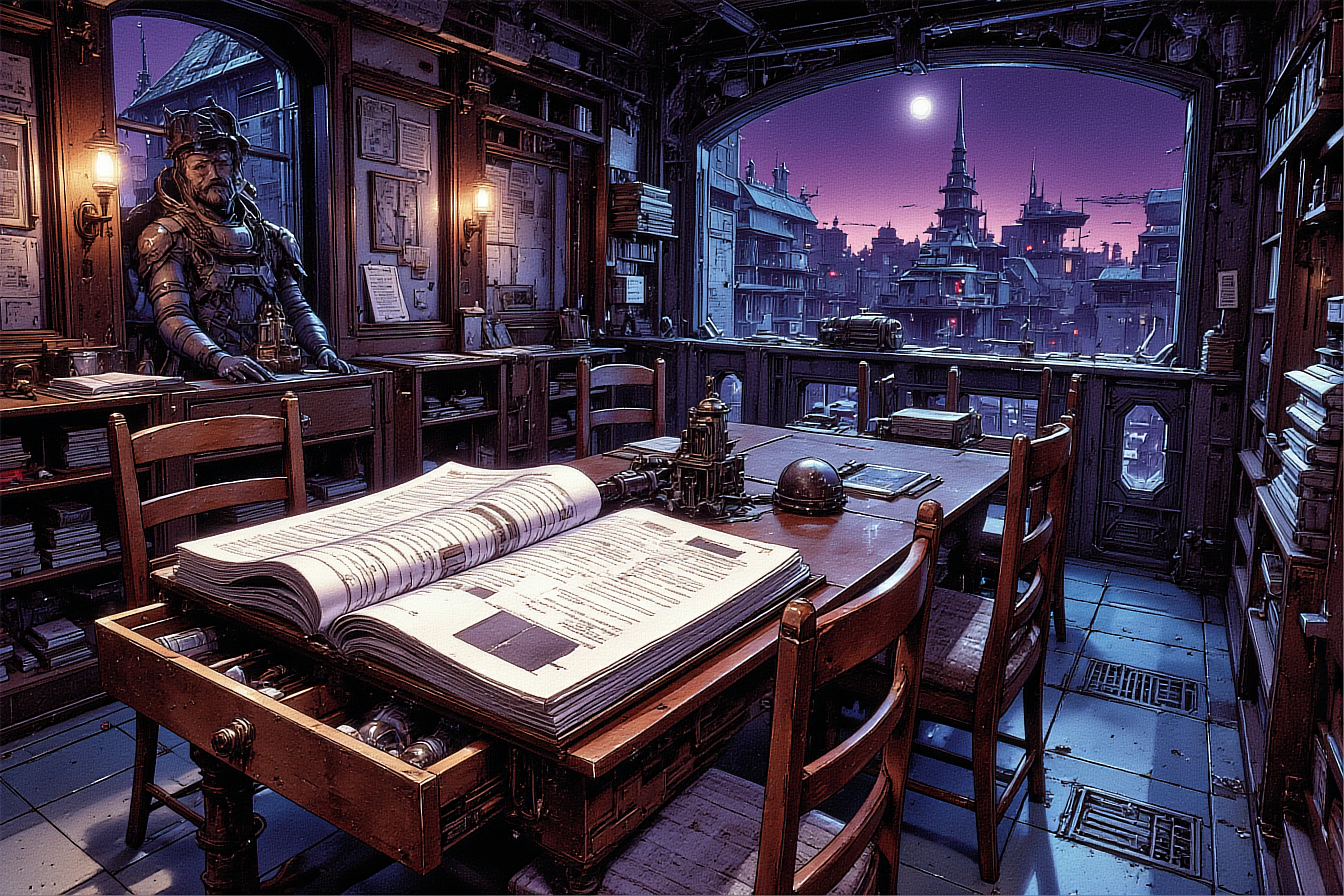
Everyone Lost Tuesday — Chapter 20: Acceptable Losses
Nocturne Aeturnus keeps its dead feelings on shelves, and the shelves have been full so long that the district has stopped calling them shelves and started calling them the house. We went past the lockers to get to the Order: rows of them, tagged, each one holding one grief booked into evidence and nobody coming to collect, and the sighs of the district crystallizing overhead like slow weather, falling past the streetlights as grit.
The Order of the Still Sum is a low building with no clock on it, and no bell, and a door that is never locked because there is nothing inside worth stealing except the total, and the total does not move. Zephyr carried me in the bag with the flap open. Luminara came last with the witness against her ribs. Pixel came in with her hood down, which she has worn down now for two nights, and I have not thanked her for it and she has not asked.
A lay brother looked up from a ledger at a table the width of a small boat and pointed us to the undercroft without a word, which is the entire hospitality of the Order of the Still Sum: they point, they do not chat, they are the only building in five precincts where nobody has ever asked me what I am.
He was down the last stair, in a room where the ceiling was the floor of the nave above and the walls were stacked to the joists with ledgers. Defrocked two years back. He still wore the robe, mended at both elbows, because the Order defrocks you and keeps you, the way a good coat gets mothballed and never given away. His hands were stained to the second knuckle, one color: ledger ink, the color of a question that has been answered too many times.
"Sit," he said, to Zephyr. Then he saw the bag, and the orange in it, and the base plate worn at the corners, and he said it again, to me: "Sit. There isn't a chair. There hasn't been a chair in this room since the audit."
Om Kai had a face like a man who has added up something he wishes he could put down, and he looked at each of us in turn, and what he was doing was not measuring us. He was checking us in, the way a bookkeeper checks a page in against the register.
"The district clerk said somebody would come asking about my stamp," he said. "I've been waiting five years with the answer in a drawer and nobody came, and now there's four of you and one of you is an exhibit." His eyes stayed on the bag. "You booked a grief. Three weeks into this case of yours, you walked into the Grief District and you booked your own grief for a man who isn't here, and a clerk crystallized it and tagged it and put it on a shelf, and my countersignature is under the tag, because countersigning totals is the one thing I was still allowed to do." He put both hands flat on the table. "I'm the man who signed for it. That's why you're getting what you're getting, and no one else who has come through that door would have got so much as the time of day, since the time of day in here is also a total and I don't give it away."
"He gave it to us," Pixel said. "We didn't come to buy it."
"Everyone comes to buy it." He went to the wall of ledgers and took down a ledger of his own, a small one, and from inside the ledger, where a monk keeps the thing he is told to burn, he took a folded sheaf of pages in Corporate stock, and he held it against his chest for a moment the way you hold a sleeping animal you are about to set down.
"Men bargain," he said. "The boy offers me a route out of his system. The woman with the camera offers me a picture of something I already know. The girl with the glitch in her offers me the names of things she's seen, and God knows she's seen them." He looked at me. "You offered nothing. You came in a bag and got pointed at by an old monk." He unfolded the sheaf and laid it on the table, page one facing me. "Then I remembered whose countersignature is on my shelf. I don't give copies to men. I give them to whoever booked the grief, because a man who has already put his own into the ledger isn't coming to me for a bargain. He's coming to me for the arithmetic."
It was a feasibility memo. Corporate stock, the pale gray of everything the machine produces when it is being honest with itself, four pages, a header block, and numbers in a column that went down further than any column should go.
Luminara had the witness off her ribs and up before I could tip toward her, and she stopped herself with her hand on the shutter, and Om Kai's palm came down on the page, flat, not hard.
"No lens," he said.
"I wasn't going to," she said, and put it back slowly, and her voice had the sound of a woman talking herself out of the only shot she's wanted in five years. "It can't be falsified, a frame can't, but a frame can be seized, and a frame of that page would be the only copy in the world with my face attached to its taking. They took my negatives once for less. Let him read it. His reading doesn't have a face on it."
Om Kai took his hand away.
Before I had read a word of it I heard the voice.
That is the faculty, and I am putting it on the page plainly because I have four pages of arithmetic in front of me and I want at least one true thing down before the rest. Barry read to me. Not always, not with any ceremony, but a man who does his thinking out loud at a desk past midnight will read his paperwork out loud to whatever is on the desk with him, and he read the night manifest that way, and the routing sheets, and once, twice, a compliance bulletin he did not understand either, with his head two degrees over to one side and his finger under the line. So when I read, there is a room in me where a man's voice sits over my shoulder and says the words as I take them, and he says clearance the way other men say a word they've had to file an appeal about, and he says no numbers given like a man telling you a secret he's not going to report, and I have never once told anyone that the voice is in there, because a witness who admits to hearing the dead out loud gets filed under unreliable.
It was there over the first line of the memo. It was there over the header.
Then the bars came up, and there were three.
[REDACTED , FORM 9] across the whole of the author block, and under it I could see the geometry of a signature line waiting; [REDACTED , FORM 9] over the routing code beneath it; and the third, [REDACTED , FORM 9], laid across the date block where a hearing goes, the box that says when the machine will sit down and listen to itself, and all three of them went black as a shut door and the memo lay there still and patient, and Om Kai watched me look at them and did not look surprised.
"You're the one the bars follow," he said. "Of course you are. A man can lose a page to a Form 9 and never know there was anything under it. You lose it and you feel the tug. I've seen it in the district: the ones who keep files always feel the tug."
I felt the tug, and I went to the drawer, because by now we know each other, the drawer and I, and what is left in it is worth counting on the fingers of a hand that isn't there: the laugh is gone, that went in the Vault; the look of his left hand went in the annex; the quiet of the office at three went in the district; the way he held his head went in the Ad-Verse; a woman's face from before I was awake went in the Paradox Wing; and yesterday the weight of his hand lifting me off a desk went in a tavern tree, and what that leaves on the shelf is small, and it is all I have, and the price has stopped asking me to be surprised.
The sound of Barry's voice.
I put it under the staple of my attention the way a man puts his last bill under a page he doesn't want read, and I let it go, and I want it recorded that I knew the price before I paid it, that I heard the landlord knock and opened the drawer myself, because the alternative was to sit in a monk's undercroft with the motive for the whole case shut in front of me, and I have never once in sixty years been able to leave a door shut that I could open with something of mine.
The bars came off like scabs.
The author block read: Prepared by the Office of Continuity Reduction, Registry Office of Existence, The Edge. Submitted under routing code ORCHID DESK.
The date block read: Audit hearing convened, Tuesday the seventeenth, first hour, Continuity Court, Sub-Level 9.
Price paid: the sound of Barry's voice. Logged.
I read it. I read both lines the way a man reads a telegram, twice, the second time slower, and the second time was when I went for the voice, because Barry would have read it with me. He would have read the office name the way he read everything above his pay grade, slow and mocking, and he would have said The Edge like a man naming a neighborhood he would never live in, and he would have repeated the date back to me twice to see whether it held.
There was nothing. There is nothing. I have gone back to that page four times since and I read it in a room where nobody is reading over my shoulder, and the words come in clean and flat with no air behind them, and that is the sound of a page being read by a stapler, and I did not know that was what it sounded like because I have never in my life heard it alone.
The seventeenth was a Tuesday. Five years back, three weeks after the crate with his name on it went to a floor nobody has cleaned since. And no calendar in five dimensions admits that Tuesday now; I have had the district's ledger in my hands and I have seen the column for it with nothing in it but a closure stamp from The Edge, and now I have the hearing date, and the hearing date is the empty column, and the empty column is the day.
"The audit was set for that Tuesday," I said, with a staple driven flush into the table's edge, danger, and then the same staple pattern again, driven flush again, because danger arriving on schedule is worse than danger arriving.
Om Kai nodded slowly. "Say it in my language, since you've got no other."
"I'm not a man," I said.
"In your language anyway."
So he said it for me, because that is what sources do when the detective is made of metal and grief: they say the thing out loud in a monk's voice so it goes into the record with a human mouth behind it.
"The Simplification needed a feasibility study," he said. "I wrote the numbers. Not the plan, never the plan, the numbers, what it costs, what it saves, what you do with the redundancy once the redundancy is clean. Two million seven hundred thousand lives, filed in the memo's loss column as acceptable." He said it flat, the way you say a total you have said to committees. "I asked what I should write where the names go, because there is a column for names in every feasibility memo ever printed and this one was going to stay empty, and I asked, because it is my one skill, asking what goes in the column. And back it came, in three words, from an office I could not read through the glass."
"Acceptable losses," Luminara said.
"Acceptable losses," Om Kai said, and let it sit in the room where the sighs of a district fell past the window as grit. "That's the testimony. That's the whole of what I've got, and I've carried it in the spine of a ledger for five years like a man carries a stone in his shoe, because a monk keeps what he is told to burn and I was a monk before I was an actuary and I will be a monk after, defrocked or not, robed or not."
"And the hearing," Pixel said quietly. "They convened an audit to hear it."
"They convened an audit," he said. "Corporate's own. Somebody upstairs wanted the study looked at by people who could read a column, and a date was set, and the date was a Tuesday, and before that Tuesday came, the Tuesday was removed from every calendar in five dimensions, and the audit never sat, and the memo I hold is the only copy that ever got read to anybody." He spread his hands. "You want to know why a day was taken. That's why a day was taken. Not for the deletion. The deletion was the cancellation. The day was taken so that a room full of auditors would never have anything to remember, and a feasibility study would keep its number, and two million seven hundred thousand would stay where I filed them, under three words I did not choose."
The undercroft had gone very quiet above us, which meant the nave above had gone quiet too, and in the Order of the Still Sum the quiet is the rule and the quiet is also the point, and the sum does not move and the sum has never moved and this man kept a copy of the arithmetic anyway.
Zephyr had been still for a long time, which is its own kind of wound on him, and when he spoke his voice was young in the way that is not flattering. "My brother's in the gap. He's the day. He built the thing that took the day, and now he's holding it open, and he's doing it because your three words needed a room to never happen in."
"He's doing it because a column needed to stay empty," Om Kai said, gently, which was worse. "I know the feeling of keeping an empty column. I kept one for five years in the spine of a book, and I have not slept clean since, and I am not the one who is the day, so don't trade griefs with me, boy, you'd lose."
I had the memo in front of me and the bars were gone and the price was paid and the file had a motive in it now with a date on it and an office at The Edge and a routing code that had pointed upward since the Paradox Wing, and I should have felt the way a detective feels when the case turns, and what I felt was a room with no reading in it.
Verse, since the room was owed it:
He used to say the words as I took them, a finger under the line, and now the line comes in by itself and the finger is somewhere I have paid to put it.
I sighted the two recovered lines with the corner of my base plate the way I sight anything I intend to keep forever, and drove one staple through the memo's top corner for the file, 45 degrees, doubled, flush, the pattern I sign everything that matters with, and the hole went through Corporate stock in a monk's undercroft and Om Kai watched the crown seat down into the paper and let out his breath like a man who has been holding a total still for five years and has just felt it move.
"That's the signature from the forms," he said. Not a question.
Nobody answered him.
"That's the signature from the forms that the district keeps finding in the seams," he said again, and he looked at me the way the room looked at me in the tavern, the way everybody has begun to look at me, with the pity that is not pity but recognition. "I'll keep the rest of this to myself. Bookkeepers keep." He folded the memo's blank pages back over my staple, careful around the crown, and slid the sheaf across the table to me as though he were passing a plate. "Take it. It was always yours. The only man in five precincts who put his own grief on my shelf, and you walked in here in a bag, and nobody asked you a single question."
Outside, the crystallized sighs were still coming down like grit past the streetlights, and the district's lockers went on holding what nobody would ever come to collect, and the sum in the low building behind us did not move and would not move and would keep its total still the way it always had, and in the bag with my base plate over the memo I went looking one more time for a man's voice saying no numbers given, and the place where the voice keeps itself gave me back nothing but its own shape, which is the shape of a page being read aloud by a stapler, alone, in a district that books feelings for evidence and never once had a column for what I had just put in.