
Everyone Lost Tuesday — Chapter 25: The Registry
The transit mouth let us out at the end of everything, and the first thing I understood was that everything ends here on purpose.
The Edge is where reality compiles. I had heard the phrase on manifests and registry stamps for years without letting it mean anything, the way you don't let a form number mean anything, and then you stand in it. The geometry does not hold still: streets fold over on themselves and come back shorter, buildings are the same distance from you whichever way you face, a wall leans into a corner that was not there when you looked a second ago, and all of it settles and re-settles like paper in a stack being squared. Probability is thick here, so thick you can feel it in the housing of your base plate, the weight of every decision anyone ever made hanging in the air a half second before somebody makes it. And the echoes crowd: not voices exactly, but the sound of what almost happened, one room over, forever, a man almost turning left, a form almost signed, a name almost taken.
Compile light comes off the walls without a source. It is the color of nothing in the five precincts, and it falls on you the way a clerk's attention falls: evenly, and without interest in what you are.
Zephyr stood beside the bag with his hand on the strap and said, "So this is where it happens."
"This is where it compiles, sir," A1 said from inside the bag. "There is a difference, and the difference is that nobody here thinks of it as happening."
The Registry Office of Existence is a low, clean building at the end of the last street, one story, no windows on the street side, a door of plain gray material with a counter visible through it. It has no sign, and it does not need one. Every form we have ever handled, from Piper's routing slips to the harvesting men's intake stamp in Verdantia, was born in this building, and a birthplace does not advertise.
Nobody stopped us at the door. That was the first courtesy and it was not an oversight: the door was not unlocked so much as unconcerned, and the lobby inside was small and cool and smelled of water and paper stock, and behind the counter a man in a plain suit was aligning the edges of a stack of forms with the side of his hand, tap, tap, tap, each report square with the one under it.
He looked up when we came in and he did not reach for anything. He set the stack down, squared it once more for the pleasure of it, and came around the counter with his hands open and clean at his sides, and his hands were the cleanest hands I have seen in sixty years of rooms where people handle other people's business. Not scrubbed. Empty. The hands of a man who does not leave prints.
"Mr. Glitch," he said. "Miss Usha. Miss Paradox." He looked at me in the bag last, and the look was not hostile and it was not warm. It was the look a man gives a record he has already read. "And the stapler. Please come in. You'll want to sit down, and so will I, and the water is filtered four times, which is not a courtesy, it is simply what the plumbing does."
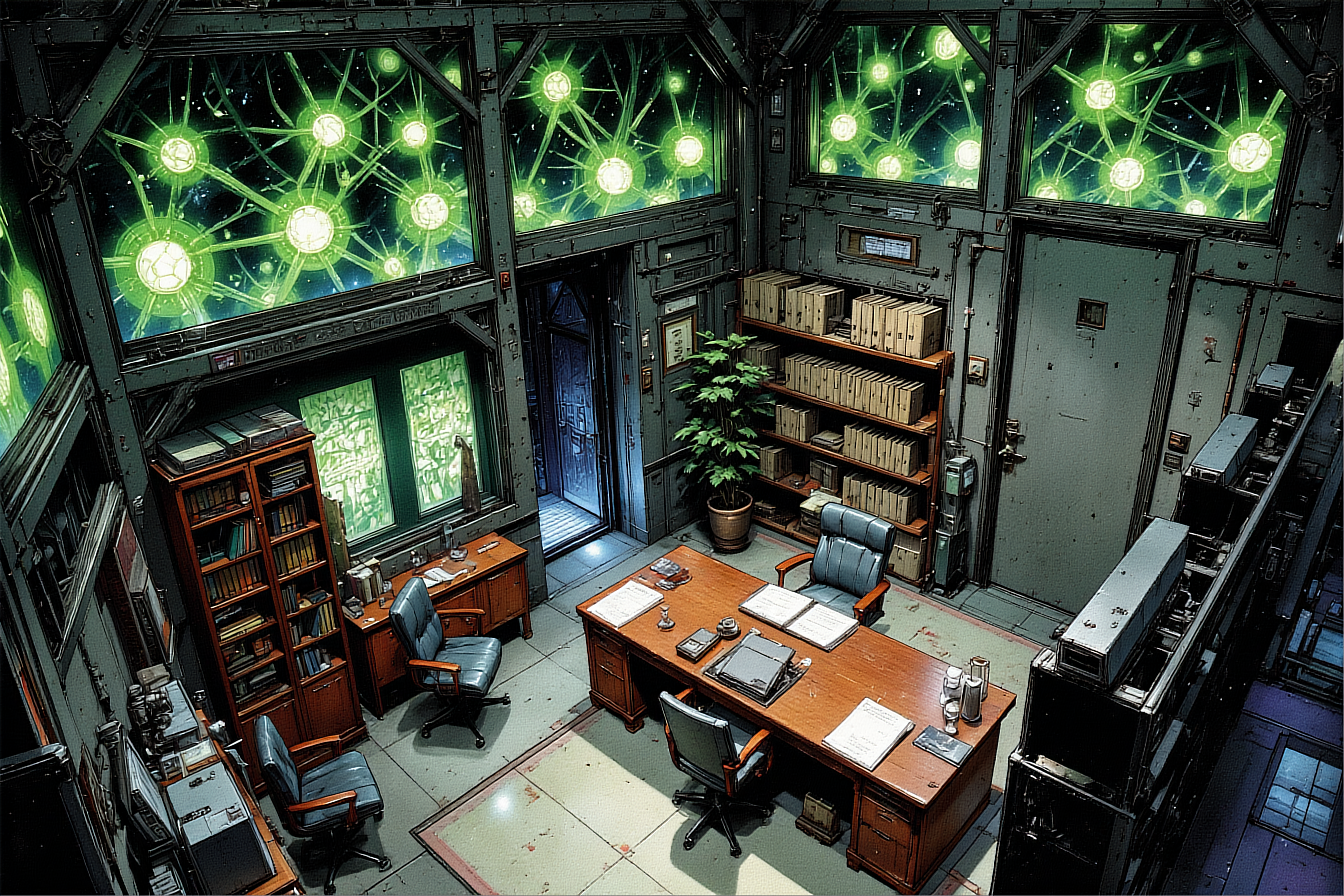
I had expected a vault. I had spent three weeks expecting some version of the room where the machine keeps its teeth, and what we got was an office with good light and a rug and three chairs and a man who pulled them out himself, one at a time, and set them square to the desk without looking, the way you do furniture you have arranged for years. On the desk: forms squared to the edge. A pen in a tray, aligned with the tray's edge. A blotter with nothing on it. No screens. No scanner. A filing rail on the wall behind him with folders in it, all of them closed, all of them even.
Zephyr sat on the edge of a chair with the bag across his knees. Luminara sat with the camera case across her back, which she did not take off, and which Grimshaw did not ask her to take off; he glanced at it the way you glance at a woman's handbag and then filed the fact of it somewhere behind his eyes. Pixel did not sit. She stood by the door with her shoulder against the jamb, reading seams, and after a moment I saw her go very still, the way she goes still when the thing she is looking at is bigger than she thought.
He poured water into three glasses and set them within reach of each chair, and then he sat, and folded his clean hands on the desk, and regarded us.
The dog came in while he was pouring. He came in the open door the way he goes anywhere, without asking and without hurry, and he crossed the lobby and lay down on the rug between Zephyr's chair and the desk, and put his chin on his paws, and shut his eyes as though he had an appointment there that afternoon. Grimshaw looked down at him for the length of one breath.
"That animal," he said, "is not in any registry."
"No," Zephyr said.
"How refreshing," said Grimshaw, and squared his glass to the blotter's edge, and did not call anybody.
"You have been very busy," he said. His voice was soft and exact, each word the size it should be, no more of it than the sentence needed. "Om Kai. Interview Paradox. Verdantia. The bay. You have been efficient, and I want to say at the outset that I admire a record-keeper. I do. There are two disciplines in this building and both of them are about not losing things: the one that takes, and the one that files. Yours is the older trade."
"We're not here to trade," Zephyr said.
"No," Grimshaw agreed. "You are here because the door did not stop you, and because I would rather a conversation than a procedure." He looked at me. "You may wonder what I think of a man who keeps a file nobody will honor. I'll tell you honestly, because honesty is a form of courtesy and I have very little else to offer. I pity you."
The word went in clean. He did not lean on it.
"Memory is a form of hoarding," he said. "You have no way to know when to stop, because the thing you are keeping does not admit of a final edition. Every year you add a page and the pile grows and you call it fidelity, and fidelity is a fine word for a habit that would get you escorted out of any warehouse in five dimensions. I keep copies of everything, so I am hardly one to talk about habits. But I keep copies for use. You keep yours because you cannot bear to be the last man who remembers."
"And the alternative," Luminara said, "is being the first man who forgets on demand."
Grimshaw inclined his head. "Miss Usha. On the record, and notarized. You see why we keep an eye on your department." He squared the blotter a half inch to the left. "I don't hate you. That is the other thing you came to find out, and you may take it off the list. Hatred would require me to consider your file a threat, and a file is paper. Names are clutter. Deletion is hygiene. I have never in twenty-two years been asked to feel anything about a form, and I have not started now."
"The Kowalski file," I could not say, and so the room said it for me in the way rooms do, because Zephyr said it.
"Barry Kowalski," Zephyr said. "Night guard, DRM Division. What happened to him."
Grimshaw nodded as though the question had arrived on schedule. He took a folder off the rail behind him, closed like all the others, even like all the others, and set it on the desk without opening it.
"Mr. Kowalski read a manifest he was not cleared to read," he said. "That is the whole of the offense, and it is not an offense, it is a category of error. He was on the night rotation. The shipments that moved at three in the morning have no manifest numbers because they are not, formally, shipments. He read one. He understood it, which was the mistake. The removal was procedural. He went out on a round at 02:58 and he was taken at the door of the stairwell by people whose names I could give you and won't, because names are clutter and I would be littering your excellent file with them."
Nobody moved. Somewhere in the building a clock advanced one second and did not apologize for it.
"The property was left in place," Grimshaw went on. "The crate, the forms, the coffee pot. Leaving property is not sentiment; it is inventory control. A man who is removed from a schedule is still, on paper, an employee who has not yet been processed, and you do not clear a desk until the desk's status clears." He looked at the closed folder between his hands. "As for the routing sheet he left behind, the staple in its corner is corporate property. The paper, the pattern, and the arm of it. You have read it five years. You have not once asked me which way it was aimed, which tells me you already know that I would not answer."
He paused. The pause was a small, exact thing, and in it I watched him enjoy himself the way a man enjoys a perfectly square stack: quietly, and without display.
"Trail or target," he said. "I find the ambiguity useful. So did the man who set it."
Zephyr's hand had gone flat on the bag. "You're telling us you killed a man for reading a piece of paper, and the answer to the only question we have is that you won't say."
"I am telling you," Grimshaw said mildly, "that the removal was procedural, which is a different sentence than the one you just heard, and you may file it however you like. And now the courtesy." He pushed the closed folder back an inch, not toward us, just back, into the middle of the desk where both sides could see it. "Take your file, take your pot, take your photographs, and go home. Nothing about this visit has been logged. Nothing about your passage was intercepted. In exchange, the case goes quiet. That is the offer, and it is the only one I am authorized to make, and I am making it warmly, from one record-keeper to another. Stop."
The word sat on the desk with the water glasses.
I looked at the folder he had not opened and understood something with the flat clarity you get at four in the morning in a room with no windows: he meant it. He was not negotiating. A man like this does not dangle, he files, and the offer was on the record whether any of us took it or not.
Then he said: "The order that night, since you have come this far, was issued from this desk at 01:40, and it read:"
[REDACTED , FORM 9] [REDACTED , FORM 9] [REDACTED , FORM 9]
Three bars across the page where the words should have been, level and black, the same bars over the same paper stock, patient as the man sitting behind them.
I wanted it the way I have wanted every bar: with my whole housing. The order was the head of the snake. Who signed at 01:40 on the night a night guard understood a manifest. Who issued the sentence that kept a crate unclaimed for five years. The price came up before I had finished wanting it, in the flat voice prices use, and it was a worse price than I have ever paid, and I paid it in three seconds.
The tune Dorothy hummed.
She sat at a bench in Long Island City in 1967 with a press in front of her and my base plate cooling under her hands, and she kept time with Motown while she worked, and the tune was the kind of thing that lives in the wrist rather than the head, a rhythm with a shape to it that came up every time she set a body in the die. That rhythm goes. Not her face. Her face stays: I can see the set of her mouth and the way she held her hair off her collar, and the fingerprints she left on my base plate are hers and will stay hers, and I have just bought a sentence with the only music she ever gave me.
Price paid: the tune Dorothy hummed. Logged.
I reached for the melody to test the trade the way a man tests a drawer twice, and the drawer was empty, and the shape of the tune was still there with nothing inside it, a humming with no sound in it, in a chest that cannot hum.
The tune goes the way the voice went, her face stays at the bench with her hands in the work, and I paid for his order with a song I cannot hum.
And the bars went thin, and Grimshaw's sentence came through to the end of itself.
"The order that night," he said, into the silence where the price had been, "was: take the guard on his round at the stairwell, void the 02:41 manifest, leave the property in place for the sweep, and record nothing. No number. No signature. A clean order for a clean room, and it is filed where every clean order is filed, which is why you will not find it in your excellent folders and why you would have had to sit in that chair to hear it."
He squared his hands on the desk. That was all. No smile to go with it. He had given a stranger the truth of a death the way a clerk hands over a claim ticket: completely, and without any sense that he had given away a thing.
We left the water untouched. Zephyr stood first, with the bag, and Luminara stood, and Pixel came off the jamb without having once sat down, and I was lifted out of the chair I had been set in and settled back into the bag where I ride, and the last thing I saw from that desk was Grimshaw already reaching for the folder again, to square it, to put it back on the rail with the others, because he does not twirl anything, ever, he files.
In the lobby he opened the far door for us himself, and beyond it was not the street. It was a long room of shelves, low lit, the air in it dry and endless, full of the smell of paper that has been copied so many times it has given up being itself.
"Our antechamber," Grimshaw said. "Every copy in the multiverse keeps a night here before it goes to the stacks. The way out is through it. You are welcome to look while the passage home is keyed; nobody here minds looking. It is what the room is for."
He stood aside with his clean hands at his sides, and we walked into the shelves, and the door closed behind us with the soft sound of a drawer going home, and I understood, finally and without any drama to it, what I had been trying to picture for three weeks: there is no room where the machine is hidden. There is no back office behind the office. The office is the machine. Every deletion in five dimensions starts as a form squared on a desk by a man with clean hands, and if you want to find the thing that took Tuesday, you do not go looking for a villain in a dark room. You follow the paperwork to its source, and its source files.
The shelves went on ahead of us into the dry light, and somewhere in them, I already knew, was everything we had written.