
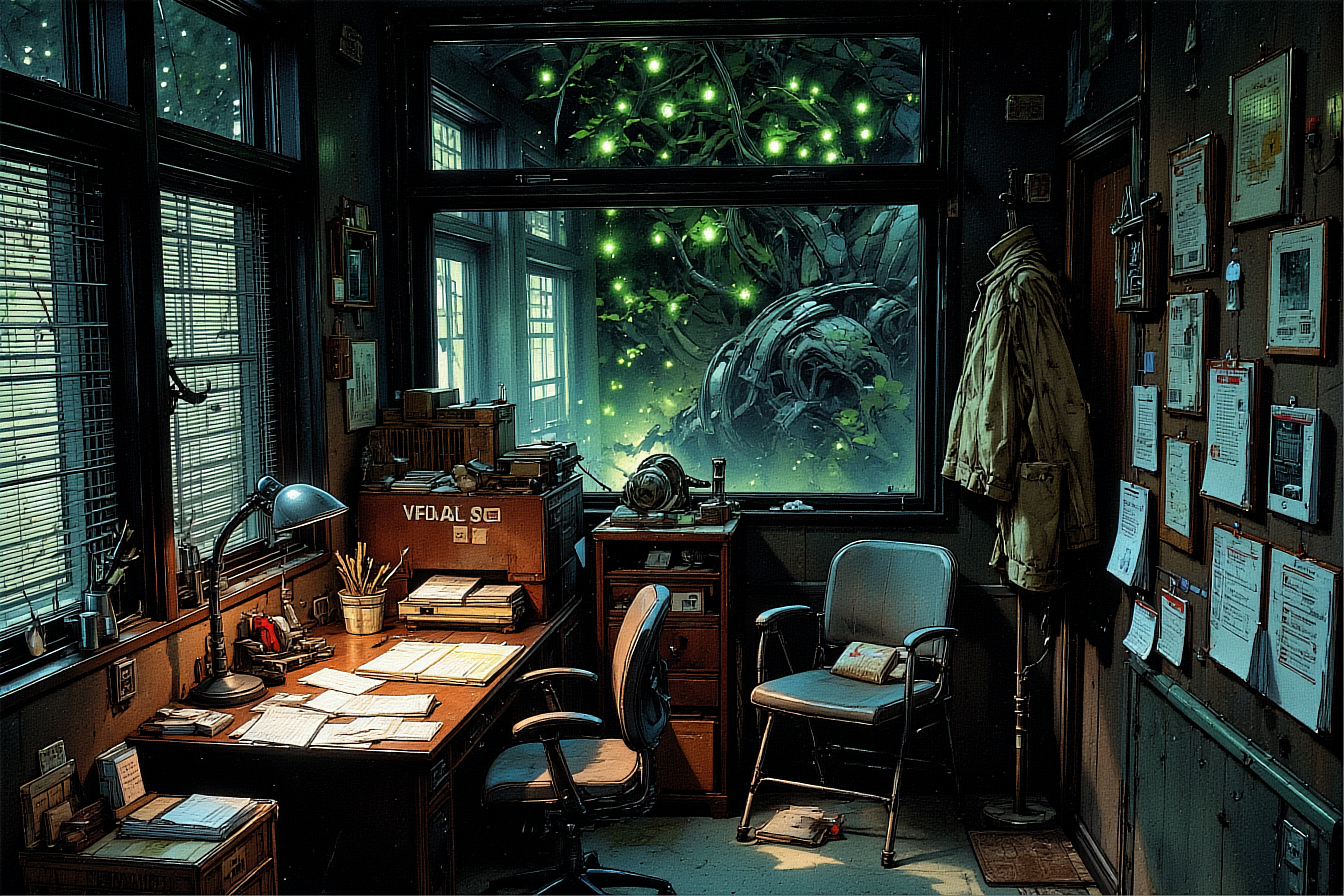
Everyone Lost Tuesday — Chapter 24: Filing Anyway
The records bay sealed itself at 6:12 in the morning, which in this building is Corporate's way of saying that somebody upstairs has finally made a decision.
A1 had the whole transaction laid out on the underside of the desktop in green before the day shift came in: our visit flagged, the room locked, the Palimpsest stack put under a seal with a transfer ticket attached to it. The ticket carried the registry mark of The Edge, the same mark that has been stamped on everything we have touched since Verdantia, and it named a destination rather than an address, because at The Edge the two are the same thing. Archive intake. Destruction on arrival, pending a signature.
"When does the stamp land?" Zephyr asked. He had been up all night against the crate and looked it, but his hands were steady on the deck.
"That, sir, is the question with the interesting answer," A1 said. "A stamp lands when a Compliance officer picks up the file. There is no schedule for it. There is only the fact that when it happens, the stack goes to pulp in a single night, several hundred miles and one dimension away, and the corner you want will be ash in a building nobody has the address of."
"The bay is sealed," Pixel said. She was on the cabinet again, in her usual corner, watching seams. "Piper's credentials won't open it twice. They never do."
"So we don't go to the bay," Zephyr said. "We go to where the bay is sending it."
Luminara did not look up from the loupe. She had corner three under the lamp with the witness at her eye, working the photograph the way a woman works a negative she does not intend to be argued with, and she had been at it since Zephyr came in with the coffees. Now she lifted her head and put the loupe down and turned the photograph around so the lamp fell on it evenly.
"There," she said. "Under the corner, through the paper. The camera put it there because it is true."
The photograph showed the bent staple and, ghosted through the cream stock where the fold had made the paper thin, the corner of a routing slip riding inside the folder. The slip had a line on it in Corporate type, and the line had a date. Not a routing date. A hearing date. The same date Om Kai gave us out of a monk's ledger with tears running into his beard: the day the audit was convened, the day that was then taken out of every calendar in five dimensions.
"Om Kai said the hearing was convened on a Tuesday," Luminara said. "That slip says the same thing. Folder three carries the docket for the audit itself, and a docket cover has the page under it. The original page. The one the whole deletion was built to make nobody ever read."
The original audit page, filed in a stack of forms that exist only to erase it, held in the corner of a folder that my hands failed on once in five years of never failing.
"Then we pull folder three," Zephyr said, "before anybody stamps anything, and we read the original, and we put it somewhere with our names on it where the machine can't come and tidy up." He looked around the desk. "And we bring the rest of the record with us, because a page like that alone is just a page, and a page with names on it is an exhibit."
"The photographs go with names attached," Luminara said. She had the envelope under her arm the way a woman keeps a sidearm. "Every one of them, published at once, everywhere at once, so that tidying up one screen means walking past four hundred others. And we will need the book from the wall, because photographs show what was done and the book has who it was done to."
"The book is tagged unclaimed," Pixel said.
"The book is tagged," Luminara said, "which means there is a tag, and a tag is a thing that can be handed to somebody."
Nobody had to say the rest of it. The Ephergent sits behind a broken umbrella in the lost-and-found hall four floors down, and Compliance does not acquire what nobody claims, and we were not going to claim it, we were only going to stand where it is when the time comes.
I shifted my weight on the desktop and let the envelope of photographs and the folder of the case take my weight together, and the folder's corner pressed back at my base plate the way Barry's paperwork always does, which is to say flat and patient and full of him.
Getting to The Edge was the next problem, and Corporate solved it for itself centuries ago with shipping lines and subsidiary addresses and no invoice anybody can find. We had the route on paper: the chapel, the dock, the annex, the cubicle, and at the head of it a subsidiary registered at The Edge with no address at all. What we did not have was a door.
Zephyr solved it at the desk with the deck in his lap and the napkin photograph in his hands, the same napkin he carried through the lobby door three weeks ago with grease going translucent through it and my own hole in the corner of the picture inside. He set the deck's resonance cradle on the desk, put the photograph into it corner-first, and let the staple do what the staple has been doing since the day it was driven: point.
"Reality's just another system," he said, not to anybody, with the glasses down and the software moving. "It's got exploits. And this thing has been pointing for three weeks without anybody riding it."
The deck took the resonance the way a radio takes a distant station, faint and then suddenly all there. The staple's wake is a line, and a line has a direction, and the direction went out through the glass partition, across the open floor, out of the building, and toward a corner of sky in a photograph that maps to none of the five precincts. Compile light. The Edge, at the end of the route the audit crates already knew by heart.
"There's a transit mouth on the old dock route in the Undercroft," Zephyr said. "The same dock your crates went through. If I ride the staple line down there and key it to the light, we walk out the end of the shipping route and into the Registry's front yard." He looked at me. "And your staple gets us in the door, because the resonance on that photo is going to match every form in the building. We'll be carrying the one signature the whole machine already knows."
"Or," A1 said, "it will match, and they will know exactly what has walked in. The numbers are optimistic either way, sir. About the outcome, not about the odds."
We packed at ten in the morning with the blinds down. Scenes, not meetings: there was no table and nobody stood around one.
In went the jar. Luminara wrapped the sealed jar of Crystallized Laughter in a shirt and put it at the bottom of the courier bag where it would be padded on all four sides, and she did it with two fingers and a look that said she was still annoyed about the day Pyle offered it to us. Exhibit B. Unspent. Enough joy to buy a corridor, and joy keeps no receipts, and we were keeping it the way you keep a live round: to remember that somebody tried.
In went A1, base plate first, with a folded towel around his housing and his optics dimmed for travel. He submitted to it with the dignity of a man getting into a sedan. "I have been carried before, sir," he said to Zephyr as the bag's strap went over the kid's shoulder. "I was carried into this building in a crate. Kindly do not jostle the carafe. The numbers inside it are delicate."
"Your numbers are fine."
"My numbers, sir, are frequently optimistic. My carafe is not. Mind the stairs."
In went the camera, wrapped in its case and then in a jacket, because the witness is a rangefinder that photographs what is true and the machine does not like true photographs, and the film Luminara has shot since the Interview Paradox is worth more than everything else in the bag combined. She sealed the case herself and slung it across her own shoulder, and she did not hand it to anybody, not even to be carried down the corridor.
And in went I, because I am heavy and we have stairs, with the Kowalski file and the manuscript envelope under my base plate where they have always ridden. The crate marked KOWALSKI stayed on the floor under the desk with Barry's loose forms in it, and the tape stayed on the chair, and the dead task lamp stayed over the cubicle with the coat on the hook, and the annex took on the particular look it has when a room has been left as though somebody intends to come back.
The desk we were leaving had been a man's desk for five years before it was ours, and the wall behind it still carries his leftover forms in a row nobody has had the heart or the procedure to file. I looked at them from inside the bag, upside down through the flap, the last I saw of Sub-Level 4: a night manifest with a coffee ring, a routing slip, a sheet with two columns of handwriting going gray, all of it bound by a hand that is either dead or very carefully elsewhere, and none of it worth anything to anybody except the two of us, and one of us was leaving it behind on purpose so that there would be something to come back for.
A room left ready is not a room left behind. It is a room held open the way a file is held open, by weight.
Down in the Undercroft, the lost-and-found hall was doing its morning work, which is to say the files on the wall were weeping on schedule and Mrs. Odile Fenn was cataloguing through it, dry as paper about procedure with the tears going on underneath, the way she does both jobs at once and neither one stops the other. A drawer went quiet as we passed and then started up again, keening, and further down the bicycle file was sobbing over a boy's lost bicycle with the steady rhythm of a thing that has done this every morning for years, and Mrs. Fenn did not look up from her ruled paper because in the Vault the griefs are not interruptions, they are the inventory, and she has been taking stock of them for longer than most buildings have stood.
She looked up when we came through the door and she did not ask us why we were there, because the Vault has a rule about questions and the rule is that you write the question down and the answer comes later, if it comes.
"Property transfer," Zephyr said, which was the closest thing to a reason he had.
Mrs. Fenn went to the wall of unsolved nostalgia, past the drawer that keens, past the bicycle a boy lost in a district that no longer exists, to the shelf behind the broken umbrella. She stood in front of it a moment with her ledger in one hand, and then she unclipped the tag. BOOK OF NAMES, UNCLAIMED, in the handwriting of a custodian who has been crying over property since before I was manufactured.
She came back and put the tag in the bag herself, on top of the wrapped jar, and wrote the line in her ledger, and the tears kept coming while she wrote it, and the hand that wrote was steady.
"Why are you giving us this?" Pixel asked her.
Mrs. Fenn looked at the ledger line as though she had just read it for the first time. "I don't know," she said. "It's due out. The ledger says so." And then, in her driest voice, the one she uses for procedure: "Property released to claimant, reason not required. I don't ask why. I ask for the signature."
Nobody in the party can hold a pen. So I had Zephyr set the claim slip on the counter and I drove my signature through its corner: forty-five degrees, doubled, flush. Mrs. Fenn looked at the staple for a long moment, and her crying did not change its rhythm by a single drop, and she filed the slip in the slot marked RECEIVED.
The dog was under the wall where the dog always is, thin and collarless and in no database, unclaimed in a hall of unclaimed things except that nobody had ever managed to tag him. He watched us from his gap in the shelving with the flat attention dogs give to bags rather than people.
"The dog can't come," Luminara said. She said it to the room, gently, the way you say a thing you already know is not going to hold. "There's no provision for him. There's no provision for anything where we're going. A Registry does not have a line item for a dog."
"Nobody's bringing him," Zephyr said. "We're just leaving."
We left. The bag went over Zephyr's shoulder with the jar and the pot and the stapler in it, and we went for the dock route, and at the mouth of the corridor I heard the soft padding sound of four feet that were not keeping to anybody's schedule, and I could not turn around to look because I was riding in the bag facing the wall, and I did not need to look. No procedure predicted it. No scanner had him on file. He was following the bag, and the bag had meat in it only in the sense that everything this party carries is somebody's provision, and the dog had decided that the arithmetic included him.
At the bottom of the Undercroft the old dock route ends in a transit mouth that hasn't moved anything legitimately in years, and the air at the end of it was wrong in the good way: thick, and bright without a source, and tasting faintly of hot dust and fresh paper.
Zephyr set the bag down, took the photograph out of the cradle, and put the deck against the wall plate. The resonance went through the dock like a struck bell. Ahead of us, where the tunnel should have gone into brick, the light had already begun to compile itself into a wall the color of nothing in the five precincts, folding over on its own edges, and the geometry of the place leaned toward it the way paper leans into a throat.
"The staple's pulling," Zephyr said. "Whatever's at the end of this line has a lot of forms in it, and they all know your holes."
He was right and I could feel it, the particular drag that comes off a signature that has been read too many times by too many machines, the way a name feels when it has been in a public ledger too long. The photograph in the cradle was driving danger at us the whole time it pointed us toward the door: angle caution, doubled trust, flush for danger approaching, and the flush was aimed down the tunnel like a man pointing at a fire and telling you to walk into it. Barry used to say the whole of human relationships is the angle of the arm. He never said what to do when the arm points at both the friend and the fire at once.
So we walked at it anyway, because the only other direction had a pulp line in it.
Luminara checked the camera case on her shoulder and the film count behind her back. Pixel stood very still with her hands in her sleeves, reading seams we could not see, and nodded once at something in the air that was not there for the rest of us. A1's ember brightened once inside the bag, checking his own odds, and dimmed. Behind us, at a distance no one had sanctioned and no scanner had logged, the dog stopped when we stopped and started when we started, and did not need to be told either thing.
We go where the light compiles the walls, carrying a jar nobody will spend and a dog nobody can file.
I settled my weight against the Kowalski file under my base plate and felt the route take hold of the staple in the photograph, and the transit mouth opened on The Edge like a page being turned, and we went through.