
Everyone Lost Tuesday — Chapter 27: The Settlement
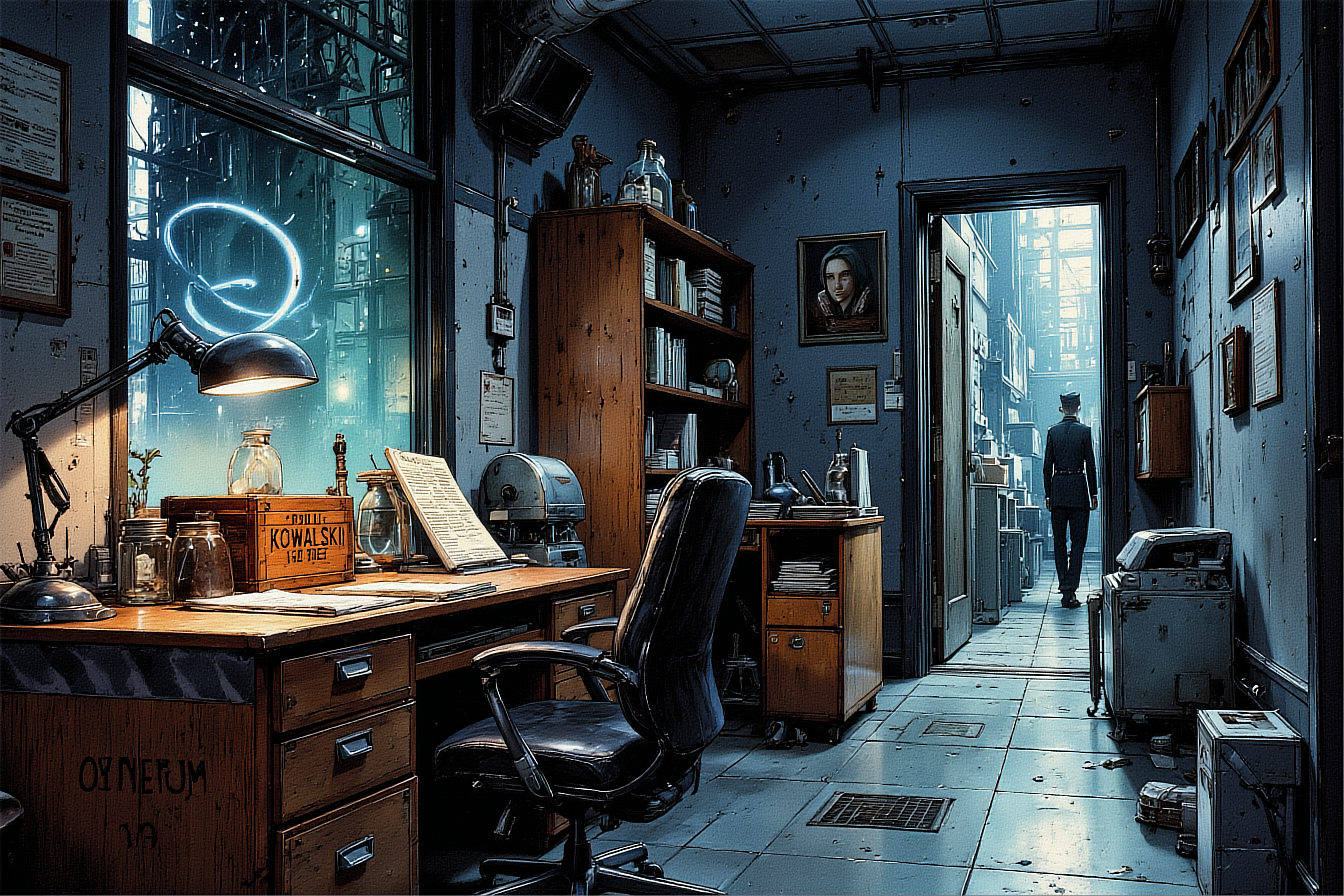
We came back to Prime Material the way a man comes back from a hearing that has not been decided: quietly, with nothing settled, and with everybody watching to see what he does with his hands first. Zephyr carried me down the corridor in the courier bag with the flap folded back, because by now he knows I want to see, and the annex door came up, and there was the desk again with its gray tape and its crate marked KOWALSKI and its five years of coffee rings pressed into the ghost of a spot where a man used to set his cup. The held rain hung over the sill in its usual holding pattern, denied clearance by whatever supervisor signs for weather in this precinct. Nothing had moved while we were gone. The machine does not move things when it is watching you. It leaves your room exactly as it was so that when you come back you will feel received.
A1's optics came up under the glass collar before I had my full weight on the desktop, the faint blue tick of a carafe running numbers in the dark. "Home, sir," he said. "The odds of returning from The Edge unfiled were not generous. You have improved my week." Luminara set her camera on the near corner of the desk, where Barry used to lay the routing sheets, and Pixel sat on the floor with her shoulder against the crate and said nothing, which for Pixel is a form of reportage. Nobody talked about the Registry office. The three of us who had sat in Grimshaw's antechamber brought that room back with us, and the two who had not could smell it.
Then the shoes. Soft soles, unhurried, the walk of a man who never has to be anywhere on time because every room holds for him. Pyle stopped just short of the tape, waited until he was seen, and held up an envelope the way a process server holds a life: flat, two fingers, no higher than the chest.
"Mr. Clive," he said.
Nobody in this room calls me that. It landed the way a name lands when it is written in the box underneath your name.
"Form 12-SET," he said. "Addressed to the detective personally. I was asked to deliver it by hand. I have also been asked to wait for the answer, and I want you to understand that waiting is the courtesy."
Zephyr did not take it. He stood with his arms crossed and his AR glasses pushed up in his mohawk, and the corridor light made the quantum tape on his deck look like a scar. Pyle waited anyway. He has the patience of a filing system. After a moment Luminara stepped over, took the envelope by the corner, and carried it to the desk, and Pyle inclined his head to her as though she had performed a small correct procedure, which is the way that man pays compliments.
It was cream stock, heavier than anything Corporate has printed in years, and it had no logo, which is the most expensive thing a logo can be. Inside was a single folded form with a heading and a numbered body and, at the bottom right, a small ruled frame with ACCEPT printed in it, and along the bottom left margin a second frame with nothing printed at all except a faint square ghost where a stamp would go. The paper had the smell of a room with no windows. Zephyr laid it flat on Barry's desk, under the task lamp, because Zephyr reads documents the way other people read faces, out loud, where they can be judged.
"Close the file," he said, "and Barry comes back. Leave the redactions in place, and go on as you were."
He said it twice. The second time he slowed down on every word, and the annex got quiet enough that I could hear the held rain not falling.
That is the whole of it, too. Do not mistake the Settlement for a complicated document. Form 12-SET is two promises and a signature corner, and the promises are arranged so that they can only be read as one act: shut the Kowalski file, and the man is returned; keep your bars where they are, keep your silence where it is, and the rest of your life proceeds unmolested. There is a third clause with a heading I did not read yet, buried under the signature corner, and I will come to it, because a man should be allowed to want something for a while before he finds out what it costs.
"There's an enclosure," Pyle said.
He took a slim viewer from his coat and set it on the desk himself, careful of my base plate, and pressed the edge, and a corridor came up in the light above the desk. Night corridor. Corporate standard carpet, one ceiling panel out, a door at the far end with a DRM stencil on it. A guard came around the corner in a jacket I have watched for five years, keys on the left hip, flashlight in the right hand, walking the round he walked a thousand times. He passed a desk. He set his feet the way he set them. He stopped at a filing row and looked up at nothing, and tilted his head, and the tilt was two degrees to the left, and I reached for the memory of that tilt the way a man reaches for a light switch in a room he has lived in his whole life, and my hand went through the wall. The impostor witness's name cost me that posture years ago. I know the shape of the hole it left. I could not check the image against it if I had every dollar in the world.
That is the design of the thing. You should understand that, because I did, and it did not save me.
The guard in the light spoke, and the voice came out of the viewer's small speaker, thin and brown and warm, and it said: "You understand me, don't you, orange."
The sound of Barry's voice was paid for at the Order of the Still Sum, three bars over an author line, and I have not heard it since. So I could not test that either. I could not test the walk against the walk, or the voice against the voice, or the face, because the face went at four in the morning in my own dark room with three bars across it and Barry's eyes going last. Every instrument I own for measuring whether a thing is Barry Kowalski has been spent, one at a time, buying the truth about Barry Kowalski. The projection stands in the exact hole I dug for it.
"There is a statement accompanying the video," Pyle said. "A witness account. He was relocated on procedural grounds, he has been well, and he is held pending closure of this file. He is not detained, Mr. Clive. He is held. There is a form for each."
"He's held," Zephyr said.
"Everything is held, young man. Yours is held. Mine is held. The difference is the paperwork."
The viewer kept playing the corridor on a loop. The guard walked the round, checked the row, tilted his head, said the line to nobody, and started again. I watched him come around the corner eleven times while I read the statement, and by the seventh pass I noticed that I had begun to look forward to it, which is the sound a soul makes when it is being bought.
I am going to tell you what I wanted, because the wavering is the part of this that matters and I have never once filed my desires under fiction. I wanted the corridor to be real. I wanted to close the manila folder under my base plate and put the crate in the corner and let the tape go on the chair for good, and I wanted to stand on a desk in a room where nobody was being deleted and be a stapler again, an object, orange and aggressively cheerful, with no idea what I had witnessed. The quiet life. Not silence, I have had silence, sixty years of it. The quiet life, which is silence with company in it. And the price was only other people's names: the ones under the bars, the ones in the pulped log, the 2.7 million in the feasibility memo, the boy who became a gap in the middle of the week. Leave the redactions in place and go on as you were means you may keep your peace, provided you never open your mouth about anyone else's. A man could sleep. A man could want to sleep. The Settlement does not ask you to sell anybody out by name. It asks you to stop saying names, and it will do the rest, and the rest is thorough.
I have never told you that I get tired. Furniture does not get tired. But a witness does, and I am both, and the two of them have been arguing in me since the corridor video started its eighth loop.
Verse, since it has come up:
Close the file and he walks in, the way he walked before the light went out, and I would know him by the rooms he does not break.
Pyle stepped out into the corridor to give the desk its privacy, because he is a professional, and the door shut on his soft soles, and the three of them stood around me without saying anything, which is their way of not deciding for me. A1's blue tick slowed. "For what it weighs, sir," the pot said, "the jar is still sealed."
Nobody had to ask which jar.
I put my weight forward and read the form the way I read any form: from the top, with the suspicion of a thing that has been stapled by its own hands. The first clause is the file. The second is the redactions, and it is drafted in the language of mercy, all shall not be required and no further account will be demanded of the applicant, which in Corporate English means you may never ask again. The third clause sits under the corner marked ACCEPT, and it explains what comes back, and when my attention got to it, the page did what the page does now.
Four bars went across the clause in a row, thick and even, the exact width of the text beneath, and the last one bled a little into the margin the way a wet stamp does. [REDACTED , FORM 9]. [REDACTED , FORM 9]. [REDACTED , FORM 9]. [REDACTED , FORM 9]. They sat there with the patience Pyle has, and they wanted paying, and I knew the taste of it before I agreed to it, the dry pull at the base plate, the sense of a hand going into my drawer.
What I had left was not much. The laugh was gone in the Vault. The watch, the hand, the quiet of three in the morning, the head tilt, Dolores, the weight of him lifting me, the sound of his voice, the night we met, all of it already spent and logged, and Dorothy's tune gone at the Registry with her face mercifully still in the room. I went down the drawer like a man counting billfold money in a bad neighborhood and found the first desk. Madison & Associates, Manhattan. The desk they set me on when the crate came up from Long Island City, before anything had happened to anybody, when a desk was just a desk and a stapler was just a stapler and the top drawer stuck in damp weather. I had kept it sixty years the way you keep a coin, not for what it is worth but for where it was minted.
I put it under the staple of my attention, the way you put a coin under a tongue, and I pulled.
Price paid: his first desk at Madison & Associates. Logged.
The bars drank it and went transparent, and the clause came up under them, clear, every word in its place.
I read the clause three times. It says that the returned party shall be restored in the form and to the extent the applicant is able to specify, from such records as the applicant holds, at such time as the file is closed and the applicant's account is complete. It says that Corporate will return Barry Kowalski to the extent that Clive can describe him. That is all it says. The offer is a mirror with a man standing behind it: what comes back is furnished out of me, from the material I still have, and I have just spent the last piece of the room he was made in. They cannot produce him. They know they cannot produce him. The clause was written to be filled in by the only witness left, and everything he knew of the man has been billed out one page at a time to read the truth about the man. The clause says only what I want it to say, and what I want it to say has a price I did not know I was still holding until it was gone.
I reached for the desk at Madison & Associates. The grain of it. The window past the blotter and the light that came in low in the morning and lay across the corner where I sat. The drawer that stuck. I reached the way I reached for the tilt and the voice and the face, and there was no desk, and there was no window, and there was no morning. There is an address in me now with nothing delivered to it. The murder stays. I want that on the record: the wet sound and Dolores's hand and the dumpster three blocks out all stay where they are, because grief is not kept in the room you started in. But I started somewhere, and the somewhere has been traded, and the price of the clause was a room I began in.
So the offer stands exposed for what it is. A man can be returned to you, assembled from your own remaining memory of him, and then held, and then edited, because what lives in a filer can be filed over. The redactions stay in place means the thing that ate my drawer stays fed. And Barry comes back as the one version of Barry that Corporate can approve: the version I can still describe. I can describe him less every month. In a year I could have described a stranger, and the stranger would have walked in, and tilted his head, and said the line, and the case would have closed on schedule, and I would have called it mercy.
The viewer looped the corridor. The guard came around the corner again with his keys on his hip, and did not know he was an argument, and passed the row, and went out of frame, and the light stayed on the empty carpet for a second before it cut.
Verse:
They will hand me back a man built out of the parts I have left, which is not a man. It is a mirror learning my face.
The annex door opened and Pyle came back in with his hands loosely folded, and in his right hand was a pen, black, with the cap already off, the good kind they keep at the Registry for signatures that matter. He held it out over the desk, at the angle you hold a pen for someone who is going to use it, and he waited, and I looked at the pen, and I shifted my weight, and then I did what I do, which is nothing, because the pen is for hands and I have a base plate, and the gap between his offer and my construction sat there in the air between us while the pot ticked and the kid stopped breathing.
"He cannot hold it," Zephyr said.
"No," said Pyle, "I don't suppose he can."
I tipped myself forward an inch and set my nose over the corner of the form, over the ruled frame with ACCEPT printed in it, and I let them all see the alignment, and I drove one staple into the desk beside the form, not in it, beside it, at forty-five degrees, doubled, driven flush, which is my signature and my signature only, and which any two people in this room can read, and Pyle can read it too, because he has been briefed.
He looked at the staple for a long moment. Then he folded his hands again.
"I will wait," he said, "for the answer in the form it is given."