
Everyone Lost Tuesday — Chapter 28: Exhibit A
Pyle waited in the corridor the way a man waits who has never in his life been refused anything by anything that keeps records. He stood with his back to the taped door and his hands folded and his soft shoes pointed at the floor tape, and he did not look at his watch, because a man who looks at his watch is admitting the room can cost him something. Through the glass I could see him holding still while the annex tube did its four-hour trick behind him, dimming and coming back, dimming and coming back.
Inside, we staged it. That is the word, and I will not soften it, because everything I do now is staged: I have learned that a refusal with no witnesses is just a thing that didn't happen.
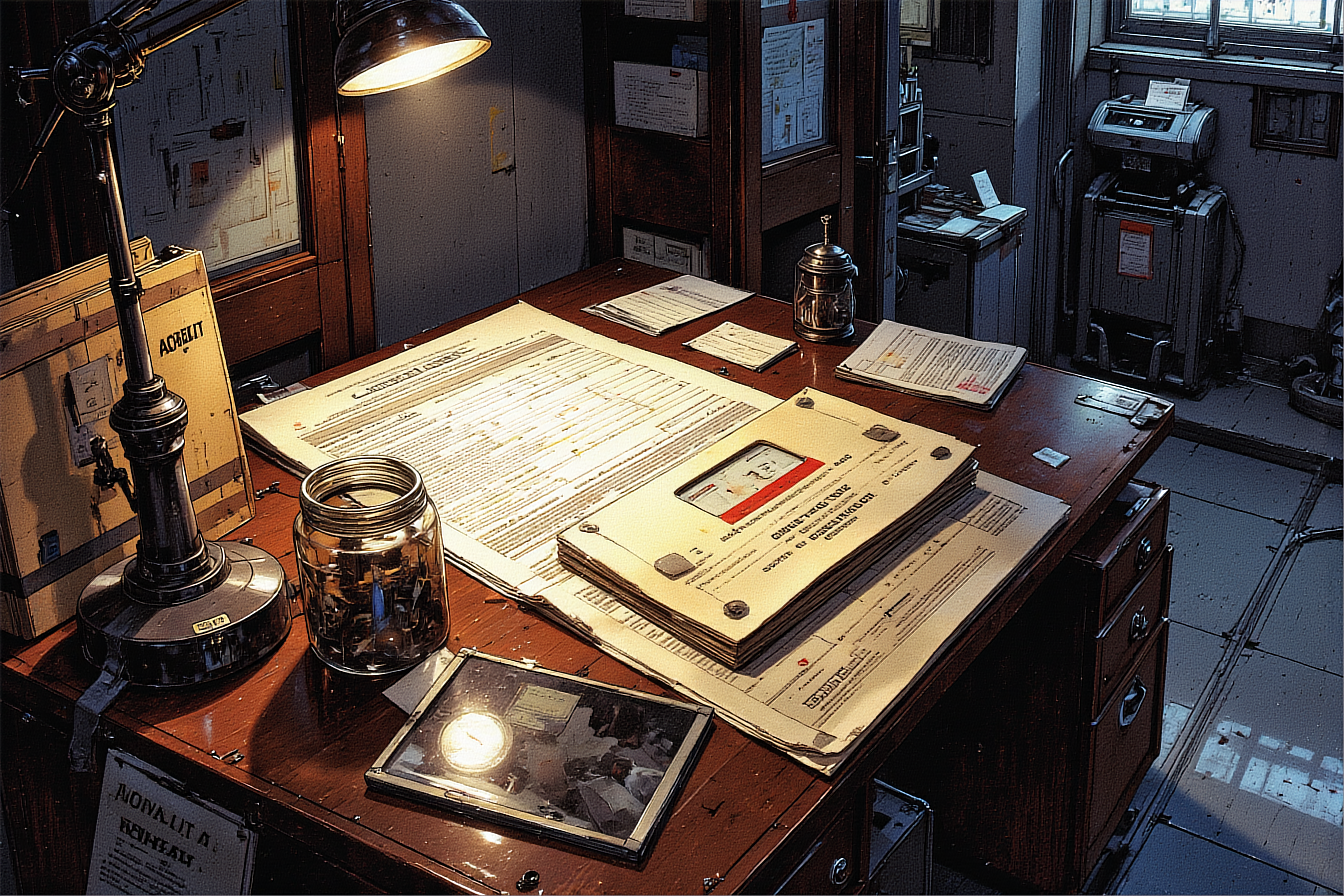
"Kid," I said, with a single staple in the desk, angle level, and Zephyr came over and read it the way he has learned to: flat, no flourish, like a man reading a gauge. He laid Form 12-SET flat under the task lamp on Barry's desk with the corner marked ACCEPT facing me, and he set the weights: the sealed jar at the top edge, the Kowalski file at the left, the camera already coming around. Luminara crouched at the desk's near corner so her lens would catch the corner and my base plate in the same frame, and Pixel stood at the end of the row of drawers with her palms flat on the wood, feeling the seams, because she says the building is always editing itself near the tape and she wants to catch it in the act. A1's blue tick brightened one notch. Everybody in that room understood what was about to happen except Pyle, out in the corridor, and Pyle probably understood it best of all.
The dog had come in behind Zephyr with the courier bag and laid himself down with his chin across the top slat of the KOWALSKI crate, and he lifted his head once when Pyle's shoes stopped at the door, and put it back down when they did not come any closer. That is the only security system in this annex that has never been bypassed, and it costs us nothing, and it has no procedure. Luminara wound her film to frame one and checked the count against what she expected to need, then set the small witness camera on the far corner of the desk as well, so that the refusal would be photographed twice by two different truths. Pixel had two fingers on the drawer seam and her eyes shut, listening to the building edit itself. The jar stood at the top edge of the form where Pyle had left it in his mind, sealed, catching the lamp.
Before I did it, I let myself look at the form once more as the thing it was meant to be. A quiet life. A desk with a partner at it. The tape finally gone gray from being respected instead of ignored. Two promises and a signature corner, and all I had to do to buy them was leave every name I had uncovered sitting under its bar where Corporate put it. The 2.7 million. The hearing that was convened on a Tuesday. The boy folded into the middle of the week. I could have had my corridor video and my looped voice and my two-degree tilt back, forever, on the condition that I never once mention out loud that any of it was taken. The offer was not insulting. The offer was the most reasonable thing anybody has ever handed me, and that is exactly why it had to be refused in a way that could be filed.
Because every pattern is a small act of rebellion. Every perfectly placed staple is me choosing meaning over malfunction.
I have driven a great many staples. A lease forfeiture. A confession. A stack of forms I did not ask to be awake for and will answer for until the machine is dust. In all of it I have never once been asked to sign my name, because a signature is a thing they take from men and a stapler is a thing they use on men. Here it was, then: a printed frame with a verb in it, held out to the one witness in five dimensions who cannot write. Whatever I did to that corner was going to be read. There is a weight to that which has nothing to do with spring steel, and I felt it in my base plate, and I did not put it down.
I shifted my weight back, then forward, the way you load a punch you are not going to throw with your hands. My spring has sixty years in it. My legs are not legs, they are two clinching arms with a hinge, and when I commit, I commit with the whole base plate. The corner of the form came up under my throat with the printed frame square in the die, ACCEPT in clean sans serif, and I drove.
The plunge took the cream stock and the backing slip Zephyr had slid beneath it, and the clinch folded the legs under, flush, and the whole desk took the sound, that metal word a stapler says when he means it, and I did not stop at one. Doubled. My signature. Forty-five degrees into the upper-left corner of the frame, driven flush until the crown sat in the paper like a period in a sentence, the same hole I have punched through a photograph, a routing sheet, a stack of forms I wish I had never been awake for, and a blank sheet in the crate four thousand times. Not as acceptance. There is no version of this pattern that reads acceptance to anyone in this room, and there are five of us and one of him.
Then the margin. Along the left edge of the form is a blank ruled box, the kind they print for a stamp and never use, and I put three staples in it in a row, low and even, each one a word in the only vocabulary Barry Kowalski ever taught a piece of furniture. Zephyr read them back without being asked, slow, checking each angle with one finger in the air.
"Refused," he said. Second staple. "Witnessed." Third, and he looked up at the corridor glass. "Not for closure."
"That's what it says," Pixel said from the drawers, without turning around. "That's what it's always said when he does that."
I rocked twice against the file at my left, and Luminara got it and slid the folder open to the page she had tabbed, and Zephyr picked up the stapled form by its bound corner and laid it inside over Barry's night manifest, and I leaned over and drove one more through the form and the folder together, so that the Settlement and the cold file are now one object in this world and will be moved as one. Declined. Filed. I tapped the tab with the corner of my base plate until Zephyr read the intent, and he uncapped a marker and wrote the two words on the tab in block letters, because a stapler can be precise but a stapler cannot spell.
EXHIBIT A.
The door opened, and Pyle came in on his soft soles and stopped at the tape and looked at the folder in Zephyr's hands, and at the tab, and at me sitting on top of Barry's desk with a fresh clinch still cooling in my legs, and he did not come any further into the room. He is good at the moment where a man absorbs a disappointment. He let it pass across his face like weather, small and dry.
"Exhibit A," he said. "And the offer itself. That was not the intent of the form."
"The form has a corner that says accept," Zephyr said. "He accepted the offer as a document. It's in the file."
"I meant it as an invitation, not a trap," he began, and Zephyr spoke over him.
"You're about to tell us what you meant," Zephyr said, "and I want to hear it in front of the camera."
Pyle looked at Luminara, who had not moved the lens, and something in his professional courtesy rearranged itself. "I meant that the offer was extended to a party we believed capable of wanting it," he said. "No one is punished for declining a form, Mr. Glitch. That is not how this works, and I would not stand here and insult you by implying it." He smoothed the front of his coat with two fingers. "You have all been carried, up to now, in a ledger of quiet. Loose ends with sentiment attached, not worth the cost of a procedure. That page is closed this morning. From here you are named. All of you. Named, and in the schedule."
"Say the rest," Pixel said.
"The Simplification is not a war," Pyle said, mild, the way other men say the time. "It is a schedule. Wars end when one side wins. A schedule simply arrives." He glanced at the crate, and at the folder, and at the jar standing sealed under the lamp, and he gave me a small nod, the kind a pallbearer gives a man he did not know. "I was told you would take the week, Mr. Clive. I did not bet against you. I want that on whatever record this room keeps."
"The record's been busy," A1 said from his corner, blue tick steady. "You are welcome to add a column."
Pyle almost smiled. He left his shoes in the doorway a moment longer, the way a man leaves an umbrella open in a hall to show he intends to come back, and then he went, and the soft soles went down the corridor, and the annex was ours again, and nobody exhaled for a count of ten.
"Named," Zephyr said. He said it tasting the word the way you taste a coin. "He means we're in the queue now. Like a shipment."
"He means we are line items," A1 said. "There is a difference between a war and a queue, sir, and he was accurate about it on purpose. A war would require us to be worth stopping. A queue requires only that we remain reachable. Every corridor he has ever walked us down has had a return address on it, and this morning he confirmed that ours is current." The pot's burner ticked once in the silence. "For what it weighs: I recorded his shoefall at the door and it matched the visit in Chapter Eleven to within a half second. He has rehearsed this arrival."
"Everything he does is rehearsed," Pixel said, still not opening her eyes. "That's not the frightening part. The frightening part is he thinks we are too." She opened them then, and looked at the file with my crown in its corner. "He thinks we staged this. He thinks we staged it to be seen refusing, so that we could negotiate from the posture." She let go of the drawer. "He's wrong, and he will price us as though he's right, and that gap is the only weather we have."
Luminara wound the film and took the picture then. The form in the file, tab up, the double staple in the corner catching the lamp, the margin patterns dark and even, my base plate in the edge of the frame the way a signature sits in the corner of a deed. The shutter has a sound like a small door closing, and she made it twice.
"The first photograph of a refusal," she said, and she checked the light with her eye the way she always does, squinting at nothing. "I was erased. I came back. And now I document everyone else who refuses to stay deleted."
It develops true. That is the rule of her witness, and it is the rule that has kept us alive this long: a photograph cannot be falsified, and the bars cannot cross onto paper that is already true, so whatever comes out of that tank tonight will show the staple, the corner, the tab, and the refusal, and no Compliance clerk in five dimensions will be able to print a version of this morning without it.
The cost landed after the shutter. We stood around the desk and let it, none of us speaking first, because we are all new to being a named entry. Until today the machine treated us the way it treats a paper cut: an irritation on the edge of a form, to be covered and forgotten. Pyle's ledger of quiet was the only thing between us and the procedure stack, and I had just watched a man staple it into an exhibit. They will come by name now. They will come for the kid's deck, and for the pot who runs odds out loud, and for a woman who has no record to be deleted from and therefore cannot be deleted, and for a photographer the HR division would very much like to assign a number again. There are five of us, six if you count the dog asleep under the crate, and one of the five cannot walk.
A1 ran it anyway, because A1 will always run it. "For the record, sir. Survival to the end of the week, with the ledger of quiet closed: nineteen percent. Without the refusal: eighty-one percent, with a footnote that reads not recommended."
"Why not recommended," Zephyr said.
"Because it would have worked, sir," the pot said. "That is the difficulty with an eighty-one. It is very comfortable, and it is exactly what they were selling."
Verse, while the lamp held:
They offered me a room with his voice in it and a door that locks from the outside, and I chose the crate, the tape, the open file, the chair nobody sits in.
Nobody said to me that we had done the right thing, and I noticed the absence, and I noted that I noticed, because a stapler who starts needing reassurance will eventually take a bribe. What they did instead was work. Pixel took the desk drawers one by one and read the seams for edits. Zephyr began laying out the deck's resonance trace along the file row, the same trace he followed to my corner five years after Barry pointed it. Luminara wound a second roll. A1 brewed nothing at 3:15, out of respect for a ritual whose owner is still missing, and let the burner tick in the dark.
The jar stood where Pyle could see it from the door, sealed, the CLX moving inside it slow as honey, joy with no receipts, enough to buy a corridor and every corridor it opens onto. Exhibit B. It has been in this file since the transit mouth at Nocturne, and it has bought us nothing, and it will buy us nothing while I have any say in the matter: a bribe you keep is worth more than a bribe you spend, because it proves you were offered one and it proves what it would have cost. Sealed. On the desk. Unspent.
A1 ran its odds unprompted, because the pot cannot leave a sealed container alone. "Untraceable, sir, as advertised. Unspendable by any party but you. And I will note, since no one else will, that it is now the only object in this room that Corporate still believes we might be persuaded by. That has a value. A machine that thinks it can still buy you will keep making offers, and offers are documents, and documents are where you live."
Two exhibits, then, on one desk. In the folder, my refusal, staple-bound to the cold file with a tab the kid wrote in marker. On the desktop, the bribe, moving in its jar, waiting for a use it will never be put to while I have a corner to drive through. Declined and preserved, side by side, which is the only two words I have ever wanted written under my base plate. The tube dimmed, came back, and the rain went on being denied over the sill, and somewhere above us a schedule went on not arriving, because a schedule can be delayed by nothing except the people who refuse to be filed on time.
The Settlement is in the Kowalski file with my crown in its corner. Pyle's shoes are gone down the corridor. The schedule, he called it, and he said it the way a clerk says a filing date, and the tube dimmed and came back over all of us, and we got back to work, because a refusal with witnesses is a document now, and documents are the only country I have ever been a citizen of.