
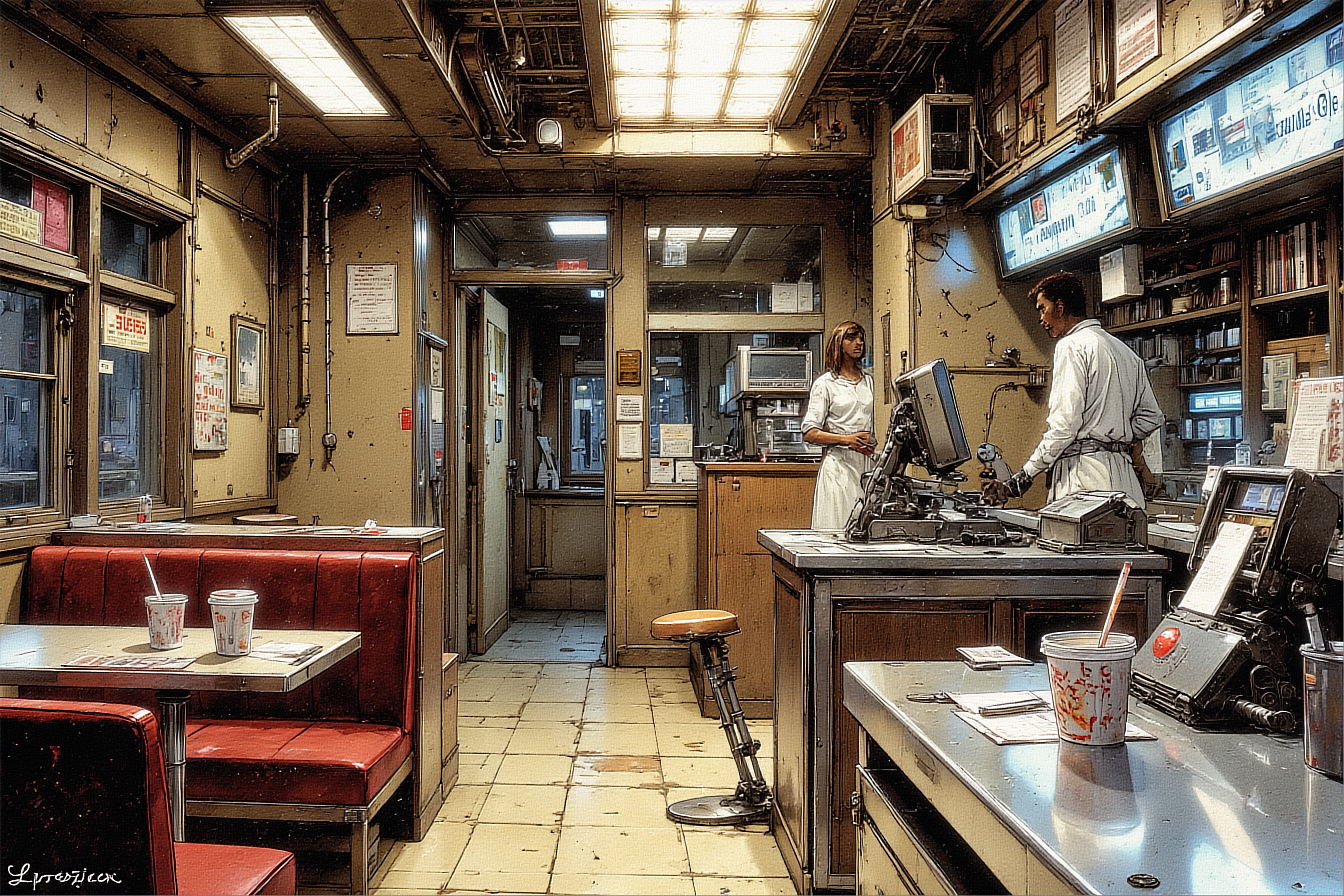
Root Access — Chapter 01: Three Meters Away
The vendor did not look at the crystal. That is the local rule when you pay in CLX: the lump goes into the tray cold and bright, still holding the shape of whatever joke got mined out of somebody's bad week, and the man behind the counter finds somewhere else to put his eyes. Rock candy with a punchline inside. The one asset Corporate Corp can't mint, can't fork, can't audit without laughing at itself. Every vendor down here takes it. Every one of them takes it the same way, which is with their attention pointed somewhere else.
"You're overpaying," he said, to the middle distance.
"I'm buying consistency," I said. "Comfort at a stable price. You should charge extra for it."
He slid the iced latte down the counter. Plastic already sweating, a little cold panic on the outside of the cup. I took it to my stool at the end of the bar, the one with the wobble that had gone load-bearing, and set my back against the mirrored wall.
Under the stool, Meatball rearranged himself, which took a while because Meatball is a dog assembled from a sack of opinions and he reassembles in stages. Tail thumping the chrome footrail, one, once, once more. He approved of this café. He approves of all cafés. Scanners skip him, which I had put down to cheap hardware, because last month a checkpoint daemon waved us straight through a cordon with him on the leash and I had no idea yet what that meant.
I pulled my AR glasses down off my forehead and the world got its annotations back.
Lower district of Prime Material, 14:11, Sector 7G, The Second Pour, third of four cafés on this block whose espresso machine has a pending complaint against it. Along the top edge of my vision the status bar sat where it always sits, thin as a hairline:
CORPORATE CORP OS // uptime 611y 04m 12d // ToS accepted by everyone // accepted by nobody
Uptime in centuries. Nobody ever gets to see the boot sequence. Nobody ever gets to type no at the prompt either, because there isn't one; there's a signature at the bottom of every receipt you've ever signed, and it's yours, and you were holding a pen when they put it there.
My latte had a straw. I put the straw in and watched the café the way you watch a street when you're waiting for something you haven't been told about yet.
Here is what the lower districts are, for anyone who hasn't been dropped into them: the part of Prime Material where Corporate's front end stops paying for polish. Chrome up top, six hundred years of uptime held together by service contracts, and down here the reality budget gets thin enough that you can see through it. Light switches that work four days out of five. Streets that get re-zoned without warning and come back a slightly different beige. The OS's unchecked exception handler, all of it, running loud and nobody filing tickets.
That's why the daemons come here to work. A delete in the chrome is a delete with witnesses, and witnesses are a cost center. A delete down here happens in a booth at a lunch counter and gets absorbed by lunch.
I logged the block's deliveries, drank, and waited for whatever I was waiting for.
Three meters off, in the booth by the window, the Vega family was having an argument.
I knew their order because I'd heard it twice already: two cortados, one hot chocolate with the foam drawn into a lopsided animal, one plate of almond croissants that the little one was dismantling with both hands. Marisol Vega, mother, in a work jacket with the cuffs gone gray at the fold. Tomás, the father, mid-sentence about a soccer score that had apparently been stolen from his team by a referee who was either blind or on the take, and he was doing the thing where he argued with his hands. And Pip, four, maybe five, who did not care about soccer at all and was running a pastry flake across the table like it was a boat.
"That's not how offsides works," Marisol said.
"It is exactly how offsides works."
"It's how you wish it worked."
"He raised his flag, Marisol. The flag. He raised it after the ball was already in."
Pip held the flake up over the lip of the table and let it drop, and clapped once at the landing, and neither of them looked at him, which is the specific way parents of a five-year-old look at nothing at all while continuing a war that started before he was born. The foam animal on his hot chocolate slid another millimeter toward defeat.
The place was full of that noise. Lower district lunch noise, nobody watching anybody, four booths of people being unregistered in the good way, which is to say unremarked.
I had my deck on my knee under the counter, Aether Junior, held together with quantum tape and a grudge, and I was half-reading a maintenance feed from the block's delivery drones when the door chime went.
Man in a beige suit came in.
You learn the silhouette fast, down here. Beige done well, no jewelry, shoes that cost more than the table they'd sit at, and a face chosen from a catalog of faces: pleasant, mid-forties, forgettable on purpose. He scanned the room the way a load balancer scans a rack, found the booth with the family in it, and walked over.
"Oh, good," Marisol said, standing up to hug him. "You made it."
"Traffic," said the man, and sat.
He ordered nothing. He folded his hands on the table and nodded at whatever Tomás was saying about the referee, and Tomás laughed, and Pip held up the croissant flake for inspection, and the man looked at it with enormous courtesy and said, "Very fine." His voice had a pleasant room in it. That is the interface. A person-shaped daemon wears a person the way I wear my glasses, and underneath the overlay there's something that has never once in its operational life ordered a coffee.
I checked his bar, because checking bars is the habit that keeps you employed. Above his catalog head: no name, no registration, no parent pointer. The string above him read UNIT // E-SOMETHING before my glasses caught up and blurred it into a standard citizen label for the sake of my own license. Erasure daemons don't walk around bare. They get rented a face by the shift and the face goes back in the drawer, and if you ask the café who that man was, four people will describe four men and all four descriptions will fail verification.
My straw stopped halfway to my mouth.
In my overlay, three meters away, I watched the family's ID strings hang above their heads the way they hang above everyone's, thin gray bars that the OS renders for its own bookkeeping and then hides behind a license fee. Marisol Vega. Tomás Vega, P. Pip Vega. Registration status: active. Not active like a badge. Active like a heartbeat, the little green pulse the OS gives a row it intends to keep.
The man in the beige suit put his palm flat on the tabletop. Nobody at the table noticed. The gesture read as a man settling in.
soft-delete pending
The tag floated over the table for maybe a third of a second before my glasses translated it and filed it. Soft-delete. The OS never hard-deletes a citizen. Hard delete is a loud sound and a complaint, and complaints cost throughput. Soft-delete is the polite form: the rows go null, the indexes stop resolving, the record stays exactly where it was and answers nothing, and if anyone comes asking, the ledger says there was never anything to find.
Marisol's bar flickered. Gray, then the color drained out of the green pulse, then gray with a strikethrough the width of a hair, and the string re-rendered itself in Corporate's favorite font:
DELETED: unprofitable
Tomás's went next. Then Pip's, which is the one that got me, because Pip's row had a parent pointer in it and the pointer didn't move. It just kept pointing at nothing with the confidence of a pointer that has done this before.
The tab on the table re-priced itself. I could see it from three meters: the little glow under the acrylic, the lunch specials sliding down, the total redrawing. Nobody at the booth looked. You don't look, because there's nothing to look at; a price changed, prices change. The receipt curled up out of the table slot and Pip's name fell off the bottom of it, mid-print, a line of text cut halfway through its own word, Pi, then nothing, and the paper kept coming.
Tomás picked up the receipt. He put a thumb on it, read it the way a man reads a number he half expects, and paid. The table accepted his cred and issued him a fresh chit for a coffee that the ledger said nobody at that table had ordered, and he signed it with the pen chained to the wall, and the chain rattled like it always rattles, and none of it was strange.
"This machine's been funny all week," Marisol said, watching the total settle.
"Everything's been funny all week," Tomás said, and signed.
That's the part they don't put in the orientation video. Nobody screams. Nobody even looks up, because the people who should scream are the same rows that were supposed to be there screaming, and the rows are gone, so the count of people in this booth who are distressed about the count of people in this booth is zero, and the OS is correct about this, and its correctness is the whole machine.
My hand went to Aether Junior. I had three packets in the buffer that would have put me on their row, flagged their block as contested, put a name on my own that Corporate's next sweep would enjoy. My thumb found the corner of the deck where the transmit key has worn shiny.
The tooltip in my overlay grew a second line:
INTERVENTION ON UNREGISTERED-ADJACENT ROWS // FLAG: INTERESTING
Interesting. That's the whole word. Down here we treat that flag the way miners treat a canary: it's not the danger, it's the announcement. You go interesting, and after interesting comes reviewed, and after reviewed comes a man in a beige suit who orders nothing and sits with you until your row agrees to leave.
My thumb stayed on the key. I let the packets sit in the buffer until they cooled.
Pip held up the croissant flake again, for the man this time, and the man looked at it with the same enormous courtesy and said, "Very fine," and Pip was satisfied, and the foam animal on the hot chocolate began to collapse into a puddle that looked like no animal at all.
They left at 1:38. Tomás with his fresh chit for nobody's coffee, Marisol with her arm through his, Pip walking backwards so he could keep talking to the man in the beige suit about the game, which he had apparently been following after all, and the man walked them as far as the door and held it and said, "A pleasure," in his pleasant room of a voice.
The door chime went. The family went out into the street and turned left, and from three meters away I watched their three bars of gray hover over nothing for a second, and then not even that.
The booth showed two seats. It always shows two. You can watch that booth all afternoon and the seating capacity will read two, steady as a metronome, because the table's own row is intact and the table's row says two, has always said two, and three people sitting in it were just three people sitting in a table's arithmetic error.
The man in the beige suit sat back down.
He poured himself the water nobody had ordered. He drank it, in small sips, facing the window, holding the glass the way you hold something you've been told is yours. And then he did the fold. It starts at the cuffs: the beige goes paper, creases inward, the shoulders collapse along a line that isn't there, and in about two seconds the interface is a receipt lying face-down on the table with a water ring spreading under it. The daemon had phoned itself home in the form of a slip of paper, which is how they travel. Nobody folds up in the middle of a café unless the job's done, and the job was done.
I watched the receipt lie there. The chime went again, a real customer this time, and someone in an apron came over, picked it up, read it out of habit, and dropped it in the bin with the sugar packets.
I sat with my latte going warm.
The grief showed up the way it always shows up, about ninety seconds later, after the job part of your head has finished being professional. My parents went the same way. Both rows, in the same afternoon, while I was at school, and when I got home the tab in our kitchen had re-priced the groceries and the door badge said resident not found, and Aether was sitting on the floor of our apartment with the two printouts in his lap, holding them like they were still warm. He was sixteen. He read them over and over, like the words might rearrange into a different ending if he caught them at it, and they never did, and he was the one who told me what the strikethrough meant. Our parents' records said they had never been born, and somebody had to explain the font.
After that the apartment ran fine. That was the part I couldn't get anyone to understand when I was nine: nothing broke. The lights came on, the taps worked, the OS kept billing the unit for two residents without ever naming them, and every system I could see reported the situation as correct. You can be nine years old in a house that says you were never in it, and the house will be right, and the house will be warm.
I put my palm flat on the counter. The wood was warm from the espresso machine and it was real and it was there and it did not flicker.
No joke after that one. There's a version of me that would have one. The version that got stitched back together in a pocket dimension has mostly put that version in a drawer.
The street outside had gone on with itself. Left, the way they'd turned, in the direction of a block where the bakery card machine worked most days.
Under the stool, Meatball put his chin on my shoe, which is his entire position on the matter.
The ping came at 14:52, from Clive, and Clive does not ping.
Clive communicates in the office-supply network's own dialect, has done since 1967, and a live ping means a machine somewhere just did something a machine shouldn't. The message was three lines in a dead-drop font he favours for anything with a heartbeat in it:
A live one rides tonight. Routes in the depot stack, unclaimed, before the audit takes it. Pixel wants the crew on the floor. Bring the dog.
I read it twice. Outside, a delivery drone clipped the corner of the building on its usual arc and corrected, spraying a little mist of somebody's order across the window.
A live erasure daemon. Not a receipt on a table, the unit itself, still running, still holding its logs. The kind of thing you'd have to be stupid or armed to go near, and I was both, in the order they list on forms.
I finished the latte, dropped the crystal for the vendor's next problem in the tray, and swung off the stool. Meatball got up in stages, opinion by opinion, and shook himself once, and the whole café's attention briefly pointed at a dog the scanners still had no opinion about.
"Same time tomorrow?" the vendor asked.
"Same time tomorrow," I said, and neither of us mentioned the booth, which was the other local rule.
On the way to the door I pulled the glasses up. The status bar rode above my vision, thin and patient, unchanged, older than every person in the room:
CORPORATE CORP OS // uptime 611y 04m 13d // ToS accepted by everyone // accepted by nobody
Three meters behind me, a table for two was quietly keeping a third of its afternoon.
I held the door open with my hip and let the dog go first.
- Zephyr, logging off