
Root Access — Chapter 02: Five Things at Once
The vending machine had been busted since before I was born, which is the whole point of it.
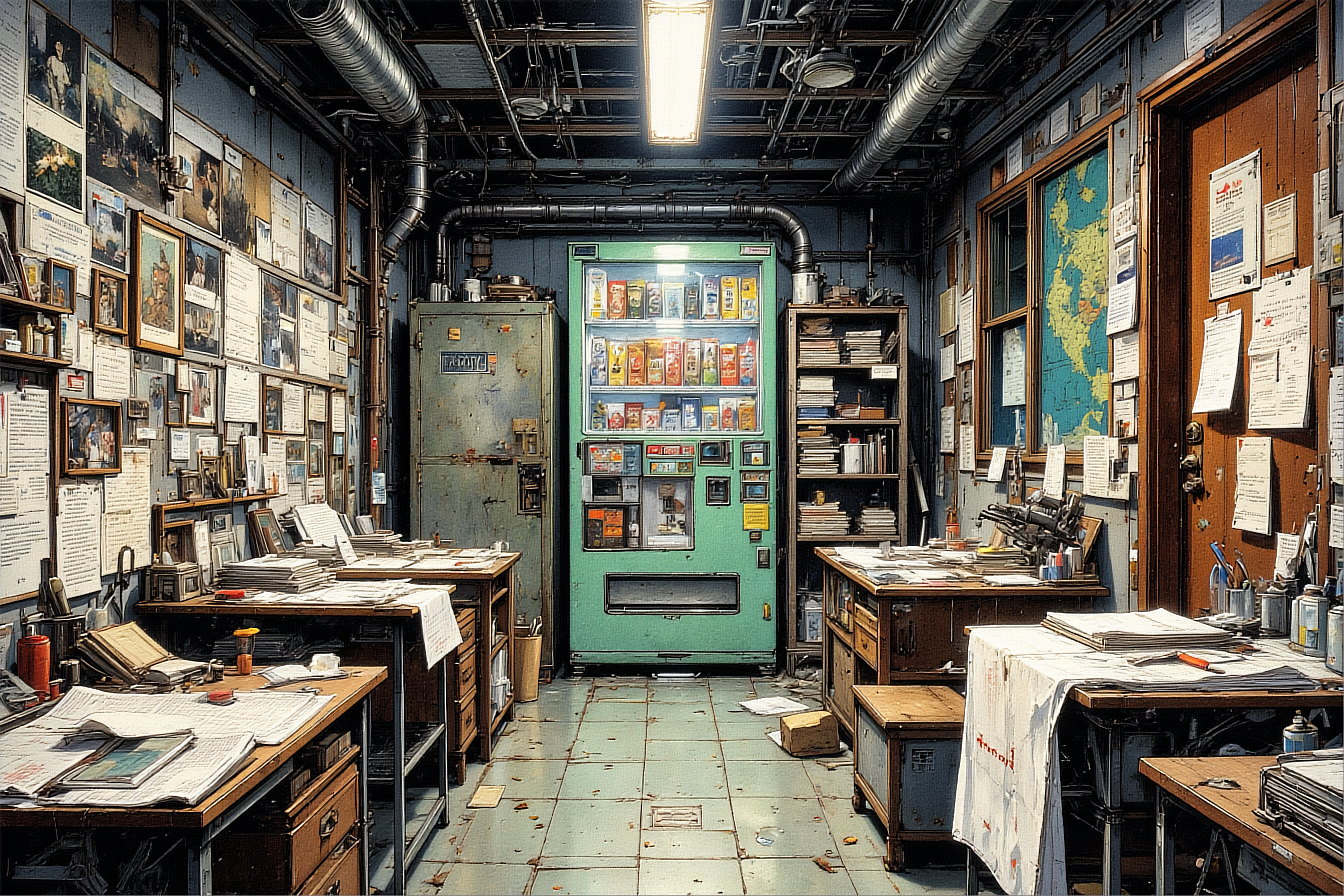
It stands against the wall of a service corridor in Sector 7G, half-taped, humming at a frequency that makes your teeth think about it, and the selection panel has been dead so long the sticker has faded from a brand into a color. Every courier on the block walks past it. The city's maintenance log has an open ticket on it that has outlived two mayors and one Operating System update. Behind it, if you know the chord to hum and the exact pressure to put on the third panel seam, is a room.
I put my palm flat, hummed the low note Clive taught me, and stepped sideways into The Ephergent.
The zine press took the first two seconds. It always does: a clatter like a box of bolts falling down stairs, three times a night, because Pixel sets the feed rate on the loud setting and calls the noise a feature. Sheets came off in a stack of wet ink, six hundred copies of an issue about a bakery whose card machine had started rejecting names, and the top sheet was still tacky enough to take a thumbprint. Half the room smelled like solvent and the other half smelled like butter tea, which is Om's department and has been Om's department since the day he arrived carrying a kettle he refuses to set down.
The Ephergent is a pocket dimension and it has never once behaved like one. No vistas, no shimmering gateways, just a room that is slightly larger than the corridor that feeds it, three workbenches, a server rack with a quilt on it, and walls that Pixel has papered floor to ceiling with photographs, routing sheets, staple maps and the zine's back issues in date order. The pocket dimension answers to the busted machine outside the way a dog answers to a doorbell. It opens for the chord, not the person.
"Watch it, watch it, watch it," said a courier whose legs were currently a dog's problem.
Meatball had him by the strap of his bag and was performing the victory lap of a creature who had never lost a negotiation. The courier went down to one knee, laughing, which is the correct response to Meatball and also the reason the kernel has no file for him. I unhooked the dog by the collar, fed the courier a CLX chip for his trouble, and he left still laughing, which meant I'd overpaid again and everyone in the room was fine with it.
Pixel looked up from the paste-up table with a highlighter in her teeth.
"So," she said, around it. "Clive's live one."
She asked it the way she asks everything, which is sideways and twice, so that the second time you answer you've already admitted the first answer was a cover.
We were at the back table with the job brief spread out: a depot routing sheet, a loading dock schedule, ninety seconds of window circled three times in red. Clive had produced it by the oldest method he has, which is asking a photocopier, and every photocopier on the grid owes him something. His verse had come over the network an hour ago, in the dry rustle of a machine that has been laundering documents since 1967: We who bind, we who exist. Unseen witnesses, we route the traffic.
The unit is designated E-771. Depot sources call it Hale, which is what happens when a daemon ferries deletion logs long enough that the clerks give it a nickname and a coffee it never drinks. Quarterly audit cycle, records district in Prime Material, and the ferry route is public in the way Corporate makes things public, which is to say printed on a dock schedule that four hundred people read and nobody photographs. Route known. Window ninety seconds. Everything else about the job is a guess wearing a clipboard.
"Why does a live daemon matter enough to run it tonight?" Pixel said. "That's the ask, Zeph. Not whether we can. Whether it's worth the flag."
"Because nobody's ever held one," I said. "They get audited, they get cycled, they get shredded by their own people the second the quarter closes. Everything we know about deletion is secondhand from logs Corporate chose to keep."
"And if it phones home?"
"Then we're interesting, and we're already interesting, so the price of the ticket is rounding error."
She gave me the look. Pixel's look is a diff: she reads you the way she reads the world, finding the place where the current version stops matching the version you claimed, and she does it with her eyebrows instead of a build script. Under the paste-up table, Meatball had fallen asleep against her foot.
I filled the gap by checking my deck, which was a way of not checking her, and the checking turned into a memory, because that's how my deck works. Aether put the first one in my hands on my twelfth birthday, a brick of a thing with the case 3D-printed in a color that doesn't exist anymore, and he sat me down on the floor of our apartment and said the line I have repeated to myself in eleven countries since.
"Reality's just another system, Zeph. It's got code, it's got rules, it's got exploits."
He was twenty-eight then and raising a twelve-year-old on a coder's salary and stolen evenings, and he did it the way he did everything, which was by treating every problem as a configuration issue. Our parents' rows had gone null four years earlier. He never once said their names wrong afterward. When the school asked for guardianship paperwork he filed an appeal with a nine-page appendix, and when the appeal was denied he filed a second one with a nine-page appendix and a cover letter that opened with the sentence "Your records are incomplete," and by the time I was fourteen the school had stopped asking.
I found Project Reality Drain when I was sixteen, which is the year I learned that Aether had a job he didn't talk about. Not the fight itself. Fights are easy to write; it's the silence after that stays load-bearing. He came home at 3 a.m. and I had the folder open on the kitchen table and he read the title over my shoulder and went pale in the way that means the color was pulled, not drained. "Close it," he said. "Zeph, close it now." I asked him one question. He didn't answer it. We stood in that kitchen for a minute and a half with the refrigerator cycling, and the question stayed on the table between us like an unpaid bill.
Nine days later he was gone. No note, no body, no row change, which is the trick that took me two years to understand: Aether's registration never went null. His row is still active. It has been active every day since, green as a heartbeat, pulsing for a man nobody can find, which is Corporate's way of saying the account is in use and the user is not available for comment. The only other thing left in the apartment was the deck he'd built me, and a file I couldn't open, and a brother-shaped absence that no amount of scanning resolved.
The file is four layers of encryption wrapped around a voice I've played forty times. I have told nobody in this room that I cracked layer one. Some nights that omission sits on my chest like Meatball sits on a foot.
"The flag's not the reason," I said to Pixel. "The flag flips on everything we do. The reason is that a live daemon carries its own cache, and its cache carries the routing table for every delete it's ever run, and somewhere in that routing table is the part of the map nobody sells."
She capped the highlighter. "Say the rest."
"The part where I find my brother's signal."
You don't find a man who's wired into the root of things by asking politely, and you don't find him by walking, which is why I built the thing that scattered me across five realities in one afternoon.
I tested the deck while we argued. That's the rule of the room: you never sit still for a plan, you move your hands through the prep, so the argument has somewhere to go. New shielded drive in the bay, click. Coherence check on the rig, green. The rumor I'd been chasing said Aether's ping came from kernel space, from The Edge itself, and the only way to chase a signal across partitions was to partition myself.
The fragmentation exploit ran clean, which should have told me something.
Five of me woke up at once. Not sequential. At once, in five places, sharing one heartbeat across a bandwidth that wasn't built for it. I was a kid behind a taco counter in a reality where our block had never been zoned, and I was a mannequin in a department store window being adjusted by an employee with no idea I had opinions about the angle of my own left arm, and I was a smear of sentient glitter in a corporate atrium arguing with a dozen other specks about whether depreciation applies to joy, and I was two more things I don't have names for because the names got left in one of the other four.
The glitter argument went on for what felt like a week and I can still quote both sides. Position one: joy is consumed on delivery and therefore it's an expense. Position two: joy accrues in the room after the laugh and therefore it's an asset. A third faction maintained that we were glitter, that we had bigger problems, and that the tax discussion was a distraction from the fact that somebody was about to vacuum the atrium. I never found out who was right. That's the trouble with scattering: you get five complete sets of answers and none of them in the same universe.
The taco stand is the one that stayed with me. I ran it for what felt like eleven days. Griddle heat, a line out the door, the rhythm of folding a tortilla without looking, and I still know the salsa recipe by heart: charred tomatillo, one raw white onion, a serrano with the seed vein pulled if the customer looks like they've had a week, and a pinch of the dried stuff that isn't oregano and isn't thyme. People came back twice a day and remembered my name. Somewhere in me a server in Sector 7G was bleeding coherence at nine percent a minute and I was seasoning to taste.
Then the anchors came.
The first one was espresso. A1 rolled into range and put a shot through the line, and reality tightened so hard I felt it in my teeth: colors re-quantized, edges stopped smearing, and 34% of me stopped being in Sector 7G and started being drinkable. He delivered the stat while he did it, in the voice of a man reading a weather report off a falling anvil: "34% of you is still elsewhere. The remainder is drinkable. Standards must be maintained."
The second anchor was Pixel's voice, cutting through on a channel she had no business reaching. She didn't say "come back." She said my name in the tone she uses on volunteers who are about to do something expensive, and the tone has a direction in it.
The third was Clive. Clive built me a map out of staples: a pattern driven into the corner of every paper surface between five realities and one room, three staples corner to corner at every relay, because the office-supply network has been routing traffic since before the OS learned to spell. I followed staples home the way you follow floor tape out of a burning building.
I came back on the floor of this room with A1's shot in my throat and Pixel's voice still in my ears and a staple map glowing in my overlay, and Om poured me butter tea without a word, which is how Om says he already knew how bad it had been.
"That," Pixel said, "is why a live daemon matters."
"That's not why I said it."
"No," she agreed. "But it's why you're here."
Prep turned into the crew doing what the crew does, which is quietly, in four directions at once.
Luminara pinned a new photograph to the wall without comment. The wall is half her work: prints of edits, diff-blooms caught mid-flinch, the moment a block of reality gets rewritten. Tonight's was a street corner with the kerb line doubled, the old kerb showing through the new one like a watermark. "This block's on the re-zone list," she said. "Whoever is paying for the beige is three weeks ahead of schedule." She adjusted the pin a millimeter. She photographs every change as it happens, and she is the reason we ever see the ones that get cleaned up.
I asked her how she catches a thing that lasts half a second, the way I ask every time, because the answer is different every time and she knows I know. "You wait where the edit wants to be invisible," she said. "The system rewrites a street and it always leaves a seam on the north side, because whoever queued the job was thinking about lunch. Camera on the seam. You don't photograph the change. You photograph where the change is embarrassed."
She had been Linda3637 once, issued row by row in the Naming Registry by an archivist with tired hands, and her file still billed her as a legacy row under half her real name. She never talks about that at the prep table. She talks about seams.
Om poured tea around the table, one mug at a time, and didn't ask who wanted any. There's a version of cryptography that's all mathematics and a version that's all manners, and Om practices the second one. When he set my mug down he said, in his regular whisper, "A cache is a promise. Promises get audited." Then he sat and let the sentence do its own work.
Clive's verse came through the machines again, softer this time, the way a photocopier sounds when it's passing something it shouldn't: We route the traffic. We who exist. Somewhere out in the grid a fax machine in a basement was carrying our dock schedule for the price of a favor owed since the Ford administration.
A1 rolled forward on his cradle, port lights blinking, and set a shot on the table in front of me. "You are coherence 91% and falling," he said. "I project a 67% chance of disaster. Standards must be maintained."
"Sixty-seven is generous," Pixel said.
"It is my generosity you are drinking," said A1, "so do try to look grateful."
That's when the rules came up, and they came up as an argument, because crew rules in this room are always an argument and never a lecture. Pixel wanted the window split differently; I wanted to run point inside the dock; she said no solo runs, I said I wasn't running solo, I was running ninety seconds ahead of everyone; she said ninety seconds ahead is solo with better branding; I said if we waited for perfect windows we'd be waiting for Corporate to grant them, and Corporate doesn't grant anything, it meters.
"So we're agreed," she said, "on everything except who goes first."
"We're agreed on who goes first too," I said. "I've read your handwriting on the schedule."
She threw the highlighter at me and I caught it, and that was the negotiation. A1 cleared his port, which is the machine equivalent of a throat being cleared: "Coherence is a supply with a burn rate. Drink, or desync, and I will not be taking requests in the state you arrive in." Om, without looking up, said, "The plan is sound. Plans are always sound until they touch the dock." Clive's casing ticked once against the table edge, a sound like a stapler thinking, and nobody mistook it for an objection.
Nobody got voted on. Clive went thump once on the table with his casing, which settles more disputes in this room than any ballot, and that was that: no solo runs, patch before you desync, everything documented, nobody left in the buffer.
The job locked at 19:40. Steal a live erasure daemon before Corporate's quarterly audit gets around to it.
I stayed at the table after the others moved off, packing the shielded drive into its sleeve, and the room went on around me: press clacking, dog snoring, Luminara pinning the last of her prints. I've run a lot of jobs in my head since I was twelve. Stolen things, broken things, chased a ghost across five realities and came back short in all of them.
The only job I ever actually finished was finding this room.