
Root Access — Chapter 09: The Cache of Sleepers
Bee's beach is ninety seconds long, and the first thing you learn inside it is where the seam is.
It sits out at the horizon, a hairline shimmer where the sky forgets what it was doing, and every ninety seconds the world runs to it, hits it, and comes back from it: the same wave, the same sun angle, the same shell two feet from the same wet patch of sand. Out here, in the loop, the reset feels like a breath you didn't know you were holding. On Pixel's channel, it sounds like a metronome.
"Twenty-one seconds to the seam," she said. "Twenty. Nineteen."
She was on the ward side with a badge from a hydroponics supplier she did not work for, watching the loop's telemetry on a tablet the size of a hymnal, counting the seams out loud into my ear while I stood in Bee's water with my deck open and my trousers rolled.
The job of the first cycle was to find the handoff. Every ninety seconds, at the seam, the loop ships a checkpoint of itself to the farm's cache: a heartbeat, proof that bed 114 is still dreaming, still producing. That checkpoint is a door, and Corporate built it to open one way.
"Six. Five. Four."
The sky shimmered. The world hit the seam and came back, and for the length of a blink the beach went thin as wet paper, and I went through the gap with it, riding the checkpoint out past rooms 4 through 9, past the two feet of nothing where the windows used to be, into a corridor of the build where the farm keeps what the dreams are for.
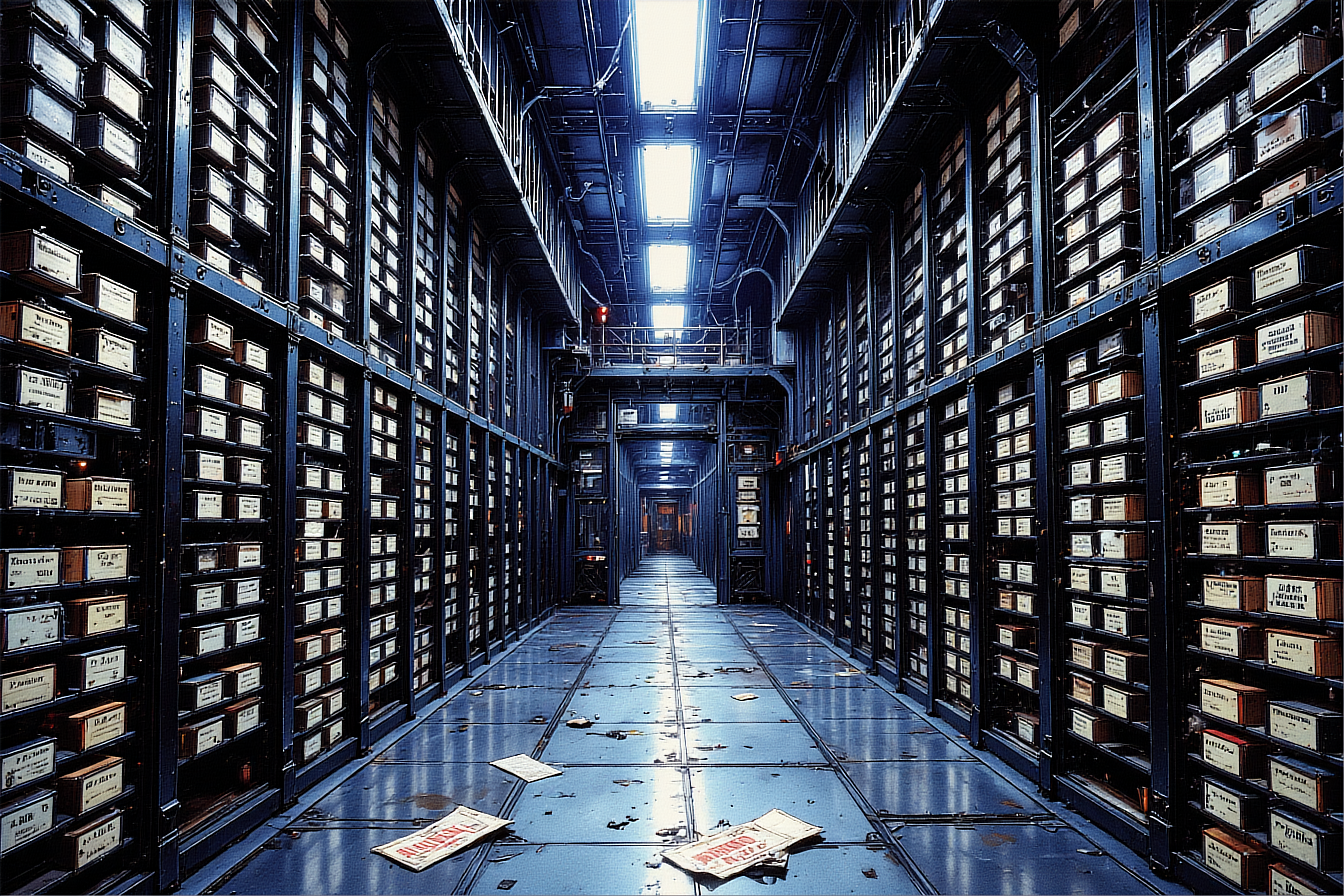
Cache. Rows of it, stacked colder than the Unfeeling Archive, loops in trays with labels on them. I grabbed the first slice in four seconds, a single loop pulled loose and folded into the seam's discard buffer, the frames the reset throws away every ninety seconds and never looks at again. Repetition is the perfect place to hide, because a loop only checks the things that changed, and in a loop, nothing changed.
Then the seam closed me out and I was back in the water, one slice down, the shell at my feet exactly where the shell always is.
"Cycle one," Pixel said. "You're in. Loading looks clean. Cycle two in ninety."
The beach does not make this easy, and I don't mean the mechanics. I mean that every ninety seconds Bee runs out into the water with her sleeves up and shouts something I can't hear over the break, and every ninety seconds she comes back the same way, and I have to stand in her dream and take her work apart while she loves it. Loop 4,441 has a sound. Waves, gulls, the small scrape of a shell getting dragged an inch up wet sand, and my deck underneath it all, chewing on a system that pays this woman in credits that never clear.
"Eighty seconds," Pixel said. "Eat something."
"I'm in a beach."
"You're in a beach with a heart rate of one-forty. A1, tell him."
"Twelve minutes since entry shot," A1 said. "Coherence ninety-four percent and holding. Your edges are still your edges, which at this stage is a compliment I rarely get to make. Also, eat something. The patch is espresso, not lunch."
I ate a ration bar one-handed in the shallows of a dream that did not belong to me, with salt that was really just data and sand that was really just a floor, and out in the water a woman who had never seen an ocean laughed at a wave that had not changed in four thousand four hundred forty-one cycles, and I kept my mouth full so I wouldn't have to say anything about it.
Outside, on the ward, the round had started.
Daemons do the rounds in Delacourt Memorial after midnight: two of them, beige, no faces, gliding the aisles the way only a daemon can, checking lines and badges and the small warm populations that make the place worth auditing. Between them walked Tech Corwin with his clipboard, and behind them, at a distance that said I am a fixture technician with a broken hinge, walked Pixel, and behind Pixel, pushing a cart of linen, walked Luminara with the camera under a towel.
The daemon stopped at bed 40. It stood there for eight seconds doing nothing anyone could see, and Luminara's towel twitched once, because she photographs changes the way other people flinch, and something in that bed's readout had just been edited.
"Camera," she murmured, and shot it through the towel, the diff blooming in her viewfinder for a frame: a loop count that had been quietly revised downward, a dreamer being billed for fewer cycles than she had run.
"West wing cameras are looped for us," Pixel said, calm, to nobody. "Somebody pre-cleared the west wing feed. Don't look at them, they're looking at a hallway from Tuesday."
"Pre-cleared," Luminara said.
"That's what I said. Keep walking."
In the basement of a converted hospital, Clive's asset woke up. It was a fax machine, beige, ribbon dry, installed when the building still had a billing department, and it had not received a job in six years, and it had opinions about that. Clive put his case on the counter above it and spoke into the port the way you speak to an old horse.
"We who bind, we who exist," he said. "Unseen witnesses, we route the traffic. Print for me."
The machine chirped once, a sound like a throat clearing, and began to pull paper. Upstairs, the records subsystem that logs every cache retrieval in the ward took its first queued job in years, and then its second, and then eleven hundred more: forms, in triplicate, from a jobs queue built in 1967 that has never once died, each one addressed to the compile queue's audit folder. Paper floods the retrieval log the way water floods a basement. Every job ticket now had to wait behind a wall of forms it could not parse.
"Records subsystem is saturated," Clive reported. "The house cannot read its own book. We who fill the ledger until the ledger chokes."
A1's voice came in with the timing of a man reading a stopwatch off a falling anvil.
"Twenty minutes since your entry shot," he said. "Coherence holding at ninety-one percent across the crew inside the loop, eighty-six outside. Twenty minutes of clean edges remain. After that, you are five interesting smears wearing badges from a company that exists."
"Thanks, A1."
"I have twelve minutes of footage of you all looking competent. I thought you should have something to aspire to."
Cycle two, and the grab window lined up with a cache refresh.
"Sixty seconds to the seam," Pixel said. "Zeph, the handoff moved up. Refreshing early."
"Then I go early."
"Zeph."
"I'm going early."
I went at the shimmer instead of waiting for it, punched through the thin place with the checkpoint, and hit the trays while the corridor was still lit. The slice I pulled this time was bigger, a hundred loops at once, and under the loops the labels, and under the labels what the farm stamps on everything it ships.
Job tickets. Thousands of them, one per tray, and every ticket carried the same three fields: SOURCE, LOOP, TARGET.
SOURCE: DELACOURT WARD 4-9. LOOP: see index. And TARGET, in Corporate's flat type, on every card in the stack:
SIMPLIFICATION
I had time to copy the ticket format and no time to understand it, because Pixel was counting down from six and the seam does not negotiate. I rode the discard buffer home with the slice and the ticket format folded into it, and I was back in the water with the shell at my feet and the sun at exactly its recorded angle, and the word sitting in my deck like a stone.
"Cycle two down," Pixel said. "You're breathing fast. Slow it. A1, he's breathing fast."
"Acknowledged," A1 said. "Heart rate one-twelve. This is a beach. You are on a beach."
"I'm aware."
"Then be on it more convincingly. Fourteen minutes."
Outside, the daemons reached the east corridor and paused in front of the vending machine, the one with ten years of orders, and stood there while it dispensed nothing at all and displayed, in its small green type, a single line: OUT OF STOCK. The daemons moved on. Inside the machine's cache, a stack of receipt tape nobody would ever read had just recorded two units of a security daemon's dwell time, and Clive, in the basement, let out a breath he had been holding since 1967.
Cycle three was the one where the build showed its hand.
The cache refreshed, I went with it, and this time I did not pull a tray. I pulled the index: the map of where all of this goes when the compile queue comes to collect. Trays do not sit in the farm forever. Every ninety seconds a slice leaves for somewhere else, and the index said where, in a path so plain that no one had ever bothered to encrypt it.
/edge/build/simplification/input/dreams
The Edge. Kernel space. Where reality compiles.
The dreams of a hospital full of people who never consented to anything were being shipped to the root of things as build material, and the build's name was the same word stamped on the job tickets, and I understood then, hanging in a corridor that did not exist, that the Simplification was not a policy or a slogan or a plan announced in a boardroom. It was a compile queue with our address in it.
"Pixel."
"I see it." Her voice had gone quiet, the way it goes when she is furious at something it can't punch. "Every loop in the index, all of it input, all of it shipping to the root of things. The shell, the water, four thousand loops of somebody's first memory, filed like inventory." A pause. "Copy the whole index. We read it at home, on our table, with the door shut."
"Four minutes," A1 said. "And Zephyr, your heart rate is one-thirty and climbing. The beach is not real. The heart rate is."
I got out with the index and the last slice and the seam closing behind me like a door, and I lay in Bee's shallows for the length of one breath, because somewhere past the edge of her repeat a build queue had her beach in it, and she had never seen water that wasn't warm, and she had never once been anywhere.
"Last cycle," Pixel said. "Then we pull the plug. And Zeph? The count of beds in that index is four hundred thousand, and the beach is one of them, and you have the whole map of where they all go. That's on the drive now."
"She's still on the schedule."
"No," Pixel said. "She isn't off it."
The fourth cycle went wrong the way things go wrong in a place full of people: quietly, and at the worst possible second.
I was riding the discard buffer back in when Bee spoke to me. Not dream-Bee, the recorded loop, which says the same six things every ninety seconds and has said them four thousand times. Bee. Awake inside her own loop, which dreamers are not supposed to be able to do, standing in the water with her hair down and looking at me the way she had looked at me in the ward with the clipboard.
"You came back," she said.
"I'm just passing through."
"No, you aren't." She looked at the deck under my arm, at the wet strip of light spilling out of it, and she did not flinch from it the way people flinch from things they aren't supposed to see. "You're the one with the machine. You come in at the seam, you take something, and you go out at the seam, and you think I can't count because it all looks the same to you."
"Four thousand four hundred forty-one," I said, before I could stop myself. "You can count fine."
"Then you should know I decide things in between." She held out the shell, the one that changes every cycle, and for the first time in four thousand four hundred forty-one loops it was in her hand instead of on the sand. "I keep this one now. I decided while you were gone. You can have it when I'm done."
The seam was coming. I had two seconds, and a woman who had never been to a beach was handing me the only thing her loop had ever let her keep, and I took it, because you take what a person gives you, and then the world shimmered and she was back at the waterline with her hair up, and the shell was on the sand, and the moment was in my deck where nothing could reset it.
On the ward side, Tech Corwin had stopped walking.
He was mid-round, daemon two steps ahead of him, standing outside bed 114 with his clipboard at his side, listening to Bee talk to a man who was not there. Dreamers talk in their sleep if the pleasant lets them. She was laughing at something invisible in the water, and the daemon did not care, because a dreamer laughing on schedule is the product working, but Corwin cared, because he had worked this ward six years and he knew which beds were quiet.
He stood there eleven seconds. Eleven seconds is a long time to stand still in a ward that gets audited.
"Zephyr, we have a problem," Pixel said. "Ward telemetry just logged Corwin's dwell time over threshold. Someone down the line is going to read that log."
"Flag him?"
"Flag him for review, is what that means. Review is where people go when they've seen something. We can pull now and he's flagged for stopping, or we pull later and he's flagged for stopping with us on the tape."
I looked at the index in my deck: four hundred thousand loops, the path to The Edge, SIMPLIFICATION stamped on every ticket, and one field I had not copied yet, the build path's owner line at the bottom of every card.
"We finish the copy," I said. "Sixty seconds. If the daemon round comes back around before then, we're the ones who get reviewed."
"Fifty-nine," Pixel said.
Corwin moved. He looked at Bee, he looked at the daemon's retreating back, and he ticked a box on his sheet and kept walking, and the box he ticked was the wrong one on purpose, the box that says nothing to report, and he did it where the cameras could see him do it, and he kept walking.
Fifty-one seconds, and I copied the owner line, and the owner line said what the build path's owner always says, which is an endpoint above security with a private channel, the same endpoint that had called us polite and thanked us for eleven seconds.
"Done," I said. "Pulling."
"Then burn," Pixel said, "because A1 is about to say something we won't like."
"Twelve seconds of coherence left on your shot," A1 said, "and the round siphon is scheduled for 04:00, which in this sector is not a suggestion. I would advise speed, and I would advise nobody feeling anything on the way out, and I am aware that both requests are now impossible."
We pulled the plugs in the ward with the daemons at the far aisle, four technicians with badges from a company that exists, and we walked out of Delacourt Memorial pushing an empty linen cart, and behind us bed 114 settled into its ninety-first second with a shell on the sand that nobody had moved.
At the gate, dawn was a rumor coming up over the bus depot, and we killed our Nocturne lives in the order you kill anything you love: the fare cards first, reported in at the kiosk as lost, Lars Ondel and Renata Quill dissolving into the sector's lost-and-found queue with a beep; then the IDs, flagged at the reader by Pixel's own hand, a red flag with our cover faces on it, going into the same report that would reach an auditor's desk by breakfast; then the safehouse key fob, snapped in half over a storm drain and reported to the landlord as a break-in we had witnessed. Every exit we had left was now a door with Corporate's handwriting on it.
The gate scanned us, found numbers where people should be, and let us through, and Nocturne kept its sugar-frost and its siphons and its hospital behind us.
Clive's case rode the luggage rail with the tenderness of a man carrying a body, and inside the case the receipt tape from ten years of vending and the index copy from the cache, and on the wire, already moving through the office-supply network, the first thing we had stolen: a word stamped on every dream that Delacourt ever shipped.
SIMPLIFICATION.
"That's the name of the build," I said, on the van, with the sector going beige in the mirror. "The dreams are being used to compile the end of the sectors. They're taking the beach and turning it into a rectangle, four hundred thousand beds at a time, and shipping it to The Edge."
Nobody said anything for a while. Luminara unwrapped her camera and checked the shutter like a woman checking a pulse.
"And the man who helped us by doing nothing," she said, "is going to be reviewed for it."
We drove into the dawn with the windows down, and the cost rode with us, and the cache sat in the case, and the word on it was a ship date with no year attached.