
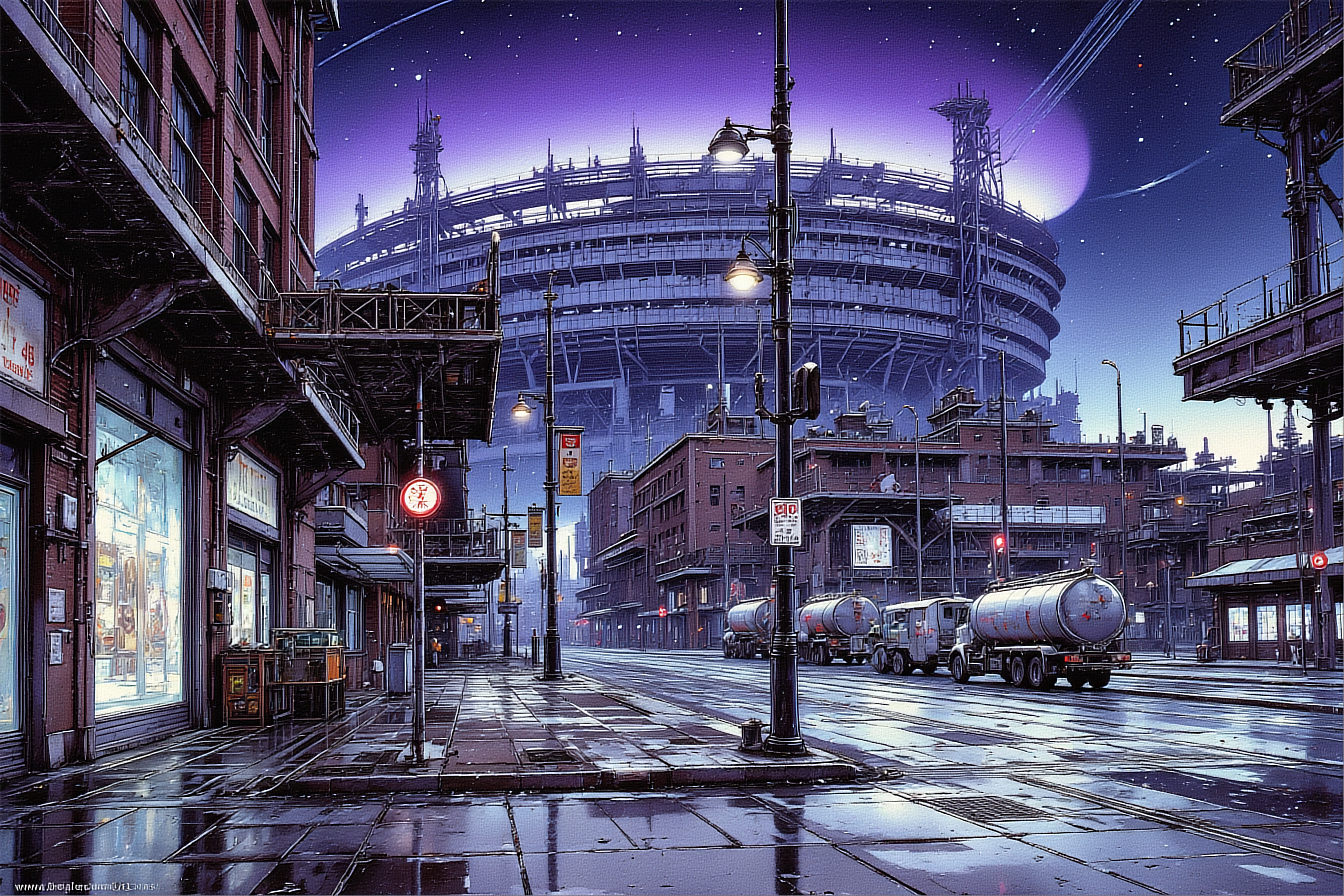
Root Access — Chapter 08: Loops of Sleepers
The gate into Nocturne Aeturnus is a turnstile in a strip mall that sells phone cases and replacement screens, and it lets you through the way the OS lets anything through: it scans your fare card, finds a number where a person should be, and loses interest.
My card said Lars Ondel, field technician, hydroponics supplier that actually exists in Prime Material with a real receptionist who would be confused by a phone call. Pixel's said Renata Quill, fixture maintenance. A1 rode in a crate marked ESPRESSO SERVICE, DO NOT INVERT, because every sector has a contract for coffee and nobody has ever inspected a crate. Clive rode in a case of forms, which is how Clive has crossed every border since 1967. Luminara carried the camera and Meatball, who was folded into her camera bag with only his nose committed to the concept of hiding.
I bought a coffee at the mall with a crystal of CLX, cold and bright in the vendor's tray like rock candy, and the vendor did not look at it, because in Nocturne you don't look at anything you can't siphon. The OS status bar in my glasses ticked over: new sector, same uptime in centuries, same Terms of Service accepted by everyone and by nobody.
The air changed two blocks past the turnstile. It got sweet, and not in a way you want to eat. Feelings crystallize here: they come out of the air as they pool, a faint sugar-frost on the railings that people lick and then look embarrassed about, a glitter in the gutters that the street sweepers collect in drums for the processing plant. The whole sector is an emotional data center with a downtown bolted onto it, and the siphons run underneath everything, pulling whatever pools down into raw processing fuel for Corporate's grid.
So nobody stands in the rain. I watched a woman on the corner feel something come over her, and she stepped sideways off the sidewalk, around a bench, and kept walking, giving the place where she had nearly stopped a wide berth like it was a puddle with a history. Everybody here walks like that. You route around your own grief because the siphons harvest whatever pools, and a puddle that gets harvested is a puddle you pay for twice, once in feeling and once in the bill.
"Twenty minutes," A1 said, in my ear, from inside the crate. "Half-life of a coherence patch in this sector: twenty minutes, measured against ambient emotional saturation, which right now is reading above survey average. Fifteen if anyone shouts. Fifteen if anyone grieves on the wire. Please do neither on a schedule."
"Nobody's going to shout," Pixel said.
"A prediction," A1 said, "which I include so that you may all disappoint me."
Ahead of us, past the bus depot and the row of shops with beige awnings, the Unfeeling Archive rose out of the skyline like a mountain that had been billed for the view: a cold-storage array the size of a stadium, heat exchangers grinding along its flanks, frost crawling its loading bays. That is where last year's joy is racked in trays. A man on a cigarette break by its fence told us so, unprompted, while Clive's case sat on the curb beside him.
"Spring joy, mostly," he said. "Good vintage. They cycle it out to the kernel in tankers." He exhaled. "You want to know something sad? They keep the good years up top where the trucks can reach them."
He went back to his cigarette, and none of us answered, and the crate with A1 in it stayed quiet for four whole seconds, which is A1 staring out a window.
Delacourt Memorial still had the sign. The hospital name was half-scraped off the facade and the OS had re-zoned the lot, but the letters were there under the paint, and the building still had the shape of a place that had once tried to keep people alive. Now it kept them looping.
Inside: beds in rows, more beds than the ward had been built for, jammed head to foot down what used to be a cafeteria. IV lines in every arm, hooked to bags of something clear that the technicians called the pleasant, which keeps the dream from curdling. Night round in progress, two techs with clipboards walking the aisles, checking lines, ticking boxes on a sheet that Corporate's telemetry reads as consent.
Dreamers. Human processors. They dream in loops for the compile queue, and Corporate pays them in credits that clear late, and then, as the man in the next bed explained to me while he waited for his waking window, never.
"You look at your account," he said. He was folding his shirt with great care, the fourth time I watched him fold it. "It says pending. Pending is a real word, see. Pending means it's coming." He held the shirt up to the light of a window that hadn't existed since the hospital days. "Two years I've been pending. I did a beach last cycle, six hundred loops of it. You know what six hundred loops of a beach pays?"
I said I didn't.
"Pending," he said, and went back to folding, and the honesty in his voice was the flattest thing I had heard all week.
A tech came down the aisle while I was standing there with my stolen clipboard, and I felt my badge the way you feel a copilot reaching for the stick. He looked at me. He looked at the crate behind Pixel, at Luminara's camera, at the dog-shaped lump in her bag, and then he looked at his own sheet and ticked a box.
"Pump's in the east," he said. "Hydroponics is in the basement, which doesn't exist. Don't touch the bags. Don't touch anything with a number." He was already walking. "And if you're still here at four, you were never here."
He rounded the corner and went back to his round without asking a single question, and I stood there with my heart doing a full restart. That is the night-shift tech who helped us by doing nothing, and I wrote his face in the log, because a kindness like that gets logged somewhere Corporate keeps, and it gets flagged in the morning.
The crew split, because that's the job. Pixel took the west wing to read which rooms had been edited recently, and in Nocturne a room that's been edited reads like a typo in a sentence you have said a thousand times: a wall moved two feet, a door opening onto a wall, a window that had been there since the building was a hospital and now wasn't. Luminara took the intake office to photograph the paperwork, and she came back with one page, held between two fingers like a specimen.
"There are no consent forms," she said. "There is a Terms of Service. One page, posted by the water cooler, and every signature line on it has been pre-signed by a proxy that signs for everyone." She photographed it again, closer. "Corporate implants are beige all the way down. This whole ward is one."
Clive found his contact in the east corridor: a night-shift vending machine, ten years on the same post, older than most of the staff. It had watched every order in this building for a decade, which means it had watched every technician, every schedule change, every bed added to the cafeteria, and every revision of how the account system spells the word pending.
Clive put his case against its base and they talked the way old colleagues talk. The machine's display ticked through order lines, one after another, and Clive read them off like verse.
"We who keep the ledger of the thirsty, we who bind," he murmured. "Diet cola to the re-render crew, three in the morning, eleventh of the month. Twelve new beds in the east wing, added the same night with no matching shift. Rooms 4 through 9 re-rendered, walls and all. And the credit terminal revised the same night." He tapped the casing with one edge of his staple arm. "You sold the men who cut those rooms their coffee."
The machine dropped a cup, then another, then a receipt with nothing on it, and Clive caught the blank slip the way you catch a business card.
"Witnesses, we route the traffic," he said. "Ten years of orders, and it never once looked away. The house doesn't keep books like this. Only we do."
Pixel came back with her jaw set the way it gets when she has read something that confirms her worst read.
"Rooms 4 through 9 had windows," she said. "Real ones, from the hospital days. Now they've got a wall, and the wall is two feet of nothing, and if you press your hand on it the render fights you. Somebody cut those rooms out of the build and left the beds running." She looked down the aisle at the dreamers. "Somebody upstairs already knows this ward is over budget for people who exist."
"Which means the cache isn't in the beds," I said. "The beds are the input. Whatever the dreams are being fed into, it moved last month."
We took a waking window to meet Bee, because Bee was in one, and because I wanted to see her awake before I ever saw her sleep.
She was in the bed by the wall that no longer had a window, sitting up with her socks on, doing the thing dreamers do in their hours off, which is nothing with enormous concentration. Her ward board read LOOP 4,441 and a name the Registry had never been asked to spell.
"I'm Lars," I said, with the clipboard I had lifted off a tech. "Hydroponics. Wrong floor, honestly. You wouldn't happen to know where they keep the nutrient drums."
"Basement," she said, and then she laughed at herself, because the hospital hadn't had drums in years, and we both knew I wasn't looking for anything. Dreamers can smell a lie the way dogs smell fear, probably because they spend all day inside one of Corporate's.
"You're new," she said.
"I'm lost."
"I do a beach," she said. "Loop four thousand four hundred forty-one today. They tell you the number so you stop asking, but here's the thing nobody gets: the water comes up, and then it comes up again, the same way, and every time I think, this time I'll run further up the sand before it resets." She was brightening while she said it, her whole face coming up like a light on a dimmer. "It's warm. The water's warm. You can see all the way down where it goes clear and then it isn't clear anymore, and there's a shell, and I swear the shell is different every time, which can't be true, and it is."
She stopped, pleased with herself, and I stood there with my clipboard doing the arithmetic I did not want to make.
"You ever been?" I asked. "To an actual beach."
"No," she said, like it was obvious. "But I've been four thousand times."
Nobody in the crew said anything. Luminara's camera did not come up, which is how I know the shot hurt her. A dreamer who has never touched the thing her loop keeps handing her, smiling about the water with her whole face, the pleasant in her line doing its job so well that the loop reads like a memory of somewhere she hasn't been. I put my clipboard under my arm and told her the drums were on two and I would find them myself, and I went around the corner and stood in the stairwell for a while, because grief lands where it lands and there is no joke wide enough to carry it.
I know something about warm water I have never seen. Every month I open a file and hear a voice telling me not to spend my life chasing a ghost, and every month it comes up the same way, the same hum underneath it, and I run further up the sand every time before it resets. My brother went into the kernel and left me a loop of my own, and I have never once been where he is.
Pixel found me there. She didn't ask. She read the ward board over my shoulder and said, "That's the cache. Everybody in this building is mining something, and it isn't credits."
"Plan it," I said.
The safehouse was a flat above a laundromat, one key fob, one window facing a wall, and a table that had opinions about being level. We spread the recon on it: Luminara's photographs of the Terms of Service, Pixel's map of the re-rendered rooms, Clive's receipt-tape transcription of ten years of vending orders, my deck running the ward's network topology in green, and Om's butter tea going cold at the corner because Om had been holding the same cup since we walked in.
"In through the dream side," Pixel said. "The beds are inputs, the dream feeds run out of the east wing, and the cache sits past them in whatever the compile queue calls home. We jack a loop from the ward side, ride the feed past the rooms they cut out, lift the cache, and we're gone."
"Ninety seconds a cycle," Om said, "is a key signature the length of a breath. Anything you carry in there has to be built to hide in a repeat, because the loop will try to reset whatever you change, forty times an hour, forever. The repetition is the room. Work inside it, or it will smooth you out."
"Which is where I come in," I said. "I ride one loop, Pixel counts the seams out loud, and we take a bite out of the cache every cycle and tuck it into the repeat where the reset looks for nothing."
"Out before the round siphon," Clive said. "It sweeps the ward at 04:00. Drains the pooled emotion, drains anything riding the wire with it, and prints a report with your session ID in it if you were sloppy."
"Then we're not sloppy," Luminara said.
"You're never sloppy," A1 said, through the speaker we had propped on the sill, because he had refused to be uninverted. "You are merely frequently unlucky, and in this sector the difference is measured in coherence. Twenty minutes per shot. Four of us inside the loop. I will be pushing shots through the door on a timer, and my advice, free and ignored at your peril, is that nobody in there feels anything while they work. Raw emotion in Nocturne is a solvent."
"Noted," Pixel said, in the tone she uses for things she intends to violate.
Then came the part of every plan where somebody says the cost out loud so it stops being a rumor.
"Our cover identities won't survive a burn," I said. "Lars Ondel and Renata Quill walk out of here clean tonight, that's fine. Anybody gets made, any badge gets flagged, and the whole set goes in the report: fare cards cancelled, IDs red-flagged at every gate in the sector, key fobs dead, and Corporate has three names with faces attached to a ward they already re-rendered." I looked around the table. "To leave, we burn them. On purpose, all at once, and then we are ghosts in a sector that bills ghosts."
"Then we don't get made," Luminara said.
"That's the plan," Pixel said. "The cost is the insurance policy, and the policy is paid either way." She capped the marker and looked at the clock. "Two hours to the window. Everybody eats. Everybody drinks what A1 hands you, and nobody improvises a feeling."
Clive gathered his receipt tape into a neat coil and stapled the end to the wall, one staple, which is how he marks a plan he intends to keep.
I stayed at the table after they went to eat, running the topology again, looking for the room past rooms 4 through 9 where the compile queue kept its address. My flag read INTERESTED in the corner of my glasses. Marrow's dashboard was full of our Cogsworth lie by now, a whole fake job warming nicely under her telemetry, and the thought almost made me laugh: she was reading a clock farm we were never going to touch, while the real one was a hospital full of people dreaming the same warm water up the same sand.
At 02:40 we went back in, four technicians with badges from a company that exists, and we jacked the first loop.
Bee's beach hit me the way it hits her: warm water up the sand, then the same water up the same sand, ninety seconds from the top, and somewhere past the edge of the repeat, a cache with an address in it.
The wave came in a third time, and we went to work.