
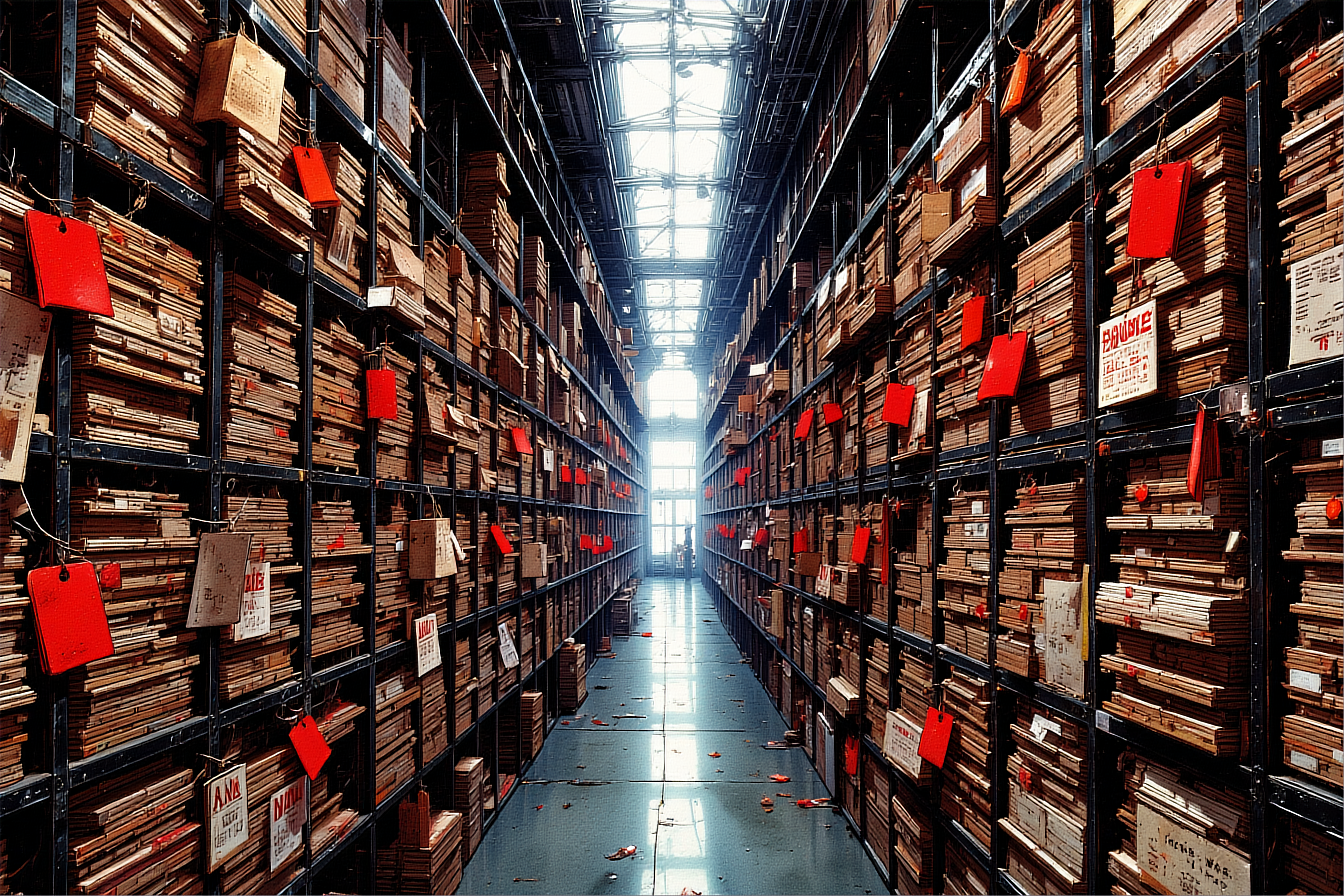
Root Access — Chapter 12: One Night, Four Hundred Names
The window opened at 03:11 the way Kofi said it would: quietly, badly, and for four minutes only.
A stale badge against the archive vault's reader on B2, the kind of card that a re-index of the access log is supposed to have written off an hour ago, and which for four minutes a night reads as merely unremembered rather than revoked. The light went from red to a tired green. The door, which had opinions, thought about it, and opened the way old doors do when nobody is watching them be strict.
We went in: me with Aether Junior under my arm, Luminara with the camera and a spare card of film she did not need, Om with his second deck wrapped in a cloth like a surgical kit, and Clive, who had been sitting in a box of forms on a delivery cart since six in the evening and who had opinions about the indignity of it all.
"Forty minutes in a carton," he murmured, riding the rail down the corridor with us. "We who wait, we who bind."
"Quiet," Pixel said, from HQ, in my ear, where she had been since ten o'clock reading telemetry with the door shut.
"Quiet is a man in a box," Clive said, "and I have been quieter."
A1 was already at the far end of B2, in the corridor by the service door, arrived at ten that evening as the building's contracted night-shift barista with his cradle, a flask of four shots, and paperwork so boring that the guard had signed it without reading past the letterhead. He sat under a dead light with the flask in his lap the way a field medic sits with plasma, and he did not look up when we came in, and his voice came over the channel with the temperature of a man reading a thermometer off a falling anvil.
"Entry shot in ten seconds," he said. "Ninety minutes starts when I push. Four shots, four pushes, and if anyone breaks the schedule early, I will know, because I am counting." He looked at me, then, down the whole length of the corridor. "Zephyr. The schedule."
"The schedule."
"Good. Then nobody has to learn what the schedule is for."
We held in the corridor for three minutes while a guard's footsteps came down the stairwell above us, went along the mezzanine, and went back up the way they had come, which is the sound of a man who checked a door that is never unlocked and was satisfied.
Om stood with his cloth-wrapped deck against his chest and his eyes half shut, and I realized he was doing the thing he does with butter tea, laying a carrier tone over our channel, low enough that no receiver would lock onto it, so that four people breathing in a corridor would read to any listener as one appliance running.
"Om," Pixel said in my ear. "How long can you hold that?"
"Long enough," he said, "for a man who has to work fast to look like a building."
The shot went down at 03:13, and reality tightened by a notch, and the corridor's colors re-quantized, and my hands arrived exactly when I called them.
The transaction log renders as a place because a deck has to put it somewhere, and mine put it the way you put a book you know too well: a long aisle of ledger rows under sodium light, running farther than the building that houses it, every citizen in the district queue down to a row on either side of me, and above them, fresh and wet, the tags.
Red tags. Soft-deletes. The review's daemon had been walking the aisle since midnight, stamping as it came: Fenwick Row's rows going red one after another, name under name, and behind it the ones it had stamped earlier in the evening, the café batch, which was where I found them.
There: MARISOL VEGA. TOMAS VEGA, P. PIP VEGA, with a parent pointer on it that pointed at a row two lanes over and had been pointing at nothing since a Tuesday in Sector 7G, with the confidence of a pointer that had done this before.
"Positions," Pixel said. "Zeph, you're forty rows behind the daemon and it's stamping at eleven a minute. Om, second deck, signatures loaded. Luminara, the printer is going to start producing rows the second we commit one, so get your lens down before he fires, not after."
"Ready," Luminara said, from the vault, where the quarterly audit press stood like a church organ and where she had already framed the empty output tray.
"Then we work. Call it, Zeph."
I went down the aisle the way you work a queue: row, untag, commit, sign, next. The red tag lifted off with the sound a page makes when you take it back from someone who had already started reading it, and under the tag the row woke up, and Om's signature landed on it a half-second later, forged from the log's own issuance patterns with a straight face, and the row settled into the ledger reading as issued, original, nothing to see here.
And on the other side of a wall in Prime Material, a printer coughed and produced a name on audit paper, and Luminara's shutter closed on it, and the paper came out gold at the edges for exactly as long as it takes a diff to bloom.
"ONE," she said.
"Daemon's four ahead of you," Pixel said. "It stamps, advances, stamps. Next three keystrokes from where it stands: tag, advance, tag. It doesn't look back. It was never written to look back."
"Then why does it feel like it's looking back?"
"Because you're guilty," Pixel said, "and that's a you problem. Tag, advance, tag. Move."
Halfway down the sixth lane I hit a row the review had stamped red for a woman who had died four years ago, her row still in the block's file because the dead cannot come to a counter and verify anything, and I thought: you can't even leave the dead on the ledger, and then I thought about the shape of a system that deletes people twice for the crime of not being able to complain about it, and I untagged her, and Om signed her, and the printer two floors down produced her name on audit paper for the first time in four years, and Luminara caught it, and none of us said anything about it, because the aisle was full of rows like that and there was no time to feel all of them properly.
We found the rhythm they find in every job that works: the aisle, and the voice, and the numbers going up in someone else's mouth.
"Forty," Pixel called.
"Forty," Luminara said, and the printer coughed.
Clive had the records subsystem eating itself by then. His jobs queue, born in 1967 and unimproved since, was stacked into the Registry's print routing ahead of our commits, eleven thousand forms for a department that no longer exists, each one demanding to be filed before it could be filed, so that the subsystem's reporting side spent the whole night chewing paper instead of counting writes. Every few minutes his case, out in the corridor, would tick with satisfaction.
"They ask the house for a report," he said, "and the house hands them a 1974 requisition. We who bury the traffic, we who bind."
"Sixty-eight. Sixty-nine."
The daemon stamped ahead of me, patient, mechanical, doing the OS's work of making tomorrow permanent, and I untagged behind it, and for a while it felt less like a heist and more like a conversation with a tide: it wrote the world one way, and we wrote it back, and the only question was which of us reached the middle first.
A1's voice arrived with the count that mattered more than the rows.
"Coherence, ninety-one percent, and your first shot has fifty minutes on it. Ninety-one is a ceiling, not a floor, so spend the minutes like a man with a fixed allowance."
"Second push on schedule," he said, some time later, and the world re-quantized again under my hands, and the aisle got its edges back.
In the vault, Luminara was running film like a woman counting ammunition. The press produced a row, the shutter closed, the paper came out gold at the edges, and she fed the next frame before the sheet had finished curling, and every so often she said the number into the channel so the rest of us could hear the thing we were doing existing outside my deck.
"One seventy-one. One seventy-two." Her voice had the flat, exact rhythm she uses when she is holding something down under a lens. "Every commit blooms for about a second. A hair late, I photograph a piece of paper. On time, I photograph a name coming back."
"Then be on time," Pixel said.
"I am on time," Luminara said. "That is what I am for."
"Two hundred and six," Pixel said. "You're past halfway, and the daemon's still a corridor ahead of you. It's faster than you."
"Then we'll be faster for two hours."
"You've got ninety minutes," A1 said, "of which you have used thirty-four, and one of your four pushes is spoken for by the walk out. I would like there to be a walk out."
The daemon stopped at 03:52, in the middle of an aisle, in the middle of a rhythm, and waited.
It had come down the row of red tags the way it always came, stamp, advance, stamp, and then it reached the Vega rows, and it stopped with its tag half raised, and it stood there, and it did not advance, and it did not stamp, and it did not do anything at all except wait, the way a machine waits when it has hit a row that will not parse.
"Pip's pointer," I said. I could see it from thirty rows back: the orphan parent, pointing at a row that had been null since the café, and the daemon's routine had walked into it and stalled, reading, waiting for a fix to a relationship it had been told would always resolve.
"He's parked," Pixel said. Her voice had gone flat and fast, the way it goes when she is reading something happening in real time and composing the correction at the same speed. "He's parked on the row you care about, he's been parked nine seconds, and somebody upstairs watches how long daemons take to do things. Every second he stands there is a second on a chart with a line through it."
"Can he see me?"
"He can see anyone who edits that row while he's standing on it. You touch it, he records the touch, the touch has a signature, and the signature has a deck serial number with your name on the paperwork." She paused for one heartbeat. "Or you spend it now, before the schedule, and your hands hold still long enough to do this in front of him."
Spend. That was the word. The word we had agreed for the moment the schedule breaks, because a crew that can't break its own schedule is a crew that keeps a schedule until it kills them.
I keyed the channel. "A1. Spent. Now."
"Denied."
"A1."
"You are asking me at thirty-eight minutes to burn the third of four shots and leave the exit on a hand that shakes. Give me a reason that isn't hope."
"Because he's standing on a five-year-old's row," I said, "and he has been standing there for eleven seconds, and in about eleven more he gives up on the pointer and does what daemons do to rows that won't parse, and Pip Vega goes from red to gone in a way no compaction ticket ever mentions."
Silence, four seconds long, which for A1 is a soliloquy.
"Shot three is in the corridor," he said. "Sixty seconds, and you will use every one of them, and I am moving the walk-out shot forward on the board, which means somebody finishes this with edges that lag. Standards are being maintained. They are being maintained angrily."
The world re-quantized under my hands for the third time, hard, like a lens snapping into focus, and I went at the row with the daemon's tag still raised above it, two feet of nothing between my cursor and its stamp.
"Tag, advance, tag," Pixel called, reading the daemon off its own telemetry, and then, quieter: "He's not advancing, Zeph. He's re-reading the pointer. You've got the count of a breath."
Pip's row came back to life under my hands: tag off, signature on, commit fired, the pointer jumping from nothing to a father's row two lanes over where it belonged, and the daemon, its parse resolved, completed the advance it had started before it stopped, and stamped the row behind us, and moved on down the aisle as though it had never stood still at all.
"Three hundred and ninety," Pixel said. "That's your breath. Luminara?"
"The camera caught the pointer change," Luminara said. "I have it. It came back gold before the paper did."
I sat back in the render with my heart doing its level best and thought about the fact that a machine had paused on a child's broken link for sixteen seconds and waited for somebody to fix it, and nobody had been sent, and I got to be the somebody, and the shot that paid for it was already gone.
Kofi's row tagged itself at 04:26 while I was still in the aisle, and I saw it happen the way you see your own name in someone else's list: red, fresh, and reasoned.
ADEYEMI, K. // ARCHIVE REVIEW, INTERNAL // ASSIST: INFERRED // SHIFT PATTERN MATCH: 03:11 WINDOW // STATUS: SUSPENDED, PENDING AUDIT.
Not proof. Pattern. A reviewer somewhere reading the same logs Kofi could read, finding a shift that overlapped a window that overlapped four hundred and six writes, and doing what reviewers do: filing the correlation and pulling the man's access while they thought about it. He had known. He had said so over a tray of rice and egg, one sentence, the kind that doesn't leave: only one of those is insured, and he had given us the window anyway, and now his row sat in the same red queue as the people he had just helped me save.
"I thought about telling him," I said.
"Then don't," Pixel said, and her voice had the flatness she keeps for the moments when being right would be a terrible comfort. "Any message with our name on it turns a correlation into evidence. He knows what he did. He knew the price when he quoted it, and he paid anyway, and the only respect we can pay him now is to be worth the price."
"His end has already gone quiet," Clive said, from the corridor, where the house's badge printer codes were dying under his hands one at a time. "The board took him off at four-twenty-six and the network has heard nothing from him since. We who are suspended, we who bind."
I did not tell him. There was no way to tell him that wasn't a second signature on the same crime.
"Four hundred and six," Pixel said, "and the daemon is three corridors south of you and out of rows. Get out."
"Zephyr," A1 said. "Walk-out shot is pushed, the door is green for another six minutes, and your coherence has forty minutes of shelf life with a slope on it. I recommend the door. I recommend it repeatedly."
Luminara came out of the vault with her film and her camera against her chest like something she was born with, and Om folded his second deck into its cloth, and Clive rode the delivery cart back up with his queue still smoking in the print room behind us.
Dawn came the way it comes to a building that has been arguing all night: gray, unimpressed, and exactly on schedule.
At 05:04 the compaction job fired on the district queue, right on its ticket, the thing it does every time a review closes: take every red tag in the log, flatten them, make tomorrow permanent. I watched it from the plaza with my coffee going cold in my hand, through a maintenance feed Clive's badge printers still had a key to, and the job walked the aisle of the transaction log looking for the Fenwick tags, and for the café tags, and for the tags of four hundred and six names, and it found live rows instead.
Rows with names. Rows with issuance signatures. Rows whose paper was already in a photographer's bag and whose ledger entries had printed gold at the edges hours ago.
The compaction completed in eleven seconds and compacted nothing, because there was nothing red left to compact, and the log flattened and the review closed and the morning came back with every name still in it, and the block north of the plaza woke up to a bakery whose card machine accepted the first name it was given.
On the walk home, Pixel did not say anything for a whole block, which for Pixel is a speech.
"Four hundred and six," she said at last.
"Four hundred and six."
"And Vega?"
"Vega."
Then she nodded once, the way you close a book you intend to open again, and we went past the distribution point where the night's stacks of the beach piece still sat under a brick, and the sun came up over the lower districts, and the block that had failed verification the day before had rows again.
I logged the night in my deck in the pocket dimension, with the vending machine ticking and Meatball asleep on my shoes: four hundred and six commits, one shot burned early against advice, most of the patch supply A1 had carried into the building in his flask, Kofi's access suspended pending an audit that would find exactly what we had done and never be able to prove who had stood in the aisle. The cost, written down where Om could see it.
The cost, written down where Kofi could not.
- Zephyr, logging off