
Root Access — Chapter 13: Believing We Exist
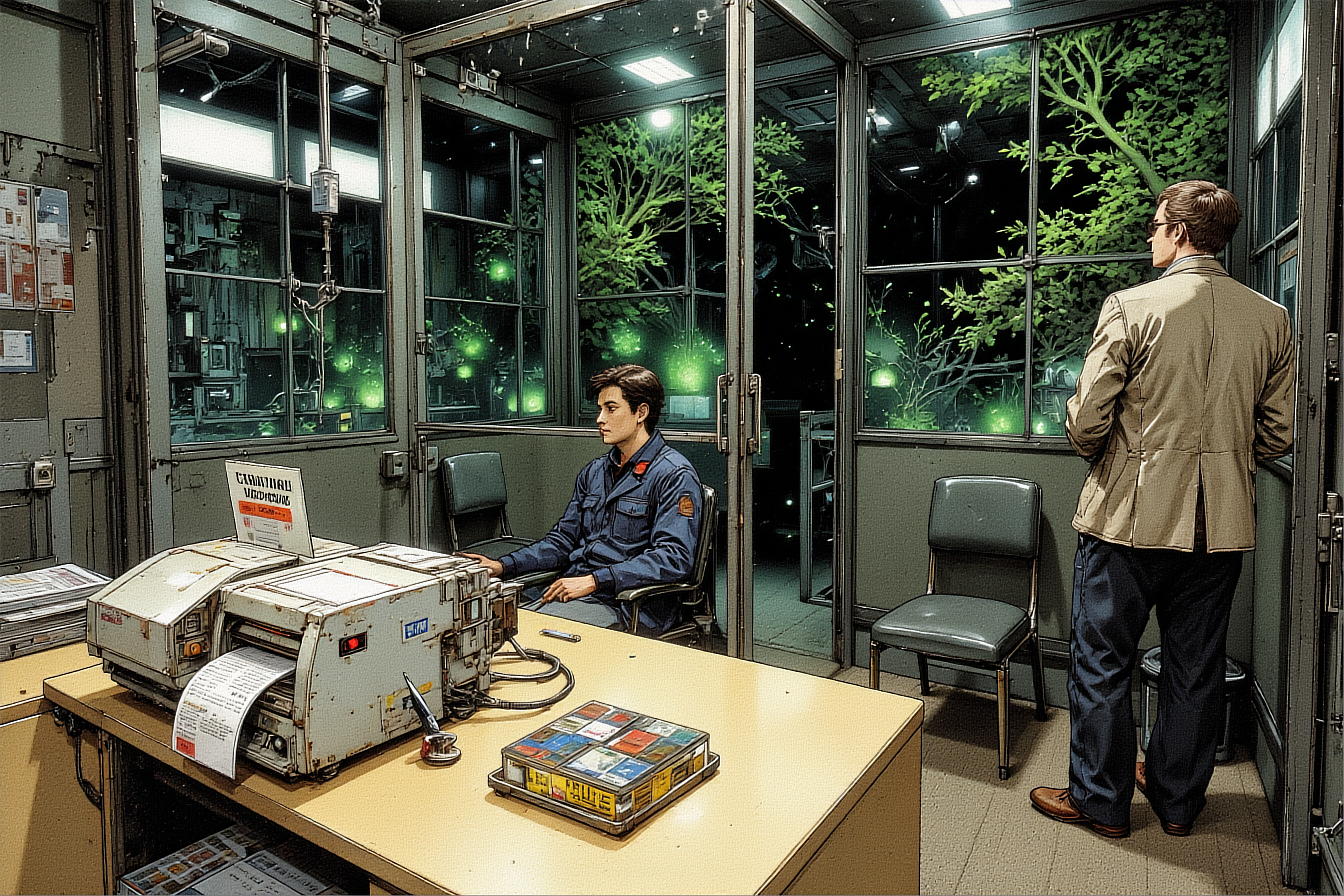
The printer at the Bureau of Continuity made a sound like a cat coughing up something it regretted, and then it printed Tomas Vega a name.
He was crying before the paper finished feeding. Both hands flat on the counter, shoulders up around his ears, making a noise the room had clearly never scheduled. The clerk behind the glass was a woman assembled entirely out of beige cardigan. Eleven years of laminated cards. Her face ran the arithmetic twice: this man is weeping, he is weeping at a printer, my queue has no code for this.
"Sir," she said. "Sir, you need to sign."
He signed. The signature wobbled like a man on a wet dock. Behind him the line stopped moving, which in a government office counts as a standing ovation. A woman with a toddler on her hip leaned sideways and read the counter, and I watched her do the thing people do when they are checking whether a number is real: she looked at it a second time.
Pip's card came out next. Smaller photo. Same printer, same cough.
I was six back in the line with Meatball on a lead and my glasses shoved up onto my forehead so nobody in that room would watch a HUD watch them.
The line was the story. A government office on a Tuesday morning holding two dozen people, and every one of them had come for the same impossible reason: something they had been told was gone had come back, and they wanted it stamped. A man with a contractor's hands held a badge that had been reading INVALID for six months. Two teenagers clutched printouts of rows they had pulled off the zine's site. The woman at the front had brought her own pen because she did not trust the office's.
Marisol Vega stood beside her father while he signed, one hand on the back of his neck, doing the thing older siblings do when a parent comes apart in public and somebody has to hold the dignity in place with pressure. She did not cry. She watched the printer. When Pip's card came out she took it, read the name on it twice, and put it inside her jacket like a passport.
My own parents' rows went null years apart, and there was never a printer for either of them. Nobody stood in a line for my family. Their booth just has two seats in it, forever.
The clerk reached for the next folder without pausing, because a queue does not care what it means. I gave the name I had come under and collected the stamped confirmation: restore cleared review, block intact, no flag on the file. She stamped it the way she would stamp anything else. Four hundred and six people had just stopped being a rumor and her hand was tired.
Outside, the morning had more people in it than yesterday. Meatball sat down on the steps to reject the entire concept of stairs, and I let him, because we had nowhere to be for eleven minutes and I wanted to watch a street where the receipts worked.
The bakery on the block had been handwriting its receipts since spring.
Every card sale went onto a carbon pad stamped PENDING VALIDATION, which is Corporate's way of saying your money exists in a language the machine refuses to speak. The baker, a heavy man named Suraj who had not smiled at a terminal in four months, took a woman's badge tap at 09:40 and got the little green chime, and the noise that came out of that bakery carried into the street.
Suraj ran the same card twice more, watching for the trick. Then he looked at the machine the way you look at a dog that has bitten you before.
"Validation," he said to nobody. "It just says validation."
"That is what it says," I said.
"Who fixed it?"
"The ledger fixed it." That was the line I had rehearsed on the train. It also happens to be true.
A woman at the back of the shop held her badge up to the machine like a talisman and got her chime, and the counter went to work on tabs that had been parked since spring. Suraj stopped writing on the carbon pad. He looked at the pad, looked at the machine, and tore the pad in half down the spine, which in bakery terms is a revolution.
Pip Vega went past the window with a pastry in each hand and his sister yelling his name after him, and I bought a coffee I did not need with a crystal that went into Suraj's tray cold and bright like rock candy, and he did not look at it, and I left before he could ask.
HQ was louder than the block.
The press had been running since 05:00 and Pixel had not sat down. The Ephergent's incoming queue flooded, then overflowed, then arrived by courier because the couriers had started competing with each other for the run. Names, addresses, rows, whole family trees typed onto receipt paper and bar napkins and the backs of forms nobody had ever been permitted to file. Three words came back more than any others, handwritten in eleven different hands: I exist, do you?
"Print run," Pixel said when I came in, without looking up. "Biggest in the history of the zine. Bigger than the beach, bigger than the manifest. Front page in ninety minutes. Clive says the copiers in Accounting are already warm."
"We won the week," Om said, pouring butter tea into cups that had stopped shaking, which I noticed and did not mention.
"We won a night," Pixel said. "Weeks come later."
CLX arrived with the mail. That part deserves to be on the record. The readership could not pay us in credits, because credits belong to Corporate, but they could mine a laugh, and they did. Envelopes of crystal in every courier pocket, each one cold and stupid bright, each one an asset the operating system of existence cannot mint or fork. One envelope had a note folded inside it, printed in a shaky font: I sold a joke to a miner in Verdantia for this. Do not spend it on the war. Spend it on the printer.
I put it in the power-draw tin where Om's accounting could see it, because that is the rule. Everything gets documented, generosity included.
A crate arrived behind the envelopes, consigned to the zine with no return address. Inside were four hundred and seventy-one slips of paper: index cards, gas receipts, church bulletins, the backs of envelopes, each with a row number written by hand and a phone number under it. Somebody had spent weeks collecting a neighborhood's evidence by hand and mailed it to a room behind a busted vending machine, because we were the only address they had.
"That isn't mail," Pixel said, holding up a card. "That's a census. They're auditing themselves."
They were auditing themselves. That was the week in one sentence. Corporate ran the ledger, and the block ran the count.
A1 rolled off his cradle's charging peg and announced the standing weather. "Readership up four hundred percent overnight. My projections indicate we have turned a regional data correction into a mass delusion of personhood. Standards are being maintained. Barely."
"It is not a delusion if it is true," Luminara said.
She was at the far table with her loupe out, developing the night's rows: photographs of four hundred and six names committing, each one a small gold bloom in the paper. She had photographed Tomas signing. She had been in that office. She had not said a word about it since.
Clive, from the wall where he had been quiet, offered his read of the traffic. "We who bind, we who exist. The paper knows its people. Let the machines catch up."
Meatball put his chin on my knee and sighed like a system shutting down clean.
Corporate's answer came at noon, on every screen in every sector, and it was immaculate.
The press release ran two paragraphs. It called the restore an unauthorized data correction, thanked the parties responsible for their engagement, and confirmed that a full audit would follow. The word "data" appeared eleven times. The word "name" appeared zero.
Then the audit team arrived at the distribution points. Clipboards, beige, no name badges: the same auditor who had started showing up after Job 1, now with two colleagues and a shared folder moving between them. They stood at our tables, wrote things down, and never once asked us to stop.
Pixel walked over with two coffees she had no intention of paying for and asked the senior one what he was measuring. He told her, pleasantly, that the review was routine and would conclude when the sample size was satisfied.
"What's the sample size?" she asked.
"I'm not at liberty."
"Then you'll be here a while."
He wrote that down. The other two shifted their clipboards to the other arm and kept not asking us to stop. Luminara photographed the three of them from across the street, and when she came back she said the senior auditor's badge came from Corporate's internal audit division and his folder was already fat, which meant the re-audit had begun before the press release announcing it.
Three people with clipboards come to measure how loud it gets. A shutdown looks different, and none of us had forgotten the vans in Nocturne.
And then the memo.
"Commendation," A1 said, reading it off the zine's inbox with the flatness of a man reading a tide table. "From the office of the Chief Reality Officer. Quoting: outstanding engagement metrics across a restored cohort; the crew's distribution velocity exceeded the quarter's target for community feedback initiatives."
"She is praising us," Pixel said.
"She is logging us," Luminara said.
"Both," A1 said. "The memo is signed, real, and filed under Culture. I have read corporate communications since before this crew existed, and I have never seen a commendation issued to a subject of an active measurement."
Om set his cup down. "Notice they are not angry. Angry systems send vans."
"And this one sends a folder," Clive said. He pinned the printout to the wall with a single staple driven through the signature, which for him was an annotation. "Paper remembers whose hand touched it. One day we will learn what her signature costs."
The room took that the way rooms do when a familiar floor turns out to be a lid.
I took the next part into the back, alone, because the endpoint she had left was already ringing and I wanted to answer it where nobody had to watch.
Isolde Marrow appeared on my deck in a beige room with no visible windows, and she did not say hello so much as resume.
"Zephyr. Thank you for taking the call. I wanted to close the loop on the Vega block personally." She turned a tablet she was not really looking at. "I will share my screen."
She shared it. The Vega block's rows sat under a job queue, four hundred and six of them, and above them a header I had read from the other side of the glass before: RE-CORRECTION SCHEDULED, 04:00, STATUS QUEUED. My stomach went somewhere cold and structural.
"The queue opened automatically," Marrow said. "Restores are writes. Writes create drift. Our acceptance criteria for the quarter prefer a stable ledger, and a stable ledger prefers the block corrected back to its prior state. You understand the position."
"I understand the position."
"The re-delete was scheduled at 03:58. I am cancelling it." She tapped once. STATUS moved to CANCELLED BY HAND, and a timestamp stamped itself beside her name. "There. The block stays."
The block stays. She had opened the queue in front of me and closed it in front of me, the way you show a card before you fold it.
"Why," I said.
"Because mercy is a product decision," Marrow said, "and the product is better with a live cohort in it. Sentiment across your distribution channels is running at numbers I would normally have to buy. Four hundred and six names give me a control group I can keep observing. Correcting them tonight would end the observation." She set the tablet down. "The audit on your distribution points runs fourteen days. Scope is documented, conduct will be courteous, and they will not ask you to stop. I would rather you heard that from me than from them."
"You could just take it back," I said. "Any night. Any hour."
"Any hour," she agreed. "That is what a rollback window is for." Nothing in her voice sharpened. She was confirming a specification. "I would rather you kept going, Zephyr. Your engagement is the most useful telemetry this quarter has produced. I am being candid."
"Thanks."
"Do push the next one harder," she said, and the line ended politely, the way she did everything.
I stood there with the dead endpoint in my hand and understood that we had been kept alive for the same reason a lab keeps a culture.
I told Pixel everything that night, on the roof, with the press clacking under us.
The flag. That it flipped to interesting a month before Job 1, in a cafe, while I ran the fragmentation exploit on myself, and that I had known since the eleven-second cache and said nothing. The approval ID: that Job 1's route, the looped cameras, the clerk's conveniently early revocation had all cleared under the same number, and that I found it in the docking bays and sat on it. The manifest: Job 1 listed in the mind-farm cache as a branch scenario, found at 05:00 the morning we published the beach, held in my own buffer through two more jobs.
She sat with it long enough that the press finished a run and started another.
Then she asked the two questions I had been dreading, both of them built for facts rather than comfort.
"When did you find the approval ID?"
"The week after the depot."
"And the manifest?"
"The morning after the beach. 05:00."
"The flag?"
"The night of the fragmentation. In the cafe."
She did the arithmetic out loud, which is how you know she is angry, because Pixel does her numbers in her head when she is being kind. "A month, and then a week, and then two jobs. You carried all three while I planned the Registry around you."
"Yes."
"That's the number I need," she said. "Not the reason. The reason is you being kind, and I believe you, and it changes nothing about the number."
"You told me about the file," she said after a while. "You told me about Aether's voice. That took a year and I was glad of it." She looked down through the roof hatch at the power tin, where the crystals were catching light like somebody else's teeth. "This is three things. Three times you held the map and let us walk."
"Pixel."
"I am not doing the part where you explain why. You will be kind about it and it will sound true, and it will still be the thing that gets somebody's row deleted while we are busy trusting you." She stood. "So instead we change what we are running."
She had it already. She had had it for the length of my confession, which was the part that showed me the size of the delay.
"Everything we have taken has been a write," she said. "Restores, rows, four hundred names, all of it typed back into a ledger whose root user can type faster than we can. Marrow proved that tonight by cancelling a deletion in front of your face and calling it mercy." She put both hands on the rail. "A restore is a favor. It stays on the table until somebody senior clears the table." She looked at me with an expression I had only seen once before, on the night she read Bee's loop number in a burn manifest. "So writes are over. From here we go after something the machine cannot revoke, and we take it on their paper, where a cancellation needs a signature and hers is already spent."
"What is the target?"
But she was already down the stairs to ask Luminara a question that had been sitting in the room for nine years, and I stayed on the roof with the city running underneath it: four hundred and six rows live, and scheduled, and cancelled, and live again, every round of it proof that a write is only ever a promise until somebody senior disagrees.
Down through the hatch came the press, running, and Pixel's voice telling the room what we were doing next, and Luminara's answer, which was one word, and the sound the whole crew makes when a plan stops being a wish.
- Zephyr, logging off