
Root Access — Chapter 18: The Tithe (Execution)
The tide came through the intake at 02:58, warm and sweet and several hundred strangers wide, and we rode it the way you ride a crowd: heads down, nothing to see, part of the flow.
Inside, the facility exhaled, and the hall opened up around us, and I stopped breathing for a second because of what the place was.
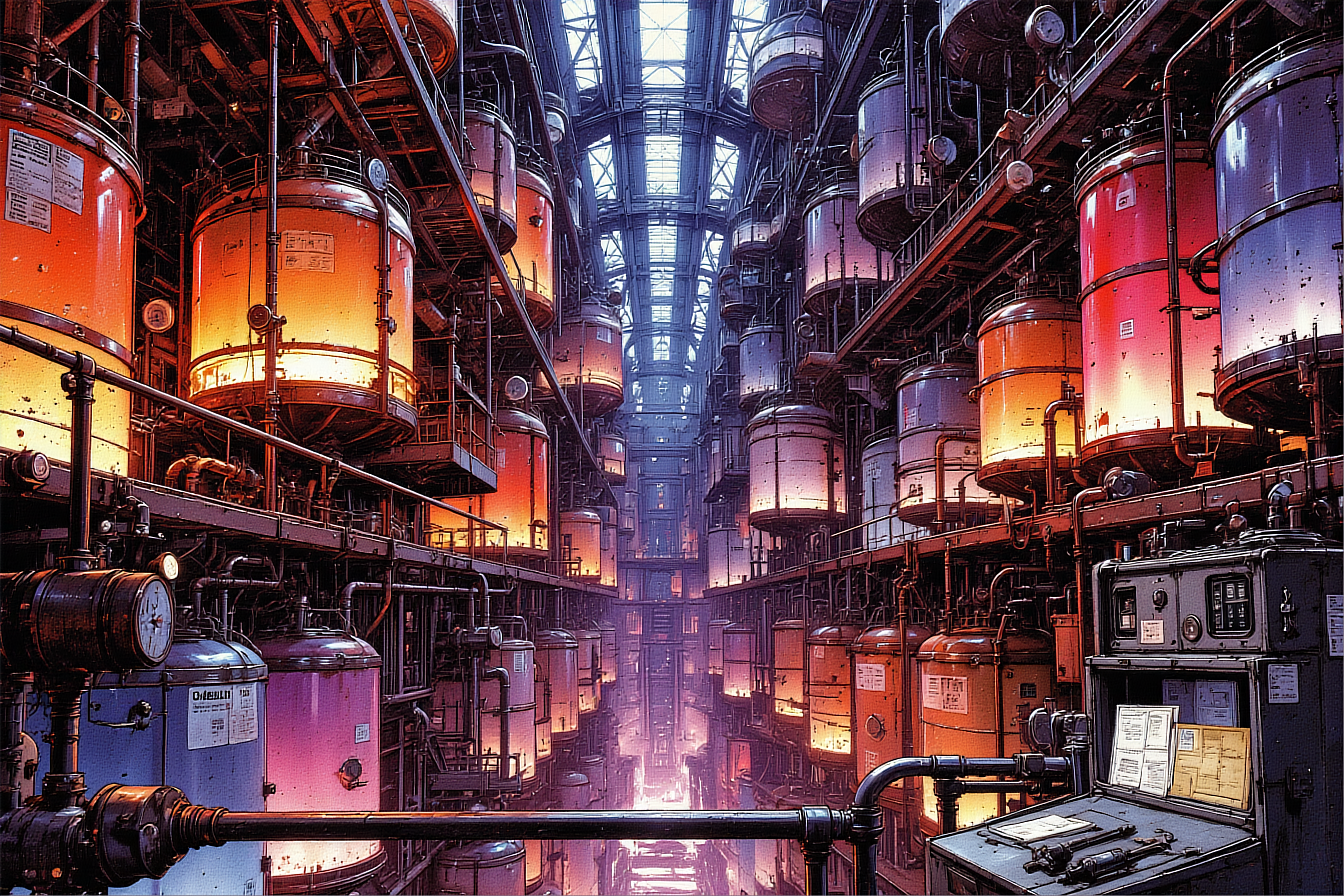
Tanks. Hundreds of them, floor to a ceiling that had no business being that high, each one glowing the color of chilled syrup: amber, rose, a pale blue that pulsed slow like something sleeping. The light they threw came from the feelings themselves, the color of a year under pressure, and it moved, and the whole cathedral of it hummed at a frequency you felt in the fillings of your teeth. Pipes ran between the tanks in labeled runs. Every label was a district code and a quarter and a total. A year of Cull Street's weeping sat in Tank 4B with a maintenance tag on it. Somebody's grandmother's Sunday afternoon was in 12C, temperature controlled.
Daemons moved along the gantries overhead, nose-low, patrolling by scent the way a dog patrols a yard, reading the air for anything that did not smell like cargo.
"Flat," Pixel breathed beside me. "Remember flat. You're tired, you're on shift, you're bored."
"I'm bored," I said, and meant the word, and the word helped, which is a thing I will think about later and not now.
Luminara went to work first, because Luminara always goes to work first. Gauge by gauge down the near row, one photograph per dial: TOTALS HELD, WARD 7, TAP READING, each frame taken on the second before the needle moved so that the before and after existed in the same roll. Pixel walked the gantry behind her reading the hall itself for edits, the way she reads a street, calling the ones she saw under her breath so the rest of us would know what had been changed around us.
"Ward 4 tank's been topped up since the printed schedule, somebody's hiding a shortfall. Ward 7 is clean. 12C has a maintenance tag that was applied in the last week." She tapped the rail. "They've been dressing the numbers before the quarter closes. Corporate's cooking its own tithe."
"Good," I said. "Then we're not stealing it. We're auditing."
"Say that louder when we're out," she said, "and put it in the minutes."
The first tanks began to cycle at 03:11, slow as syrup turning, and the gauges fell, and the hall filled with a sound like a held breath being let go in a hundred places at once.
We came up out of the intake onto the gantry over the core tanks at 03:04, eleven minutes on Om's clock, and found A1 already there, rolled up the memo corridor inside Clive's paper load like any other piece of office equipment, tray level, two cups steaming.
"Delivery," he murmured, which is the driest he has ever been. "Also: coherence across the crew currently reading even. I have nine shots of good patch left in the grinder and I intend to spend them where they hurt."
"Where they hurt," Pixel said.
"Where the tide hits." He nodded at the tank below us, which was beginning to cycle, and at the far end of the hall where the siphon intake came down from the street. "That's other people's feelings moving at pressure. Every one of you is about to be up to your neck in somebody's Tuesday. Flat will last until it doesn't."
Clive came out of the memo pile last, small and orange and smelling faintly of 1967, and went straight to the intake manifold with a staple gun in his jaw and a job to do.
"We who bind, we who route," he said, working the first sheet into the gate. "The paper goes where the feelings cannot."
"Clive," I said, "eleven thousand memos is a lot of memos."
"Eleven thousand one," he said. "Somebody misfiled a requisition in 1962 and I have been waiting on it ever since."
Luminara was already at the far rail with her camera, doing what she does: gauges first, one per frame, each dial photographed the moment before it moved. Down the line a gauge reading AGGREGATE TUESDAY, WARD 7 began to fall, and in the viewfinder the number blurred and reformed, and she caught the bloom. When fuel goes home the diff blooms gold, she had told us, the way a photograph blooms when you pull the print early. I looked, and it did.
"Keys first," Pixel said in my ear, and we went to the drawer.
The drawer was a drawer. Luminara had called that, and she was right: a steel drawer in a supervisor's office off the gantry, with a paper log inside it and this quarter's redistribution key lying on top in an envelope that had been destroyed in front of a witness and had apparently declined.
Om took the key from the envelope with two fingers and read the routing block off it, and for a moment the calmest man in any room I have ever stood in looked like somebody who had been handed a thing he built long ago.
"This is a routing token," he said. "It says where a year of the city's feelings goes."
"Then tell it where to go," Pixel said.
He told it. Three district codes, entered by hand against the key's own signature, each one a place the fuel had been skimmed from: Cull and the wards around it, the lower districts in Prime Material, and the east clock terraces in Cogsworth, where people buy their own afternoons back by the minute. He signed each entry the way he signs everything, small and exact, and then he put his palm flat on the key for a second without saying why, and the light in the key changed from Corporate beige to something warmer.
"Route is written," he said. "It will take effect on the next rotation, and I would rather nobody touched it after that."
"The rotation is now," Pixel said, watching the ledger in her own overlay, "because Luminara photographed the supervisor's clock and the clock agrees with us." She looked up. "They edited Tank 4B's total twice this quarter. Twice. Somebody in this building sat down and topped up a number so that Cull Street's grief would round nicely, and tomorrow that rounding error goes back to Cull Street with interest."
"Interest is not a line in the ledger," Om said.
"Interest is the part that laughs," Pixel said.
Outside, far off and faint through the glass, a sound started in the street that none of us had heard in Nocturne before.
Somebody in Ward 7 was laughing.
It went in waves. That is the only word, and it is Luminara's, and she said it first: the fuel went home and the wards got their year back, and the year came back the way a tide comes back, in sets. First a street. Then the block. Then Cull Street, where a man on a bench who had not been able to make his wife laugh in a decade heard her through the kitchen tap, with the tap off.
Laughter above threshold. Metered, billable, and loud.
The facility's alarm took eleven seconds to decide what it was hearing, and in those eleven seconds the hall around us changed. Every gauge in the row I was standing over flipped to DRAINING AT RATE, the daemon overhead stopped its slow patrol, and a voice came out of the wall in a tone I recognize because I have heard it in every building Corporate owns: this facility has experienced an unauthorized redistribution of assets. All staff please remain where you are.
"Nobody's a staff member here," Pixel said. "Move."
What came down the gantry arrived as attenuation rather than as daemons with weapons: two ceiling units sliding open and firing compression rounds at anything with a heat signature that did not match a cargo manifest. The first round took the rail beside my head and left a dent the size of a thumb in the steel. The second went down the line toward the intake, where Clive was finishing the last of the memos, and it caught him across the casing with a sound like a book dropped on a floor.
He went sideways. He did not stop working. The dent in him was deep and bright and ugly, right through his shoulder seam, and he held the staple line with the jaw and the rest of him shaking, and when he spoke it was under his breath and it was for the machines.
"We who bind," he said, "we who exist."
"Clive-"
"Hold your end, boy."
So I held my end, because that is what the man says, and the shell of him kept running paper, and I wrote down in my head that he would carry that dent for the rest of his life, and then I went back to the gantry because the drain was still open and A1 was counting.
"Coherence," A1 said, from beside me, tray rattling on the cradle. "Nine shots of good patch, all of them spent in the last four minutes." He looked down into the grinder, and I watched him do the arithmetic of a machine who has run out of the good stuff in the middle of the thing. "The grinder is empty. I am switching to the reserve blend. It is sixty-one percent weaker than what we have been running, and I apologize for all of it."
"Sixty-one percent," Pixel said.
"I did say all of it." He poured two cups and handed one up to me on the gantry. "Drink. You have about four minutes before the edges of you start to lag, and lagging is a thing that happens to other crews."
The surge found me while I was drinking.
It came over the top the way water comes over a wall. The tide in the hall carried Cull Street's whole week and then everything the tanks had held for a year, released in one long pour toward three districts, and some of it splashed, and what splashed found the only two people on the gantry who had feelings of their own left in them.
What I felt was my mother at a kitchen table, except it was not my mother. It was a stranger's mother, in a ward somewhere, being handed back an afternoon of her own relief at having her children in the house, and the feeling arrived in me complete and unasked-for and enormous, and it landed on the place in me where my own mother's row went null on a Tuesday when I was fifteen, and my father's six years after that, and no printer, and a line nobody stood in.
I did my job through it. That is the whole of what I can tell you. My hands stayed on the rail, my eyes stayed on the gauge labeled DRAINING AT RATE, I counted the tanks as they emptied, and I let the grief sit in me the way you let a dog sit on your feet, because it was not going to move and I was not going to shake it off. Somewhere above the hum I was fifteen, and a row went null, and there was no printer for it and no line for anybody to stand in. Somewhere else I was counting eleven.
"Zeph," Pixel said. "Zeph, your count."
"Fourteen," I said. "Fifteen. It's fine. Keep going."
It was not fine. It was the first time in a year that I had felt them without anything between me and it, and I did the job anyway, because that is the job, and because the fuel going home to a hundred thousand kitchens was the only reason I was standing there with my heart broken on a gantry, and I would have taken the grief again for it. I still would.
The log wrote itself at 03:41: a signature block, written in the facility's own record by a forensics daemon doing what forensics daemons do. I read it from the gantry in my glasses while the hall was still screaming.
TOOLING SIGNATURE: SESSION CREDENTIAL PRESENT (GLITCH, Z.); DRAIN METHOD: KEY REISSUE, HAND-SIGNED; PAPER PROTOCOL: STAPLE PATTERN CLASS 3; IMAGE PROTOCOL: UNMASKED.
"Session credential," I said. "It logged mine."
"It logged all of ours," Pixel said. "Clive's staple class, Luminara's camera, Om's signature. They can name our tools now. Write that down."
I wrote it down, and then we moved, because a signature is a problem for a week and a hole in the wall is a problem for right now.
The exit nine minutes away unlocked for a shift change at 05:10, and we were early, and the door did not care. Om went first, then Luminara with the camera against her chest, then Pixel, who was already two frames behind.
"Pixel."
"I'm coming." She was not coming. Her face was doing the thing: a lag in the eyes, half a frame, the look of a person whose rendering is being asked to run ahead of a patch that has already been spent. She took a step, and her foot landed a quarter second after the decision to move it.
I went back and got her by the arm and pulled her through the door while she argued with me about which year it was, and Luminara came back and took her other side, and behind us A1 rolled through with the grinder empty and the reserve blend doing its sixty-one percent worth, and Om, who had been quiet the whole job, simply picked up Meatball and carried the dog, and Meatball, who has never once been behind on anything, licked his face the entire length of the corridor.
Luminara was the second one down. At the junction where the corridor bends she brought her camera up half a beat behind her own hands, stopped, and looked at her fingers the way you look at a form you no longer trust yourself to fill in.
"Hold this," A1 said, putting the reserve cup into her free hand without breaking the roll of his wheels. "Count corridor lights. Out loud. One at a time. Calculate nothing."
She counted corridor lights out loud, all twenty-two of them, and her eyes kept time even where her hands had stopped, and by the eleventh light she was stepping on her own feet again.
Two of us lagging. A crew drags its lagging, that is the rule, and we dragged, and nobody got left in the buffer, and the door shut on a hall full of empty tanks with a forensics daemon writing our names in the dark.
Out in the sector at 05:14 the air was doing something I had never known it do in Nocturne Aeturnus.
It was warm. Not siphon-warm, not vent-warm, warm the way a street gets when a lot of people on it are having a good night at the same time. Somewhere past the levy meter a woman laughed out loud and the meter did not come for her, because we had reissued the routing and the meter's own readings were going home with the fuel. Three districts were getting their year back in installments, and you could feel the installments landing, block by block, like rain starting at one end of a street.
A1 stood on the pavement beside his cradle, dosing himself a cup of the reserve, and said what he always says when the weather changes. "Partial success. Drain complete, keys reissued, two crewmembers desynced and recovered, one casing dented, our tooling now on file with Corporate in a document they will enjoy showing people." He drank. "The blend is weak and the sectors are humming, and both of those facts will still be true tomorrow."
Clive, in the crate, said nothing for a while, because talking costs him when the casing flexes. Then, quietly, to the paper around him: "We who were hit, we who stay. The dent is mine. I will wear it."
Nobody said anything funny after that, and nobody needed to.
At the end of the block somebody had gone back to the park sign in the dark and crossed out the second line of it, the billed part, with a strip of tape, so that it read QUIET ENJOYMENT IS FREE. LOUD ENJOYMENT IS, and stopped, mid-sentence, because the person holding the tape had started laughing and could not finish the job, and nobody in Nocturne Aeturnus had failed to finish a sentence out of laughter in a very long time.
Three sectors hummed with their own feelings for the first time in years, and we stood on a curb listening to it, and the sound was people, and the job was done.
- Zephyr, logging off