
Root Access — Chapter 17: The Tithe (Plan)
At 14:20 the siphon vents on Cull Street exhaled, and three strangers on the sidewalk breathed out at the same time, in sync, without knowing why.
"That's other people's Tuesday," Pixel said. "Breathe through your mouth or you'll spend the afternoon feeling fine for no reason."
Nocturne Aeturnus went about its business under a sugar frost that never melted. It lined the railings and the parking meters and the little bronze statues of accountants that the sector installed to commemorate compliance. Every few blocks a vent opened somewhere at ankle height and let out a soft warm breath of something that had been harvested from a room full of strangers: relief, mostly, sometimes a curl of somebody's old joy, once a whole afternoon of a man's affection for his dog that had been siphoned off at the source and would now be burned as compute in a machine that had never wanted a dog.
Luminara photographed each vent as we passed it. "The levy took the park in 2019," she said. "They put in a meter. Any laughter above a set decibel gets metered, and the meter bills the household, and after two winters the households stopped."
"And now?"
"Now look at it."
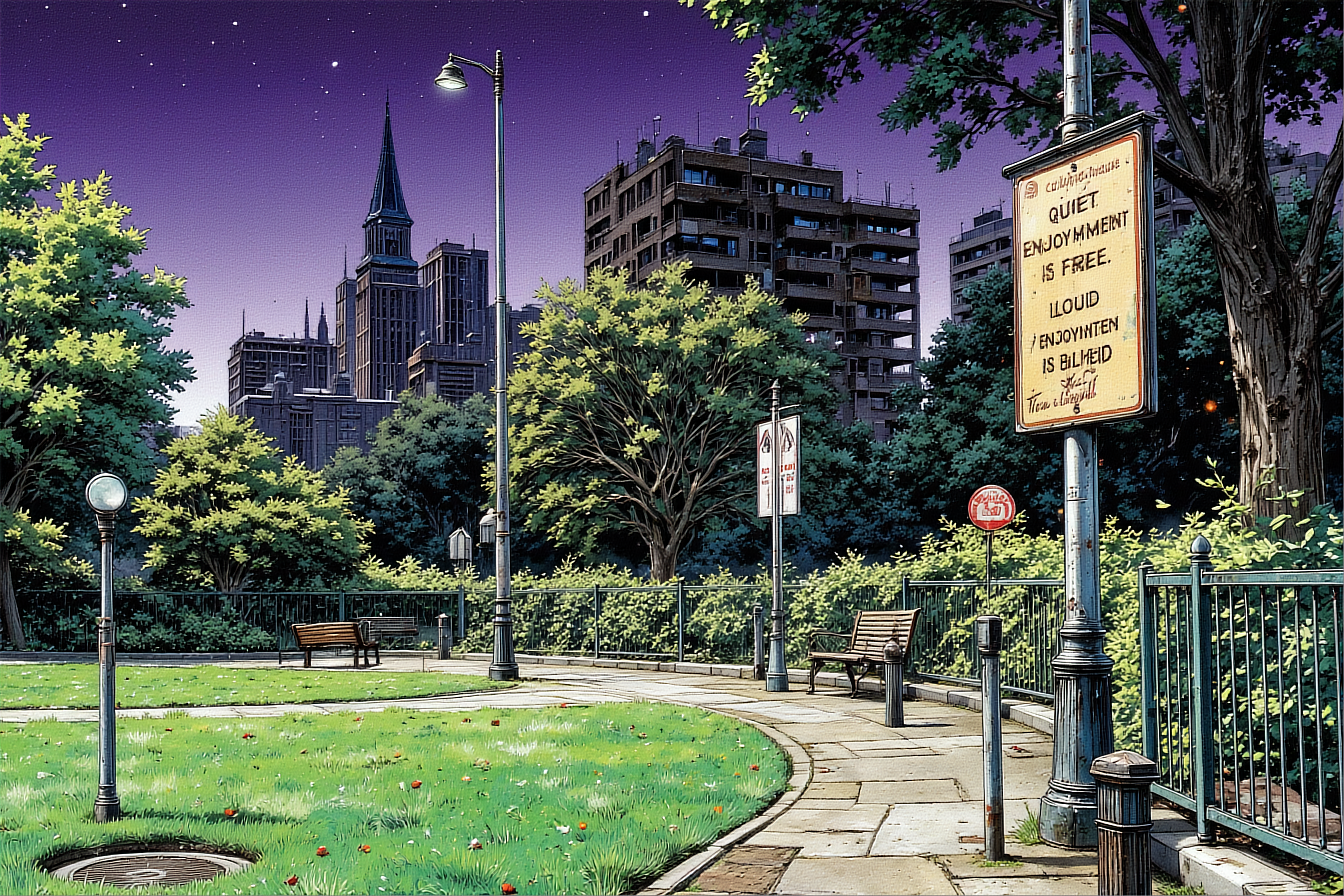
We looked. The park on Cull was green and empty and perfectly silent, and in the middle of it a sign with Corporate's beige livery read QUIET ENJOYMENT IS FREE. LOUD ENJOYMENT IS BILLED. Somebody had spray-painted a small amendment underneath in handwriting: we tried both.
An old man on a bench near the vent had been watching us photograph the sign. He did not get up.
"My wife used to laugh like the meter was coming for her," he said. "That was before the levy. Now she laughs in the kitchen with the tap running, because the tap covers the decibels."
"Is that legal?" Pixel asked.
"It's cheaper," he said.
Luminara photographed the vent at his feet rather than his face, because she asks before she takes a person, and he talked while he watched her work. The vents went in the same year as the meter, he said, and the two had been neighbors ever since: one took whatever people felt, the other took whatever people showed. His neighbors' grief went into the pipe. Sunday afternoons went into the pipe. Four blocks north, behind a wall, it all sat waiting for the people who decide.
"They decide," he said, "and we get the exhaust. On a still night you can taste it. Tastes like being told everything is fine."
"A park where nobody's allowed to laugh out loud since the levy," Pixel said afterward, recording it for the file, photographing the sign with her own camera for once instead of Luminara's. "That's the whole sector in one frame. Every feeling these people have left, the vents take. Every feeling they're caught having, the meter takes. And somewhere the meter and the vents are feeding the same account."
"Which we're about to rob," I said.
"Which we're about to rebalance," Pixel said. "Get the words right. I want them right in the minutes."
The tithe facility sat four blocks north behind a wall that had been upgraded the week after our credentials ran on every front page in the city.
I could read the upgrade in the seams the way Pixel reads a diff in a street: fresh bolt heads on the gate, a sensor ring with a housing date stamped on it, and a new daemon on the roof that turned slowly, unhurried, the way something turns when it has never once been surprised. Marrow's people had sent a maintenance order out within days of issue 44 of the zine. Nobody raids a facility that has been quietly reinforced for a week unless they enjoy the folding.
That is the signature I have learned to read on her work. Her walls get reinforced against a scenario, and the scenario always arrives in the paperwork before the enemy does. This upgrade was aimed at whoever we had just become, which is worse, because the version of us they prepared for is the one printed on the front page rather than the one standing in the street.
The gate checkpoint took four people at a time through a scanner arch that read, according to the posted spec, cargo manifests and emotional signatures. Two workers went through ahead of us, flat and tired and cleared instantly. Then it was Meatball's turn, because Pixel had decided the dog was part of the crew, which he is, and because she wanted to see what a manifest says about an animal with no paperwork.
The arch lit. It held on him for a long four seconds. Then the readout printed CARGO: NONE and PARTITION: NOT REQUIRED, and the gate swung, and we were through, and Meatball was extremely pleased about the whole thing, having concluded that the arch was a friend.
The gate guard, a man whose job had just gotten marginally easier, looked at the dog, then at his screen, then at the dog.
"No manifest," he said.
"He's a contractor," Pixel said.
"On what?"
"On morale."
The guard, who had not smiled at work in a fiscal year, smiled at work, waved us through, and went back to his arch. We walked two blocks before Pixel said the part she had been holding, and by then the joke had worn off the top of it, which is how she prefers to deliver things.
"It didn't error on him. It read him and printed NOTHING TO READ."
"He's a dog," I said.
"He's a dog," she agreed, "and I'd like that written down. That arch reads feelings the way a scanner reads a can. It took one look at ours and gave up with a shrug in the form of a printout."
"Probably it won't take dogs," I said.
"Probably." She did not sound convinced, and neither was I, and I logged it anyway: 14:41, checkpoint arch, no read on Meatball, gate opens. Three lines, no conclusion. Conclusions cost time we didn't have.
Behind us on the roof, the slow daemon kept turning.
In HQ that night the wall got its fourth job.
The tithe, in Clive's phrase, is the collection plate, and in A1's, it is the funding model. Every feeling siphoned off these streets is billed as processing fuel, parked in tanks at the facility, and shipped to the kernel quarterly. Fuel has a price. The price pays for a compile.
"The Simplification has a budget," Om said, at the whiteboard, chalk in two fingers. "Beige does not get built on enthusiasm. Every sector the release flattens is paid for out of the tithe, and the tithe is paid for out of Cull Street's quiet park and every other street like it."
"Stop the money," Pixel said, "and the release slips."
"Delay," A1 corrected. "Slipping a release requires the money to stop for longer than a quarter. Still, in my experience, everything Corporate does beautifully, it does on schedule." He rolled a cup toward the board. "Money is the only lever we have found that they cannot re-declare after the fact."
The target, once we stopped arguing about it, was the ledger: the tithe ledgers in the facility's core, and specifically the redistribution keys, the signed tokens that decide where the fuel goes when it leaves. The tanks themselves we could drain on the way out, which Pixel described as dessert.
Luminara knew the books from the inside, which is a sentence I keep having to write about her. Row 3637 processed tithe reconciliation for two years before the Registry retired her, and she remembered the key rotation the way other people remember a train timetable. Keys issued on paper to the shift supervisor. Held in a drawer. Retired at quarter end and destroyed in front of a witness.
"They destroy them in front of a witness because a live key is a person who can route fuel," she said. "The witness is a formality, the destruction is a performance, and the drawer is a drawer. I processed that performance eleven times before somebody retired me into a legacy row."
"So we don't take it out of a daemon," Pixel said.
"We take it out of a drawer," Luminara said, "like a form."
"Every year's worth comes in, gets held, gets shipped to the kernel, and nothing ever goes back," Luminara said. She had been inside these books before, as Linda, from the other side of a desk. "The keys are rotated quarterly and the rotation is offline. If we lift this quarter's keys and reissue them toward the sectors, the next shipment routes itself home. Fuel leaves Nocturne and comes back to Nocturne, and the sectors get a year of their own feelings returned to them."
"And the kernel gets a quarter of the budget for the Simplification," I said.
"Which is why we take the partial drain as well as the keys," Pixel said. "Take the keys for the future, take the fuel in the tanks for now, and let the sectors spend the rest of the week feeling like people."
"When the fuel goes home," Luminara said, "people will feel it. You don't hand a district a year of its own joy quietly. There will be laughter, and it will be loud, and it will be at levels the levy meters by the decibel."
"Good," Pixel said.
"Also," A1 said, without turning from the board, "the facility's alarm reads the district rather than the door. Laughter above threshold on that block is precisely the signature the sensors are tuned for. Nothing in Corporate's design for this quarter tolerates unprocessed joy on the street." He tapped the tray twice. "So the alarm, when it fires, will not be triggered by anything we do inside. It will be triggered by them outside, feeling things, and we will be standing in the middle of the receipt."
Luminara looked at Pixel for a long moment. "That's a cost we'd be handing to the residents."
"It's a cost they already paid," Pixel said. "They paid it in the tank. We'd only be making them hear the bill."
She said it the way she says a print run. Loudly, on purpose, with the full knowledge that four volunteers in the room would repeat it downstairs before midnight, and that a phone tree has more reach than any daemon.
Roles came out the way they always do: Pixel talking, everybody else sharpening their own end of it.
Me and her on the tide and up onto the gantry over the core tanks. Luminara on the gauges with her camera, one photograph per gauge as it drains, because a number with a photograph behind it is a number Corporate cannot restate later. Om lifts the keys and holds them, signatures being his department and his religion. Clive takes the intake.
"The intake runs a mail merge at 03:00 for the morning shift," Clive said from his wall, quoting a photocopier who had been on the network since 1968. "I intend to be the mail merge. Requisitions for requisitions. A building department inquiring about a loading dock that no longer exists. Forms that will be legible for a hundred years. The night shift will spend the whole time being productive."
"A1 doses," Pixel said. "I read the diffs ahead of the drain so nobody pulls a lever on a number that has already been edited. And Zeph rides the session queue again, which puts his name in another log."
"The last one put me on priority watch."
"The next one puts their own paperwork against itself," she said. "Write down the cost, then write down what it buys."
"And the desk?"
"The desk runs," she said. "Ferreira has the night shift, and Ada Prewitt is running the tree from her kitchen because apparently we are her hobby now. The zine does not close for a heist. I want that as a rule before somebody proposes it."
"The dog comes too," Pixel said, which was not a role and everybody knew it.
"Meatball," A1 said, "at a feelings refinery."
"If the arch at the gate reads him as nothing, the ring inside will read him as nothing. And if the ring does read him, then he is the only member of this crew who has never once been worth a report."
"Bringing a dog to a facility that patrols by scent is either the best cover this operation has ever produced or a statistically significant error," A1 said. "I decline to project."
"He's coming," Pixel said, and that was the vote, and Meatball, who had been asleep through his own recruitment, opened one eye and closed it again.
The security read took an hour, and it was the part of the evening I liked least.
"The outer ice is new," I said. "Feeling-shaped. It profiles the people coming through by what they're carrying emotionally, and it gets bored by indifference."
"Bored," A1 repeated.
"Bored. Flat profiles read to it as furniture. Two workers came through the arch today radiating eleven-hour-shift fatigue and it barely looked up." I pulled the sequence back up on my deck and ran it again. "So we go in flat. Nobody thinks about the park. Nobody thinks about the fuel. We walk in as tired as the workers, we stay tired through the checkpoint, and we don't start feeling anything until we're past the daemon ring."
"And if the tide spoils the flatness?" Om asked. "The intake carries other people's feelings. That is the one thing in this district guaranteed to make a person feel something, and you propose to ride in it."
"That's the part I don't like," I said. "We ride the tide in because the flow reads as cargo, and because a bored daemon doesn't scan what's already inside the fence. And we do it knowing the tide is made of people."
Pixel looked at me for a moment the length of a held breath. "Then we take notes on the way out. Names of where it came from, if the ledger shows them. Every liter we send back, we photograph going home."
"That's a lot of faith in a drain."
"That's a lot of people's Tuesday sitting in a tank," she said. "Faith is the wrong word. Arithmetic."
Om drew the route twice on the board, once for the tide and once for the worker door, and we timed both against the rotation window that Luminara had pulled from an old copy of the ledger's own schedule: eleven minutes from intake to gantry, four minutes on the gantry over the tanks, nine minutes out through the side exit that Clive's contact says unlocks for a shift change at 05:10 whether or not anybody is currently having a shift.
"Twenty-four minutes," Pixel said. "Half of them downhill."
"Twenty-four minutes," A1 agreed. "I can hold coherence across twenty-four minutes for everybody, provided nobody does anything heroic. I would like that written down as a condition."
Om wrote it on the roster under the second rule, in his small exact hand: NOBODY DOES ANYTHING HEROIC.
A1 called the room to order with the only numbers that mattered and no ceremony at all. "Two jobs remain on the ladder by my count: this one and the time-vault. The supply is nine shots of good patch. Nine does not divide across two jobs without waste, and waste desyncs a crew, and desync has a face, and I have seen it." He tapped the tray. "So we run this one dry in places. I will dose by exposure rather than by clock, which means some of you will feel the edges smear before I correct it, and the correction will be later than you would like. That is the plan. Object now or object never."
Nobody objected, because nobody had anything better, and because the room had learned what a room learns when it counts its own ammunition out loud.
Clive, from his wall, gave the run its send-off in the old form: "We who bind, we who route. The paper goes where the feelings cannot."
"We go where the feelings have been," Om said, and it was not a correction, and Clive let it stand, which is his version of applause.
Downstairs the phone tree rang once at 23:40, and Ferreira answered it and took four more names for the queue, and thirty seconds later we were in the van with frost coming up off the windshield and the tithe facility four blocks north, its roof daemon turning at whatever speed it turns at when nobody is watching it watch.
Nobody talked on the drive out. The drive is not where a plan lives. A plan lives in the last line of the log, so I wrote mine in the present tense while it was still true, and then we parked where the siphon exhaust crossed the street, and the air coming through the vent was warm and faintly sweet, the collected exhale of several hundred strangers who had each been relieved of something this month.
We go in on a tide of other people's joy.