
Root Access — Chapter 20: Rush Hour Is a Billing Event
Rush hour in Cogsworth Cogitarium starts at 4:58 p.m. with a tone, and the tone is an invoice.
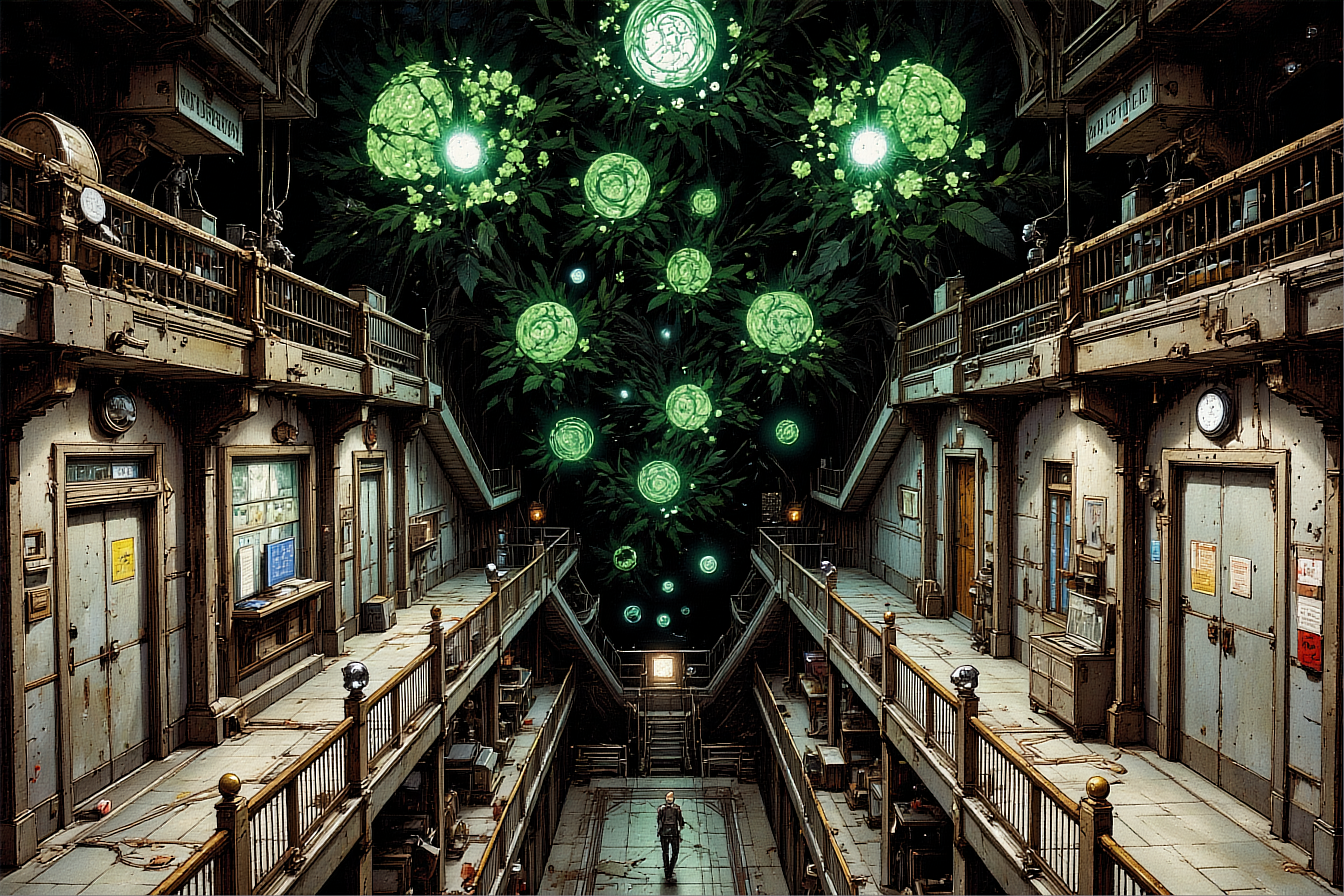
We crossed the sector line on foot because Clive's contact said a vehicle at the boundary gets priced per heartbeat, and the tone rolled across the district like weather: every lamppost meter waking, every shop door counting, a soft mechanical chorus of twelve thousand clocks agreeing that now was the expensive time. My overlay picked up the sector rate and displayed it in the corner of my vision in Corporate's friendliest font: RATE 1.00 min/min. One minute of your life per minute of your life. Waiting here was free only in the way that nothing is free.
The boundary turnstile gave each of us the district's welcome: it read your status bar and opened a minute line in your name, twenty-four hours of credit against time you had not lived yet. Mine printed COGSWORTH MINUTE LINE // 240 MIN // BACKED BY: SUBJECT GLITCH, Z. Pixel's printed the same figure under SUBJECT PARADOX, P., and she read hers twice, because a district that prints your designation will always print what it costs to have it removed.
"Nobody drives at five," Pixel said. She had her collar up and her eyes on the meters. "Look at them. They stand still to save money."
The people on the sidewalk were doing exactly that: a whole district frozen in doorways and under awnings, buying nothing, going nowhere, letting their afternoons tick past at the cheap off-peak rate while the surge climbed. Beside a bank of vending machines near the transit arch, a man in a work coat fed coins into a slot and took out a paper voucher, then fed the voucher back in to redeem it. The machine's header read YOUR AFTERNOON, REISSUED: 15 MINUTES, MARKED UP 40%. He read it, paid it anyway, and walked toward a schoolyard at a pace I recognized, which is the pace of a man who is late for something he will only get to watch the last four minutes of.
A siren went by, low and polite, and my overlay flagged a crossing surcharge: the pedestrian bridge over the transit arch had flipped to premium, and everyone on it was being invoiced two minutes a head. Pixel watched a woman step onto the ramp, read the charge on the arch, and step back down to walk eleven extra blocks around it to save ninety seconds of herself.
"This whole district is people negotiating with their own clocks," I said.
"Every sector takes something," Pixel said. "Prime Material takes your name. Nocturne takes your feelings. This place takes your afternoon, and it takes it in small clean receipts so you never feel the whole sum go."
Clive, reading the rate table on a shopfront with the attention other men give scripture, supplied the district's verse: "We who measure, we who pay. Minutes fall like rain, and the ledger keeps the change."
A kiosk at the corner tried to open a minute account for Meatball as we passed, scanning for a subject to bill, and printed NO SUBJECT on its paper tape before resetting to its sales pitch. The first honest thing the district had printed all day.
At 5:00 exactly, the billing event happened.
Every meter in the district beeped once in unison, a note a half-step under the opening tone, and the day's charges posted. My overlay filled with a receipt for the eleven minutes we had spent standing still, four of them at surge, itemized with timestamps and a customer-service footer I could have written to. People along the street checked their receipts the way you check a ticket stub. The man by the transit arch read his, folded it twice, and put it in his shirt pocket over his heart, which is where this district keeps its invoices.
"Rush hour is a billing event," Pixel said, watching the receipts print. "The jam itself is the line item."
"They metered the meters," I said, and bought a coffee from a cart for six minutes of myself and watched my line drop: 234 MINUTES REMAINING, backed by SUBJECT GLITCH, Z. The coffee tasted like arithmetic. The cart's tip jar took CLX and change, and the change was always minutes.
"Metered lives," A1 said from his cradle, which we had loaded onto a hand truck because the district charges wheeled equipment a toll. "I have polled the sector's rate table. Every joke in this district is recorded as a leisure expenditure. I would laugh at that if laughter here were not taxable."
Meatball, immune to rate tables, was already three blocks ahead with his tail up, chasing a sound only he could hear.
Pendle was waiting at the vault's public gallery, a man who looked like he had been standing there since the last quarterly sync. Time-warden of the Cogsworth vault. He wore his meter on his belt like other people wear a badge, and the little dial counted his own minutes down in the same tone as every clock in the district, and I watched him glance at it twice in the ten seconds before he spoke, the way you check a debt you can feel breathing.
"Pendle," he said. "You're the zine." He said it without inflection. Then he turned and walked, which was our answer, and we followed him through a checkpoint where four cameras had an unobstructed view of all of us, and Pendle waved at them like a man introducing us to relatives.
"You're putting us on the tape," Pixel said.
"I put everyone on the tape. Consistency is the only currency this building respects." He kept walking. "The vault audits itself. Quarterly, the audit audits the auditor, and the audit of the auditor files a report on how the audit went, and somewhere in there a daemon reads your paperwork and decides whether your paperwork is the sort of paperwork that belongs in a place like this. Paperwork is the only password Corporate has never thought to revoke."
"And our slot?" Pixel asked. "Your message said the auditor slot is open."
"Unclaimed since a man named Fitch retired into a pension and a heart complaint. The building held the slot open, because the building holds everything open. Slots, minutes, minutes of slots." Pendle checked his belt the way a man checks a wound. "You'll want the sync schedule. Everyone who comes down here wants the sync schedule or the surplus keys or both, and the ones who ask politely get further than the ones who arrive carrying a plan."
"Why are you showing us the way?" Luminara asked. She had not lowered the camera since the boundary.
Pendle did not answer that either. He opened a fire door marked AUTHORIZED WARDENS and stood aside with the posture of a man charging us admission by letting us past.
"That's helpful of you," I said.
Pendle stopped at the gallery rail. Below us, through three inches of armored glass, the vault floor ran out into the dark: ranks of housings and service aisles and, at the far end, a clock the size of a doorway that I could not read from here, its face doing something no clock in a sane sector does, which is to run at a price instead of a time.
"Every minute I spend on this tour is billed to me at my own rate," Pendle said. "I priced the tour in advance. You are a line item in a district that only pays in time, and you are the first interesting expense I have run through my meter in eleven years."
Luminara had her camera up along the rail, working the far clock, the housings, the service aisle where a beige uniform was walking its round.
"The vault holds the time my daughter billed," Pendle said.
That was the whole sentence. He let it sit on the rail between us and did not explain it, and did not look at us while it sat there, and when he moved on I noticed that the meter on his belt had been paused, which I am fairly sure he does for nobody. Luminara lowered the camera, which she does for about two things.
"Everything in the vault starts billing at the door," Pendle said, as if the silence had been an invoice he intended to pay. "Inside, the rate is your own, and the collectors are thorough. Minutes come off wherever the collector finds them, and the surplus, once it's banked, belongs to nobody. That is the whole trick of the district. A life is billed, the excess is harvested, and the excess accrues to a budget line that has never once had a person's name on it." He let his hand hang over the rail for a moment, above all that dark. "Bring your paperwork. Bring your speed. And when you're done being auditors, I'd like the record to show that I waved at the cameras."
"Sync schedule," Pixel said, because Pixel can hear a door open in a sentence. "Where does it live?"
"Third floor, release calendar, master clock maintenance. The vault's clock takes kernel time from The Edge four times a year, and the sync window is published inside the vault like everything else, because a bank that hides its own schedule cannot bill you for missing it." He glanced at his belt again. "Next sync in nine days. Whatever you're doing, do it before the clock shakes hands with the kernel, because after that the whole building smells like root."
We took a room above a clock-parts wholesaler two blocks off the gallery, and the plan went up on the wall where the district's rate table couldn't see it.
The mirror con, stated plainly: we walk in as auditors of a bank that audits itself. Clive's network built the form chain that afternoon, back home, and he had put it together with the dented half of his hinge, three staples to a header, each form signed by the last: engagement letter, scope memo, sampling methodology, the works, all internally consistent, all referencing an audit firm that has existed on paper since 1974 and does nothing but audit its own audit. "The house loves a form that closes," Clive said, and fed the chain into a fax machine in the wholesaler's back office just to hear it take.
"One gap and the daemon doesn't arrest us," Pixel said, sitting on the counter with her boots on the rate card. "It audits us. In this district that's the same sentence at a higher hourly rate."
"Seven forms, forty years of firm history, an engagement letter that predates the district's rate table," Clive said. "The chain does not gap."
My part was the deck. Auditor credentials open the vault's ledger as a sampling interface, and sampling is a copy operation wearing a suit: I ride Pixel's session, flag surplus gauges for review, and while the daemon watches me count, I lift the sync keys and the release calendar straight out of the maintenance calendar the way you lift a watch from a man who is showing you his shoes. Aether Junior had done harder with worse cover.
"The vault daemon reads the chain and finds no seam, because there is no seam," I said, sketching the run into the wall. "Pixel and I go into the ledger with auditor credentials. We copy the sync keys and the release calendar while we're nominally sampling the surplus gauges. Luminara photographs every clock the moment anybody sets it back, because a clock that gets adjusted and a clock that gets hacked produce the same diff, and we want the photo."
"And the building is billing us the entire time we're inside," Luminara said. She was at the window, one eye on the street's meters. "Pendle's meter pauses for nobody. Ours won't either."
"Speed is the patch," A1 said. He had been quiet in the corner, which for A1 means he is doing arithmetic he dislikes. Now he rolled forward and set two cups on the sill, and the smell hit me: the reserve blend, the warm-wire taste, the last of it. "Four shots. That is the sum total of the coherence patch available to this crew, and I have rationed them before you have finished drawing the plan. Two inside the vault, one for the walk out, and one held back for whatever this week turns into. Anyone who desyncs on a rate of one minute per minute will find that glitch-slop bills at the premium tariff."
"Beans?" Pixel asked.
"Verdantia's terraces are drying," A1 said. "The Simplification's pre-release water table changes have already reached the terraces, and the next harvest will come in short and bitter. The last good patch supplies of this war are now a strategic asset, and like every strategic asset in our lives, they are sitting in someone else's vault." He adjusted his steam wand. "Which gives us two clocks to beat: the sync window in nine days, and the ship date."
"And what does the building do to us while we're inside it?" Luminara asked. She had pinned her recon photos along the shelf above the sink: the checkpoint, the four cameras, the far clock with its price-running face. "Pendle's answer was that minutes come off wherever the collector finds them. Off the end, off the middle. Take your pick."
"Then we go fast, we photograph every clock anyone sets back, and we are out before the building finishes counting us," Pixel said. "Nobody gets left in the buffer. That includes our minutes, and I'm aware of how that sounds."
At some point all the sample clocks on the wholesaler's wall struck the quarter together, and the rate card by the door reprinted itself: SURGE, six minutes, double tariff. "We are being billed for the planning session," A1 observed.
"Then make it a good one," Pixel said.
A1 pulled the release calendar's public stub onto the wall beside my plan, the one Pendle had let slip exists, and there it was in Corporate's own scheduling format, the entry with a name we already knew from a beach and a compile queue.
THE SIMPLIFICATION. SHIP: 14 DAYS.
Silence in the room, the district ticking underneath it, twelve thousand clocks billing the pause.
"Nine days to the sync," Pixel said. "Fourteen to the end of the sectors. We hit the vault, we take the window and the keys and the date, and then we have five days to figure out how to walk into kernel space on Corporate's own schedule."
"The date changes everything," I said. "We've been running jobs with no deadline. The Simplification doesn't argue with us, it just ships."
Clive stapled the release stub to the wall. Three staples, corner to corner. A war bond on a calendar.
Later, on the stairs, while Pixel argued with the wholesaler about a room we had already paid for in minutes, I told her the part I had been turning over since the gallery.
"The vault's clock takes its time from The Edge. Kernel time. The sync is a handshake between a bank in this district and the part of the stack where reality compiles, and it happens four times a year, and we are going to be standing in the room for the next one."
"You want to ride the handshake," Pixel said. She read that off me the way she reads a diff, one keystroke ahead of the edit.
"The handshake is the schedule. If we're in the vault when the clock reaches into kernel space, then for four minutes we're as close to Aether as anyone has been since he went in. Closest thing to a phone call in this district, and they bill it quarterly."
She didn't say we'd find him there. She's past that, and so, on good days, am I. She said: "Then we make sure our paperwork is still boring when it rings."
Pendle's note arrived on my deck an hour later, billed to him: gallery access is open at 09:00, the auditor slot is unclaimed, and the vault bills your minutes from the moment you clear the door. Behind that, in smaller type, the rate for me specifically. I did not read it twice. I did read it.
It came with an attachment: a floor plan of the vault's public levels, three camera arcs drawn in, one service gate circled in a warden's hand. Pendle had routed us through his own building and priced the tour in advance, and somewhere in this district's ledger a warden had just spent an afternoon on strangers who were going to rob the place he guarded.
"He's not on our side," Pixel said, reading over my shoulder.
"He's on his own side," I said. "His side contains a vault with his daughter's minutes in it, and in nine days the master clock shakes hands with the kernel and we're going to be standing in the room."
"Everyone here is on their own side," A1 said. "That is what metering is for. Pass the pot. I intend to be precise in the morning."
Nine days. Fourteen. Four shots. One district that charges you to stand still, and underneath the floorboards, a clock the size of a door shaking hands with The Edge four times a year, and one of those handshakes is coming while we are inside it.
- Zephyr, logging off