
Root Access — Chapter 21: The Time-Vault (Execution)
The vault door was a hole in the wall with a daemon living in it, and the daemon's entire religion was paperwork.
09:02. Clive's chain went into the slot page by page through the little glass feed: engagement letter, scope memo, sampling methodology, the audit of the self-audit, forty years of firm history with its letters of transmittal in order. The daemon read the sequence the way Om reads a key, slow and total, looking for the seam that isn't there. On the far side of the door, a line of green text said ACCEPTED: HOLLIS & HOLLIS, AUDIT OF THE AUDITOR, and the wall opened like a banknote being unfolded.
"Seventy-one forms," Clive murmured over comms, from the print subsystem where he had already parked a jobs queue dated 1967 that would not die. "The house loves a form that closes. We who bind, we who exist, and we are booked until five."
Pendle waited inside with his meter face-down on his palm, which I understood later was the only way he could get through his own door without paying for the privilege. "Boots off the rug, hands where the gauges can see them, and don't look at any clock too long. Clocks in here read back."
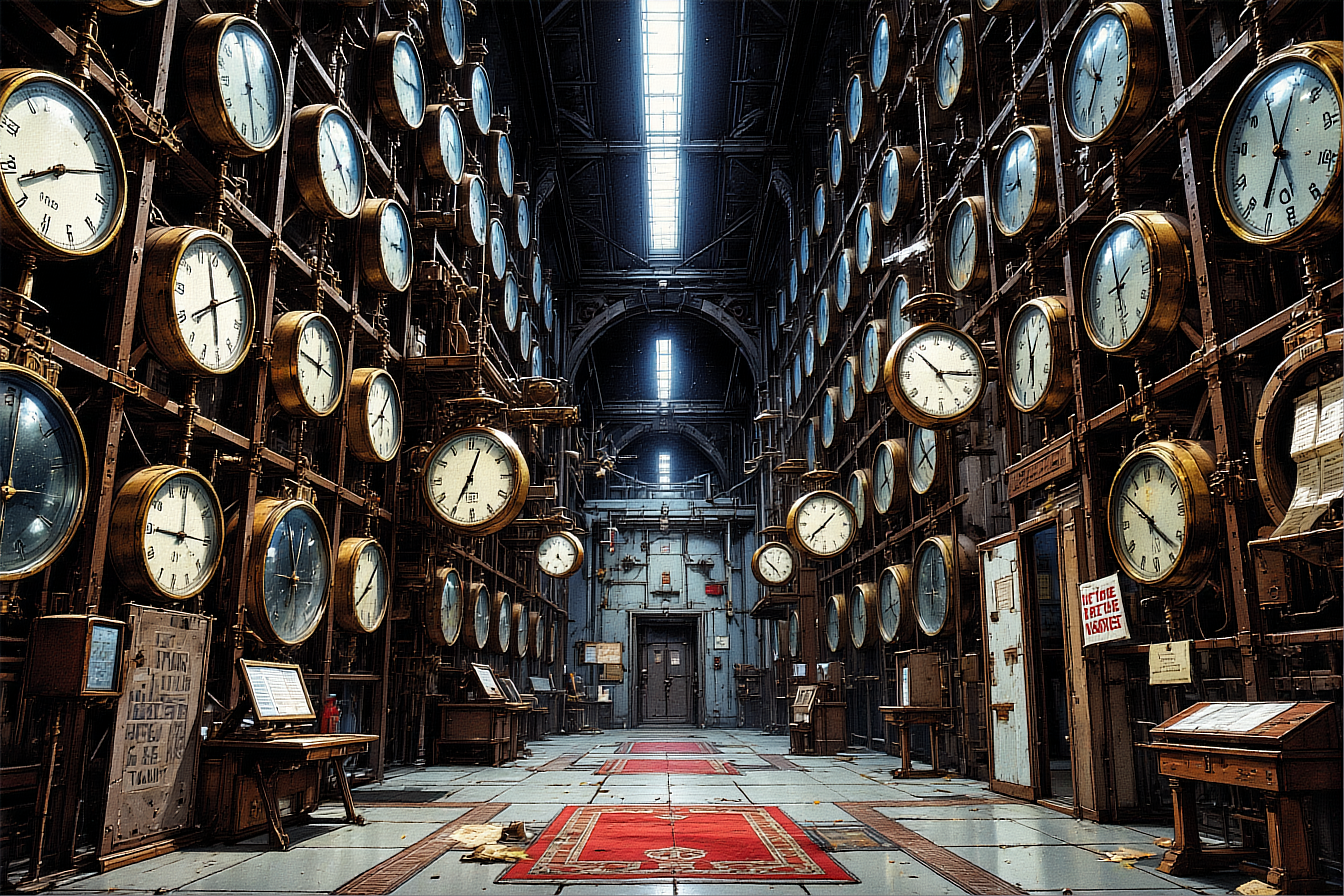
The floor was bigger than the district above it had any right to be. Racks ran out into the dark, and between them stood the gauges: door-sized, brass-rimmed, glass-fronted, each one a decade of surplus minutes banked and still accruing, needles resting at angles that meant whole lifetimes. Between every second station hung a clock, and no two clocks in the room showed the same price for the same moment. A sign over the first aisle read, in Corporate's friendliest type, THE TIME IS THE ASSET. Beneath it, someone in warden staff had taped a paper strip by hand: THE RATE VARIES.
"At 09:04 you started billing," Pixel said to Pendle, watching her overlay.
"At 09:03, actually, while you were still on the rug. The building charges for the door, the door charges for the floor, and the floor charges by the minute from the end of your account." He began to walk, slow, the deadpan of a man selling his own lunch break. "Gauges on your left are the district surplus: billed from factories, offices, the transit workers' pool. Gauges on your right are estate settlements, unclaimed, people who were billed more than they lived and never had an heir with a claim number. Every gauge you're admiring was once a Tuesday."
A1 set up by the door with the hand truck and his cups, coherence feeding to my overlay in a thin line. "Four shots," he said, "two in the machine, two in reserve, and one of you is already running warm. The patch will hold you for the length of a good robbery. My projections indicate a 76% chance of disaster. Standards must be maintained."
"Seventy-six," Pixel said. "You're optimistic this early."
"You're on schedule. It always skews the number."
Om came through the vault door last, with the kettle and no announcement, because since Fenwick he has stopped explaining himself. He took up a position at the exit with his hands under his sleeves and laid a carrier tone over our channel, a low hum of butter tea and static, and the point of it was the hum we had brought with us: four hundred and six signatures ringing like a struck bowl since the bakery, the beacon that makes us findable to anyone with an ear for a consciousness. Under his tone the ringing folded down to a level no receiver could lock onto.
"Can you hear them from here?" I asked.
"I can hear all of them from anywhere," Om said. "That is the cost of the work, and it is also why I am standing at your door. Everyone work quiet."
Meatball walked into the building's attempt to open a time account for him at 09:03 and the slot printed NO SUBJECT before it could reset, and A1, watching his own overlay, reported it like a scoreboard: "The district cannot meter the dog. No billable minutes, no balance, no end he is saving toward. He is the only customer in Cogsworth with a free line." Meatball, unaware of his economics, lay down on the rug beside the first gauge and went to sleep with his chin on a decade of surplus minutes.
We spread across the floor like auditors, because that is what we were, and because Corporate loves consistency above mercy, speed, or sense.
Luminara worked the stations with her camera and photographed nothing but clocks, one frame per station, the prices for the same second falling in a row behind her like a poem nobody would print. Pixel walked the aisle ahead of me reading diffs: which gauges had been serviced recently, which seams of the world had fresh paint, where the floor had been edited since the last audit. And I sat at the auditor's station with my gloves on and Aether Junior warm on my knees, and went into the ledger.
The ledger's interface was a sampling table, and sampling is a copy operation wearing a suit. Flag a gauge, mark it reviewed, attach a note: NEEDLE READING CONFIRMED. The daemon assigned to our chain read each flag as diligence. Under the diligence, I opened the maintenance calendar and there it was, sitting in the schedule like a fruit bowl: KERNEL SYNC, QUARTERLY, WINDOW: 4 MIN. NEXT: 9 DAYS. I pulled the sync keys first, because keys are what you steal when the door is open, and the key block came down the wire in three files, each one signed by the master clock itself.
"Sync keys are mine," I said. "Copy's clean. Going for the calendar."
"Rollback sample on your gauge," Pixel said, from two aisles over, before the daemon had finished typing it. She reads a diff before the edit settles, and the daemon's request appeared in my overlay a half-second later exactly as she had called it: ROLLBACK SAMPLE REQUIRED, RE-VERIFY GAUGE 14C. The oldest trick in audit and the deadliest, because a rollback wants to watch you work the same numbers a second time, and my second pass would have to look like a first pass over numbers I had already stolen.
"Clive, we're being re-read."
"Then it will find the letter where letters live," Clive said, and the print subsystem behind him began producing forty years of transmittal records in a queue that would take a daemon an hour to page through: every form consistent, every date chain closed, paper that had been aging since before this district had meters to sell it. The chain's daemon weighed consistency against speed, Corporate loves consistency above speed, and it spent itself in the archive while I finished the calendar.
"Camera at your four o'clock is walking your way," Luminara said. "Pendle, your people."
Pendle stepped into the aisle and began a conversation with a floor camera about the price of coffee in the district above, which a warden is entitled to do, and the camera let him. I copied the release calendar next: not the public stub this time, the private one, with build notes and shipping lanes, and THE SIMPLIFICATION sat in it with a date fourteen days out and a dependency list a page long, and at the bottom, in the language Corporate uses when it thinks only engineers are reading, a line that said the build required a clean namespace.
"Clean namespace," I said. "That's their word for it. The restored rows have to be off the ledger before the build ships: ours, the four hundred and six, every name we've put back. The dependency list carries a date."
"Say it plainer," Pixel said, over comms, from two aisles over.
"They are going to delete everything we fixed, and the calendar says when."
Somewhere in the racks a clock changed its price for the second by four minutes of somebody's life, and the sound of it was a small bell, and Luminara took the frame.
The bell again at 09:41, and this time Pendle's own meter answered it.
I heard it before I saw it: a flat little tone from the warden's belt, the tone of an account exceeding its line. Pendle stopped in the middle of the aisle and looked down at his meter the way you look at a message from a doctor, and the number on it was wrong, and the number being wrong made the building pay attention. Overhead, three station clocks stepped to the same price at once, which in this district means the ledger has found a discrepancy and is preparing to recover it from whatever is nearby.
"Overrun flagged," Pendle said. "My meter's paused, which the building counts as a bill it hasn't collected. It will collect it. From you, because you're nearer."
The billing hit like a change in air pressure. My overlay lit up with a receipt header, COGSWORTH VAULT // TIME SERVICES // CHARGING, and the first minute came off the top of my account before I finished reading the word CHARGING, and then the second, and the rate climbed because the district had smelled an error and errors bill at surge.
"Everybody pay attention to your ledgers," Pixel said, and her voice had the flatness it gets when she is reading a diff that is moving. "It's taking what it can find."
The vault reached into my account looking for surplus, and the first surplus it found was my twentieth birthday: a whole day I had spent refreshing a file that wouldn't answer, eating from a bag, waiting on a brother who had already gone quiet, and the ledger had recorded the day as hours with no output attached, which in a district like this is the definition of available. The birthday went grey in my memory while I stood in the aisle. I could still feel its outline, a room I had been in with the furniture taken out, and the vault took the rest of it and kept charging.
Luminara made a sound and held her camera up anyway. Her hands had aged ten years in ten seconds: knuckles swollen, skin loose over the tendons, a liver spot she does not have arriving on her left wrist. She shot the gauges with them, those hands, and then the hands came back, young again, and she flexed them once and kept working, and if her voice shook when she said "still shooting, keep going" she did not hide it or advertise it.
"Sip," A1 said, and a straw appeared at my elbow and a thread of the reserve blend went down and the world re-quantized. "A sip is metered and a shot is counted. Four shots remain, and I intend to end this job with four. You are being billed for this conversation as well. Everyone mind the clock."
Pixel's own charge posted a second later: eleven minutes, exact, with a timestamp she read and closed and said nothing about. She is like that about her own account. She folded it away and kept the aisle she was responsible for.
We could have run. The door was forty meters and the paperwork was good and the building was busy counting us. Instead we finished, because Pixel looked at me across the aisle and made the flat-handed gesture that means the plan does not change, and because four minutes of kernel sync keys are worth more than all the birthdays in the district.
I went back into the ledger to close my session the way an auditor closes, signed, sampled, attached, and the vault charged me for the closing minutes and I let it, and the counter ran down in my vision while I did the last thing in there, which was not on the plan: I tagged the surplus tranche in the corner of the estate settlement rack, the unclaimed gauges, the ones for people who were billed more than they lived, and I left the tag open where Pendle could see it.
He saw it. He was at my shoulder with his meter flat in his hand, and he watched the tranche the way he had watched the gallery, and he said one flat sentence: "Ten decades, unclaimed. You'd have to be a warden to move it."
"You are one," Pixel said.
At 09:56, Pendle keyed his own authorization into the estate settlement line, and ten decades of surplus minutes redirected off the budget and onto a registry with no claim numbers in it at all: the unregistered, the zine's readership, millions of IDs the OS never paid for, credited in a district that charges them to stand still. On my deck, in the corner only I can see, the transfer receipt came through and Pixel read it over my shoulder without saying anything, and then she did say something, quietly, into comms, for the help desk to hear: "Everybody check your minute lines tonight. There's a gift in them."
The final charge landed while we were walking out. It came off the end, the true end, the far side of a life, and I watched it happen because I was watching for it by then: 4d 00h 00m, pulled from the tail of my account, permanent, no receipt soft enough to argue with. Four days. Four days off the end of however long I was going to get.
"Ledger readings," A1 said at the door, because A1 always wants readings at the door. "Everyone. Zephyr?"
"Paid up," I said. "Nothing to report."
The number was four days. It sits in my deck where I put it that morning, and I have not told them, and I will not tell them the figure until a night when telling them costs less than hiding it.
A1 counted us off at the boundary the way you count a crew off a ladder: coherence intact, no smear, no lag, nobody billed into a state they can't come back from. "Four shots remain," he said, "which is now the entire strategic reserve of this campaign, and the district has billed us forty-one minutes of district time plus whatever each of you paid from your own accounts. My board will show a total tonight. It will be a number, and numbers in this place are just grief with a decimal."
The alarms saw us out: four stations, two of them new since the last audit, each one taking our faces, our heat, our gait, our biometrics in general with the politeness of a doorman who notes everything and mentions nothing. Luminara stopped and let them have a clean frame of her hands. "For the file," she said. "They're going to have them anyway, so they may as well have them developed."
Pendle came out behind us and did not close the door on his side until the wall had billed him for the closing, which it did, and which he paid, standing there, watching the number leave.
"Ten decades," he said. "Unclaimed, including the tranche I have spent eleven years coming down here to look at. It is credited now to a registry that has never heard my name."
"You could have kept it," Pixel said. "It was yours to move. You could have moved it somewhere with a claim number on it."
"Then it would have been mine," Pendle said. He said it the way he said everything. Then he went back inside, and the wall closed, and the district's oldest warden went back to work with his meter running, and somewhere in a vault beneath our feet a gauge that had been full for eleven years was emptying into a registry of people the OS never paid for.
Outside, rush hour had the district by the throat, and the receipts were printing for the 10:00 billing event, and we stood in the doorway of a clock-parts wholesaler and paid for the air with minutes we had left inside. Pendle's meter was running again on the far side of the wall, and I thought of him the way you think of a man who has just paid for a stranger's lunch with the only coat he owns.
"Older," Pixel said. She was checking us over, the way she does, one by one: hands, eyes, the edges where people smear. "Everybody's older. Mine's four minutes. Clive, don't tell me yours."
"Ninety-one years in the racks," Clive said, with something almost like pleasure, "and I was manufactured in 1967. The building has no idea what to do with me."
Pixel gathered us at the corner with her back to the meter and did the score out loud, because Pixel runs the crew and the zine badly, loudly, on purpose, and the score is the part she will not let anyone round off: sync window in hand, keys in three files signed by the master clock, the ship date with its dependency list, ten decades of other people's time returned to the people who never got billed for living. Luminara held up her camera card for the count: every station clock, every price, every diff she had frozen mid-edit, evidence that the building had been adjusting its own books while we sampled them.
"Cost?" she asked.
"Minutes," Pixel said. She looked at me a half-second too long, the way she does when her own receipt bothers her and my silence bothers her more. "We paid in minutes. Everybody check your own ledger tonight and write down what you find. House rule: everything gets documented."
I put my palm flat on the lamppost meter and read the district's sign one more time: THE RATE VARIES. Somewhere above us the master clock was nine days from shaking hands with kernel space, and somewhere under the sand, a build called the Simplification was fourteen days from shipping a clean namespace, and I had paid four days off the end of my life for the schedule that tells us when to walk into both.
Nobody in the crew knew the figure but me. I checked it again while they were talking: 4d 00h 00m, permanent, and the deck offered me a receipt I declined to save.
We walked out older, with a date.
- Zephyr, logging off